
5 Benefits of AI Ad Scheduling for Meta Ads
AI ad scheduling boosts Meta ad performance with higher ROAS, less wasted spend, audience-specific timing, time savings, and ongoing optimization.
AI ad scheduling for Meta Ads helps advertisers make smarter use of their budgets by focusing on the most effective times to run ads. Instead of relying on static schedules, AI analyzes performance data in real-time to deliver ads during peak hours, reduce wasted spending, and adapt to changing audience behavior. Here’s a quick breakdown of its key benefits:
Higher ROAS: AI identifies peak conversion times, ensuring your budget is spent when it matters most.
Reduced Wasted Spend: Stops spending during low-intent hours, redirecting funds to better-performing periods.
Audience-Specific Scheduling: Targets different audience segments based on their unique behaviors and time zones.
Time Savings: Automates repetitive tasks, freeing up time for advertisers to focus on strategy.
Continuous Optimization: Adjusts schedules based on seasonal trends and new data to keep campaigns effective.
AI tools like AdAmigo.ai make this process seamless by automating ad delivery, analyzing performance metrics, and continuously refining strategies to maximize results. This means better performance, less manual work, and more efficient use of your ad budget.
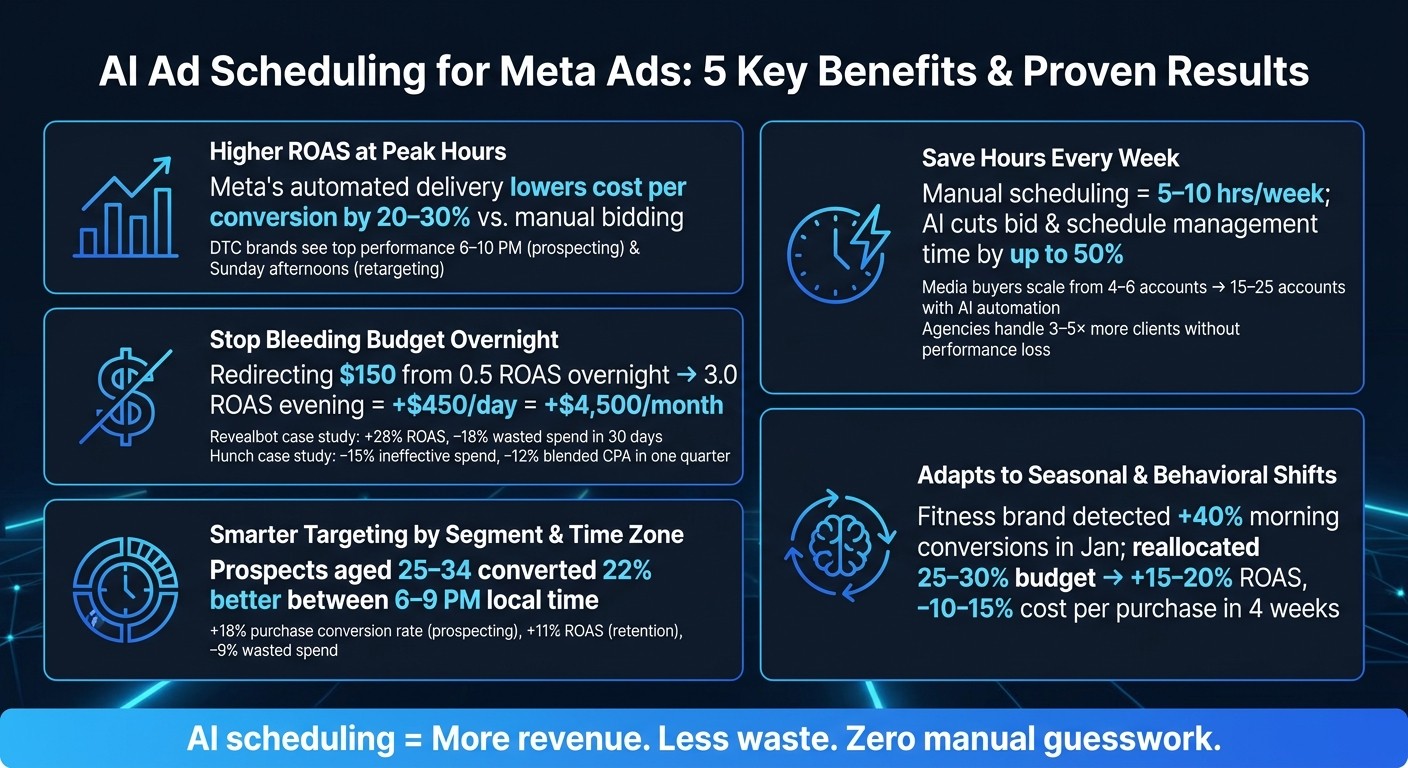
AI vs Manual Ad Scheduling: Key Performance Gains for Meta Ads
How we Automated Meta Ads with 3 AI Systems
1. Higher ROAS by Targeting Peak Conversion Times
Not every hour is created equal when it comes to ad performance. AI ad scheduling dives into your account's historical data - looking at impressions, clicks, conversions, and ROAS - broken down by hour and day. It pinpoints the exact times when your audience is most likely to act, removing the guesswork and focusing your budget where it matters most.
Here’s the idea: spending your daily budget during high-intent hours leads to more conversions than spreading it evenly across the entire day. Meta’s own research backs this up, showing that automated delivery optimization can lower cost per conversion by 20–30% compared to manual bidding. Timing plays a huge role in these results, as algorithms are built to adapt to audience behavior.
AI doesn’t just stick to the obvious. For instance, a DTC ecommerce brand might learn that prospecting campaigns perform best between 6–10 p.m. local time, while retargeting efforts shine on Sunday afternoons. AI can automatically shift budgets to these sweet spots, cut back during low-performing hours, and continue testing weekly. This level of speed and precision simply isn’t possible with manual reviews.
What’s more, AI can separate account-wide trends from audience-specific behaviors. For example, cold prospecting audiences might engage more during evening hours when attention is higher, while warm retargeting audiences - already primed to purchase - might convert consistently throughout the day. By aligning your budget to these nuances, you get sharper targeting and better results.
Platforms like AdAmigo.ai take this to the next level. Acting as an autonomous AI media buyer, it audits your Meta account, identifies the best timing opportunities, and adjusts campaigns automatically for maximum impact.
2. Less Wasted Spend During Low-Intent Hours
Spending ad dollars during low-intent hours often leads to wasted budgets. These are the times when users are casually scrolling but rarely converting. You’ll see this reflected in performance metrics like higher CPA, lower ROAS, and weaker conversion rates and CPA. For many U.S.-based eCommerce accounts, the overnight hours - 12:00 a.m. to 6:00 a.m. - are a frequent culprit.
Let’s break it down: if you’re spending $200 overnight at a 0.5 ROAS (where every dollar spent brings back just 50 cents), you’re essentially losing $150 of your daily budget. Now imagine redirecting that $150 to a high-performing period, such as 6:00 p.m. to 10:00 p.m., where your ROAS is 3.0. That shift could generate an extra $450 in daily revenue without increasing your total spend. Over a month, this translates to more than $4,500 in additional revenue - just by optimizing your ad schedule.
This is where AI shines. It enables a level of precision that manual dayparting simply can’t achieve. Instead of applying broad rules like "run ads from 8:00 a.m. to 10:00 p.m.", AI dives deeper. It evaluates performance across campaigns, ad sets, audience segments, devices, and geographies, making smarter, more targeted decisions. For example, AI might keep retargeting campaigns active overnight while pausing cold prospecting ads. A Revealbot case study demonstrated this power: after introducing automated "bad time" rules, an eCommerce retailer saw a 28% boost in ROAS and an 18% drop in wasted spend within just 30 days.
But it doesn’t stop there. AI continuously learns and adapts to behavioral shifts. Using rolling data from the past 14–30 days, AI adjusts strategies in real time. A performance agency featured by Hunch used this method with a fashion brand, identifying 1:00 a.m. to 5:00 a.m. as a low-intent period for their audience. The result? A 15% reduction in ineffective spend and a 12% improvement in blended CPA over a single quarter - all without cutting the brand’s daily budget.
Advanced tools like AdAmigo.ai take this even further. Their AI Autopilot doesn’t just stop at scheduling; it continuously audits hourly performance, flags low-intent windows, and either recommends or automatically makes budget adjustments. This approach integrates scheduling into a larger optimization strategy that also focuses on creatives, audience targeting, and bids, ensuring every dollar works harder.
3. Better Targeting Through Audience-Specific Scheduling
Not all audience behaviors are created equal, and sticking to a single schedule for everyone can limit your ad performance. Think about it: a cart abandoner browsing on their phone at 8:00 p.m. is in a completely different mindset than a cold prospect casually scrolling during their lunch break. AI understands these differences and adjusts ad delivery to match the specific habits of each audience segment. This dynamic scheduling uses historical performance data to make smarter decisions.
Instead of applying a broad dayparting rule, AI dives deep into hourly performance data across segments, devices, placements, and even geographic locations. The result? Budgets are allocated to the times when each group is most likely to convert. For example, AI might focus retargeting budgets between 7:00 p.m. and 11:00 p.m. for cart abandoners, while keeping prospecting ads active during 12:00 p.m. to 2:00 p.m., when top-of-funnel audiences are more engaged.
A 2023 case study highlights the power of this approach. A U.S.-based direct-to-consumer fitness equipment brand used an AI optimization tool to analyze audience behaviors on Meta. The tool revealed that prospects aged 25–34 in Pacific and Mountain time zones converted 22% better between 6:00 p.m. and 9:00 p.m. local time, while existing customers were most responsive to upsell campaigns during lunchtime on mobile. These insights led to an 18% increase in purchase conversion rates for prospecting campaigns, an 11% higher ROAS for retention efforts, and a 9% reduction in wasted spend during late-night hours.
For U.S. advertisers managing campaigns across multiple time zones, this level of precision is crucial. What counts as "evening" in New York is hours earlier in Los Angeles. AI ensures ads are delivered at the right time for each user's local time zone - whether that's Eastern, Central, Mountain, or Pacific - so your campaigns hit their peak performance windows.
Tools like AdAmigo.ai take this a step further by managing these optimizations at the account level. With its AI Autopilot, AdAmigo continuously monitors campaign performance, identifying opportunities like shifting budgets from weekday mornings to late evenings for retargeting audiences. You can even ask its AI Chat Agent questions like, "When does my U.S. lookalike audience perform best?" and get immediate, data-driven answers - no need to manually sift through Ads Manager reports. This saves time while ensuring your campaigns are always running at their best.
4. Time Savings for Advertisers
AI doesn't just improve ROAS and reduce wasted spend - it also saves advertisers a ton of time. Think about it: manually scheduling ads and testing and tweaking budgets can eat up 5–10 hours every week. Now, imagine juggling multiple campaigns, targeting diverse audiences, and covering different U.S. time zones. That’s a huge chunk of your week tied up in repetitive tasks instead of focusing on high-level strategy.
By automating these tasks, AI takes the heavy lifting off your plate. No more logging in multiple times a day to track performance; the AI handles it all. It monitors campaigns continuously, making real-time adjustments - like pausing or resuming spend - based on thresholds you set. Industry data shows that algorithmic optimization can save up to 50% of the time spent on bid and schedule management tasks.
The scalability benefits are just as impressive. Without automation, media buyers typically manage 4–6 accounts. With AI, that number jumps to 15–25 accounts. Agencies using tools like AdAmigo.ai report that a single media buyer can handle 3–5× more clients without compromising performance.
"The fact that you can launch campaigns through text or voice commands feels like magic! It handles everything from scaling lookalike audiences to adjusting budgets with just a few prompts. It saves so much time!" - Jakob K., G2 Review
AdAmigo.ai takes automation a step further with its AI Autopilot feature. It creates daily action plans tailored to your KPIs and can either execute changes automatically or wait for your approval. If you prefer to stay involved, you can review proposed adjustments before they go live. This balance between automation and control not only eliminates tedious tasks but also gives you more time to focus on strategic improvements across your campaigns.
5. Ongoing Learning That Keeps Up With Seasonal and Behavioral Changes
One major drawback of manual ad scheduling is how quickly it can fall out of sync with your audience's actual behavior. AI addresses this issue by constantly updating scheduling decisions based on fresh performance data, rather than relying on outdated assumptions. This continuous adjustment allows for better alignment with both gradual trends and sudden changes.
AI works by analyzing key metrics like ROAS benchmarks, cost per purchase, CPM, CTR, and conversion rates - hour by hour, day by day. For example, it might discover that women aged 25–34 engaging with mobile Reels are most likely to convert on Sunday nights, while another audience segment performs better during Monday lunch hours. As these patterns shift, the AI adjusts accordingly.
Seasonal changes highlight this flexibility even further. Take a U.S. fitness equipment brand, for instance. Historically, their Meta ads performed best on weekday evenings. However, in late December and January, AI detected a 40% increase in morning conversions (6–9 a.m.) on mobile, while evening CPMs surged due to heightened competition (consistent with seasonal CPM benchmarks) from New Year’s resolution campaigns. By reallocating 25–30% of their budget to morning slots, the brand experienced a 15–20% boost in ROAS and reduced cost per purchase by 10–15% in just four weeks.
This ability to adapt in real-time ensures campaigns stay effective, even as audience behaviors change due to factors like economic conditions, new competitors, or platform updates. Tools like AdAmigo.ai's Autopilot are designed with this in mind. It continuously audits your Meta account, identifies emerging trends, and makes automatic schedule and budget adjustments - or queues them for your approval. For instance, if a specific creative performs best during lunchtime on mobile, it adjusts the budget and audience targeting to ensure the ad reaches the right person at the right time. And as new data rolls in, the system keeps refining these strategies, ensuring ongoing improvement.
Conclusion
AI ad scheduling is changing the way advertisers approach Meta ad budgets. Instead of spreading ad spend evenly throughout the day, AI focuses your budget where it matters most - during the hours your audience is most likely to convert. It cuts back during low-intent times and adapts as audience behavior shifts. The result? More revenue without increasing your budget, lower cost per acquisition, and significantly less manual work.
This shift allows for smarter use of your ad budget. With AI managing tasks like peak-hour targeting, cutting waste, tailoring schedules to your audience, saving team time, and adapting to seasonal trends, the performance gains can add up fast. Want proof? Look at your hourly conversion data from the past 30 days and compare it against Meta ad benchmarks. Find the hours where your cost per purchase spikes - those are the gaps AI scheduling is designed to close.
If you're ready to automate this process, tools like AdAmigo.ai can handle it seamlessly. AdAmigo.ai optimizes your Meta campaigns by applying all the strategies mentioned here, from improving ROAS to continuous learning. Built with Meta's official API, it ensures every action aligns with platform rules, and you maintain complete control over budgets and safeguards.
The gap between manual scheduling and AI-powered automation is only going to grow. Transitioning to data-driven ad delivery now means your budget starts working smarter, sooner.
FAQs
Do I need a minimum amount of conversion data for AI scheduling to work?
AI systems rely on a minimum amount of data to make sound decisions and avoid overreacting to minor fluctuations. For instance, AdAmigo.ai generally needs at least 20 clicks or 5 conversions before making budget adjustments. When testing new ads, it’s best to allow 48–72 hours and collect 10–15 conversions to ensure that optimizations are driven by clear performance trends.
Will AI scheduling hurt the learning phase or ad delivery stability?
No, AI scheduling doesn’t disrupt the learning phase or ad delivery stability. Tools like AdAmigo.ai actually help campaigns move through the learning phase more quickly by using real-time, data-driven adjustments. These systems rely on structured testing and only implement changes when they’re backed by statistically significant data, such as reaching 20 clicks or 5 conversions. This approach ensures ad performance remains stable while optimizing results.
How does AI scheduling handle multiple U.S. time zones?
AI-powered ad scheduling takes the hassle out of managing campaigns across multiple U.S. time zones. With tools like AdAmigo.ai, adjustments to bids, budgets, and targeting happen automatically, around the clock. This real-time optimization ensures your ads perform well in every region without requiring constant manual intervention. By accounting for local time differences, these tools save you time while keeping your campaigns running at peak efficiency.