
Best Meta Ads AI Agent After Meta’s MCP Launch
Autonomous AI agents can outperform manual ad management—choose by control, cost, and compliance.
Meta's Model Context Protocol (MCP), launched in February 2026, has transformed how businesses manage advertising on Meta platforms. By enabling AI tools like ChatGPT, Claude, and others to directly connect to Meta’s ad systems, advertisers no longer need complex API setups. The key question now is which AI agent delivers the best results while ensuring safety and compliance.
Top Choices for Meta Ads AI Agents:
Designed for Meta advertising.
Delivers results with tools like bulk ad launches and predictive adjustments.
Pricing: $99–$295/month; agencies get discounts.
Best for: Businesses focused on Meta platforms needing automated campaign optimizations.
Fully autonomous, multi-platform management (Meta, Google, TikTok).
Flat pricing: $40/month.
Average ROAS: 3.8x within 6 weeks.
Best for: Hands-free management across platforms with minimal cost.
Claude/ChatGPT with MCP
User-guided workflow with advanced diagnostic insights.
Requires manual prompts for execution.
Best for: Advertisers who prefer staying involved in campaign decisions.
Rule-based automation for precise control.
Pricing: $99–$399/month.
Best for: Agencies or power users needing detailed, custom rule setups.
Quick Comparison:
Feature | AdAmigo.ai | Ryze AI | Claude/ChatGPT + MCP | Revealbot |
|---|---|---|---|---|
Automation Level | High | Full | Low | Medium |
Platforms Supported | Meta-only | Multi-platform | Multi-platform | Multi-platform |
Creative Tools | Yes | No | Limited | No |
Pricing | $99–$295/month | $40/month | $20/month | $99–$399/month |
Best For | Meta campaigns | Hands-off management | Deep audits | Granular control |
Each tool has strengths depending on your needs. Ryze AI is ideal for affordable, autonomous management. AdAmigo.ai excels for Meta-focused campaigns with automation and creative tools. Claude/ChatGPT offers unmatched insights but requires manual input. Revealbot is perfect for those needing strict control through custom rules.
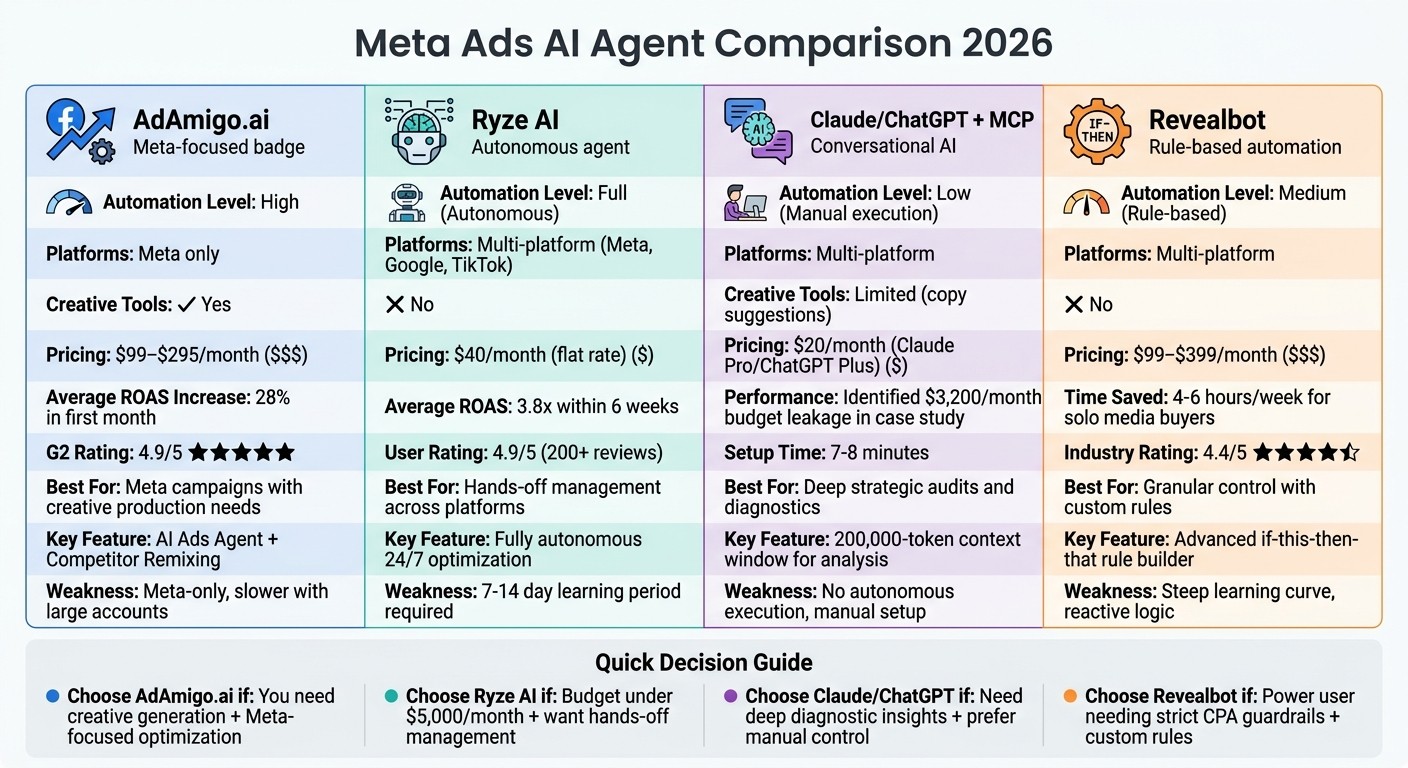
Meta Ads AI Agent Comparison: Features, Pricing, and Best Use Cases
How AI Agents Run My 7-Figure Facebook Ad Account
1. AdAmigo.ai
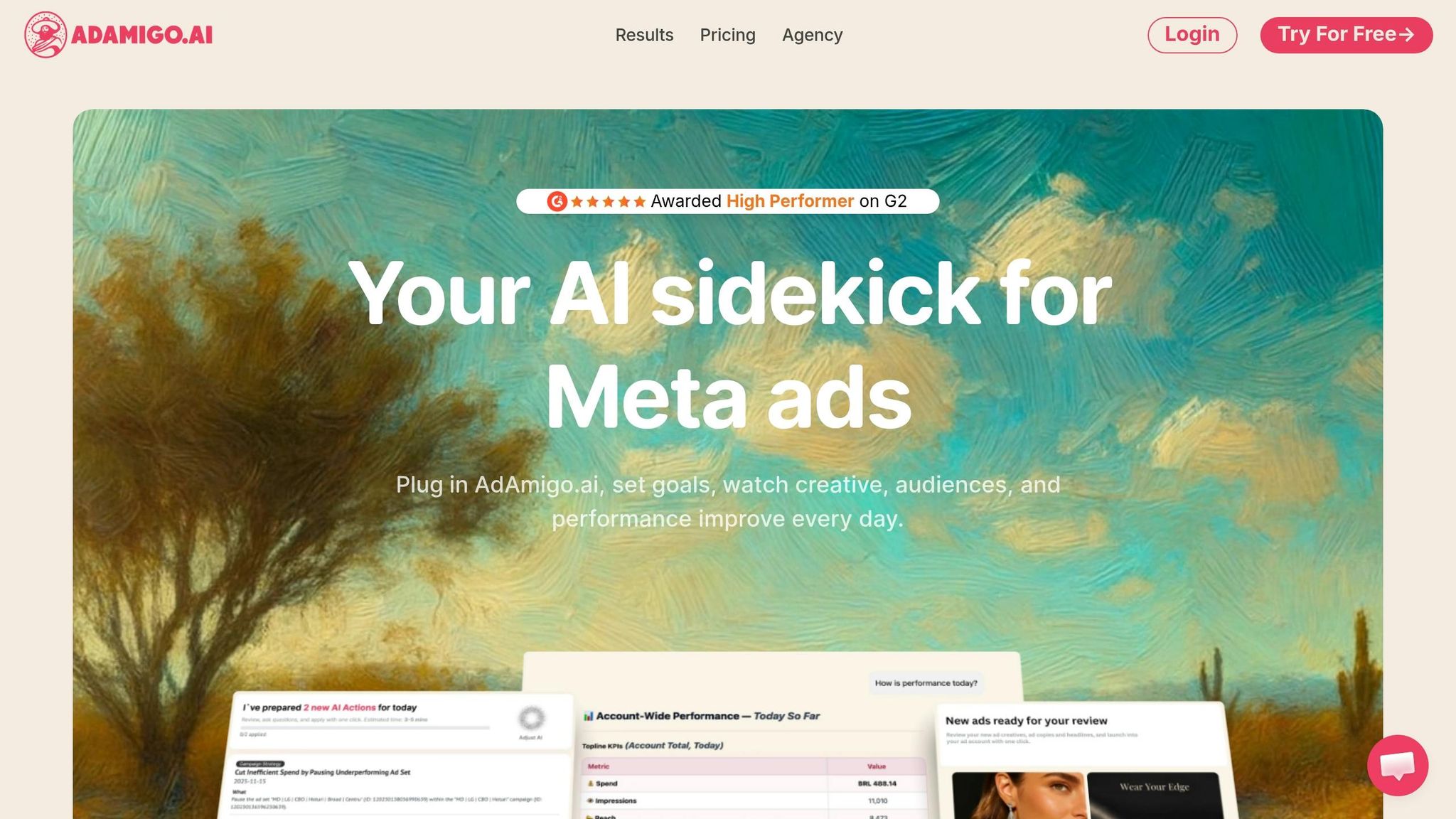
AdAmigo is built specifically as an AI media buyer, tailored to handle advertising needs rather than serving as a general-purpose assistant. With over 700 brands and agencies using the platform, it has earned Meta Business Partner status, which guarantees more reliable API functionality compared to unofficial scripts or third-party tools. On average, users see a 28% increase in ROAS within the first month, with some case studies highlighting improvements as high as 83%.
Autonomous Optimization
AdAmigo's Action Agent conducts daily account audits and provides predictive suggestions instead of relying on reactive rules. Instead of using fixed thresholds, the system explains its recommendations and forecasts potential outcomes. In Autopilot Mode, users can define CPA or ROAS limits, allowing the AI to automatically adjust budgets and bids overnight. This predictive approach focuses on expected results rather than merely reacting to past data.
Beyond budget and bid adjustments, AdAmigo also offers tools to enhance ad creativity.
Creative Generation
AdAmigo includes a Competitor Remixing feature that analyzes competitor URLs to identify effective creative strategies, adapting them to fit your brand. It integrates seamlessly with Google Drive, enabling users to upload assets and launch hundreds of ads in just minutes - eliminating the need for manual uploads. This bulk launching aligns with Meta's recommendation of using 10–20 unique creatives for optimal performance.
Budget Management
The platform’s dynamic reallocation feature ensures ad spend is focused on high-performing segments by continuously adjusting budgets and bids. Users can establish CPA or ROAS thresholds to maintain control over spending. For teams that prefer oversight, AdAmigo offers a semi-automated mode where recommendations require manual approval before implementation.
Compliance and Safety
AdAmigo's Protect feature provides round-the-clock monitoring for potential issues like setup errors, budget irregularities, disapproved ads, broken links, or even hacker threats. Thanks to its Meta Business Partner status, the platform enjoys greater API stability and reduced risk of account restrictions compared to tools with unofficial integrations. While AdAmigo boasts a G2 rating of 4.9/5, some users have pointed out that it is currently limited to Meta platforms and may experience slower load times on accounts with thousands of ad sets. Pricing starts at $99/month for the Entry Plan (covering up to $2,500 in ad spend) and scales to $295/month for the Unlimited Plan. Agencies managing four or more accounts can take advantage of a 30% discount.
With its extensive range of features, AdAmigo is a strong option for businesses looking to optimize their Meta ad campaigns through AI.
2. Ryze AI
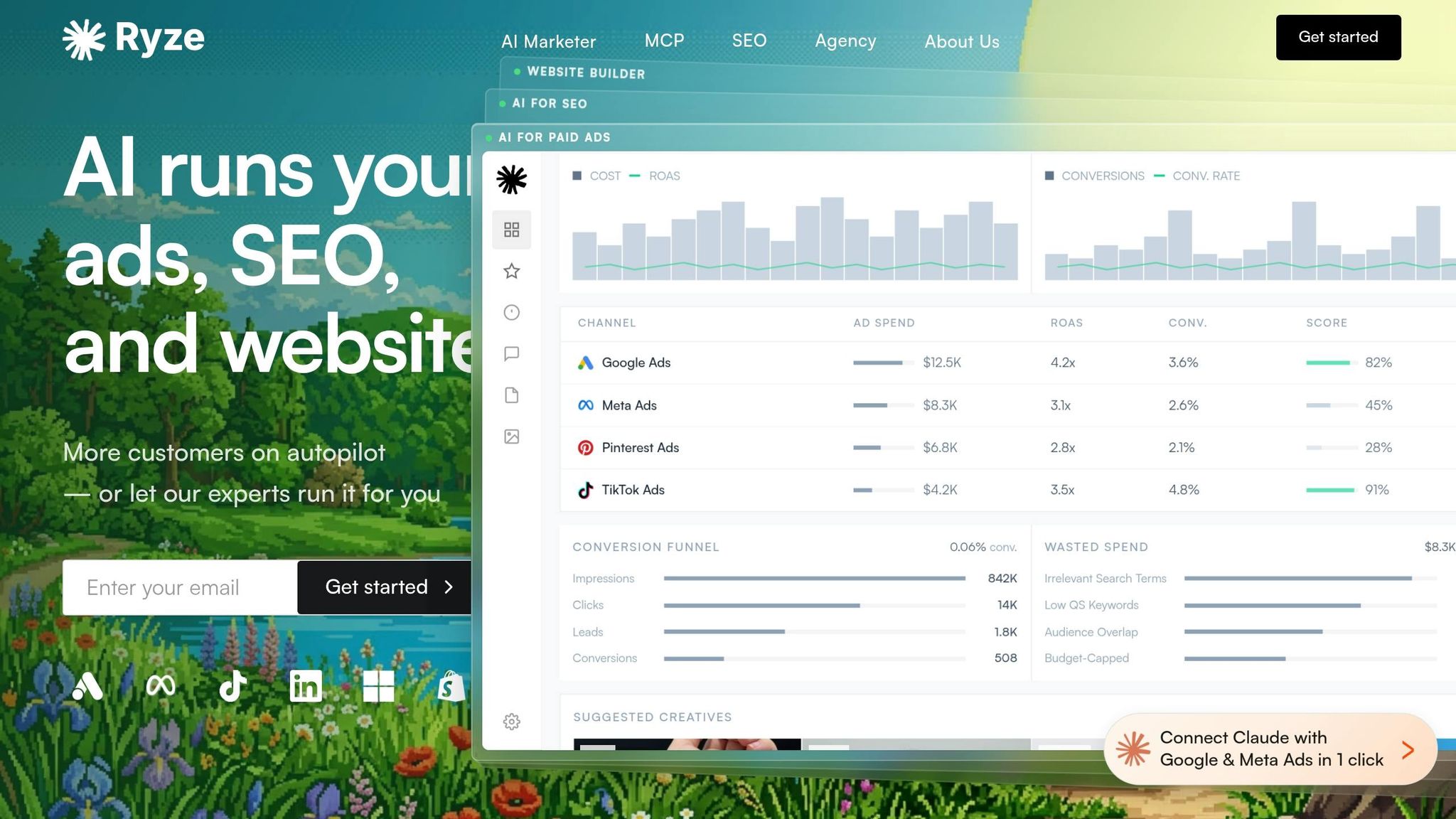
Ryze AI stands out as a fully autonomous platform designed to meet the demands of Meta's Model Context Protocol (MCP) environment. Unlike traditional rule-based tools that rely on specific commands, Ryze AI independently monitors your Meta ads account and makes real-time adjustments - tweaking bids, reallocating budgets, and refining audience targets - without needing manual approval for every action. This hands-free approach sets it apart from automation tools that require constant oversight.
Autonomous Optimization
Ryze AI focuses on driving ROAS and conversions rather than just increasing clicks. The platform evaluates data every 15 minutes and adjusts bids based on marginal ROAS. For instance, in March 2026, an e-commerce account with a $45,000 monthly budget saw Ryze AI identify three underperforming ad sets and reallocate funds, which led to a 34% drop in CPA (Cost Per Acquisition).
The tool also integrates with ChatGPT via Meta's MCP, enabling advertisers to use natural language queries like "How are my Meta campaigns performing?" to get actionable insights.
"Ryze AI is the only tool on this list that operates as a true autonomous agent. Instead of giving you dashboards and letting you decide what to change, Ryze AI analyzes your Meta Ads account 24/7... and executes changes." - Ira Bodnar, Author
In addition to optimizing campaigns in real time, Ryze AI also fine-tunes creative assets to maintain consistent performance.
Creative Generation
Ryze AI includes tools to detect creative fatigue by monitoring engagement decay patterns. It flags creatives that are losing effectiveness and suggests timely updates - identifying fatigue up to 48 hours faster than manual monitoring. The platform also performs audience overlap analysis, which identifies when multiple ad sets are competing for the same users. This feature helps reduce costs and prevents performance issues caused by audience cannibalization.
Budget Management
Managing over $500 million in ad spend for more than 2,000 clients across 23 countries, Ryze AI offers a flat-rate pricing model starting at $40 per month. For managed optimization services, pricing begins at $100 per month. Unlike percentage-based pricing models, this structure ensures there’s no incentive to inflate budgets unnecessarily.
Users report impressive results, with an average 3.8x ROAS within the first six weeks of onboarding. Some accounts have seen improvements from 2.4x to 4.1x in that timeframe.
"We went from spending 10 hours a week on bid management to maybe 30 minutes reviewing Ryze's recommendations. Our ROAS went from 2.4x to 4.1x in six weeks." - Sarah K., Paid Media Manager, E-commerce Agency
Compliance and Safety
Ryze AI operates within Meta's MCP standards to ensure safe execution. It requires an initial 7–14 day learning phase, during which it analyzes historical data and calibrates its autonomous mode to align with your campaign goals. During this period, the system identifies budget inefficiencies and underperforming campaigns, often pausing problematic ad sets up to 48 hours sooner than manual checks would.
The platform has earned a 4.9/5 rating from over 200 reviews. While many users appreciate its hands-off approach, some experienced media buyers note that it may feel restrictive compared to tools offering more granular manual controls.
3. Claude/ChatGPT/Gemini with Meta MCP
This approach offers a user-guided workflow rather than relying on fully autonomous agents. On April 29, 2026, Meta introduced the Model Context Protocol (MCP) server, unveiling 29 tools that allow users to manage campaigns directly through AI assistants like Claude and ChatGPT. The setup process for these tools takes roughly 7–8 minutes. Unlike fully autonomous systems, this conversational model requires user interaction for every step.
Autonomous Optimization
Claude with MCP operates as a conversational assistant rather than an autonomous agent. For example, you can prompt it to conduct a morning audit, where it identifies anomalies and suggests budget adjustments based on real-time data. A fitness brand using this workflow identified underperforming creatives and introduced new variants, leading to a 15% increase in monthly revenue. However, since the tool requires manual prompts, it does not offer continuous monitoring or automatic adjustments like purpose-built agents. This makes it a better fit for advertisers who want to stay involved in decision-making while still benefiting from Meta's MCP capabilities.
"The MCP connection is best suited for workflow automation, reporting, and campaign management rather than replacing Meta's native optimization engine."
– Common Thread Collective
The tools function synchronously, meaning they lack the speed required for real-time programmatic bid management.
Budget Management
Using MCP, Claude can adjust budgets and reallocate spending through commands like ads_update_entity. For instance, you can say, "Increase the budget on my top-performing ad set by $500", and Claude will make the update. However, vague instructions can lead to unintended spending. To avoid this, it’s recommended to set hard budget guardrails within Meta Business Suite before granting write permissions. Accessing these features requires a paid subscription to Claude Pro or ChatGPT Plus. While these tools provide flexibility, they should always be paired with strong compliance measures.
Compliance and Safety
Meta's MCP uses OAuth authentication with detailed permission settings, allowing you to choose between read-only, read/write, or read/write/financial access. This reduces the risk of account suspension compared to unauthorized third-party connectors. It’s wise to start with read-only permissions to see how the AI interprets your prompts before enabling write access.
"An ambiguous prompt or a model hallucination can generate real spend."
– Pasquale Pillitteri, Software Engineer
Currently, Gemini does not support the MCP protocol (as of May 2026), though Google has announced plans to integrate this feature. This limitation reduces the tool's flexibility across platforms. Additionally, AI assistants do not perform policy reviews automatically, so it’s essential to manually verify AI-generated content against Meta's Advertising Policies before launching any campaigns.
4. Revealbot
Revealbot stands out by relying on rule-based automation instead of generative AI or machine learning. It uses conditional logic to take specific actions when certain performance criteria are met. Unlike predictive AI tools, which forecast outcomes, Revealbot reacts to performance signals within the structured environment defined by Meta's MCP. This makes it a precise and controlled tool for advertisers who prefer predefined triggers over predictive decision-making.
"Revealbot is the veteran of Meta Ads automation, and for good reason. Its rule builder is the most powerful in the market, offering deep if-this-then-that logic for every aspect of campaign management."
– Wissam Hallak, Co-founder of AdAdvisor
Industry experts rate the platform 4.4/5, and it reportedly saves solo media buyers 4–6 hours per week by handling routine tasks. The professional tier starts at $99 per month.
Autonomous Optimization
Revealbot’s automation is all about reacting to conditions rather than predicting them. For example, you can set up rules like "pause ad set if CPA exceeds $40 for 3 days" or "increase budget by 20% if ROAS is above 3 and spend is under the daily cap." Its visual rule builder allows for detailed, multi-condition setups with time-specific controls. A helpful feature is the "Learning Phase Protection" rule, which can pause ad sets that fail to achieve at least five conversions after seven days of overspending.
"Revealbot solves ops, not strategy."
– AdLibrary
Budget Management
Revealbot is particularly effective at scaling budgets based on ROAS. For instance, you can automate a 15% budget increase if a campaign maintains a ROAS above your target for three consecutive days. Its "Anomaly Guard" feature monitors spending in real time and sends alerts via Slack or email if daily spend deviates by more than 40% from your target within the first eight hours. This helps catch unexpected platform issues or bid anomalies before they cause significant losses. However, all conditions must be manually programmed, so the platform won’t suggest new rules or identify opportunities you haven’t already defined.
Compliance and Safety
Revealbot also emphasizes transparency and safety in campaign management. Every action it takes is traceable to a specific rule, so you’ll always know why a budget was adjusted or an ad was paused. The platform integrates with Meta's Conversions API (CAPI) and includes a notification system to alert you to unexpected spending spikes or performance declines. You can even set "Creative Fatigue Triggers" to pause ad sets when frequency exceeds 3.5 and CTR drops by more than 20% over seven days, helping you avoid high CPMs and potential brand issues. However, it does not automatically perform policy reviews, so you’ll need to manually verify compliance before launching new campaigns.
Advantages and Disadvantages
After analyzing individual platforms, here's a quick breakdown of their strengths and weaknesses in the evolving AI automation platforms in the MCP landscape.
Each AI agent brings its own set of benefits and trade-offs, depending on your goals for control and optimization. AdAmigo.ai shines in creative output and autonomous campaign management, specifically for Meta platforms, offering impressive performance boosts. Its voice and text command interface makes launching campaigns effortless. However, it’s limited to Meta platforms and can struggle with large accounts that have hundreds of active ad sets.
Ryze AI is notable for its flat pricing - about $40/month regardless of ad spend - and its ability to autonomously manage campaigns across Meta, Google, and TikTok. Users report an average 3.8x ROAS within six weeks. The downside? Ryze requires a high level of trust during its 7–14 day learning period, during which interrupting its algorithm isn’t recommended.
Claude, ChatGPT, or Gemini with Meta MCP offers unparalleled diagnostic analysis. Claude’s 200,000-token context window, for example, enables audits that standard dashboards often miss. In one case, Claude identified $3,200/month in budget leakage on a $40,000/month account that Revealbot overlooked. However, these tools don’t execute changes directly - you’ll need to manually implement every recommendation, and setting up the technical MCP can be challenging for those without development expertise, requiring strict AI guardrails to prevent errors.
Revealbot remains the go-to for power users seeking granular control. Its advanced automation rules saves media buyers around 8 hours per week on routine monitoring. While its "if-this-then-that" logic is precise, it requires significant manual setup and comes with a steep learning curve compared to newer AI tools.
Here’s a summary of the key features and limitations for each tool:
Feature | AdAmigo.ai | Ryze AI | Claude/ChatGPT + MCP | Revealbot |
|---|---|---|---|---|
Primary Strength | Creative generation + autonomous actions | Flat pricing + multi-platform autonomy | Deep diagnostic analysis | Granular rule-based control |
Primary Weakness | Meta-only; slower with large accounts | Trust needed during learning period | No autonomous execution; manual setup | Steep learning curve; reactive logic |
Automation Level | High (Autopilot available) | Full (Autonomous Agent) | Low (Analysis only) | Medium (Rule-based) |
Daily Recommendations | Prioritized list with "why it matters" | Fully automated actions (no approval needed) | Ad-hoc chat analysis | Alert-based triggers |
Creative Generation | Yes (AI Ads Agent) | No | Copy suggestions only | No |
Supported Platforms | Meta only | Multi-platform | Multi-platform | Multi-platform |
Pricing Model | Tiers: $99–$295/mo based on spend | Flat ~$40/mo | $20/mo (Claude Pro) | Scales: $99–$399/mo with spend |
Best For | Creative production gaps + Meta focus | Total hands-off management | Deep strategic audits | Strict CPA guardrails + power users |
Conclusion
Choose the Meta Ads AI agent that aligns with your workflow, budget, and risk tolerance. If you're looking for a fully autonomous and affordable option, Ryze AI is a standout at approximately $40 per month, making it ideal for advertisers with budgets under $5,000 per month.
Each tool offers something different. For creative production combined with optimization, AdAmigo.ai shines. It features voice-command ad launches and AI-generated creatives, which help brands meet Meta's recommendation of rotating 15–25 ad variants weekly. With an average 28% ROAS lift in the first month, it’s an excellent choice for efficiency and performance. As Rochelle D. from G2 shared:
"Agencies paying significantly more have found AdAmigo's cost-effectiveness unmatched."
For those who need granular, rule-based controls - such as agencies or power users targeting specific CPA goals - Revealbot is a strong contender. Its advanced rule builder can save up to 8 hours per week on monitoring tasks. If deeper diagnostic capabilities are what you’re after, Claude with Meta MCP is a great option. At just $20 per month, it provides detailed budget insights; in one case, it identified $3,200 per month in budget leakage that standard tools missed.
Advertisers leveraging AI tools for ad management are seeing ROAS improvements ranging from 40% to 280% compared to manual optimization. The question isn't whether to use AI - it’s about finding the right tool to elevate your campaigns while ensuring they remain effective and secure.
FAQs
Is Meta MCP safe to connect to my ad account?
Meta’s MCP (Model Context Protocol) and its AI connectors allow third-party AI tools, such as ChatGPT and Claude, to securely access your ad account for both reading and writing data. While these connections are generally safe when used correctly, it’s important to exercise caution. Make sure you only connect trusted and official tools to your account. Always take the time to verify a tool’s authenticity before granting it access to ensure your account remains secure.
How much control do I have over what an AI agent changes?
You have a lot of control over what an AI agent does. Most platforms allow you to set specific KPIs, review and either approve or reject daily suggestions, and track its activity to make sure any changes match your objectives. Plus, you can keep an eye on its performance to ensure it stays safe and works effectively.
What should I check before letting an AI agent manage budgets?
Before handing over budget management to an AI agent, make sure it meets a few key requirements. It should be able to recommend daily actions and carry them out securely. Look for capabilities like spotting budget problems - whether that's overspending or underuse - and making adjustments to stay aligned with your KPIs. The system should also actively monitor for errors, steer clear of policy violations, and stop any unexpected budget leaks. Finally, ensure it’s easy to use, works across multiple accounts, and doesn’t demand a complicated technical setup.