
6 Shopify Campaign Autopilot Alternatives for Serious Advertisers (2026)
Compare six alternatives to Shopify Campaign Autopilot for better ad creative, cross-account control, and multi-channel performance.
If you spend more than $10,000 a month on ads, Shopify Campaign Autopilot will likely feel limited fast. It’s fine for getting started, but it falls short on net-new ad assets, account control, and multi-account use.
Here’s the short version:
Best overall:AdAmigo for teams that want ad asset production, media-buying help, and use across accounts using an AI testing framework
Best free option:Meta Advantage+ for Meta-only advertisers
Best for rule control:Revealbot for advertisers who want exact automation rules
Best for Meta-heavy brands:Madgicx for deeper Meta analysis and optimization
Best no-software path:Managed agencies or freelance buyers
Best Shopify-only fallback:Shop Campaigns + Shopify apps
A few numbers matter here:
Many ecommerce ads wear out in 2 to 3 weeks
DTC brands often need 15 to 30 new ad variants per month using AI-powered bulk testing
Third-party tools tend to make more sense once spend passes $10,000/month
Shop Campaigns only works in the U.S. and Canada
If your main problem is ad asset output, control, channel mix, or working outside Shopify, this list gives you the main options without the fluff.
Three generative AI tools to create better ads faster in Meta Ads Manager
Quick Comparison
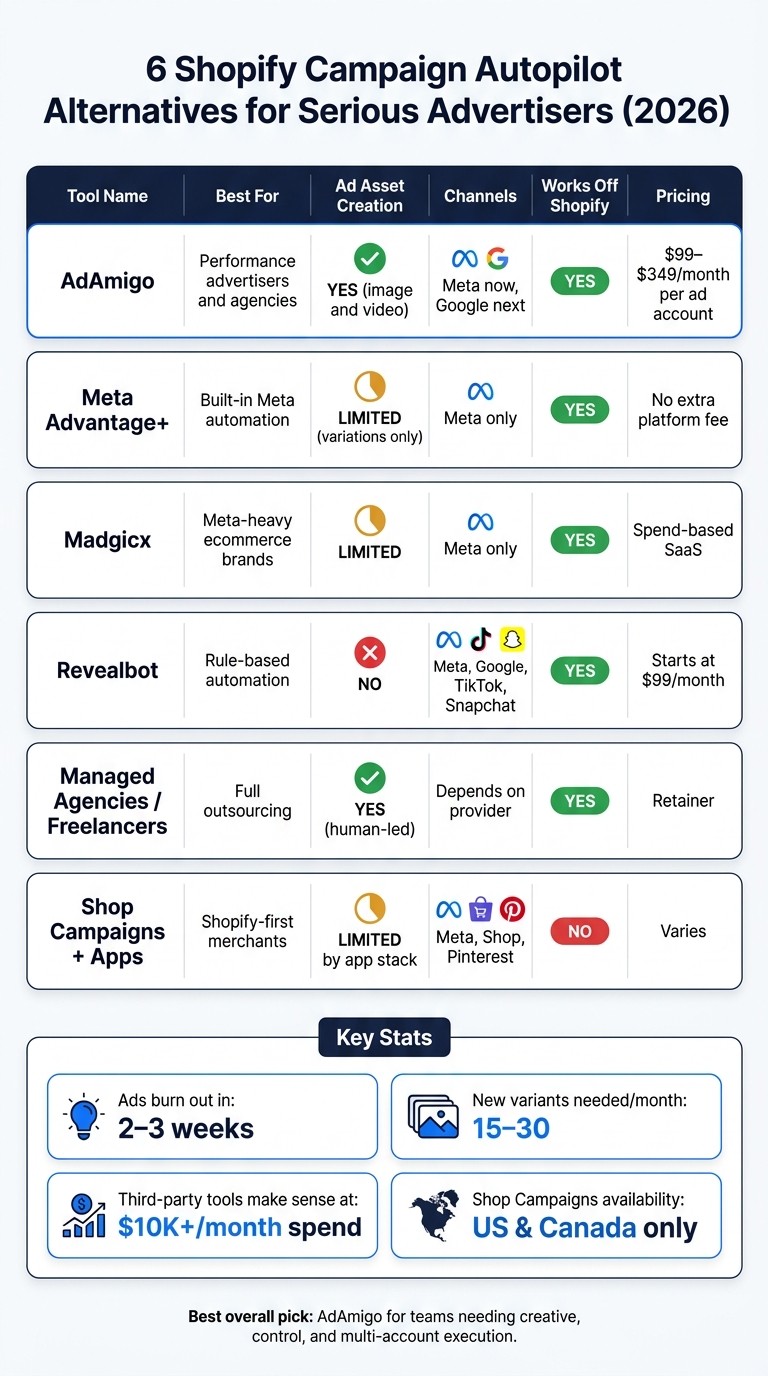
6 Shopify Campaign Autopilot Alternatives Compared (2026)
Option | Best for | New ad asset creation | Channels | Works outside Shopify | Pricing |
|---|---|---|---|---|---|
AdAmigo | Performance advertisers and agencies | Yes - image and video via automated creative testing | Meta now, Google next | Yes | $99–$349/month per ad account |
Meta Advantage+ | Built-in Meta automation | Limited - variations only | Meta | Yes | No extra platform fee |
Madgicx | Meta-heavy ecommerce brands | Limited | Meta | Yes | Spend-based SaaS |
Revealbot | No | Yes | Starts at $99/month | ||
Managed agencies / freelancers | Full outsourcing | Yes - human-led | Depends on provider | Yes | Retainer |
Shop Campaigns + apps | Shopify-first merchants | Limited by app stack | Meta, Shop, Pinterest | No | Varies |
I’d use Campaign Autopilot only if I were a new Shopify merchant with a simple setup. If not, I’d look at these six options first.
Why advertisers look beyond Campaign Autopilot
Serious advertisers tend to move past Campaign Autopilot for a few clear reasons.
The biggest one is creative generation. Autopilot reuses catalog assets, but it doesn't make net-new creative. That's a problem because ecommerce ads burn out fast. In many cases, winning creatives lose steam in 2 to 3 weeks, and high-performing DTC brands often need around 15 to 30 new variants per month just to hold performance steady.
Control is another sticking point. Campaign Autopilot builds a separate campaign setup next to your current account structure. On paper, that can sound fine. In practice, it can split learning and spread budget across more campaigns than you want. You also don't get much insight into why the system made a move. So when CPA jumps or budget shifts, you're left piecing the story together on your own.
There are also setup limits that rule it out for many brands. Shop Campaigns only works in the U.S. and Canada, which shuts out sellers in other markets. And Campaign Autopilot only runs inside Shopify, so if your store lives somewhere else, that's the end of the road.
Agencies run into a different issue: scale. If you're managing a batch of accounts, the workflow gets clunky fast. There's no multi-account orchestration and no cross-client template system, which means teams often have to rebuild things account by account.
If those limits hit your setup, it's fair to ask whether Autopilot is enough at all.
Is Campaign Autopilot enough for you?
Campaign Autopilot is a solid place to start for a brand-new Shopify merchant who wants a free, low-friction way to get ads live.
The bigger issue is simple: have you hit its ceiling?
A few signs make that pretty clear.
Creative is your bottleneck. Campaign Autopilot leans on catalog assets, so if your brand needs 15 to 30 new variants each month, you'll outgrow it fast.
Your spend is high enough that efficiency starts to pay off. Once ad spend gets past $10,000 a month, even small gains can make better tools worth the cost.
You sell outside Shopify or run multiple Meta ad accounts. Its Shopify-only, single-store setup turns into a hard stop at that point.
If any of that sounds like your setup, the alternatives below are the next move.
1. AdAmigo
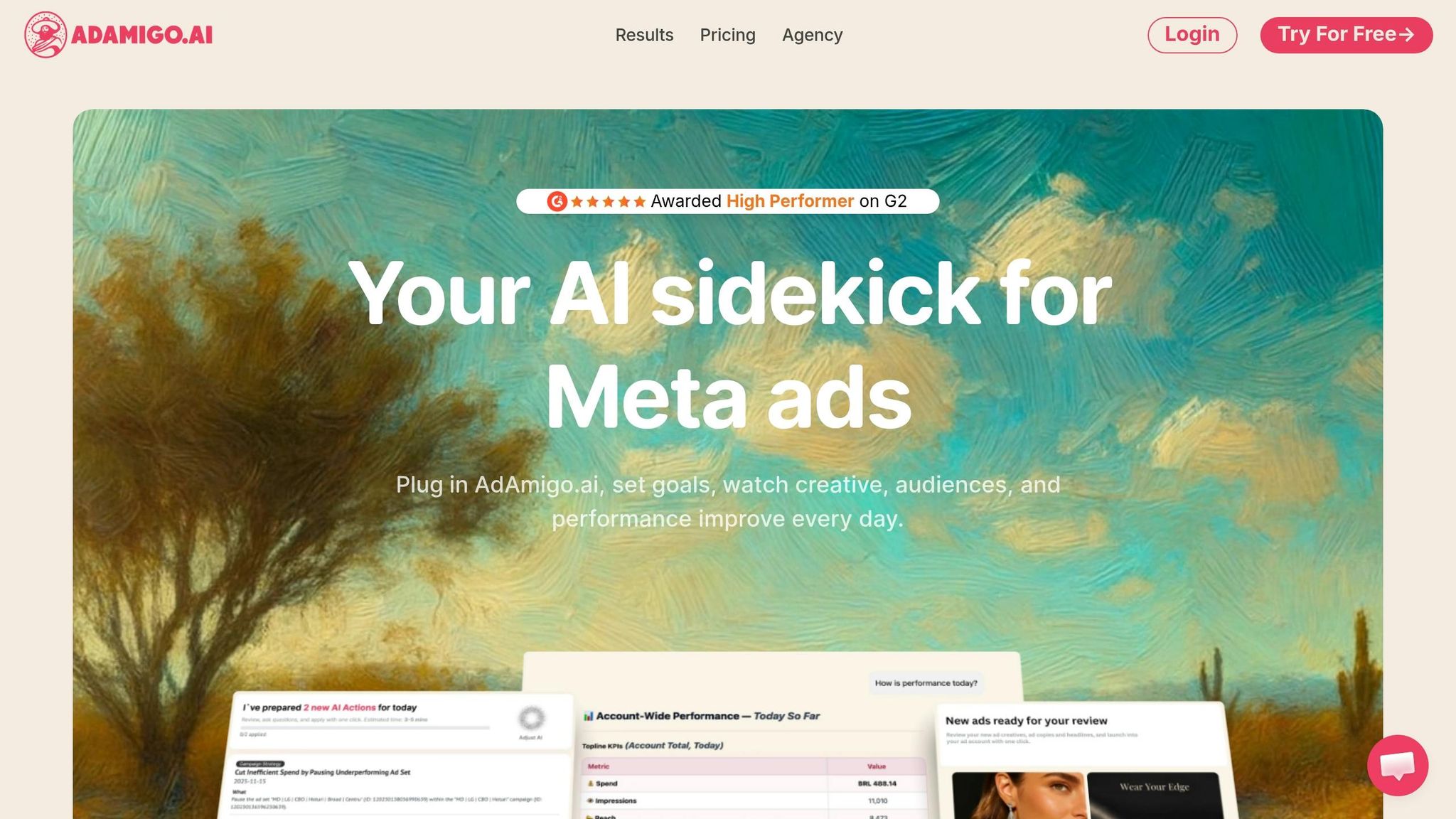
AdAmigo is a performance execution platform built for advertisers and agencies that want new ad creative, tighter media-buying control, and the freedom to work across accounts. That matters because it covers the three holes Campaign Autopilot still leaves open: net-new creative, account-level control, and flexibility beyond one store setup.
Best for: Performance-focused advertisers and agencies that need fresh creative, hands-on media-buying logic, and multi-channel execution - on or off Shopify.
Limitations: Paid product ($99–$349/month per ad account); currently Meta-focused, with Google Ads next.
AdAmigo sits on top of your ad channels, audits accounts, and uses AI agents to suggest actions.
Creative generation
AdAmigo's AdFactory can generate both image and video ads. That's a big difference from Campaign Autopilot, which depends on assets already sitting in your catalog.
Channel coverage and platform flexibility
Right now, AdAmigo is Meta-native. Google Ads is next, and TikTok is on the roadmap. It works with any ad account, not just Shopify stores.
Automation depth and control
This is where the gap gets much clearer. AdAmigo doesn't stop at making creative. It also gives you more say in how campaigns run day to day.
A Priorities model sets the direction, while Autopilot follows operator SOPs for ABO, funnel structure, creative testing, and scaling. Each suggested move shows up in recommendation cards with a plain-English explanation. You can approve actions one at a time or let the system run on its own.
Pricing: $99/month per ad account for Signals; $349/month for Full Access.
If you want ONLY Meta's built-in automation and don't want a third-party layer, the next option is Meta Advantage+.
2. Meta Advantage+
Meta Advantage+ is Meta’s built-in AI automation suite inside Ads Manager. It includes Advantage+ Shopping Campaigns (ASC), Advantage+ Audience, and Advantage+ Creative. And it doesn’t cost anything beyond your ad spend.
Best for: Meta-first advertisers who want built-in automation without adding third-party AI automation platforms.
Limitations: Meta-only, less strategic control, no net-new creative generation, and no cross-account or agency layer.
Channel coverage
Advantage+ works only inside Meta’s ecosystem. So it fits best when most of your budget goes to Facebook and Instagram. If you also run Google, TikTok, or other channels, it won’t help you manage the full mix.
Automation depth and control
Advantage+ automates audience targeting, placements, and budget allocation. That can save time, but there’s a tradeoff: the system is pretty opaque. You set a target ROAS, and Meta takes it from there with limited manual control. Its native rules support only single-condition triggers, which means more advanced if-this-then-that setups aren’t possible.
The creative side has similar limits. Advantage+ Creative can tweak brightness, backgrounds, or music overlays on assets you already have. But it can’t come up with net-new creative concepts. If tight brand consistency matters, you may want to turn off certain enhancements when needed.
Meta says ASC tends to work best when you’re getting about 50+ conversion events per week.
For agencies or advertisers handling multiple accounts, there’s another catch. You don’t get bulk deployment, a template system, or a multi-account management layer. It’s built to work one account at a time.
If Meta-only automation feels a bit boxed in, the next options give you more control and broader channel coverage.
3. Madgicx
Madgicx is a Meta-focused automation and analytics platform for ecommerce brands that want deeper optimization than Meta’s native tools provide.
Best for: Meta-heavy ecommerce brands spending about $10,000 to $15,000 per month or more that want stronger creative and audience analytics than Ads Manager offers.
Limitations: It’s Meta-only, so it works well for Facebook and Instagram but doesn’t do much outside those channels. Setup can take some work, and pricing goes up as ad spend climbs.
Channel coverage
Madgicx is built around Meta. Use it when Meta drives most of your budget.
If you also need serious Google Shopping or Performance Max management, you’ll need another platform alongside it.
Automation depth and control
Madgicx goes further than Meta’s native tools with fatigue detection, bid automation, and AI creative suggestions. In plain English, it helps you spot ad fatigue early, before ROAS starts to slide. Its bid automation can also shift budget allocation without forcing a full reset every time you make a change.
It also comes with audience intelligence tools, including lookalike building based on LTV signals. That can give ecommerce teams a better read on which audiences are worth pushing harder.
There’s a catch, though. Below $15,000 in monthly spend, the optimization layer can be too thin on data to drive steady gains.
If you want broader channel coverage or tighter hands-on control, the next option is a better fit.
4. Revealbot
Revealbot is the other end of the spectrum. Instead of leaning hard on AI, it gives you the controls and follows the rules you set.
Revealbot, now Birch, is a rules engine built for advertisers who want precise, transparent automation.
Best for: Agencies and performance specialists who want exact if-this-then-that automation across multiple accounts.
Limitations: No creative generation, no AI strategy layer, and no autonomous decision-making. Every rule has to be built and maintained by you.
Channel coverage
Revealbot supports Meta, Google Ads, TikTok, and Snapchat. It can make changes across those platforms, not just show reports.
Automation depth and control
This is where Revealbot shines. Its main strength is rule precision. You can build multi-condition rules, like cutting budget after CPA and frequency go past set thresholds for two days. Meta's native automated rules don't offer that same level of multi-condition logic or cross-account deployment.
If you already know the rule you want, Revealbot does the job with a lot of control. But if you need help figuring out the strategy first, setup can feel heavy.
There’s also upkeep to think about. Rules can accidentally pause campaigns during Meta's learning phase if you don't manually add guards with the effective_status field. And because the engine checks conditions about every 15 minutes, there’s always a small lag between a data change and the rule firing.
For advertisers who want strict rule control instead of AI-led automation, Revealbot is a solid fit.
If you'd rather hand off the whole job instead of building rules yourself, a managed agency or freelance buyer is the next option.
5. Managed agencies or freelance media buyers
If you'd rather outsource than add another tool, hiring a managed buyer is the cleanest path. It’s the no-software option for teams that want to hand off strategy, creative, and campaign execution. That said, human oversight still matters, especially for exclusions, account structure changes, and policy issues.
Best for: Brands with enough budget to outsource the full advertising function, including strategy, creative concept work, and campaign management.
Limitations: Retainers, uneven quality, slower iteration, and less in-house capability. If the buyer leaves, their strategy can disappear unless it’s documented.
Creative generation
Agencies and freelancers can handle ad creative as part of their scope (or use AI tools to generate ad creatives). But the amount of output and the quality can vary a lot from one provider to the next.
Channel coverage
Coverage depends on who you hire. A larger agency may run Meta, Google, TikTok, and Pinterest at the same time. The upside is flexibility across channels. The tradeoff is a higher retainer.
Works off Shopify

They can work with both Shopify and non-Shopify stores. That’s the main tradeoff here: less software, more dependence on people.
6. Staying inside Shopify with Shop Campaigns and marketing apps
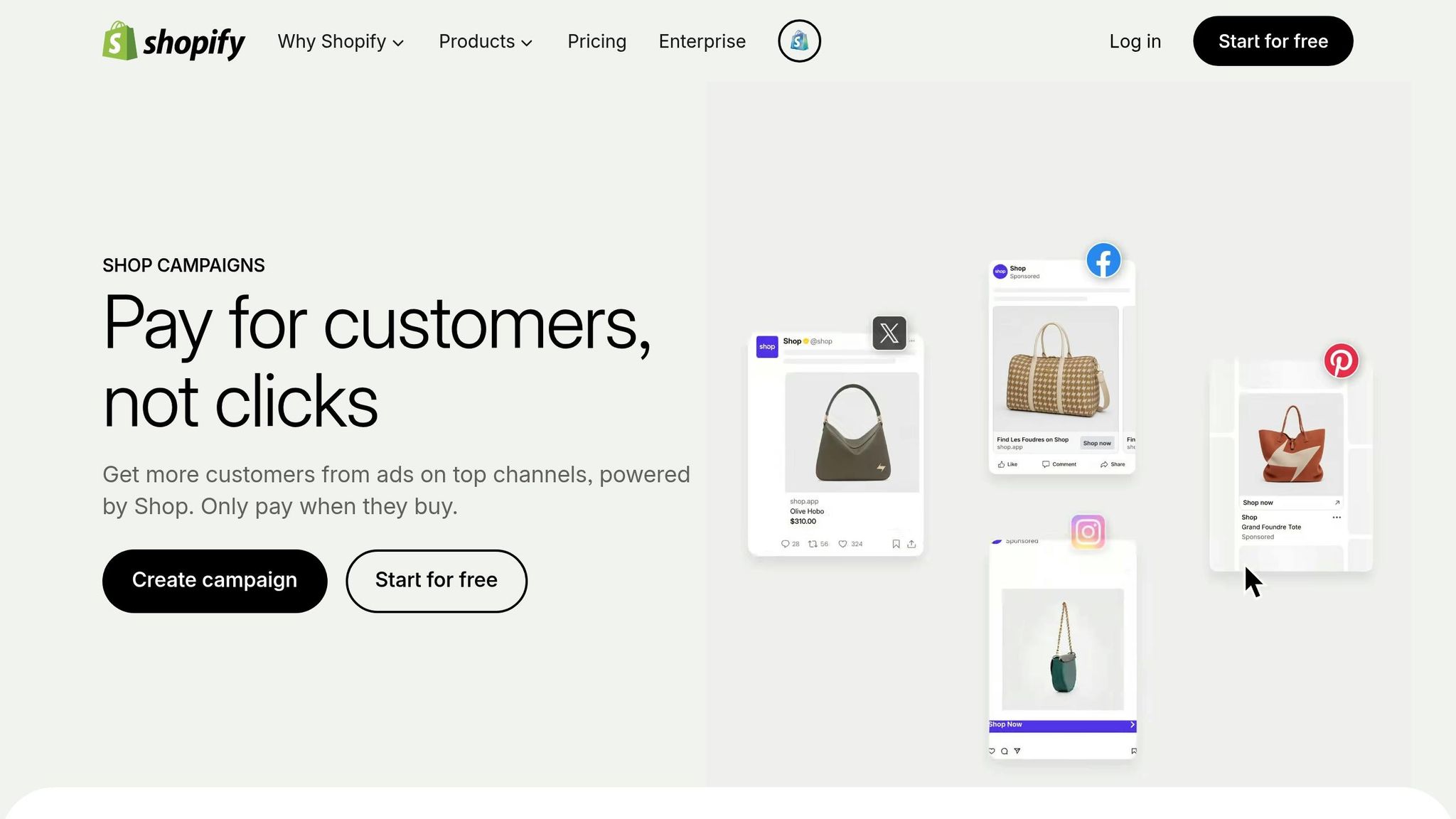
For advertisers who want to stay inside Shopify’s ecosystem instead of adding a third-party platform, the fallback is a Shop Campaigns + app stack. The big upside is simplicity. You stay in one familiar world.
The downside? You get less control and weaker connections between tools. So while this is the closest fit for merchants who want to avoid third-party software, it’s not a true stand-in for a performance layer.
Best for: U.S.- and Canada-based merchants who want to stay fully inside the Shopify ecosystem and are comfortable managing separate tools for ads, email, and creative.
Limitations: You still hit much of the same platform ceiling as Campaign Autopilot. Each app works on its own, with no shared strategy logic or single execution layer. That means you’re still making data and budget calls across separate dashboards.
Channel coverage
Shop Campaigns cover Meta, Shop surfaces, and Pinterest, with ChatGPT Ads and Microsoft Advertising listed as coming soon. Availability is limited to the U.S. and Canada.
Automation depth and control
Here’s the catch: channel access is not the same thing as unified automation.
Adding Shopify App Store apps gives you more flexibility than Campaign Autopilot on its own. But each app still runs separately, so you have to reconcile data and budget decisions yourself. It can work when the setup is simple. Once things grow, though, the lack of shared logic can make the stack tougher to manage than a single automation layer.
That makes this path workable for simpler setups, but not for teams that need one system to manage creative, spend, and reporting together.
Quick comparison table
Here’s the fastest way to compare the main alternatives.
Tool | Best for | Creative generation | Channels | Works off Shopify | Pricing model |
|---|---|---|---|---|---|
AdAmigo | Performance advertisers and agencies | Yes - image and video | Meta now, Google next | Yes | Per-account SaaS ($99–$349/mo per ad account) |
Meta Advantage+ | Partial - AI variations only | Meta (Facebook and Instagram) | Yes | No extra fee | |
Revealbot | Rules-based technical advertisers | No | Meta, Google, TikTok | Yes | Per-account SaaS (starts at $99/mo) |
Managed agencies or freelance media buyers | Brands that want to hand off everything | Yes - human-led | Multi-channel | Yes | Retainer |
Shopify Campaign Autopilot | Brand-new Shopify merchants | No | Meta, Shop surfaces, email | No | Free on paid Shopify plans |
Use this table to line up each tool with your main bottleneck. If your issue is creative output, control , or scaling with multi-format creatives, or channel coverage, the right option starts to stand out pretty fast.
From there, it’s easier to pick the best fit for your team, budget, and channel mix.
How to choose the right alternative
Pick based on your main bottleneck: creative, control, channels, or outsourcing.
If you're a brand-new Shopify merchant, Campaign Autopilot is a solid place to start. Free native tools like Meta Advantage+ and basic Shopify marketing apps are often enough early on. Paying for third-party automation tends to make more sense once ad spend gets to about $10,000/month.
If you're a growing ecommerce brand, AdAmigo's AdFactory helps keep new image and video variations coming, so your ads don't go stale.
For Meta-only teams, the choice comes down to how hands-on you want to be. Pick Revealbot if you want to build the rules yourself. Pick AdAmigo if you want the platform to handle execution for you.
For multi-account agencies, pricing per account and support across many accounts matter most. AdAmigo is built around that setup.
If your business doesn't run on Shopify, Campaign Autopilot isn't a match. Meta Advantage+, Revealbot, and AdAmigo all work on their own, no matter which ecommerce platform you use.
Use the comparison table above to see how they stack up side by side.
The bottom line
For serious advertisers, this is the ceiling. A performance execution layer handles a different job altogether: creative, scaling, and control across many accounts. That’s why the options above matter.
The decision is pretty simple: native automation or one of the best AI media buying platforms. Campaign Autopilot helps with launch mechanics, but it doesn’t fix the core bottleneck.
If you need the most complete alternative, start there. For serious advertisers and agencies, AdAmigo is the strongest overall fit - built for fresh creative, real media-buying logic, and multi-account execution, on or off Shopify.
FAQs
When should I move beyond Campaign Autopilot?
Move beyond Campaign Autopilot when its basic setup starts to hold you back. It’s a solid free starting point for new Shopify merchants, but once you’ve got more experience, you may want tighter control and more room to work.
It makes sense to look at other options if you need to:
run ads for businesses outside Shopify
handle multiple client accounts
make new ad creative
use more advanced media-buying logic across multiple platforms
Which option is best if I need fresh ad creative?
AdAmigo is the top overall pick if you need new ad creative fast. Its AdFactory tool produces both image and video assets for advertisers focused on performance.
If you need a larger volume of assets, AdCreative.ai is a common option. Meta Advantage+ has only a small set of built-in generative edits, while Hyper leans into brand-aware variations across channels like Meta and Google.
What should I use if I’m not on Shopify?
If you’re not on Shopify, start with Meta Ads Manager’s built-in automation, Advantage+, for the core Meta setup. It covers the basics without adding extra tools right away.
If you want more control, add a third-party rules layer on top. A common setup looks like this:
Meta Ads Manager + Revealbot for rules-based optimization
adlibrary for creative and angle research before launch
Madgicx if you want more Meta-focused AI support
That mix gives you Meta’s native automation first, then extra control where it matters most.