
Shopify Campaign Autopilot vs AdAmigo: Which One Actually Runs Your Meta and Google Ads
Compare Shopify's Campaign Autopilot starter tool with AdAmigo's execution OS for running and optimizing Meta ads.
If I had to sum it up in one line: Shopify Campaign Autopilot helps you launch ads from Shopify, while AdAmigo is built to run and adjust your live Meta account.
Here’s the short version:
Shopify Campaign Autopilot is a free feature in Shopify, launched on June 17, 2026
It works across Meta, Shop, and Shopify email
It uses your existing catalog images
It creates separate campaigns and does not touch your live Meta campaigns
AdAmigo is a paid platform that runs Meta ads now and plans to add Google Ads next
It handles account setup, testing, budget moves, scaling, and monitoring
It starts at $99/month for Signals and $349/month for Full Access per ad account
If you’re new to ads and just want to get campaigns live, Shopify’s tool may be enough.
If you already care about ROAS, CPA, testing new ad angles, and fixing live campaigns, AdAmigo does more of the day-to-day work, functioning as one of the AI tools for Meta ads that automates execution.
One number matters here: the article points to 30+ monthly conversions as a rough level where AI-driven ad decisions become more stable. Below that, a simple setup may be enough. Above that, account control starts to matter more.
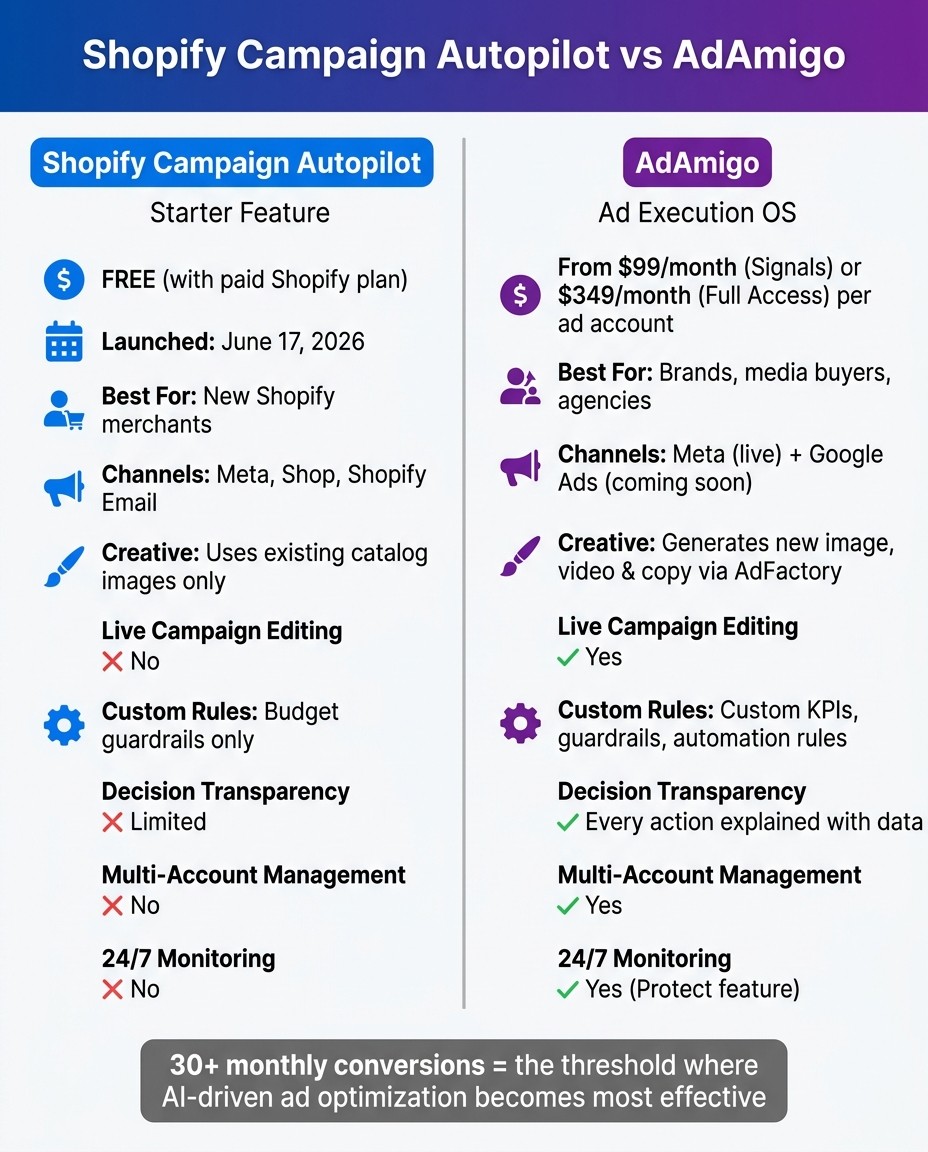
Shopify Campaign Autopilot vs AdAmigo: Side-by-Side Comparison
How we Automated a Meta Ad Agency with AI

Quick Comparison
Criteria | Shopify Campaign Autopilot | AdAmigo |
|---|---|---|
Main job | Launch campaigns inside Shopify | Run and improve live ad accounts |
Best for | New Shopify merchants | Brands, media buyers, and agencies |
Channels | Meta, Shop, email | Meta now; Google next |
Uses live campaigns | No | Yes |
Makes new ads | No | Yes, including image and video ads |
Rules and guardrails | ||
Explains changes | Limited | Yes |
Pricing | Free with paid Shopify plan | $99/month or $349/month per ad account |
My take: this is not a close one if your question is “Which platform actually runs the ad account?” Shopify helps you start. AdAmigo is the one built to manage the account itself.
That’s the lens I’d use for the rest of this comparison.
How Shopify Campaign Autopilot works inside Shopify
Campaign Autopilot sits inside the Shopify admin under the Growth tab. You connect your channels, set a monthly USD budget, and add guardrails to put limits in place. Once that budget is used up, campaigns pause on their own.
It runs across three channels:
Meta ads on Facebook and Instagram
Shop Campaigns in the U.S. and Canada
Shopify Messaging for email flows such as abandoned cart and browse abandonment
You can approve campaigns before they go live, or give the AI more room to run on its own. That setup makes Shopify's role pretty clear: it helps launch and run campaigns within a defined box.
What it automates and what it leaves alone
It creates separate campaigns and does not touch your current ad accounts. That makes it simple to turn on, but it also sets a hard limit. It can launch ads, yet it does not optimize live campaigns already running in market.
Where control falls short for performance teams
It only uses images already in your catalog, so it can't make new images or video. Control is mostly limited to budget, guardrails, and approval level.
For performance teams, that's where things get tight. If you need active creative testing, scaling budgets, and account-level control, Shopify Campaign Autopilot won't give you much room. That's the tradeoff: it's simple by design, while AdAmigo runs the live account itself.
How AdAmigo runs Meta ads and prepares for Google
AdAmigo sits on top of your ad channels and handles the decisions that move results: Meta ad account structure, creative testing, budget moves, and scale-or-cut calls. That’s the gap between a tool that just launches campaigns and one that acts as an execution layer.
The core system: AdFactory, Intelligence, Context Layer, and Priorities
Four parts work together to run the account.
AdFactory looks at your top-performing ads and competitor creatives, then produces new image and video ads built for Meta placements. So instead of leaning only on your current catalog assets, you keep a steady stream of new angles ready for testing.
Intelligence is a multi-agent layer that builds a business-specific brief. In plain English, it makes decisions based on your business data, not a one-size-fits-all prompt.
Context Layer helps keep those decisions aligned across the ad, ad set, campaign, account, and channel levels.
Priorities let you tell the system what matters most right now. Say new-customer acquisition is this month’s goal, even if blended ROAS drops for a bit. You can set that goal on purpose and define how hard the system should push for it. That means it won’t just chase the easiest metric to optimize.
"It's like having an extra set of super-smart hands helping me hit my KPIs." - Sherwin S., G2 Review
Autopilot modes, approvals, and custom rules
AdAmigo runs in two modes. You can approve every recommended action yourself, whether that’s scaling a winner, pausing a loser, or launching a new test. Or you can let it run on its own inside the guardrails you set. In both cases, each action comes with the recommendation and the data behind it.
You can also build your own rules straight into the system. For example, you can:
Set a spend threshold before a new creative gets judged
Define a CPA target that triggers a scale or a pause
Cap frequency before the AI changes a budget
AdAmigo’s Protect feature watches the account all the time to spot delivery issues or anomalies before they turn into wasted spend.
Meta is live today. Google Ads is next. That split shows up clearly in the side-by-side comparison below.
Shopify Campaign Autopilot vs AdAmigo: direct comparison
Shopify Campaign Autopilot launches campaigns inside Shopify. AdAmigo, on the other hand, reviews and improves live ad accounts across Meta right now, with Google coming next.
Table 1: Positioning, channels, creative, and control
Shopify Campaign Autopilot | AdAmigo | |
|---|---|---|
Core idea | Built-in Shopify growth feature | Execution layer across your ad channels |
Built for | New Shopify merchants | Performance teams and agencies |
Shopify dependency | Lives inside Shopify | Standalone SaaS |
Channels | Meta, Shop, email | Meta now; Google next |
Creative handling | Uses existing catalog images | Generates image, video, and copy |
Existing campaigns | Creates separate campaigns; won't touch live ones | Audits and optimizes live campaigns |
Decision transparency | Limited visibility | Actions explained in plain language |
Custom rules | Budget guardrails and simple approvals | Custom KPIs, guardrails, and automation rules |
Extensibility | None | Connectors and custom automations |
Cost | Free on paid Shopify plans (you only pay ad spend) | $99/month (Signals) or $349/month (Full Access) per ad account |
Table 2: What running ads looks like in practice
This is where the split becomes obvious. On paper, both help with ads. In day-to-day work, they handle very different jobs.
Job | Shopify Campaign Autopilot | AdAmigo |
|---|---|---|
Test a new creative angle this week | ✗ - limited to existing catalog images | ✓ - AdFactory generates new image and video for immediate testing |
Run ads outside a Shopify store | ✗ - requires Shopify admin | ✓ - works outside Shopify |
Fix underperforming live Meta campaigns | ✗ - leaves existing campaigns untouched | ✓ - audits and optimizes live campaigns |
Manage multiple client accounts | ✗ - one store, one setup | ✓ - the same OS across every ad account |
Apply custom rules and priorities | ✗ - budget guardrails only | ✓ - custom rules, KPIs, and ranked objectives |
Know why the system moved your budget | ✗ - no reasoning exposed | ✓ - every action includes the data and rationale |
Use competitor and market context | ✗ - not available | ✓ - studies performance data and competitor creatives |
✗ | ✓ - Protect monitors spend anomalies, broken links, and disabled ads |
If you're a new Shopify merchant and want a built-in way to get campaigns live, Shopify Campaign Autopilot fits that lane. If you need to work on live Meta campaigns, test new ad angles fast, or manage several accounts with your own rules, AdAmigo does a lot more.
That difference is what shapes which kind of advertiser each tool is for.
Which tool fits which advertiser, and the final verdict
Best fit by scenario and monthly ad spend
The practical choice depends on where the business is right now, how much ad volume it has, and how much hands-on control the team wants.
Scenario | Typical Spend / Volume | Key Metric | Best Fit |
|---|---|---|---|
New Shopify merchant, first campaigns ever | Low spend | Getting ads live | Shopify Campaign Autopilot |
Growing DTC brand with creative fatigue | 30+ monthly conversions | AdAmigo | |
Agency managing multiple client Meta accounts | Varies by client | Efficiency across accounts | AdAmigo |
If you're a new Shopify merchant, you usually don't need an execution OS yet. You just need to get your first campaigns out the door. In that case, Shopify Campaign Autopilot is often enough for a first-time advertiser.
That changes once volume picks up and learning becomes more stable. AI-run campaigns generally need at least 30 monthly conversions to provide a stable signal. When you hit that level, AdAmigo starts to make more sense. Its AdFactory and full execution layer give teams more room to optimize, test, and react.
For agencies, the fit is even clearer. AdAmigo works well because it can run one system across multiple ad accounts, which matters when you're juggling different clients, goals, and account setups.
Conclusion: Shopify feature vs ad execution OS
The split here is pretty simple: starter feature vs. execution OS.
Shopify Campaign Autopilot is a good starting point for merchants who have never run an ad before. It lowers the barrier to launch and takes care of basic campaign setup without asking for much media buying experience.
AdAmigo plays a different role. It's not just there to get something live. It's built for autonomous optimization, custom rules, and tighter control over execution. So if your team needs new creative, clearer decision-making, or a workflow that can grow past a single store, AdAmigo is the stronger fit for performance teams - running Meta now and extending to Google next.
For first-time merchants, Campaign Autopilot works as a starting feature. For teams that need a live execution layer, AdAmigo is the stronger fit.
FAQs
Can I use both tools together?
Yes, but they run in separate lanes.
Shopify Campaign Autopilot creates and manages its own campaigns, and it leaves your existing account structure untouched. AdAmigo works right inside your live ad account and manages the campaigns that are already there.
So they usually don't clash. Still, they function as two separate systems, each handling a different slice of your budget.
When should I move beyond Shopify’s built-in automation?
Move beyond Shopify’s built-in Campaign Autopilot when you need performance-grade execution, not just convenience.
It makes sense to upgrade when you need net-new creative, ads that send traffic to non-Shopify sites, support for multiple client accounts, tighter control over media-buying rules, or a clear view into why campaign decisions and optimizations are happening based on market and competitor context.
Will AdAmigo manage Google Ads too?
Yes. AdAmigo plans to support Google Ads in the future.
Right now, the platform is built for Meta. But Google Ads is already marked as the next channel on its roadmap.