
Predictive Analytics for Budget Optimization
Use predictive analytics to reallocate Meta ad budgets in real time, reduce wasted spend, and boost ROI with automated tools.
Struggling to make every dollar count on Meta ads? Predictive analytics can help. By forecasting ad performance using AI and historical data, it reallocates budgets in real time - saving wasted spend and boosting returns. Unlike manual vs AI budget testing, which often lags by days, predictive tools analyze patterns like audience behavior and creative fatigue every few minutes. The result? Faster adjustments, better performance, and higher ROI.
Here’s how it works:
Spot Early Success: Detect high-performing ads early and scale them before competitors catch on.
Prevent Waste: Shift budgets away from underperforming campaigns or saturated audiences.
Optimize Timing: Adjust hourly spend during peak conversion windows for maximum impact.
Speed Up Learning: Allocate funds to help campaigns exit Meta’s "Learning Limited" phase faster.
Tools like AdAmigo.ai automate this process, offering features like real-time budget reallocation, performance monitoring, and even AI-generated ad concepts. With pricing starting at $99/month, these platforms make advanced AI accessible to businesses of all sizes.
Predictive analytics doesn’t just save time - it transforms how you manage ad budgets. Whether you're scaling campaigns or fine-tuning performance, it ensures your money works where it matters most.
How To Optimize Facebook Ads In 2026
How Predictive Analytics Improves Budget Allocation
Predictive analytics focuses on anticipating future outcomes instead of just reacting to past data. By analyzing thousands of data points across campaigns, it identifies patterns that hint at future performance. This allows for quicker scaling of successful campaigns and timely adjustments to underperforming ones.
Forecasting Campaign Performance with Data
Advanced algorithms predict future performance by comparing current engagement metrics with historical data benchmarks from successful campaigns. For example, if an ad set shows early signs of success - like high click-through rates or a surge in add-to-cart actions - these systems anticipate higher future ROAS (Return on Ad Spend) and proactively increase the budget. They also track creative fatigue, monitoring drops in engagement that often signal declining conversions. This enables a smooth transition to fresh creative variants before performance dips.
Some tools go even further, identifying specific two-hour windows where conversion rates can be up to 40% higher. By adjusting hourly spend during these periods, they maximize returns. All of this happens in real time, ensuring budgets are continuously optimized based on the latest forecasts.
Dynamic Budget Reallocation
AI tools take budget reallocation to the next level by operating across campaigns, unlike Meta's Campaign Budget Optimization (CBO), which only redistributes funds within a single campaign. These tools assess opportunity costs across your entire ad account, reallocating funds from campaigns with saturated audiences to those gaining momentum.
This dynamic system also maintains balance by enforcing budget limits and guardrails - ensuring strategic testing budgets are preserved while avoiding over-investment in any single campaign. By continuously tracking conversions, engagement patterns, and the interplay between campaigns, these tools make precise adjustments to keep your budget aligned with the highest-performing opportunities. For those starting from scratch, using a Meta ads budget planner can help establish the initial baseline for these automated tools to optimize.
Top Tools for Predictive Budget Optimization
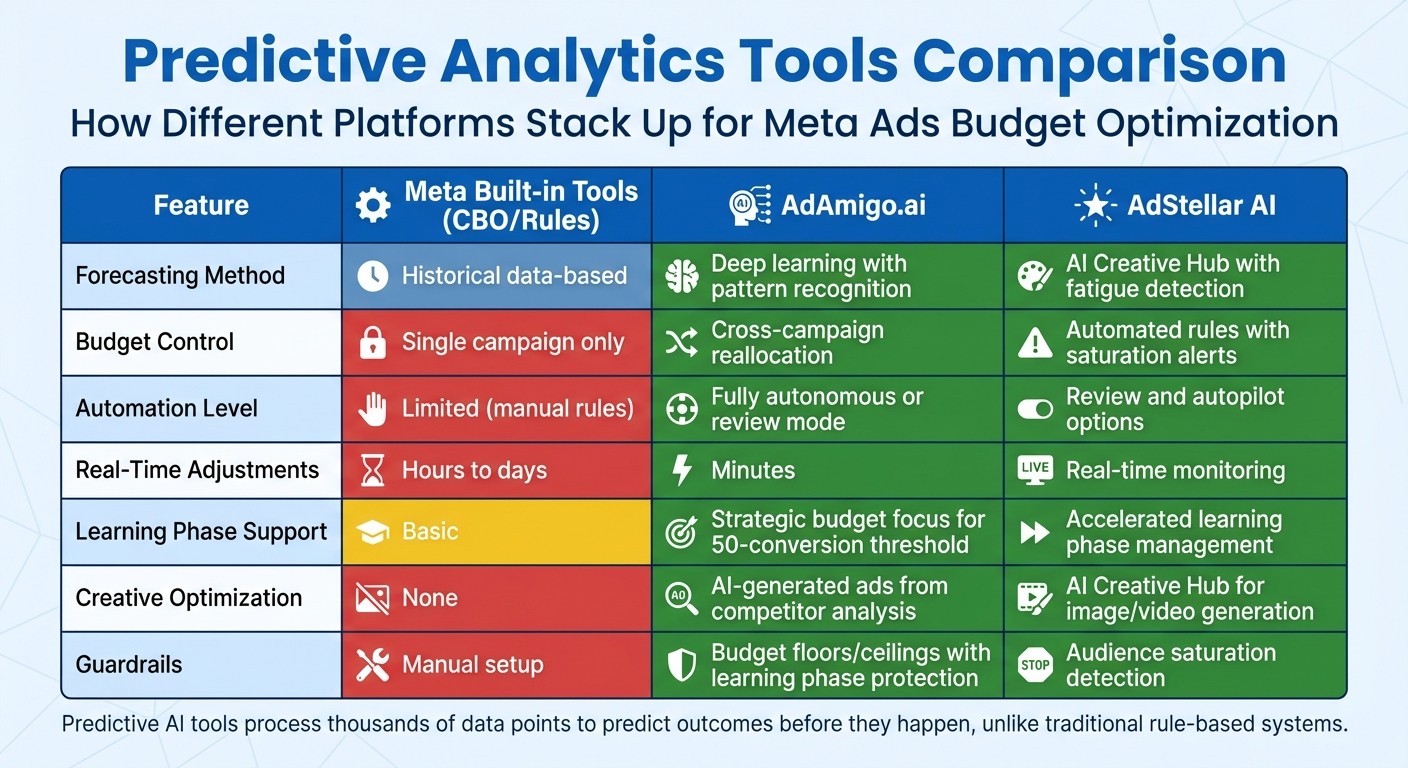
Comparison of Predictive Analytics Tools for Meta Ads Budget Optimization
Leveraging advanced dynamic budget reallocation, tools like AdAmigo.ai take your ad strategy to the next level.
AdAmigo.ai: Autonomous AI for Meta Ads
AdAmigo.ai acts as a self-learning system designed to optimize Meta ad accounts. It continuously evaluates your campaigns, identifies opportunities, and implements changes - managing everything from creative updates to budget shifts. You can choose whether to let it operate in fully autonomous or manual review modes.
The platform’s AI Autopilot constantly audits key elements like creatives, audiences, bids, and budgets. It tests new ideas, reallocates spending across campaigns based on real-time opportunities, and scales high-performing ads while pausing underperformers. As mentioned earlier, AdAmigo.ai focuses on reallocating funds to campaigns that promise better returns. Additionally, its AdAmigo Protect feature monitors account activity for anomalies, helping you avoid unnecessary spending.
Pricing starts at $99/month for limited daily recommendations, with full automation available at $349/month. Agencies managing multiple accounts can access custom, white-labeled solutions.
This tool is just one example of how predictive analytics can reshape campaign management.
Comparison of Predictive Analytics Tools
Here’s a breakdown of how AdAmigo.ai stacks up against other predictive tools:
Feature | Meta Built-in Tools (CBO/Rules) | AdAmigo.ai | |
|---|---|---|---|
Forecasting Method | Historical data-based | Deep learning with pattern recognition | AI Creative Hub with fatigue detection |
Budget Control | Single campaign only | Cross-campaign reallocation | Automated rules with saturation alerts |
Automation Level | Limited (manual rules) | Fully autonomous or review mode | Review and autopilot options |
Real-Time Adjustments | Hours to days | Minutes | Real-time monitoring |
Learning Phase Support | Basic | Strategic budget focus for 50-conversion threshold | Accelerated learning phase management |
Creative Optimization | None | AI-generated ads from competitor analysis | AI Creative Hub for image/video generation |
Guardrails | Manual setup | Budget floors/ceilings with learning phase protection | Audience saturation detection |
Traditional Meta ads budget automation rules often fall short because they rely on simple "if-then" logic, like "if ROAS < X, reduce budget." These systems don’t account for broader performance trends. Predictive AI tools, on the other hand, process thousands of data points - such as conversion rates by time of day or creative fatigue patterns - to predict outcomes before they happen. This allows platforms like AdAmigo.ai and AdStellar AI to adjust budgets proactively, preventing performance dips and maximizing ad spend efficiency and ROI.
Beyond budget optimization, these tools also simplify campaign scaling by providing actionable, real-time insights. This is crucial for hitting ROAS benchmarks while increasing spend.
How to Implement Predictive Budget Optimization
To make predictive budget optimization work with your campaigns, you need to connect your advertising data to downstream business metrics. This allows AI to make real-time decisions about reallocating budgets in a way that maximizes return.
Setting Up Data-Driven Budget Rules
Start by linking your Meta ads to critical business metrics like CRM data, lifetime value (LTV), or revenue attribution. This ensures the AI focuses on actual business outcomes rather than just platform-reported conversions.
Another key step is enabling cross-campaign budget reallocation. Traditional methods often lock budgets into separate campaigns, but predictive systems can shift funds between campaigns based on opportunity cost. For example, if your retargeting campaign performs better on Thursday evenings, the system can automatically pull budget from prospecting campaigns during those hours.
Dayparting is another powerful tool. By analyzing hourly performance data, you can set rules to adjust budgets throughout the day. If data shows that conversion rates spike between 7–9 PM on Thursdays, predictive tools can allocate more budget during that time and reduce spending during slower periods.
Additionally, set up audience saturation detection. This feature monitors engagement levels and reallocates budget before performance declines due to audience fatigue.
Finally, schedule monthly reviews to align AI-driven budget patterns with changing priorities, such as seasonal trends or new product launches. These regular check-ins help keep your strategy aligned with your business goals.
Scaling Budgets Gradually
Once you've configured your budget rules, focus on scaling budgets incrementally based on performance triggers. Predictive AI can analyze data like click-through rates (CTR), return on ad spend (ROAS), and creative fatigue to anticipate trends and adjust budgets before your dashboard reflects them.
Set specific performance-based triggers. For instance:
If your cost per acquisition (CPA) drops 20% below the target for three consecutive days, increase the budget by 10–20%.
If ROAS exceeds your target by 30% and you’re seeing at least 10 daily conversions, scale the budget up by 20%.
To avoid runaway costs, set budget ceilings at 2–3 times your typical daily spend. Also, implement "learning phase protection", which prevents budget changes during the first seven days of a new ad set. This ensures the campaign can hit Meta’s recommended 50-conversion threshold to stabilize performance.
Before applying any automated rule changes, wait for statistical significance. For example, ensure at least 20 clicks or 5 conversions are recorded before adjusting budgets. For accounts with lower conversion volumes (fewer than 50–100 conversions per month per ad set), it’s better to let AI manage higher-level budget distribution across campaigns, as micro-optimizing individual ad sets can lead to unreliable results.
Scaling Trigger | Condition | Recommended Action |
|---|---|---|
High Efficiency | CPA 20% below target for 3 days | Increase budget by 10–20% |
High Volume | ROAS > Target by 30% and 10 daily conversions | Increase budget by 20% |
Underperformance | CPA 40% above target for 2 days | Decrease budget by 20% |
Zero Signal | 80% of daily budget spent with 0 conversions | Decrease budget or pause |
Tools like AdAmigo.ai can automate these scaling rules using deep learning. The system distinguishes between temporary performance dips and real creative fatigue, ensuring budgets are concentrated on ad sets with strong early signals. This approach helps campaigns hit the 50-conversion threshold faster, shortening the learning phase and stabilizing performance sooner.
Advanced Scaling with Predictive Insights
Advanced scaling takes proactive budget management to the next level by using predictive insights to drive sustained growth. Instead of waiting to react to performance changes, this approach uses AI to forecast shifts before they even show up in your metrics. By combining automation rules for scaling with predictive analytics, businesses can connect initial adjustments to long-term, strategic growth efforts.
Creative and Audience Diversification
Predictive systems excel at identifying the best combinations of creatives, copy, and audience segments by analyzing patterns from past high performers. One crucial aspect here is detecting audience saturation. AI tools monitor engagement trends, spotting declines that often signal an upcoming drop in conversions. This allows for timely budget reallocation, preventing a decline in overall performance. Additionally, these systems predict short-term dips and automatically pivot to fresh creatives when needed. Ensuring a consistent flow of new creatives and audience segments keeps the AI equipped with options to maintain and scale performance effectively.
24/7 Optimization with AI Tools
AI tools now make it possible to optimize campaigns around the clock, eliminating the delays typically associated with manual management. For example, manual adjustments can take 48–72 hours to address issues, but platforms like AdAmigo.ai analyze real-time data and make adjustments instantly. AdAmigo.ai offers two modes: Autopilot Mode for full automation and Review Mode for those who prefer manual approval of AI recommendations. The platform continuously audits accounts, identifies opportunities, and executes changes - whether that’s launching new tests, reallocating budgets, refining audience targeting, or generating new creatives.
AdAmigo.ai’s AI Creative Generation feature, known as Ad Factory, studies your top-performing ads and competitor content to develop fresh ad concepts. This process helps prevent creative fatigue by iterating on proven formats. Another standout feature is dayparting, which detects micro-patterns like specific hours during certain days that deliver up to 40% higher ROAS. The platform automatically adjusts hourly budgets to capitalize on these peak windows.
For agencies, this technology allows a single media buyer to handle three to five times more clients, as the AI handles execution while strategists focus on growth planning. In-house teams benefit from having an AI media buyer that works nonstop, constantly improving its effectiveness over time. This creates a powerful partnership where AI not only optimizes on-the-go but also builds on predictive insights to drive continuous improvement.
Conclusion
Predictive analytics is changing the game for Meta ad campaigns, shifting them from reactive adjustments to proactive, strategy-driven management. Instead of waiting days to analyze data and implement changes, AI-powered systems respond to real-time signals, adjusting budgets within minutes. This speed ensures advertisers can seize high-performance opportunities that manual processes often miss.
But it’s not just about faster reactions. Predictive tools can spot audience saturation before ROI takes a hit, speed up the learning phase by allocating budgets to early signs of success, and maintain stability by scaling Meta ad budgets gradually based on data - avoiding the disruptions caused by abrupt manual changes.
For agencies, this means a single media buyer can manage three to five times more accounts, as AI takes care of repetitive tasks. In-house teams, on the other hand, gain a virtual, 24/7 media buyer that continuously improves its decision-making over time. Each adjustment feeds into a loop of smarter future optimizations, creating a compounding effect that human teams alone can’t replicate.
This isn’t just an operational improvement - it’s a strategic shift. With AI managing the nitty-gritty, like budget adjustments and spend reallocation, advertisers can focus on what truly drives growth: refining creative direction, optimizing messaging, and tackling big-picture business goals. The result? Better ROI, less manual effort, and adaptive scaling that keeps pace with performance trends far beyond human capabilities.
Getting started with predictive budget optimization is straightforward: connect your Meta ad account, set your KPIs and boundaries, and let the system take it from there. Whether you prefer a fully automated approach or manual oversight of AI recommendations, the system works within your guidelines to deliver consistent, data-driven improvements - day and night.
This strategic leap doesn’t just boost ROI; it also frees up your team to channel their efforts into impactful creative and strategic work.
FAQs
What data is needed for predictive budget optimization?
To make predictive budget adjustments, you need access to real-time performance metrics. This includes data like CTR (Click-Through Rate), CPA (Cost Per Acquisition), audience engagement stats, and historical campaign performance. These insights allow you to estimate ROI and fine-tune your spending for better results.
How do I set safe budget limits so AI doesn’t overspend?
To avoid overspending, tools like AdAmigo.ai can be a game-changer. They allow you to set clear budget caps and key performance indicators (KPIs) to stay within your financial limits. These platforms handle tasks like automating budget reallocation, merging ad sets, and gradually increasing spending - all while sticking to your predefined boundaries.
The key? Configure detailed rules within the tool, keep a close eye on performance, and let the AI handle the heavy lifting. This approach helps ensure your spending remains under control while still aiming to maximize your return on investment (ROI).
When should I choose full autopilot vs review mode in AdAmigo.ai?
Choose full autopilot if you'd like AdAmigo.ai to handle everything for you. This includes managing budgets, creatives, targeting, and bids - letting you focus on broader strategy while the system works to enhance performance automatically.
On the other hand, opt for review mode if you prefer to have the final say. Here, you can approve or reject AI-suggested changes before they go live, ensuring every adjustment aligns with your specific goals or requirements. Full autopilot is perfect for hands-off automation, while review mode gives you more control over the process.