
Meta's 2025 Health Ad Policy Updates: What Changed
Summarizes Meta's 2025 health ad rule changes: limits on tracking, new tiered classifications, stricter content rules, and steps advertisers should take.
Meta’s 2025 health ad policy overhaul has introduced stricter rules for healthcare advertisers, including HIPAA-related data handling changes. These changes aim to protect user privacy and comply with global privacy rules. Key updates include:
Data Tracking Restrictions: Health-related ads can no longer optimize for lower-funnel events like purchases or appointments. Advertisers must now focus on upper-funnel metrics such as landing page views and engagement.
Tiered System for Health Ads: Ads are categorized based on sensitivity, with stricter rules for medical conditions or provider-patient relationships.
Content Limitations: Ads cannot use symptom-based language, before-and-after visuals, or claims of guaranteed results. Age restrictions apply to weight loss and cosmetic ads.
These changes require advertisers to rethink full-funnel strategies, adapting to policy changes and emphasizing compliance, first-party data, and softer messaging to avoid ad rejections.
URGENT Meta Advertising Update For Health & Wellness Brands
What Changed in Meta's 2025 Health Ad Policies
Meta's 2025 policy update brought in three major changes that have reshaped how healthcare and wellness brands approach advertising on the platform. These changes impact everything from tracking conversions and targeting audiences to creating ad content. Let’s break down each of these updates.
New Limits on Data Tracking and Event Sharing
Meta has rolled out stricter rules on data tracking and event sharing to enhance user privacy and meet legal standards.
Starting January 2025, health and wellness advertisers are no longer allowed to optimize campaigns using lower-funnel conversion events like "Purchase", "Add to Cart", "Checkout Completions", or "Booked Appointments". Instead, advertisers must rely on upper-funnel metrics such as Landing Page Views vs Lead Generation forms, "Engagement", or "Video Views".
Additionally, Meta has restricted Pixel data and CAPI (Conversion API), making it harder to track detailed customer activity. Custom audiences based on sensitive health behaviors are now disabled, and lookalike audiences derived from these behaviors are also prohibited. Marketing consultant Barry Hott has pointed out that losing access to this data could be devastating for some brands, calling the shift potentially "catastrophic".
The impact has been significant - many brands have reported a 30–40% drop in ad performance since the changes took effect. Some companies, like the wellness brand Happy Healthy You, have adapted by launching their own mobile apps. This strategy allowed them to bypass Meta's restrictions, boosting user engagement by 42% and cutting customer acquisition costs by 31%.
These new rules are forcing advertisers to shift their focus toward upper-funnel campaign objectives. But that's not all - Meta has also introduced a tiered classification system for health ads.
New Tiered System for Health and Wellness Ads
To better manage health-related advertising, Meta has implemented a system that groups advertisers based on the sensitivity of their content.
Under this system, businesses mentioning medical conditions, health statuses, or provider-patient relationships are automatically flagged and placed in the "Health and Wellness" category. Notifications about this classification are sent via email or through the Meta Business account.
This tiered approach means different levels of restrictions for various advertisers. For instance, telehealth providers, supplement brands, and medical device companies now face tighter controls on targeting, optimization, and reporting. As part of these changes, Meta began disabling custom audiences with names like "arthritis_interest_list" in Q3 2025, even if they had previously been approved. A second wave of restrictions is expected in early 2026, focusing on lead generation for physician practices and behavioral health clinics.
This classification system adds another layer of complexity, leading to stricter rules for ad content and targeting, which we’ll explore next.
More Restrictions on Targeting and Ad Content
Meta has also tightened its content guidelines to ensure ads respect user privacy and avoid sensitive or misleading messaging.
Advertisers can no longer use symptom-based language or visuals like before-and-after photos for weight loss or wrinkle reduction. Phrases that promote negative self-perception (e.g., "Fix your flaws") or make exaggerated claims (e.g., "Cure diabetes") are now banned. To comply, advertisers must use neutral, anonymized naming conventions for audiences and conversion events, avoiding references to protected health information.
Age restrictions have also become stricter. Ads for weight loss products, dietary supplements, and cosmetic procedures are now limited to users aged 18 and older. Meanwhile, Meta’s AI moderation system has become more vigilant. In 2024, it flagged health and wellness ads for manual review 1.6 times more often than any other category, and in just the first half of 2025, over 20,000 ads in this vertical were flagged.
These updates demand a complete overhaul of how advertisers approach their campaigns - from how they track conversions to the way they craft ad copy and define their target audiences.
How to Adapt Your Healthcare Ads to the New Policies
Recent Meta ads targeting limits are pushing healthcare marketers to rethink their strategies for ad content, audience targeting, and campaign execution.
Adjusting Ad Copy and Creative to Align with Policy Guidelines
Meta’s new policies restrict certain language and imagery in healthcare ads, so it’s time to get creative while staying compliant. Words like "cure", "treat", "heal", "fix", "diagnose", and "symptoms" are now flagged unless you’re a licensed professional with proper regulatory approval. Similarly, phrases such as "guaranteed results", "instant relief", or "results in 24 hours" are likely to trigger rejections.
Instead, shift the focus to ingredients and lifestyle benefits. For instance, instead of saying a supplement "boosts immunity", highlight its specific ingredients and dosages. Replace claims like "cures depression and anxiety" with softer, more inclusive language such as "support your mental wellbeing." Likewise, swap "lose 10 lbs in 7 days" for "start your fitness journey today."
Visuals need to follow suit. Meta now prohibits before-and-after comparisons, close-ups of body fat or skin imperfections, and any imagery that might exploit insecurities - like tape measures or scales. Opt for photos that showcase active, fulfilling lifestyles instead of clinical or overly personal imagery.
Even your call-to-action (CTA) buttons need a refresh. Hard-sell CTAs like "Buy Now" or "Book Your Appointment" are being replaced with softer alternatives such as "Learn More", "Speak with a Specialist", or "Download Our Guide." URLs and event names should also steer clear of sensitive health terms. For example, change "yoursite.com/book?condition=diabetes" to something neutral like "yoursite.com/book?service=type1." Use generic event names like "event_01" to avoid triggering automated blocks.
Once your ad creative is compliant, the next step is building audiences that meet these new standards.
Building Audiences with First-Party Data
Meta has tightened restrictions on Pixel and Conversion API tracking for sensitive health behaviors, making first-party data your most reliable asset. This means gathering data directly from your own platforms - like email lists, website interactions, and mobile apps - while following privacy and consent best practices - rather than relying on Meta’s tracking tools.
Anonymization is key here. Meta actively scans for and disables custom audiences with names that suggest sensitive traits. Use neutral labels like "audience_segment_A" or "group_T4B9" to avoid issues.
Server-side tracking via the Conversion API can help ensure compliance by filtering out Protected Health Information (PHI) before sharing data with Meta. This way, only anonymized, policy-compliant information is transmitted. Additionally, building direct communication channels such as email and SMS can reduce your dependency on Meta’s increasingly limited retargeting options. As Accelerated Digital Media explains:
Meta's health advertising policy posture is shifting from encouraging compliance to actively preventing misuse of its platforms.
With lower-funnel tracking like purchases and appointments now restricted, focus on upper-funnel metrics like "Landing Page Views", "Engagement", or "Qualified Lead Volume." These indicators can help you measure campaign success without relying on conversion events that may be blocked by the new policies.
Once your first-party data strategy is solid, you can turn to AI tools to streamline compliance and boost performance.
Using AdAmigo.ai to Stay Compliant and Improve Results
In this evolving landscape, AI tools like AdAmigo.ai can help healthcare advertisers stay compliant while optimizing performance. The platform automatically scans your ad content, targeting, and landing pages to flag compliance issues with a Meta ad policy checker before they become problems.
AdAmigo.ai’s AI Ads Agent goes a step further by analyzing successful competitor campaigns and generating compliant, educational ad creatives. These ads focus on raising awareness without making prohibited health claims, saving you the hassle of manual trial-and-error testing.
The platform’s AI Actions feature provides daily, prioritized recommendations for improving your creatives, audience targeting, budgets, and bids. This real-time feedback is invaluable in a fast-changing environment where policy enforcement is becoming stricter by the day.
For additional support, AdAmigo.ai’s AI Chat Agent offers real-time answers to compliance questions and policy updates. This makes it easier to launch bulk campaigns while ensuring all ads meet Meta’s guidelines. Agencies managing multiple healthcare clients will find this especially useful, as it allows one media buyer to handle significantly more accounts while senior strategists focus on broader planning. Plus, AdAmigo.ai’s privacy-first approach ensures sensitive health data is never processed or stored, keeping you compliant with healthcare privacy standards.
Before and After: Meta Health Ad Policies in 2025
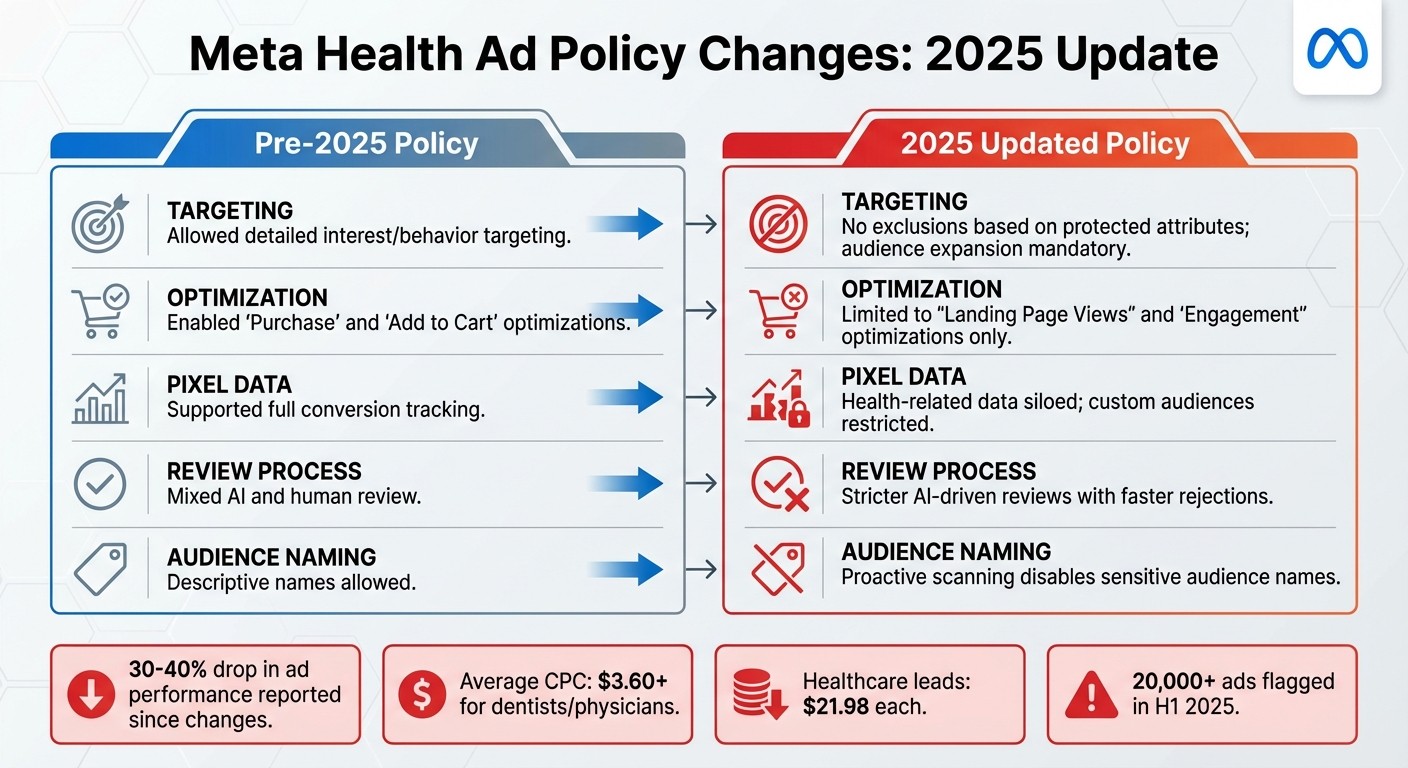
Meta Health Ad Policy Changes 2025: Before vs After Comparison
Meta's updated healthcare advertising policies mark a major shift, reshaping how advertisers approach campaigns in this space. Understanding the differences between the old and new rules is key to adapting effectively.
What Changed: Old Policies vs. New Policies
Here's a side-by-side look at the key differences between the pre-2025 policies and the updates introduced in 2025:
Feature | Pre-2025 Policy | 2025 Updated Policy |
|---|---|---|
Targeting | Allowed detailed interest/behavior targeting | No exclusions based on protected attributes; audience expansion is now mandatory |
Optimization | Enabled "Purchase" and "Add to Cart" optimizations | Limited to "Landing Page Views" and "Engagement" optimizations |
Pixel Data | Supported full conversion tracking | Health-related data is siloed; custom audiences face restrictions |
Review Process | Mixed AI and human review | Stricter AI-driven reviews with faster rejections |
Audience Naming | Descriptive names allowed | Proactive scanning disables sensitive audience names |
How These Changes Affect Your Campaigns
These policy updates bring significant changes to campaign strategies, particularly in areas like targeting, conversion tracking, and cost management. Advertisers now face stricter rules around audience targeting, with no room for exclusions based on protected attributes. Mandatory audience expansion forces campaigns to reach broader, less specific groups, which can dilute targeting precision. This makes it harder to leverage interest-based targeting effectively.
Conversion tracking has also undergone a major overhaul. Meta now uses a three-tier restriction system for healthcare websites. At the strictest level (Full-Restricted), tracking custom conversions is entirely blocked for condition-specific services, such as mental health or addiction treatment. As a result, advertisers are shifting focus to upper-funnel metrics like landing page views and engagement rather than high-intent actions like purchases or appointment bookings.
The financial impact is notable. In 2025, average CPCs for dentists and physicians exceed $3.60, healthcare leads cost around $21.98 each, and wellness brand CPMs hover near average CPCs for dentists and physicians exceed $3.60, healthcare leads cost around $21.98 each, and wellness brand CPMs hover near $11.251.25. For instance, during the 2024/2025 Black Friday season, health and wellness brand Naturtreu increased its marketing budget by 122% and achieved a 23% boost in ROAS by using Admetrics' PRISM4 Marketing-Mix-Model to adapt to Meta's evolving data policies.
These shifts emphasize the importance of moving from direct response campaigns to educational strategies that rely on first-party data. Adjusting to these changes is essential for staying competitive under the new regulations.
What Healthcare Advertisers Should Do Next
Meta's upcoming policy changes for 2025 require healthcare advertisers to act swiftly. With the move from reactive enforcement to proactive prevention, ads could now be flagged or even disabled before they go live. This makes staying compliant more important than ever.
Steps to Take Right Now
First, audit your data collection practices. Make sure that no Protected Health Information (PHI) or sensitive health data is being sent through Meta Pixel or Conversions API. Scrub tracking metadata of terms like "diagnosis", "condition", or procedure names, and replace health-related event names with generic codes. For instance, instead of "mental_health_consultation", opt for something like "event_01."
Next, check your business categorization in Meta Business Manager. Determine if you're labeled as Core, Mid, or Full-Restricted. If you find your classification is incorrect, file an appeal immediately. To further safeguard sensitive data, implement server-side tracking through CAPI to filter out PHI before it reaches Meta's systems.
When it comes to your ad creative, shift focus to educational content and lifestyle benefits. Avoid emphasizing specific health outcomes or using "before-and-after" visuals. Move away from lower-funnel goals like Purchases or Add to Cart, and instead aim for upper-funnel objectives such as Landing Page Views, Engagement, or Brand Awareness. Use softer calls-to-action, such as "Learn More" or "Speak with a Specialist", rather than direct purchase prompts. If you're advertising prescription drugs, ensure you obtain LegitScript certification to prevent immediate ad rejections.
To make these adjustments easier, consider using AI tools for Meta ad management to help streamline compliance and improve performance while adhering to the new rules.
How AI Tools Help You Navigate Policy Changes
AI tools can take the guesswork out of compliance, saving you valuable time. Platforms like AdAmigo.ai can flag potential issues before your ads go live, offering instant detection and adjustments. These tools monitor campaigns around the clock, scanning ad content for violations while optimizing performance under the new data restrictions - all starting at $98 per month.
AdAmigo.ai’s AI Actions feature provides a daily list of prioritized optimizations for creatives, audiences, budgets, and bids. Instead of manually reviewing a handful of creative variants each week, the platform allows for unlimited automated testing and generation. This proactive strategy is crucial in a landscape where Meta’s enforcement now relies on automated scanning of metadata and naming conventions to prevent misuse.
FAQs
How do Meta's 2025 health ad policy changes affect small healthcare businesses?
Meta’s updated health ad policies for 2025 bring tighter privacy controls, significantly impacting how healthcare advertisers can target and optimize their campaigns. If your business mentions medical conditions, treatments, or wellness services on its website, it will automatically fall under the "Health & Wellness" category. This classification triggers more rigorous reviews and limits conversion tracking to higher-level metrics like page views or general engagement, rather than detailed actions.
For smaller healthcare providers - think local clinics, telehealth platforms, or wellness studios - these changes can be tough to navigate. Expect challenges like less efficient ads, rising costs per lead, and reduced precision in audience targeting. On top of that, stricter compliance rules mean a higher risk of account suspensions. Without access to detailed health-related data, creating effective direct-response campaigns becomes an uphill battle.
To keep up, small businesses can lean on tools like AdAmigo.ai. This platform automates ad optimization while staying within Meta’s updated rules. It can rewrite ad creatives, fine-tune bidding strategies, and offer real-time suggestions for compliant audience targeting. With tools like this, businesses can focus on maintaining ad performance while shifting toward broader branding strategies.
How can advertisers adapt to Meta's updated 2025 health ad policies?
To align with Meta's stricter health ad rules set for 2025, advertisers need to focus on both refining their content and tweaking technical approaches. Here's how:
Polish your messaging: Make sure your ad copy complies with the new guidelines by targeting individuals aged 18 and older, steering clear of body-shaming language, and avoiding claims that tie products to specific health outcomes.
Shift to privacy-conscious tactics: Move away from third-party health-based targeting. Instead, rely on first-party data like email lists or website visitors. Also, ensure event names don’t disclose sensitive health information.
Reassess campaign goals: Focus on broader objectives like building brand awareness or encouraging engagement rather than direct conversions, which Meta now discourages for health-related ads.
Tap into automation tools: Use AI-driven platforms like AdAmigo to help ensure compliance, improve ad performance, and automatically fine-tune targeting, bids, and budgets in line with the new rules.
By making these adjustments, advertisers can stay effective while meeting Meta's updated requirements.
How do Meta's new health ad tiers affect targeting options for advertisers?
Meta's 2025 update introduces a new three-tier system for health-related ads: Core, Mid, and Full. This system places tighter restrictions on how advertisers can target audiences, depending on the level of sensitivity.
Core-level ads: These allow targeting based on broad demographics using anonymized data but exclude detailed health-related interests or behaviors.
Mid-level ads: Targeting here is even more restricted. Custom or lookalike audiences are off the table, and advertisers can only use high-level categories like age (e.g., 18+). The emphasis shifts to reaching broader groups rather than precise targeting.
Full-level ads: Ads in this category, often for services like mental health or chronic illness care, cannot use health-specific tracking or detailed targeting. They rely solely on generic audiences and first-party data.
Advertisers will need to rethink their strategies under these new rules. For Core-level ads, they’ll need to focus on broader, interest-free audiences. Mid-level ads will require leveraging first-party data and simple demographic filters. Meanwhile, Full-level ads must avoid any health-specific targeting, relying entirely on generic audience approaches.
AI tools like AdAmigo.ai can simplify this transition. By automatically aligning campaigns with the correct tier, these tools help advertisers stay compliant while optimizing performance within the new guidelines.