
Real-Time GDPR Monitoring Tools for Meta Ads
Compare six tools for real-time GDPR compliance with Meta ads, covering consent management, server-side tracking, and 24/7 anomaly alerts.
Running Meta ads for European audiences means strict adherence to GDPR rules. Non-compliance can cost you up to €20 million or 4% of global revenue. The challenge? Many marketers detect issues too late - on average, 11 days after they arise. Manual audits can't keep up with fast-paced campaigns.
Solution: Meta ads compliance monitoring tools automate compliance checks, ensuring your ads meet regulations without disrupting performance. Here are six tools to consider:
Admetrics: AI-driven monitoring for data compliance and setup errors.
Piwik PRO: Privacy-focused platform with consent management and tag control.
Cometly: Conversion tracking with limited GDPR-specific details.
RedTrack: Server-to-server tracking for privacy-safe data handling.
WeTracked: Affordable cookieless tracking (features unclear).
AdAmigo.ai Protect: Anomaly detection and account health monitoring for Meta ads.
Quick Tip: Combine tools like Piwik PRO for consent management, RedTrack for server-side tracking, and AdAmigo.ai Protect for 24/7 monitoring to cover all compliance bases.
Meta Conversion API & GDPR Consent Setup
1. Admetrics
Admetrics is a data intelligence platform designed specifically for performance marketers managing Meta campaigns. It provides round-the-clock monitoring using AI agents that can detect ad metric anomalies, sudden spikes in spending, and setup errors. By addressing these issues early on, Admetrics plays a key role in helping marketers stay compliant with GDPR regulations. For a deeper dive, see our Meta Ads and GDPR compliance guide.
2. Piwik PRO
Piwik PRO is an analytics and tag management platform designed with privacy and GDPR compliance at its core. Unlike more general analytics tools, it’s specifically built to handle consent and data governance, making it a strong choice for advertisers managing Meta campaigns in markets with strict regulations. Its focus on consent and unified data management is what sets it apart.
One of its key features is the built-in Consent Manager, which ensures that tags like the Meta Pixel only activate after users give explicit consent. If consent isn’t granted, the Meta Pixel remains inactive, safeguarding user privacy.
To deploy the Meta Pixel, you’ll need to install one JavaScript container and use Piwik PRO’s integrated Tag Manager, similar to how you would setup Meta conversions with GA4. Since analytics, consent management, and tag management are all bundled together in one platform, there’s no need to juggle multiple tools to maintain compliance.
Advertisers with experience in tools like Google Tag Manager will likely find the setup straightforward, though smaller teams might need some onboarding to get started.
Piwik PRO’s privacy-by-design architecture further emphasizes its commitment to treating consent as a core feature. For advertisers needing to prove GDPR accountability, this approach is a crucial advantage.
3. Cometly
Information about Cometly's real-time GDPR monitoring for Meta ads is sparse. Unlike Admetrics and Piwik PRO, which clearly outline their GDPR-focused features, Cometly's specific approach to compliance hasn't been documented. Details about its integration process, tracking capabilities, or setup guidelines are missing. This makes it difficult to debug Meta Ads conversion tracking issues effectively. Advertisers looking to determine whether Cometly aligns with GDPR compliance for Meta audience data will need to explore other resources. This lack of clarity sets it apart from the more transparent options discussed in this analysis.
4. RedTrack
RedTrack takes a different route compared to other tools by focusing on server-side data handling. Instead of relying on browser-based tracking, it uses S2S (server-to-server) tracking to transfer data directly between servers, bypassing the user's browser entirely.
Another standout feature is its use of custom tracking domains with CNAME configuration. This setup ensures that data collection is treated as first-party, meaning the advertiser maintains direct ownership of the data relationship. This approach aligns well with GDPR requirements, offering a more privacy-conscious solution.
5. WeTracked
There isn’t much verified information available about WeTracked's real-time GDPR monitoring for Meta ads. While other platforms in this field often focus on privacy-first data collection and server-side tracking, it’s unclear from public details whether WeTracked integrates with the Meta Conversions API or includes built-in tools for managing GDPR consent.
Since specific features and compliance details aren’t readily available, advertisers should reach out directly to WeTracked to clarify its capabilities, setup process, and GDPR compliance measures.
6. AdAmigo.ai Protect
AdAmigo.ai Protect is the built-in safety feature of the AdAmigo platform, designed to safeguard Meta advertisers' accounts. While it’s not a GDPR auditing tool, it tackles a critical issue by identifying anomalies, configuration mistakes, and suspicious activities before they turn into bigger problems.
How it works: Protect operates around the clock, learning your account's typical spending and performance patterns through baseline analysis. When something goes off track - like unexpected spending spikes, broken links, disabled ads, or even signs of a potential hack - it sends you instant alerts. Plus, you can set your own thresholds, such as a minimum ROAS or a daily spending limit, so the system keeps an eye on the metrics that matter most to your campaigns. An auto-pause feature is in the pipeline, which will let Protect stop campaigns automatically when it detects critical issues, rather than just notifying you.
Meta integration and compliance: Protect works exclusively with Meta's official API, ensuring that all monitoring and actions comply with Meta's approved data handling protocols. Setup is quick - just two minutes through Meta's API - and it begins by scanning your account to establish a baseline for normal activity. This seamless integration sets Protect apart from tools focused solely on consent management.
How it stands out: Protect is all about ongoing account health monitoring, which makes it different from tools that focus strictly on GDPR consent and data tracking. It won’t audit your consent management system or confirm that your pixel only fires after user consent. Instead, it’s built for advertisers who need continuous, real-time anomaly detection within their Meta ad management workflow. This fills a gap that standalone compliance tools often miss. Pricing starts at $99/month, with the full Autopilot features available for $349/month per ad account.
Pros and Cons of Each Tool
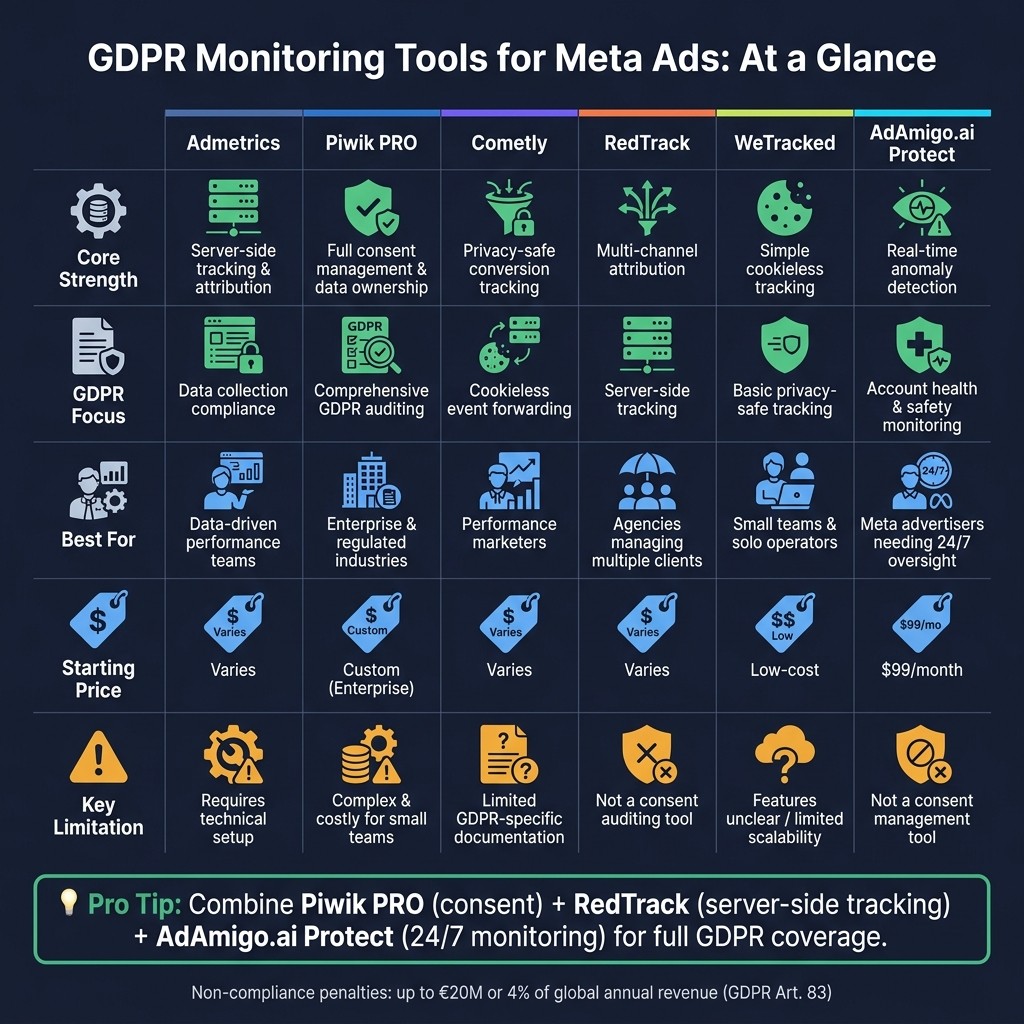
GDPR Monitoring Tools for Meta Ads: Side-by-Side Comparison
Each tool discussed here approaches Meta ad account security differently, with no single tool offering a complete solution. Here's a breakdown of their strengths and limitations.
Admetrics provides powerful server-side tracking and attribution, which is crucial for GDPR compliance. However, setting it up requires technical know-how, and it mainly serves as a data analytics tool rather than a real-time compliance monitor.
Piwik PRO is a robust GDPR compliance suite that includes consent management and ensures full data ownership. It's a great fit for privacy-focused organizations, but its complexity and enterprise-level pricing may pose challenges for smaller teams.
Cometly and RedTrack specialize in conversion tracking and attribution using privacy-safe, cookie-free methods. These tools work well for performance marketers who need reliable data without depending on browser cookies. However, they aren't specifically tailored for auditing consent flows.
WeTracked offers an affordable, user-friendly solution for smaller teams looking for cookieless tracking without a steep learning curve. That said, its features may feel limited as business needs grow.
AdAmigo.ai Protect takes a different route, focusing on 24/7 monitoring for anomalies, spending spikes, broken links, and potential hacks. It has earned a 4.9/5 rating on G2 and carries a "High Performer" badge on the platform.
The table below provides a quick comparison of these tools:
Tool | Core Strength | GDPR Focus | Best For | Starting Price |
|---|---|---|---|---|
Admetrics | Server-side tracking & attribution | Data collection compliance | Data-driven performance teams | Varies |
Piwik PRO | Full consent management & data ownership | Comprehensive GDPR auditing | Enterprise & regulated industries | Custom |
Cometly | Privacy-safe conversion tracking | Cookieless event forwarding | Performance marketers | Varies |
RedTrack | Server-side tracking | Agencies managing multiple clients | Varies | |
WeTracked | Simple cookieless tracking | Basic privacy-safe tracking | Small teams & solo operators | Low-cost |
AdAmigo.ai Protect | Real-time anomaly detection | Account health & safety monitoring | Meta advertisers needing 24/7 oversight | $99/month |
Conclusion
When deciding on the right tools, it's essential to focus on your specific compliance requirements. The tools discussed earlier highlight how combining different solutions can address unique aspects of compliance effectively.
For managing consent, Piwik PRO stands out, while Cometly or RedTrack excel in cookieless tracking. To ensure continuous anomaly detection, consider incorporating AdAmigo.ai Protect. A layered strategy - such as using Piwik PRO or Admetrics for consent and server-side data collection, pairing it with Cometly or RedTrack for cookieless conversion tracking, and adding AdAmigo.ai Protect for ongoing account monitoring - provides a comprehensive approach to GDPR compliance. This combination ensures thorough data compliance, dependable tracking, and effective anomaly detection. Understanding common ad anomalies is the first step toward securing your budget.
"What others promised, AdAmigo.ai delivered. True AI, automation, and results." - Nadia Toffar
Instead of relying on a single platform, choose tools that address specific compliance gaps to create a seamless and reliable solution.
FAQs
Do I still need a consent banner for Meta Pixel under GDPR?
Yes, a consent banner is generally required when using the Meta Pixel under GDPR regulations. Before collecting personal data through tracking technologies like pixels, users must give explicit consent.
While platforms like AdAmigo.ai can assist in managing campaigns within Meta's compliance framework, they don't replace the necessity of obtaining user consent directly on your website. Ensuring this step is crucial for staying compliant with GDPR requirements.
What’s the difference between consent management and server-side tracking?
Consent management and server-side tracking serve different purposes in the realm of data collection and privacy. Consent management is all about gathering and managing user permissions to ensure compliance with privacy regulations like GDPR or CCPA. It focuses on giving users control over what data is collected and how it's used.
On the other hand, server-side tracking shifts the process of data collection and processing from the user's browser to a server. This method can enhance data accuracy and security by reducing the impact of browser limitations, such as ad blockers or cookie restrictions.
To fully understand how these two approaches compare or complement each other, diving deeper into their technical specifics and applications would be beneficial.
How do I set up real-time alerts for Meta ad account anomalies?
AdAmigo Protect makes it easy to set up real-time alerts for any unusual activity in your Meta ad account. All you need to do is connect your account and verify your email to kickstart 24/7 monitoring.
The AI behind AdAmigo Protect studies your account's typical performance patterns, so it can quickly identify anything out of the ordinary. Plus, you have the flexibility to tailor alerts by adjusting signals, thresholds, and conditions right in the dashboard.
For notifications, you’re covered across platforms like Slack, WhatsApp, and others, keeping all performance updates centralized and easy to track.