
Multi-Touch Attribution for Meta Ads
Allocate conversion credit across Meta touchpoints with Pixel + CAPI, choose the right MTA model, and use AI to optimize results.
Most advertisers rely on last-click attribution, which gives all credit for a sale to the final ad interaction. This method overlooks the impact of earlier touchpoints in the customer journey. Single-touch vs. multi-touch attribution models differ in how they distribute credit across interactions, helping you understand how different ads contribute to conversions.
Key Takeaways:
What is MTA? A method that assigns credit to all touchpoints in a customer’s journey, not just the last one.
Why it’s important: It provides a full-funnel view, showing how top-of-funnel ads (awareness) drive conversions.
Challenges it addresses:iOS 14.5 privacy changes and over-reliance on Meta’s native reporting.
How to implement: Use Meta Pixel and the Conversions API (CAPI) for accurate tracking and data integration.
MTA helps allocate budgets wisely, improve performance, and refine ad strategies by highlighting what works across the entire funnel. Let’s break down how to set it up and choose the right model.
Setting Up an Attribution-Ready Tracking System
How Meta Pixel and Conversions API Work Together
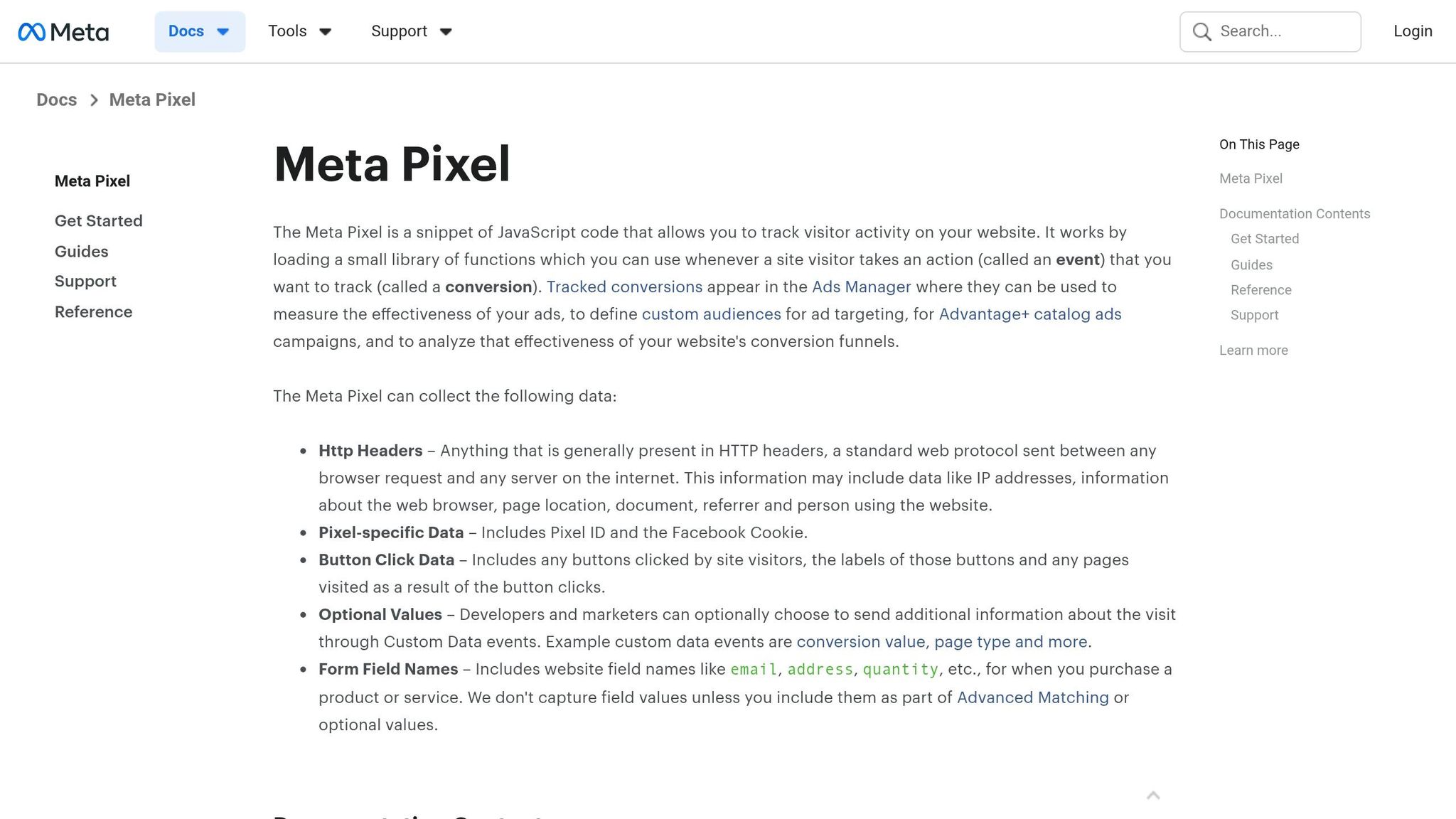
Meta Pixel focuses on browser-side tracking, capturing actions like page visits, adding items to a cart, or completing purchases. On the other hand, the Conversions API (CAPI) operates server-side, sending the same event data directly from your server to Meta. Together, they form a layered tracking system that ensures data remains intact, even when browser signals are blocked by ad blockers or privacy settings.
This dual approach has become essential, especially since iOS 14.5 introduced restrictions that reduced the reliability of browser-based tracking. CAPI now plays a key role in maintaining accurate attribution. If you're only using the Pixel without CAPI, you're likely missing out on a large chunk of conversion data—consider a Meta Conversions setup with GA4 to bridge the gap - leaving your attribution model incomplete from the start.
For a seamless CAPI setup, work with a verified Meta Business Partner. This ensures stability and proper permissions for the API. Avoid using unapproved third-party tools, as they can drop events without warning, creating unnoticed gaps in your data.
Building an Effective Event Structure
A well-structured event setup is the backbone of any multi-touch attribution system. To capture the full customer journey, track these key events: PageView, ViewContent, AddToCart, InitiateCheckout, and Purchase. Leaving any of these out can create blind spots in your data.
But it's not just about tracking the events - you also need to include the right parameters with each one. Use UTM tags (source, medium, campaign, content, term) with every ad, along with the fbclid parameter that Meta automatically adds when someone clicks on an ad. These details allow your attribution model to map conversions back to the specific touchpoints across sessions and devices.
Pay close attention to your Event Match Quality (EMQ) scores. Meta rates events from 0 to 10 based on how well they can match an event to a user. Scores below 6.0 indicate weak matching, which can harm attribution accuracy. Enabling Advanced Matching - which passes hashed customer data like email addresses or phone numbers - can quickly boost these scores and improve tracking precision.
Maintaining Data Quality and Governance
Even the most carefully designed tracking systems can face issues over time. A website update might break a Pixel event. A new campaign might launch without UTM tags. Or a CAPI integration might start sending duplicate events. These problems can corrupt your attribution data, and the impact often only becomes clear weeks later when performance metrics look off.
To avoid this, use automated monitoring tools. These tools can detect issues like broken links, duplicate events, missing conversion windows, or sudden drops in CAPI signals. Addressing these problems early can make a big difference - advertisers who implement automated monitoring often see a 34% improvement in performance within 30 days by closing data gaps.
Another critical step is standardizing naming conventions for campaigns and ad sets. Inconsistent naming can confuse attribution models and AI tools, leading to misattributed credit and poor budget decisions. Set clear naming rules early on and apply them consistently to every campaign.
Once your tracking system is solid, you’ll be ready to choose the best multi-touch attribution model for your advertising efforts.
Multi-Touch Attribution: What’s Working, What’s Dead, and How to Fix It
Choosing the Right Multi-Touch Attribution Model
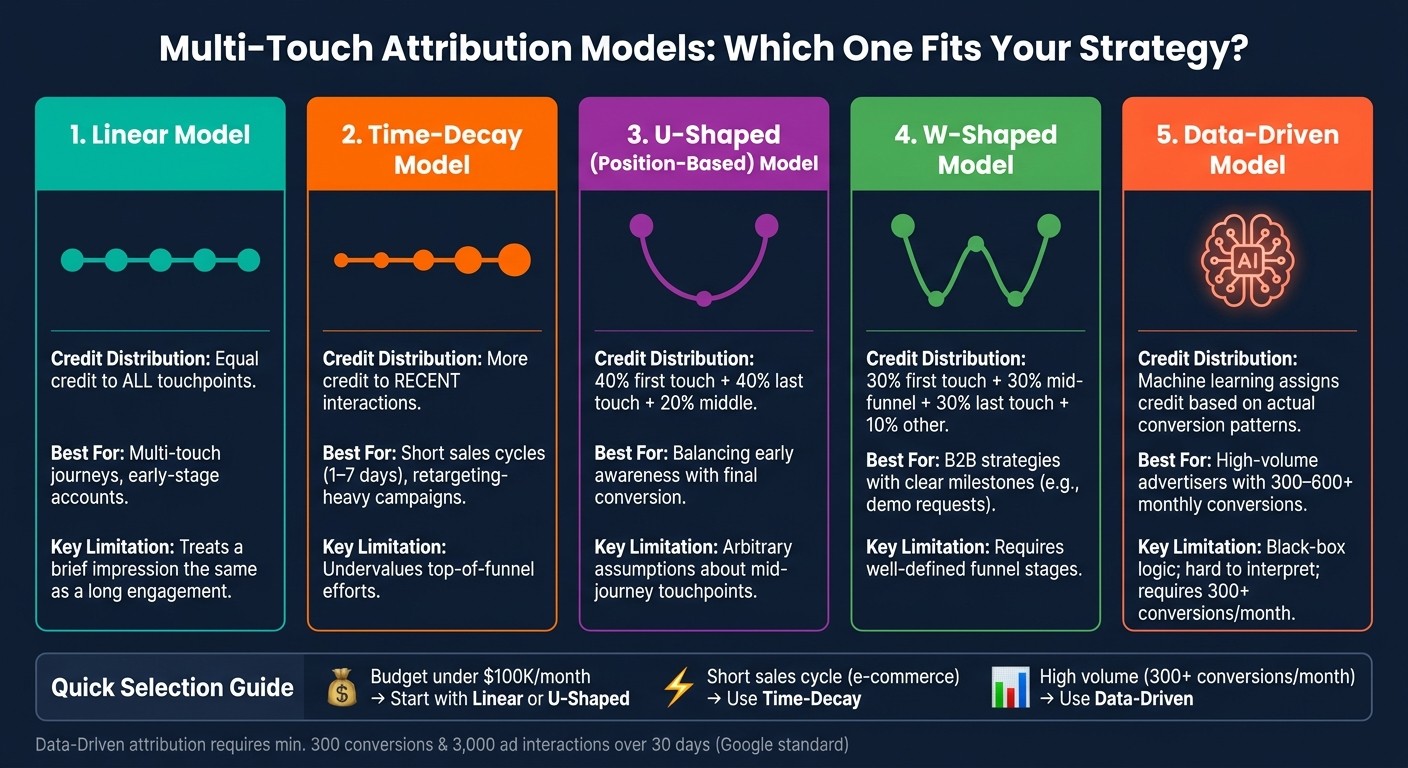
Multi-Touch Attribution Models Compared: Which One Is Right for Your Meta Ads?
Common Attribution Models Explained
Once you have a reliable tracking system in place, the next step is selecting the multi-touch attribution model that best fits your needs. The right choice ensures you’re allocating your budget wisely. Here’s a breakdown of how popular models assign credit across touchpoints:
Model | How Credit Is Assigned | Best For |
|---|---|---|
Linear | Distributes credit equally across all touchpoints | Multi-touch journeys |
Time-Decay | Gives more credit to recent interactions | Short sales cycles or retargeting-heavy campaigns |
U-Shaped (Position-Based) | 40% credit to the first and last touchpoints, 20% to the middle | Balancing early awareness with final conversion |
W-Shaped | 30% credit each to the first, mid-funnel, and last touchpoints | B2B strategies with clear milestones like demo requests |
Data-Driven | Uses machine learning to assign credit based on actual conversion patterns | High-volume advertisers with 300+ monthly conversions |
Among these, the data-driven model is the most precise but also the most demanding. For example, Google’s data-driven attribution requires at least 300 conversions and 3,000 ad interactions over 30 days to generate reliable insights. If your account doesn’t meet these thresholds, simpler models like U-Shaped or Linear may offer more consistent results.
How to Pick a Model for Meta Ads
Selecting the right attribution model for Meta ads comes down to three key factors: sales cycle length, campaign objectives, and available data.
For e-commerce campaigns with short purchase cycles, time-decay attribution works well since it prioritizes recent interactions that drive immediate purchases. On the other hand, brands with longer sales cycles benefit more from U-Shaped or Linear models, as they account for early touchpoints that last-click attribution tends to overlook.
"When you only credit one touchpoint, you make budget decisions based on incomplete data. You might cut spending on channels that are actually critical to your conversions." - Cometly
Budget size also plays a role. If you’re spending less than $100,000 per month, first-click attribution can provide straightforward insights without the complexity of multi-touch models. For larger budgets, behavioral or data-driven models often yield better results. Additionally, running first-click and last-click models side by side can help you distinguish between demand creation (early-stage awareness) and demand capture (final-stage conversions).
Once you’ve chosen a model, the next step is leveraging tools to turn these insights into actionable strategies.
Using AI Tools to Support Attribution Decisions
Even the most carefully selected attribution model is only as valuable as the actions it informs. That’s where AI tools come in - not just for analyzing data but for bridging the gap between insights and campaign optimization.
Take AdAmigo.ai as an example. Unlike Meta’s built-in attribution, which can sometimes lack transparency, AdAmigo integrates external data sources like Google Analytics 4 and CRM signals alongside Meta’s API data. This broader integration offers a clearer view of how different touchpoints contribute to conversions, avoiding the "black box" limitations of native systems. Advertisers who use tools like these often report a 22% increase in ROAS compared to manual campaign management.
However, for AI-driven attribution to work effectively, each ad set typically needs at least 50 optimization events per week. If your campaigns fall below this threshold, the algorithm might struggle to make accurate decisions. A quick fix? Consolidate campaigns to reduce the number of ad sets while increasing budgets per set. This approach helps ensure the algorithm has enough data to deliver meaningful optimizations, setting the stage for ongoing success.
Turning Multi-Touch Attribution Insights into Action
Using Attribution Data to Guide Budget Allocation
Touchpoints only drive conversions when you act on them. Multi-touch attribution (MTA) data pinpoints where your budget works well in the funnel - and where it might be falling short.
A good way to start is with the triple-source method. This involves comparing Meta's reported numbers with Google Analytics 4 (GA4) data and an "Assumed Real" metric. The "Assumed Real" is typically calculated by multiplying your GA4 conversions by 1.2 to account for tracking gaps. When these three numbers align, you can trust the data. If they don’t, it’s worth reviewing your metrics before making changes to your spending.
Once your data checks out, use MTA insights to adjust your budget across different funnel stages. For instance, if upper-funnel prospecting campaigns are shown to influence final conversions - even without receiving last-click credit - it’s a sign to maintain or even increase investment in those campaigns.
These budget tweaks set the foundation for improving creatives and targeting.
Refining Creatives and Audiences with Attribution Data
Attribution data doesn’t just tell you where to allocate your budget; it also highlights what works and who it works for. In Meta’s current advertising ecosystem - often called the "Andromeda" era (spanning late 2025–2026) - creative content has taken the lead over micro-targeting as the main driver of ad performance. By identifying the ad formats and messages that appear in successful conversion paths, you can create similar variations. For example, AI-powered creative scaling can deliver an average 42% boost in performance, making regular creative testing a highly effective approach.
Beyond creative and audience insights, automation can take optimization to the next level.
Using AI to Automate Ongoing Optimization
Manually tweaking campaigns can be tedious and time-consuming. This is where AI tools come into play, translating your MTA insights into actionable steps.
AI platforms like AdAmigo.ai streamline this process. Its AI Autopilot feature continuously analyzes performance data to pinpoint the campaigns, audiences, and creatives driving conversions. It then makes adjustments - scaling successful campaigns, reallocating budgets, or pausing underperformers - either automatically or with your approval. Advertisers using automated workflows report a 34% performance increase within 30 days. The platform also includes an AI Chat Agent, which allows you to ask questions like, “Which campaign is driving the most assisted conversions?” and get quick, actionable insights without diving into Ads Manager.
For teams managing several accounts, automation is a game-changer. AdAmigo users report being able to handle 15–25 ad accounts per media buyer, compared to just 4–6 with manual workflows. Pricing starts at $99 per month and goes up to $349, depending on the level of automation you need.
Measuring and Improving Your Attribution Setup Over Time
Key Metrics to Track Attribution Performance
When evaluating your attribution setup, focus on metrics like return on ad spend (ROAS) by funnel stage, customer acquisition cost (CAC), and the assisted conversion rate - the percentage of conversions involving multiple touchpoints before the final click. In Meta's "Andromeda" era, creative performance is just as critical as audience targeting. Keep an eye on metrics such as creative fatigue rate and creative throughput to spot underperforming ads quickly. If a once high-performing ad starts slipping, your attribution data should catch it early to prevent unnecessary spending.
That said, even strong metrics need to be evaluated with an understanding of the limitations of multi-touch attribution (MTA).
Limitations of Multi-Touch Attribution
MTA models, while helpful, come with challenges. Privacy changes on iOS, browser cookie restrictions, and the need for significant conversion volume can all create data gaps. For example, Google Ads typically requires 600+ conversions per month, while GA4 needs around 300–400 conversions to generate reliable data-driven models.
Model bias is another concern. First-click models can overemphasize awareness campaigns, while last-click models tend to favor bottom-funnel tactics and branded search. A practical way to evaluate your model’s accuracy is to run two or three models in parallel for 30 days and compare their results to actual revenue data. If the models show conflicting stories, it’s a sign to investigate your tracking system rather than blindly trust the numbers.
Here’s a quick breakdown of common attribution models and their strengths and weaknesses:
Model | Best For | Key Limitation |
|---|---|---|
Linear | Early-stage accounts; a safe starting point | Treats all interactions equally, even a brief impression vs. a long engagement |
Time-Decay | Short sales cycles (1–7 days) | Often undervalues top-of-funnel efforts |
Position-Based | Balanced funnels | Relies on arbitrary assumptions about mid-journey touchpoints |
Data-Driven | High-volume accounts (600+ conversions/month) | Uses complex, "black box" logic that can be hard to interpret |
Refining and Scaling Your Attribution Setup
Once you’ve gathered initial insights, focus on scaling while ensuring your data stays reliable. Start by validating your data through a triple-source check: compare Meta, GA4, and an "Assumed Real" metric (GA4 conversions multiplied by 1.2). If all three align, you can make decisions with confidence. If they don’t, investigate your tracking setup before making changes to your campaigns.
To keep your data clean as you scale, use atomic creative units - bundled combinations of image, URL, product, and copy that can be tracked as a single entity. This approach helps pinpoint which creative combinations are driving results. Structurally, plan to audit your attribution model quarterly rather than daily. With 75% of companies moving away from single-touch models, regular updates to your setup can make the difference between continued improvement and stagnation.
Tools like AdAmigo.ai can simplify this process. It consolidates performance data across campaigns and highlights which creatives and audiences contribute most to conversions. Plus, its Unlimited Plan at $295/month supports unlimited ad spend and AI-driven actions, making it a practical solution for teams managing large-scale accounts.
Conclusion
By applying the strategies discussed earlier, multi-touch attribution can significantly enhance the performance of your Meta ads. It allows for smarter spending by uncovering the entire funnel of touchpoints, eliminating guesswork, and enabling confident budget decisions.
Key steps include integrating Meta Pixel with the Conversions API, verifying data accuracy with triple-source measurement, and selecting a model that aligns with your conversion volume and sales cycle. To get meaningful insights, ensure each ad set generates enough optimization events weekly before analyzing results.
As your campaigns grow, the 60-30-10 budget rule provides a helpful structure: dedicate 60% of your budget to proven performers, 30% to variations of those performers, and 10% to testing new creative ideas. This approach keeps your testing process active while preventing your audience from seeing the same ads too often.
Many advertisers are now embracing automated ad buying, where AI takes over execution based on overarching goals. Tools like AdAmigo.ai exemplify this shift, offering solutions that manage budgets, audit accounts, and pinpoint the creatives and audiences driving the best results - all without manual input.
FAQs
Do I need both Meta Pixel and CAPI?
To achieve precise tracking and reliable attribution, you need both Meta Pixel and Conversion API (CAPI). These tools work together to track conversions across platforms, ensuring your data remains accurate.
The Meta Pixel collects data directly from your website, while CAPI sends server-side events to Meta. By combining them, you gain a more comprehensive view of user actions, improve performance tracking, and validate conversion data effectively. This dual approach helps optimize your campaigns and ensures nothing important slips through the cracks.
Which attribution model should I use for my sales cycle?
To select the right attribution model for your sales process, it’s essential to incorporate external data sources like CRM systems or Google Analytics 4 alongside your Meta ad account. Relying solely on Meta’s internal reporting might leave gaps, especially when dealing with multi-stage funnels.
By linking your CRM or attribution platform to tools like AdAmigo.ai, you can validate cross-channel data more effectively. This approach provides a comprehensive view of revenue attribution across the key stages of your funnel: awareness, consideration, and conversion.
How can I tell if my attribution data is trustworthy?
To make sure your attribution data is reliable, start by ensuring your tracking is accurate across every marketing channel. This means verifying that your data captures user interactions both on ads (like clicks and views) and off ads (such as purchases) within the set attribution windows.
Challenges like cross-device tracking gaps or over-reliance on last-click attribution can skew your insights. To address these, consider using tools that analyze behavior across multiple devices. Advanced tracking methods and AI-powered solutions can give you a more complete picture of your customers' journeys.