
Meta Data Retention Limits: Impact on Ads
Shortened attribution windows and capped ad data caused conversion drops; rely more on CAPI, CRM checks, and exported history.
Meta’s 2026 data limits changed how many advertisers read ad results overnight. After January 12, 2026, many accounts saw reported conversions drop by 15% to 40% because Meta removed 7-day and 28-day view-through attribution and cut access to older detailed data.
If I had to sum it up in plain English, it’s this:
Reports got shorter. Some older breakdowns now expire after 6 to 13 months
View-through credit got cut. Only 1-day view and 1-day engaged view remain
Dashboards can break quietly. Old API fields like
7d_viewmay return blanks instead of errorsSome businesses got hit harder. Brands with long sales cycles saw reported conversions fall by 20% to 60%
The fix is not just inside Meta. I’d lean on CAPI, exported data, CRM checks, and lift testing more than platform numbers alone
Here’s the short version: Meta now keeps less detailed history, gives credit across fewer windows, and leaves advertisers with less signal for both reporting and optimization. That means old ROAS trends, retargeting logic, and benchmark targets may no longer match what you see today.
A quick snapshot:
Area | What changed | What it means for you |
|---|---|---|
Attribution | 7-day and 28-day view removed | Fewer reported conversions, mostly for longer buying cycles |
API history | Frequency capped at 6 months; some breakdowns at 13 months | Less year-over-year detail |
Reporting | Deprecated fields can return blank data | Dashboards may look normal but show missing numbers |
Optimization | Fewer conversion signals feed Meta’s systems | Delivery may swing for 1 to 2 weeks after the shift |
Measurement | Platform data is less complete on its own | You need outside checks like CRM, GA4, and stored exports |
If you run Meta ads, the main takeaway is simple: trust shorter-window platform reporting less on its own, and build your measurement around first-party data and saved history.
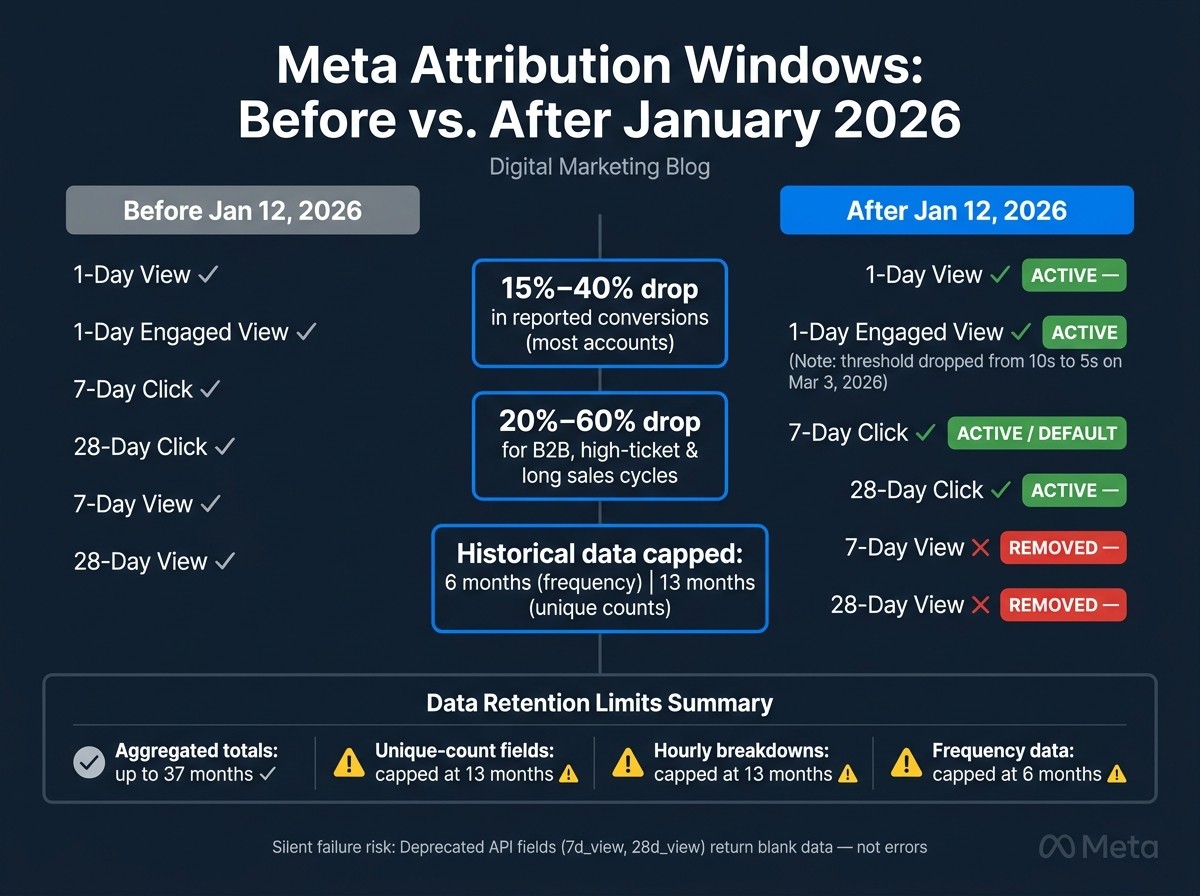
Meta Attribution Windows: Before vs. After January 2026
Meta’s New Attribution Update Explained: What Every Advertiser Needs to Know

What Meta Data Retention Limits Actually Cover
Meta puts tighter limits on detailed data than on rolled-up reporting. In Ads Manager and the Ads Insights API, aggregated totals stay available for up to 37 months. But when you dig into detailed historical queries in the Ads Insights API, the rules get stricter: unique-count fields stop at 13 months, hourly breakdowns also stop at 13 months, and frequency data is limited to 6 months. For advertisers, that means less historical context for optimization, attribution, and reporting.
Attribution windows are a separate issue, but they connect directly to this same problem. Meta removed the 7-day and 28-day view-through windows on January 12, 2026. What’s left is 1-day view, 1-day engaged view for video, and 1-, 7-, or 28-day click. Shorter attribution windows also give Advantage+ less conversion history to work with, which can weaken optimization.
There’s also a quiet failure point here. If an API call still asks for 7d_view or 28d_view, it now returns blank data. That can break dashboards without setting off any alarms, and tools like Looker Studio or Supermetrics may just show empty fields with no error message. That’s the kind of issue that slips by until someone asks why last quarter’s numbers suddenly vanished. To prevent this, many advertisers export Meta data to BigQuery to maintain a permanent historical record.
Regulatory and Platform Drivers
A lot of this comes back to privacy pressure. Laws like GDPR and CCPA push platforms to limit how long they keep user-level data. Apple’s ATT and iOS 17/18 Link Tracking Protection add another layer by stripping fbclid parameters from URLs. That removes a key deterministic signal and pushes more attribution toward modeled estimates.
Meta’s API caps also serve a platform goal. By limiting detailed historical queries, Meta can reduce mismatches between the API and Ads Manager. In plain English: fewer long-range, detailed pulls means fewer chances for the numbers to drift apart.
Meta Policy Changes Advertisers Should Watch
On March 3, 2026, Meta tightened click attribution and lowered the video engaged-view threshold from 10 seconds to 5 seconds.
Here’s how each attribution window affects measurement today:
Window Type | Status | Notes |
|---|---|---|
1-Day View | Active | Conversion within 24 hours of an impression |
7-Day Click | Active (Default) | Conversion within 7 days of a click |
28-Day Click | Active | Available for reporting, not optimization |
1-Day Engaged View | Active | Triggered after a 5-second video view |
7-Day View | Removed | Eliminated January 12, 2026 |
28-Day View | Removed | Eliminated January 12, 2026 |
These limits hit hardest because they shrink the historical signal Meta can use to optimize delivery and assign credit for results.
What Recent Studies Show About Performance Impact
Recent studies show that the cutoff reduced reported conversions fast, mostly by shortening the attribution window. The first hit shows up in optimization signals. After that, you start to see the drop in attribution quality.
Effects on Targeting and Optimization
It also weakens the signals Meta's AI learns from. Shorter windows mean fewer attributed conversions flow back into the system. That cuts conversion signal volume and weakens Lookalike and Advantage+ audience quality. When there are fewer signals to optimize against, delivery can wobble for 1–2 weeks during recalibration.
Retargeting took a hit too. Without 7-day and 28-day view-through windows, advertisers can’t pick up users who saw an ad and converted days later without clicking. That’s a big miss for brands with longer consideration cycles.
The clearest way to see the change is by looking at each window type.
Window | Recency/Intent | Signal Quality | Performance Impact |
|---|---|---|---|
1-Day View | Highest | Moderate | Only remaining view-through signal; undercounts long-cycle sales |
7-Day Click | High | Very High | New default; stable for direct response |
28-Day Click | Moderate | Moderate | Available for reporting only; useful for longer-cycle analysis |
7-Day View | Medium | Medium | Removed Jan. 12, 2026; returns empty data |
28-Day View | Lower | Lower | Removed Jan. 12, 2026; biggest reporting gap for B2B and luxury brands |
Longer windows gave advertisers a broader view of the customer journey, but they also increased the chance of giving too much credit to a conversion. Shorter windows give cleaner intent data. The tradeoff is simple: trend lines look tighter, and some sales that used to appear in reports now disappear from view.
Short-Term Disruption vs. Long-Term Adjustment
Not every business felt this the same way. B2B brands, high-ticket e-commerce, and awareness campaigns - where longer sales cycles or view-based credit matter most - reported losing 20% to 60% of attributed conversions under the new windows. Impulse-buy categories like fashion saw much less disruption.
That gap helps explain why many advertisers are moving toward server-side tracking through the Conversions API (CAPI). The goal is to recover conversions Meta no longer picks up well on-platform.
The next issue is reporting: shorter windows also skew attribution and dashboard workflows.
How Retention Limits Change Reporting and Attribution
If optimization signal loss is the first problem, reporting loss is the second. The same cutoff also disrupts reporting workflows. And for many advertisers, Ads Manager no longer shows the full conversion story.
What Breaks in Reporting Workflows
The biggest issue is the silent failure. Deprecated window queries return empty or null data instead of errors, so dashboards can look fine while quietly showing incomplete data.
There’s another problem too: Meta’s retention limits put hard caps on historical data. That makes year-over-year unique-user and frequency analysis impossible past the cutoff. For agencies planning Q4 or e-commerce brands checking holiday results against prior periods, that’s a serious blind spot.
A smart move is to export and archive unique-count and frequency data before it disappears. Teams can save those snapshots in warehouses like BigQuery or Snowflake. But there’s a catch: connector tools such as Supermetrics still inherit the same API limits at the source, so a direct pipeline is the safer bet.
Measurement Methods That Hold Up Better
No single method fully replaces what’s gone, but some methods hold up better under the new limits.
Measurement Method | Data Availability Needed | Impact of Meta Retention Limits | Main Bias/Limitation |
|---|---|---|---|
Platform Attribution | Real-time API / Pixel signals | High; 7d/28d view windows removed; historical data capped at 6–13 months | Can overstate impact and miss delayed conversions |
Exported Warehouse Data | Daily API snapshots | Low; if captured before expiration | Requires technical setup and maintenance |
Lift / Incrementality Testing | Geo-holdout / Audience split | None; measures causal lift | Expensive; requires pausing spend in test regions |
Marketing Mix Modeling (MMM) | Multi-year historical spend/revenue | Moderate; API access now restricted to asynchronous jobs | Correlation-based; needs high data volume |
One of the clearest ways to sanity-check platform numbers is to pair platform attribution with a health ratio. That means dividing Meta-reported conversions by CRM or GA4 conversions. After January 2026, a healthy ratio will usually land between 0.9x and 1.4x. If it falls outside that band, something in the measurement stack likely needs a closer look.
That’s why many advertisers are shifting toward archived data, CAPI, and lift testing instead of relying on platform reporting alone.
How Advertisers Are Responding and What Works
Account and Workflow Changes That Reduce Risk
When retention windows get shorter, the job changes. It stops being only about measurement and starts being about day-to-day operating habits. The goal is simple: depend less on Meta data wherever you can.
First-party data is the starting point. Use CAPI with enriched first-party identifiers to win back some of the signal lost with pixel-only tracking.
Audience strategy has to change too. Since 7-day and 28-day view windows are gone, it makes sense to build recency-based segments around 1-day view and 7-day click. Customer lists also need regular refreshes so those segments stay accurate as older data drops out of the platform.
Old ROAS and CPA benchmarks don’t mean what they used to. A better way to guide budget moves is to look at 4-week rolling trends. It also helps to reset ROAS and CPA baselines with a 90-day pre/post comparison. And if you want a cleaner read over time, export data to BigQuery or Snowflake as it’s generated.
Where AI Automation Fits
Shorter data windows mean there’s less room to wait. That’s where automation comes in. As signals expire faster and audiences age out sooner, manual workflows that only run during business hours can fall behind.
Tools like AdAmigo.ai fit this setup well. They watch accounts around the clock, adjust budgets, and test creatives so teams can react when performance shifts, not hours or days later.
Key Takeaways for Meta Advertisers
The practical move is to rely less on Meta’s aging data. Retention limits reduce signal, tighten attribution windows, and make first-party data and faster workflows more important.
Under shorter windows, three habits hold up best:
CAPI
External measurement
Recency-based audience management
Those are now the default ways to operate when data expires sooner. Teams that automate monitoring and work off shorter data horizons can adjust faster.
FAQs
Why did my Meta conversions suddenly drop?
Your reported conversions likely dropped because Meta removed the 7-day and 28-day view-through attribution windows from Ads Insights API and Ads Manager on January 12, 2026.
This is a measurement change, not necessarily weaker ad performance. Put simply, some conversions that used to show up in your reports may no longer be counted under the new 1-day view or 7-day click windows.
That can hit a few setups harder than others, especially:
Long sales cycles
Awareness campaigns
Video-heavy strategies
If people often see an ad, think about it for a while, and convert later, the old view-through windows used to give that ad more credit. Now, a chunk of that credit may disappear from reporting even if the campaign is still doing the same job.
Which Meta attribution windows still work?
As of June 23, 2026, Meta no longer supports the 7-day and 28-day view-through attribution windows.
The available attribution windows are:
1-day view
1-day click
7-day click
28-day click(reporting only)
1-day engaged view
If you use the API, update action_attribution_windows. Requests that still include the removed view windows will return empty datasets.
How should I measure Meta ads now?
Use 7-day click and 1-day view as your reporting standard. Then update your API integrations and dashboards to match.
For better accuracy, pair the pixel with Conversions API. Export Meta data for long-term trend analysis, and compare Meta-reported conversions with your CRM or internal sales data before you change budgets. That extra check helps you confirm the trend instead of reacting to a reporting swing.
AdAmigo.ai can help automate optimization as these reporting metrics change.