
Meta Alcohol Ads 2025: Age Targeting & Compliance Guide
Navigate Meta's 2025 alcohol ad rules with confidence: country-by-country age requirements, creative guidelines, and a compliance checklist to stay approved.
Meta's new 2025 alcohol ad policies bring stricter rules for advertisers. Here's what you need to know:
Mandatory age gating: Ads must include 21+ age verification on all components.
Influencer Rules: Featured influencers must be at least 25 years old.
Geofencing: Automated systems block ads in restricted regions (e.g., UAE, certain Indian states).
Content Restrictions: Ads can't show excessive drinking, health claims, or youthful styles. AI-generated content must be labeled as "Synthetic" to maintain AI transparency.
Transparency: Alcohol ads now appear in a dedicated Ad Library, showing spending, targeting, and creative details.
Violations may lead to account restrictions, reduced reach, or higher costs. Understanding how to avoid Meta ad rejections is critical for maintaining account health under these new rules. To comply, focus on storytelling around heritage and lifestyle while avoiding depictions of consumption or intoxication. AI tools for Meta ads can help streamline compliance by pre-screening ads and automating updates.
Can You Advertise Alcohol or CBD on Meta?
What Changed in Meta's Alcohol Advertising Policies for 2025
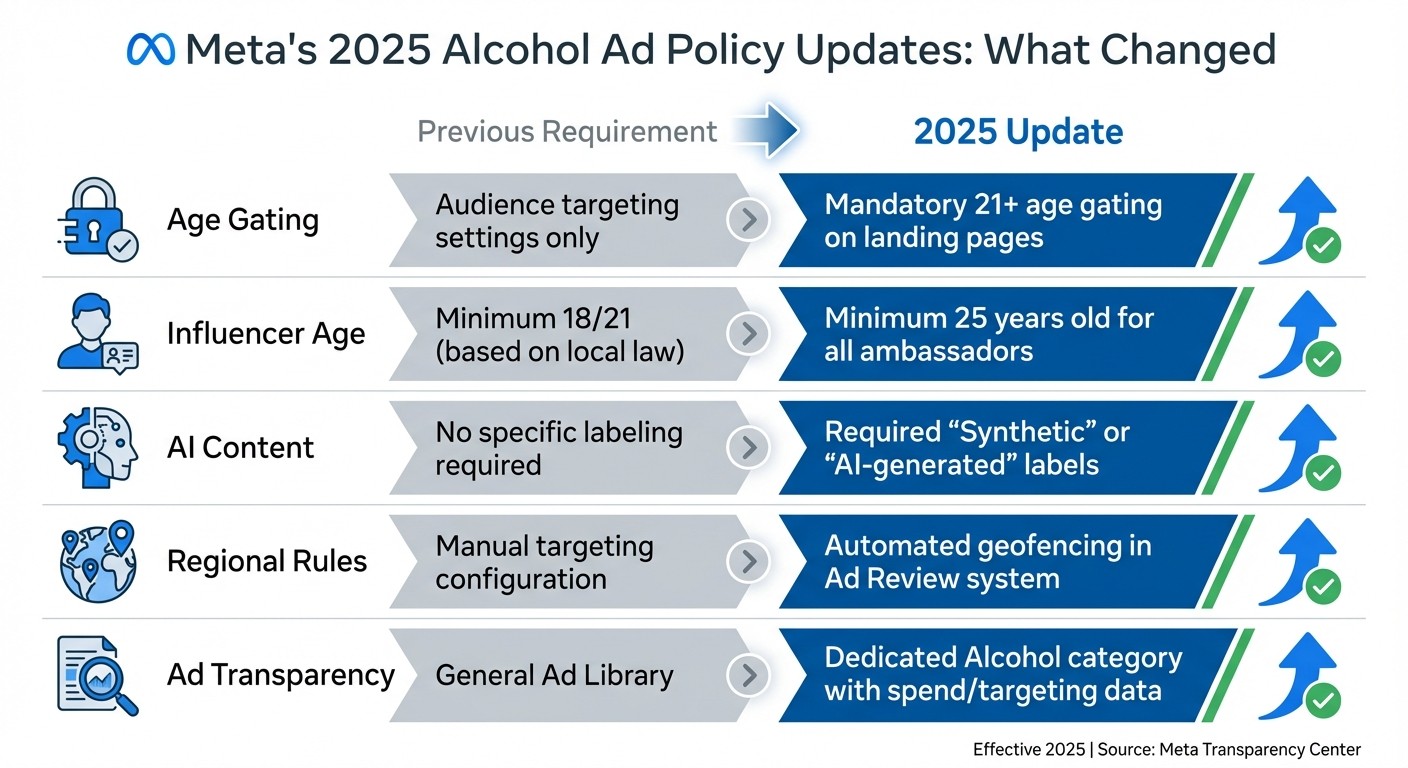
Meta's 2025 Alcohol Ad Policy Changes: Before vs After Comparison
Meta has introduced updated rules for alcohol advertising in 2025, focusing on stricter age verification, enhanced regional targeting and geographic expansion, and refined content guidelines. These changes aim to ensure compliance with global regulations and maintain transparency. Below, we’ll break down the key updates, including age restrictions, creative standards, and Meta's improved ad review process.
New Age Restrictions and Targeting Requirements
Meta’s new policies go beyond simply setting age limits in audience targeting. Now, all alcohol ad landing pages and placements - such as Reels and Stories - must include a clear 21+ age verification step. Additionally, influencers and brand ambassadors featured in alcohol advertisements must be at least 25 years old.
Age requirements differ significantly across regions. For example:
In the U.S., alcohol ads must target users 21 or older.
Some regions, like Sweden and certain Indian states (Delhi, Maharashtra, Punjab), set the minimum age at 25.
Countries such as Japan, Iceland, and Paraguay enforce a 20+ minimum, while Canada, Korea, and Nicaragua require targeting users aged 19 or older.
Meta’s automated systems help advertisers meet these varied requirements, but campaigns still need to be carefully configured to avoid rejection.
Content and Creative Requirements
Meta has also tightened its creative guidelines for alcohol ads. Depictions of excessive drinking are now prohibited, as are claims suggesting health benefits, relaxation, or confidence boosts. Instead, advertisers are encouraged to highlight aspects like product heritage, craftsmanship, or social moments - without showing actual consumption.
AI-generated content is allowed, but it must be clearly labeled as such. For instance, if an ad includes an AI-generated photorealistic human, the label "Synthetic" must appear prominently next to the "Sponsored" tag, rather than being hidden in menus. Pedro Pavón, Meta’s Director of Monetization Policy, stated:
"We recognize that the transparency expectations around generative AI are rapidly evolving, and we are committed to providing clear information about how our generative AI tools contribute to the ads people see on our services".
Advertisers should also steer clear of "youthful aesthetics" in their ads. This includes avoiding slang, memes, or visual styles that might inadvertently appeal to underage users.
How Meta Reviews and Monitors Alcohol Ads
Meta’s ad review process now combines automated tools with human oversight, involving a global team of over 15,000 reviewers. Most ads are reviewed within 24 hours, but even approved ads can be re-reviewed at any time after going live.
To promote transparency, Meta has introduced a dedicated Alcohol category in its Ad Library. This feature provides public access to alcohol campaign details, including creative previews, regional spending data, and targeting parameters. These records are kept for seven years, ensuring accountability for both regulators and competitors. Additionally, users can flag potentially non-compliant ads through the "Why am I seeing this ad?" feature, which triggers manual reviews.
Policy Area | Previous Requirement | 2025 Update |
|---|---|---|
Age Gating | Audience targeting settings | Mandatory 21+ age gating on landing pages |
Influencer Age | Minimum 18/21 (local law) | Minimum 25 years old for all ambassadors |
AI Content | No specific labeling | Required "Synthetic" or "AI-generated" labels |
Regional Rules | Manual targeting | Automated geofencing in Ad Review system |
Ad Transparency | General Ad Library | Alcohol category with spend/targeting data |
How to Create Alcohol Ads That Meet Meta's Requirements
To run successful alcohol ad campaigns on Meta, you need to balance creativity with strict compliance. Here's a closer look at ad formats and AI tools that can help you stay within the rules while achieving your marketing goals.
Ad Formats and Messaging That Stay Within Guidelines
When crafting your ads, focus on showcasing your brand's story, craftsmanship, and lifestyle appeal - without directly showing alcohol consumption. For instance, a craft brewery could highlight its brewing process, share the founder's journey, or feature an outdoor gathering where unopened bottles are part of the scene.
Video ads and carousel formats work well to present your brand's history and atmosphere, often starting with high-converting UGC scripts. However, avoid any imagery or messaging that suggests intoxication, makes health or relaxation claims, or uses youthful slang or memes. Phrases like "unwind after work" or "boost your confidence" are off-limits. Instead, emphasize details like flavor profiles, awards, or ties to traditions. Use influencers who are at least 25 years old and ensure all partnerships are clearly disclosed.
Leveraging AI Tools for Compliant Ad Creatives
AI tools can simplify the process of creating ads that meet Meta’s policies while optimizing performance and scaling. For example, AdAmigo.ai uses its AI Ads Agent to analyze your brand identity and automatically generate image and video ads. These ads focus on lifestyle moments and craftsmanship, steering clear of depictions of consumption. The tool studies your top-performing creatives and competitor campaigns, then delivers ready-to-launch ads directly to your Meta account with just one click.
Meta now requires clear labeling for AI-generated content. If your ad includes photorealistic people or heavily edited visuals, it must carry a "Synthetic" label next to the "Sponsored" tag. AdAmigo.ai takes care of this labeling automatically and ensures visuals and messaging avoid youthful styles before launching.
Additionally, AdAmigo.ai includes geofencing capabilities to ensure your campaigns comply with local regulations. Its AI Chat Agent can answer questions like "Why was this ad rejected?" and allows you to launch multiple region-specific variations using a single spreadsheet - saving you significant time and effort.
Compliance Checklist for Alcohol Advertisers
Before launching your alcohol-related ads on Meta, it's essential to ensure every aspect complies with their strict guidelines for 2025. Here's what to double-check.
What to Check Before Launching Your Ads
To avoid ad rejections or account penalties, follow compliance monitoring best practices and review these critical points:
Age Targeting Is Key
Set the correct minimum age for your audience: 21+ in the U.S., 25+ in regions like Sweden or specific Indian states (Delhi, Maharashtra), 19+ in Canada, and 18+ in most European countries and Australia. Always confirm your targeting aligns with local laws for each location.
Eliminate Youth Appeal in Creative Content
Examine all visuals, video clips, and text to ensure they don't include youthful elements like slang, memes, or imagery that might attract underage audiences. Influencers and brand ambassadors should be at least 25 years old. Avoid showing alcohol consumption, intoxication, or making claims about health benefits, relaxation, or confidence boosts.
Landing Page Compliance Matters
Meta reviews not just your ad but also its destination. Your landing page must include age verification and any required warnings. If you're running influencer collaborations, use Meta's Branded Content Tool to tag partnerships and include proper disclosures.
Check Geofencing and Restricted Regions
Meta automatically blocks ads in countries where alcohol advertising is banned, such as Russia, Turkey, the UAE, Saudi Arabia, and Afghanistan. Certain Indian states, including Bihar and Gujarat, also prohibit alcohol ads. Make sure your targeting excludes these regions.
Keep these steps in mind to ensure your ads remain compliant and ready for launch.
Staying Updated on Policy Changes
Meta's advertising policies can change without much notice, so staying informed is crucial. Here's how to keep up with updates:
Check the Official Policy Change Log
Visit Meta's Transparency Center and navigate to the Alcohol policy page's "Change Log" section. This log lists recent updates with their effective dates. Bookmark the page and set a monthly reminder - checking on the first Monday of each month works well.
Leverage the Account Quality Tool
Within Ads Manager, the Account Quality Tool provides real-time updates for your ad accounts, Pages, and user profiles. If your ad violates a policy, you'll often see the alert here before your ads are paused. Understanding how to recover disabled ad accounts is vital if these alerts lead to a shutdown. You can also use this tool to request a manual review if you believe a rejection was made in error.
Explore the Meta Ad Library's Alcohol Section
Meta has a dedicated section in its Ad Library for alcohol campaigns. This area showcases ad previews, targeting details, and regional spending data. Regularly reviewing this section can help you identify trends and adjust your strategy to remain compliant.
Meta's team of over 15,000 reviewers can reassess and reject ads even weeks after they've gone live. Using third-party tools for Meta ad compliance to keep your creative assets organized and ready for quick updates will help you maintain a smooth advertising process, even if policy adjustments arise.
Manual vs. AI-Driven Compliance: A Comparison
Let’s take a closer look at how manual processes stack up against AI-driven solutions vs. manual compliance for alcohol ads on platforms like Meta. With strict age limits, creative guidelines, geofencing rules, and ever-changing policies, the big question is: should you compare manual vs. AI-driven methods for your campaigns?
The Manual Approach
Handling compliance manually means juggling a lot of moving parts. You’re constantly monitoring dashboards, researching regional laws, and verifying ads for data privacy before they go live. It’s a reactive process - submit your ad, then wait up to 24 hours for approval. If you’re running campaigns across multiple regions, there’s even more to manage: adjusting targeting for different jurisdictions, setting guardrails for Meta ads to ensure age restrictions are met, and keeping up with local rules. And let’s face it, even a tiny mistake can result in disapproved ads or compliance issues.
The AI Advantage
AI-driven tools flip the script by taking a proactive stance. Instead of waiting for Meta’s review process, AI solutions scan your ads before submission. They check for prohibited language, flag visuals that might appeal to younger audiences, use creative testing benchmarks to ensure performance, use a target audience finder to refine reach, and automatically apply required AI content labels. Tools like AdAmigo.ai can even create compliant ad copy, adjust targeting based on up-to-date geofencing protocols, and ensure your campaigns align with Meta’s evolving standards. All of this happens while you focus on the bigger picture - strategy and growth.
Manual Compliance vs. AI Tools: Feature Comparison
Feature | Manual Compliance Methods | AI-Driven Solutions (e.g., AdAmigo.ai) |
|---|---|---|
Review Timing | Reactive (Post-submission) | Proactive (Pre-submission) |
Time Required | Hours per week; daily dashboard monitoring | Less than 5 minutes weekly |
Accuracy | Human errors likely, especially with regional laws | Automated scanning ensures alignment with latest policies |
Scalability | Limited by available hours; one buyer handles fewer clients | High; one buyer can manage 4–8× more clients |
Content Creation | Manually drafted and checked for compliance | AI-generated compliant creatives and copy |
Policy Updates | Requires ongoing manual research | Automatically updated to reflect Meta’s 2025 standards |
The standout benefit here is scalability. Manual processes limit how many campaigns a person can handle effectively. On the other hand, AI tools allow teams to manage significantly more clients - up to 4–8× more - while maintaining precision. For brands navigating the stricter rules coming in 2025, automation isn’t just helpful; it’s essential.
This comparison makes it clear: in today’s fast-paced advertising landscape, AI-driven compliance tools aren’t just a nice-to-have - they’re a game-changer. They empower teams to stay ahead of evolving standards while freeing up time for creative and strategic efforts. The shift toward proactive, tech-enabled compliance is reshaping how brands approach ad management.
Conclusion
Meta's 2025 updates for alcohol advertising represent a major step toward more ethical and transparent marketing practices. The new guidelines include mandatory 21+ age verification, a 25+ age requirement for influencers, bans on portraying intoxication or making health claims, and clear labeling for AI-generated content. These changes emphasize storytelling around heritage and craftsmanship rather than risky or misleading narratives. Additionally, geofencing now restricts ads in regions like India, UAE, and Indonesia, making compliance a visible and essential part of the process.
Meeting these standards manually can be a daunting task. It requires thorough checks on influencer ages, adherence to regional regulations and data retention governance, proper age-gating on landing pages, and constant monitoring and Meta ad account analysis through Meta ad policy training. Meanwhile, Meta's team of over 15,000 reviewers ensures advertisers stay within the lines, with even minor mistakes potentially leading to ad disapprovals or account restrictions.
For brands looking to ease this burden, AI-driven tools provide a practical solution. For instance, platforms like AdAmigo.ai can pre-screen ad creatives with a Meta ad policy checker, flag prohibited content, verify age-appropriate visuals, and automatically apply AI content labels. Pedro Pavón, Meta's Director of Monetization Policy, explained:
"If an advertiser is using our in-house generative AI creative features and these tools result in a significant edit to the image or video, we will apply an AI label".
These tools not only simplify compliance but also allow advertisers to scale their operations. With AI, a single media buyer can efficiently manage multiple clients, dedicating as little as five minutes per week to compliance checks. This frees up valuable time for developing creative strategies.
Whether you rely on manual processes or advanced AI tools, staying proactive is essential for running successful campaigns under Meta's new rules. Regularly audit influencers, label synthetic media, tailor content to regional laws, and keep up with policy updates. Combining efficient compliance measures with strategic creativity ensures brands can thrive in this evolving landscape.
FAQs
What steps should advertisers take to comply with Meta's 2025 alcohol ad age verification rules?
Meta has introduced a new policy for 2025 that mandates strict age verification measures for all alcohol advertisements. Advertisers targeting U.S. audiences must set the minimum age to 21, while most other countries require a minimum age of 18. Beyond that, advertisers are required to implement an age-verification gate on landing pages, ensuring only users of legal drinking age can access the content.
Here’s how to ensure compliance:
Set proper age restrictions: For U.S. audiences, target users aged 21 and older. For other countries, adjust the minimum age to 18 as required.
Implement age-verification gates: Add a gate on landing pages that checks a user’s age before displaying alcohol-related content.
Focus on adult-oriented advertising: Avoid using youthful visuals, slang, or messages that could appeal to younger audiences.
It's also essential to review local regulations for each market to ensure campaigns meet regional legal requirements. Tools like AdAmigo.ai can streamline this process by automating compliance checks, identifying potential issues, and helping fine-tune ad creatives for an adult audience - all while adhering to Meta's guidelines.
What happens if alcohol ads violate Meta's updated policies?
If an alcohol ad doesn't meet Meta's updated guidelines, it risks being rejected. Beyond that, advertisers could face severe penalties, such as account restrictions, temporary suspensions, or even permanent bans from the platform.
To steer clear of these issues, make sure all alcohol-related ads align with Meta's rules. This includes adhering to both targeting restrictions and content standards.
How can AI tools help advertisers comply with Meta's updated alcohol ad policies in 2025?
AI tools make navigating Meta's 2025 alcohol ad policies much easier by automating crucial steps and reducing the chances of mistakes. These tools can review ad copy, visuals, and videos to ensure they align with Meta’s guidelines - like steering clear of restricted content, targeting audiences aged 18 and up, and adhering to specific age restrictions in different countries.
When it comes to ads featuring AI-generated content, these tools can automatically include required labels such as "synthetic" and embed metadata to comply with Meta’s transparency standards. On top of that, AI can track local laws, fine-tune targeting settings, and flag or even update ads that don’t meet compliance standards. This means advertisers can spend less time on manual checks and more time focusing on their overall strategy.