
Meta Ads Data Security: Key Encryption Standards
Encryption plus account-level anomaly monitoring protects ad accounts from breaches and unauthorized changes.
Meta ensures ad account security by combining strong encryption standards with advanced monitoring tools. Here's the breakdown:
Encryption at Rest: Meta uses AES-GCM-SIV, a secure algorithm, and the FBCrypto library to protect stored data.
Encryption in Transit: Data transfers are encrypted using TLS 1.2+ and X25519 key exchanges, with 0.05% of CPU cycles dedicated to these operations.
Post-Quantum Readiness: Meta is preparing for encryption methods resistant to quantum computing threats.
AdAmigo Protect: This tool complements Meta’s encryption by monitoring account activity for anomalies like budget changes or delivery issues, integrating securely via Meta’s API.
Quick Tip: Combine Meta’s encryption with tools like AdAmigo Protect for a layered security approach. Enable two-factor authentication and review user permissions regularly for added safety.
1. Meta Ads Encryption Standards

Encryption at Rest
Meta protects its stored data using the FBCrypto library, a centralized cryptographic system implemented across its core infrastructure. This setup ensures that all services, including the Ads platform, follow the same security protocols.
For encryption, Meta relies on AES-GCM-SIV, a highly secure algorithm designed to safeguard data stored in databases or vaults. To enhance security and scalability, Meta employs a key derivation function (KDF) that generates millions of unique "child" keys from a smaller set of "parent" keys.
Encryption in Transit
When data moves between systems - like when tracking real-time conversion events or retrieving campaign reports - or connecting to third-party tools - Meta uses TLS 1.2 or higher to encrypt connections. This ensures that sensitive details, such as email addresses, phone numbers, and purchase data, stay secure during transmission.
Meta dedicates 0.05% of CPU cycles to X25519 key exchange operations, which are crucial for establishing secure connections. While this percentage might appear minor, it represents a significant computational effort across Meta's vast infrastructure.
Effectiveness in Ad Account Security
Meta's encryption practices provide a strong base for securing ad accounts. By combining at-rest and in-transit encryption, the company ensures data confidentiality and prevents unauthorized access to stored credentials. Beyond encryption, Meta employs a large-scale cryptographic monitoring system to identify weak algorithms and rotate keys before they hit their protection limits.
Looking ahead, Meta is preparing for post-quantum cryptography (PQC). This involves transitioning to encryption methods that can resist potential threats posed by quantum computing, ensuring long-term security for asymmetric encryption use cases.
2. AdAmigo Protect

Compliance with Meta API Guidelines
AdAmigo Protect operates using Meta's official API, which means it benefits from the same encryption protocols Meta employs. All data transmissions align with Meta's encrypted systems, ensuring a secure flow of information across the platform.
By leveraging Meta's encryption framework, AdAmigo Protect introduces an added layer of proactive security monitoring. It strictly adheres to Meta's API guidelines, respecting platform permissions, rate limits, and compliance measures. Instead of storing Meta login credentials, the system uses revocable OAuth tokens, ensuring a safer and more secure integration.
Effectiveness in Ad Account Security
AdAmigo Protect enhances Meta's encryption by actively monitoring for potential security threats. It keeps a constant eye on account activity, detecting unusual patterns such as unexpected budget increases, delivery issues, or performance irregularities - any of which could indicate unauthorized access or configuration problems.
Here’s a quick comparison of manual ad management versus the automated approach provided by AdAmigo.ai:
Feature | Manual Meta Ads Management | API-Driven Automation (AdAmigo.ai) |
|---|---|---|
Monitoring | Requires manual setup and tracking | Automates campaign creation, optimization, and reporting |
Scalability | Limited by human capacity | Manages multiple campaigns/accounts at scale |
Execution | Susceptible to human error | Delivers consistent, AI-powered execution |
Responsiveness | Slow to adapt to performance changes | Makes real-time adjustments using data insights |
Strengths and Limitations
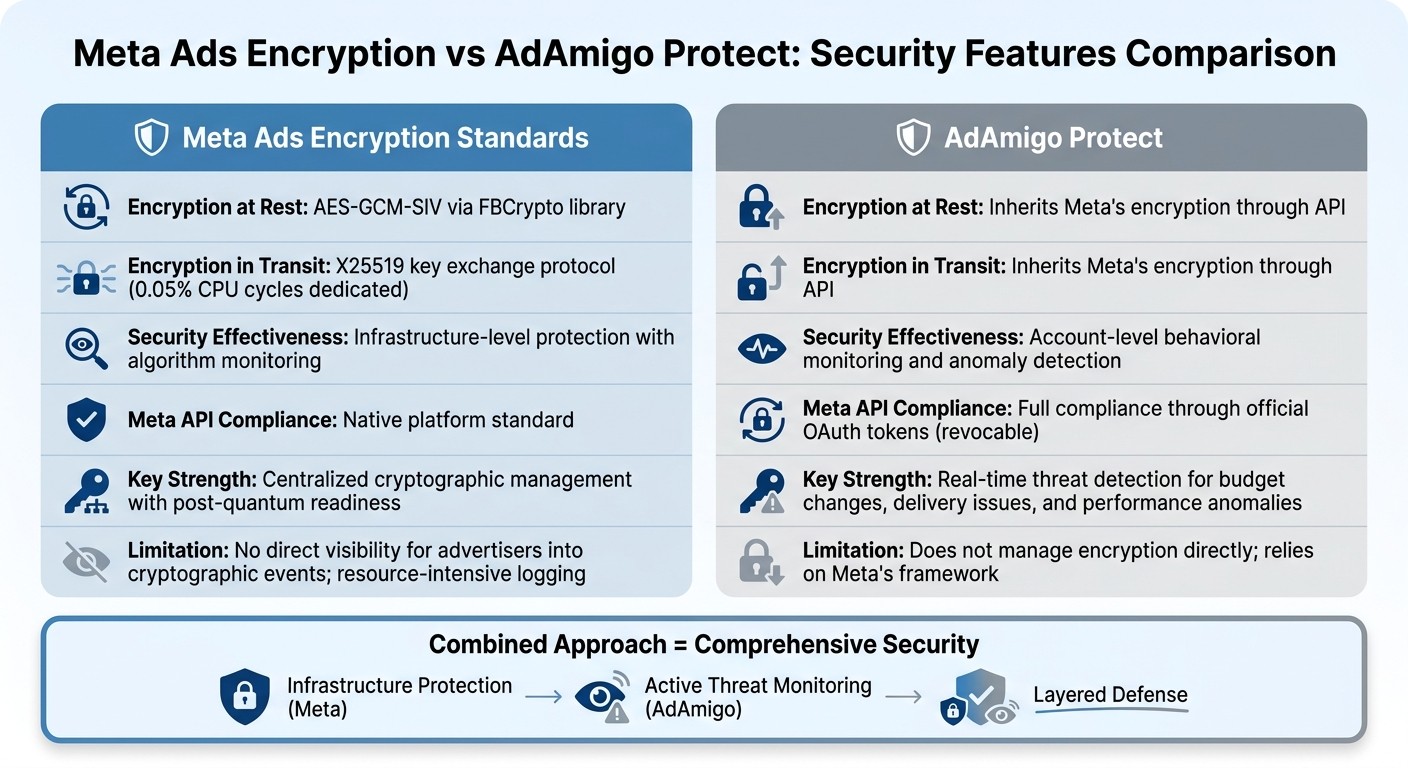
Meta Ads Encryption vs AdAmigo Protect Security Features Comparison
This section takes a closer look at the encryption practices mentioned earlier and evaluates their strengths. It also highlights how AdAmigo Protect's behavioral monitoring complements Meta's encryption efforts to create a well-rounded security framework.
Meta's encryption system offers solid protection through centralized cryptographic management and constant algorithm oversight. However, advertisers face a challenge: they don’t have direct visibility into cryptographic events or key rotations tied to their accounts. Another downside is the system's heavy reliance on resources. Its logging process, while thorough, requires significant compute power and storage, relying on buffering and flushing methods to handle the data load efficiently.
AdAmigo Protect takes a different yet complementary route. Instead of managing encryption itself, it integrates seamlessly with Meta's security framework via the official API, utilizing revocable OAuth tokens. Its standout feature is its ability to detect threats in real time and respond automatically. This tool can flag unusual activity, such as unexpected budget changes, delivery disruptions, or performance anomalies - issues that Meta's encryption alone doesn’t address at the individual advertiser level.
By combining Meta’s encryption strengths with AdAmigo Protect's proactive monitoring, advertisers gain a more comprehensive defense against security threats.
Feature | Meta Ads Encryption Standards | AdAmigo Protect |
|---|---|---|
Encryption at Rest | AES-GCM-SIV via FBCrypto library | Inherits Meta's encryption through API |
Encryption in Transit | X25519 key exchange protocol | Inherits Meta's encryption through API |
Security Effectiveness | Infrastructure-level protection with algorithm monitoring | Account-level behavioral monitoring and anomaly detection |
Meta API Compliance | Native platform standard | Full compliance through official OAuth tokens |
Conclusion
Meta's encryption infrastructure and AdAmigo Protect work together to create a robust defense system for ad account security. Meta secures the backbone of data protection by encrypting stored data with AES-GCM-SIV and safeguarding data in transit using X25519 key exchange protocols. This ensures your data remains encrypted both on Meta's servers and as it moves across networks, offering a strong foundation for security.
On the other hand, AdAmigo Protect takes a more hands-on approach by addressing active risks at the account level. It keeps an eye on potential threats like unauthorized changes to ad creatives, unexpected budget increases, and unusual login activities - issues that encryption alone can't prevent. By leveraging Meta's official API, AdAmigo Protect adds behavioral monitoring while maintaining the highest encryption standards.
Advertisers can strengthen their defenses by combining Meta's encryption capabilities with AdAmigo Protect's real-time monitoring. To further secure accounts, it's smart to enable two-factor authentication (using authenticator apps or physical keys), conduct quarterly reviews of user permissions and admin roles, and set up automated budget safeguards.
This layered approach ensures no gaps are left unaddressed. Meta's cryptographic safeguards focus on long-term security, including readiness for post-quantum threats, while AdAmigo Protect handles immediate risks like MFA fatigue and credential theft. Together, they form a complementary security framework.
For agencies managing multiple client accounts, this system simplifies security management. AdAmigo Protect's API integrations eliminate the need to share sensitive login details, aligning perfectly with Meta's encryption infrastructure to provide a seamless and secure experience.
FAQs
Does Meta encrypt my ad data end-to-end?
Meta encrypts user data when it's stored, ensuring protection at rest. However, it's not entirely clear whether advertising data benefits from end-to-end encryption. The available information does not provide a definitive answer on this matter.
What can’t encryption prevent in my ad account?
Encryption is a powerful tool for protecting data, but it doesn't cover everything. It won't stop unauthorized access caused by issues like compromised accounts, weak passwords, or stolen API keys. It also can't guard against mistakes made by users or actions taken by malicious insiders. While encryption does a great job securing data when it's being transmitted or stored, keeping your account safe requires more. Strong passwords, consistent monitoring, and strict access controls are essential to truly safeguard your information.
How does AdAmigo Protect access my account safely?
AdAmigo Protect keeps a close eye on your account, scanning for unusual activity, potential threats, and any irregularities. By identifying these issues early, it helps block unauthorized access and resolves account-related problems, ensuring your account stays secure and runs smoothly.