
How AI Tracks Audience Behavior in Real Time
Real-time AI uses Pixel and Conversions API to analyze behavior, optimize Meta ads, adjust bids, and refresh creatives.
AI systems analyze audience behavior instantly, using real-time data to optimize ad targeting, budgets, and creative elements without human intervention. Platforms like Meta and tools like AdAmigo.ai leverage signals such as clicks, purchases, and engagement patterns to adjust campaigns continuously. This approach reduces wasted ad spend, improves ROAS, and ensures ads are shown to the right people at the right time.
Key takeaways:
Real-time tracking captures data like page visits, cart actions, and engagement.
AI optimizations include adjusting bids, reallocating budgets, and refreshing creatives based on live performance.
Meta Pixel and Conversions API are essential for reliable tracking, overcoming browser and privacy limitations.
Dynamic segmentation groups users by behavior, not just demographics, ensuring precise targeting.
Automation with human oversight balances efficiency with control, safeguarding campaign quality and compliance.
Predict Behavior with Customer AI in Real-Time CDP | Adobe for Business

Real-time data processing is essential to improve ad targeting and reduce wasted spend.
Understanding Real-Time Audience Behavior on Meta

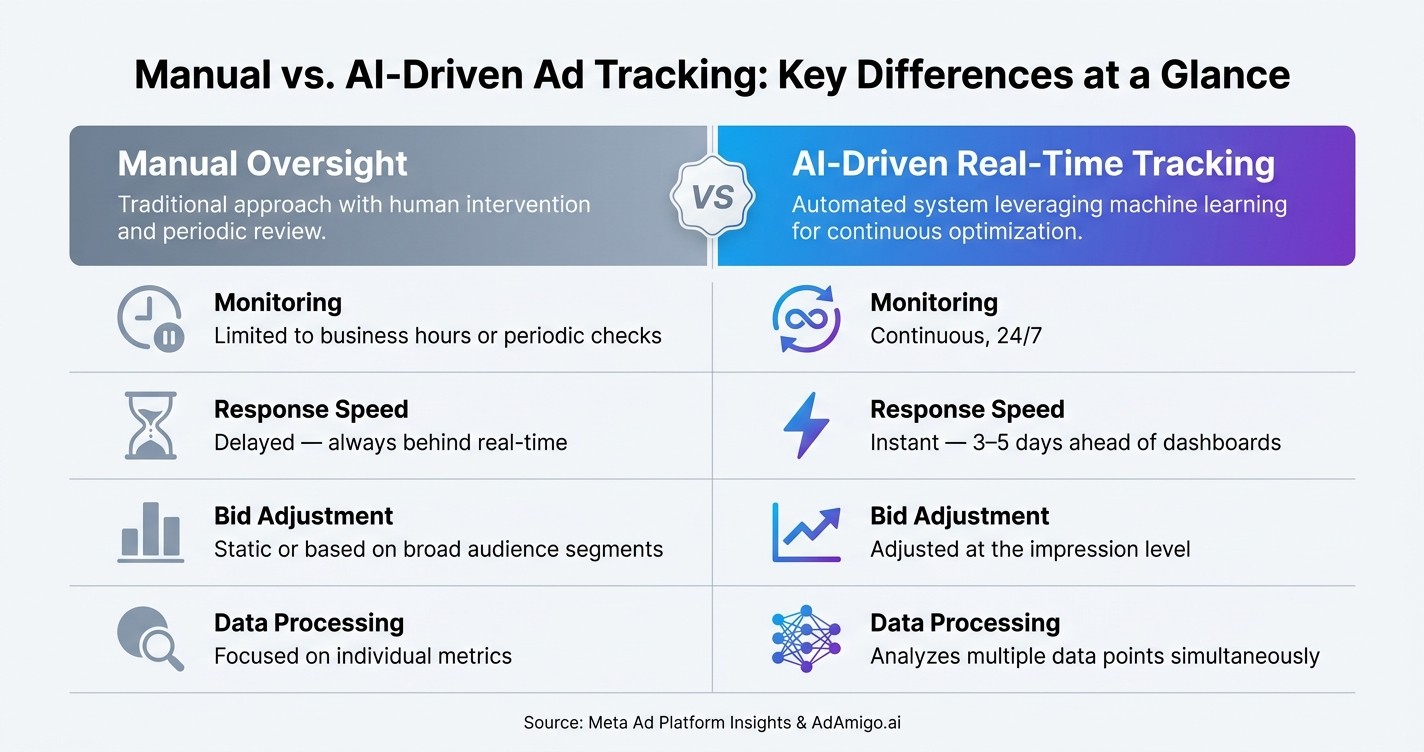
Manual vs. AI-Driven Ad Tracking: Key Differences at a Glance
Meta's ad platform processes millions of interactions every single day. Every click, scroll, or purchase generates a behavioral signal that Meta's AI can analyze and act on instantly - not hours or days later. This immediate feedback loop is what powers smarter, more effective ad campaigns. The real-time data collected feeds directly into AI systems that tweak and optimize your campaigns continuously.
What Real-Time Behavior Data Includes
When we talk about real-time behavior data on Meta, it goes far beyond basic demographics. It captures page visit sequences, engagement patterns with content, time spent on specific categories, app usage, inferred purchase history, and even cross-device activity. On the commerce side, it tracks actions like adding items to a cart, starting the checkout process, and completing purchases. It also includes engagement trends, such as how often someone interacts with content and how recently they’ve engaged.
This wealth of data helps Meta's AI paint a detailed picture of where users are in their decision-making process. By analyzing these signals, the system can take precise targeting actions, ensuring your ads are shown to the right people at the right time.
The depth and variety of these signals are what make dynamic ad adjustments possible.
Why Real-Time Behavior Tracking Matters
Relying on manual tracking means you're always a step behind - data from dashboards often lags. AI-driven tracking, on the other hand, operates around the clock, constantly monitoring metrics like ROAS (Return on Ad Spend) and CPA (Cost Per Acquisition).
"Intelligent targeting means the system identifies who to show the ad to, and at what bid, based on a predictive model of conversion probability - and that model updates continuously as new data comes in." - Larry, AdLibrary
As Larry points out, Meta's AI doesn’t just optimize at the audience or ad set level. It adjusts bids for every single impression based on the likelihood of conversion. The table below breaks down the differences:
Feature | Manual Oversight | AI-Driven Real-Time Tracking |
|---|---|---|
Monitoring | Limited to business hours or periodic checks | Continuous, 24/7 |
Response Speed | Delayed | Instant (3–5 days ahead of dashboards) |
Bid Adjustment | Static or based on broad audience segments | Adjusted at the impression level |
Data Processing | Focused on individual metrics | Analyzes multiple data points simultaneously |
This level of precision is the backbone of AI tools like AdAmigo.ai, which help streamline campaign management on Meta. To make the most of these tools, it's essential to consolidate your ad sets. Each ad set needs at least 50 conversions per week to provide the AI with enough data for accurate, real-time adjustments. Spreading your budget across too many ad sets can dilute the data, making it harder for the algorithm to perform effectively.
Setting Up Real-Time Tracking Infrastructure
To enable AI to analyze and respond effectively to audience behavior in real time, you need a reliable tracking system. This system should provide clean, consistent data collected across browsers, devices, and even offline interactions.
Installing Meta Pixel and Conversions API
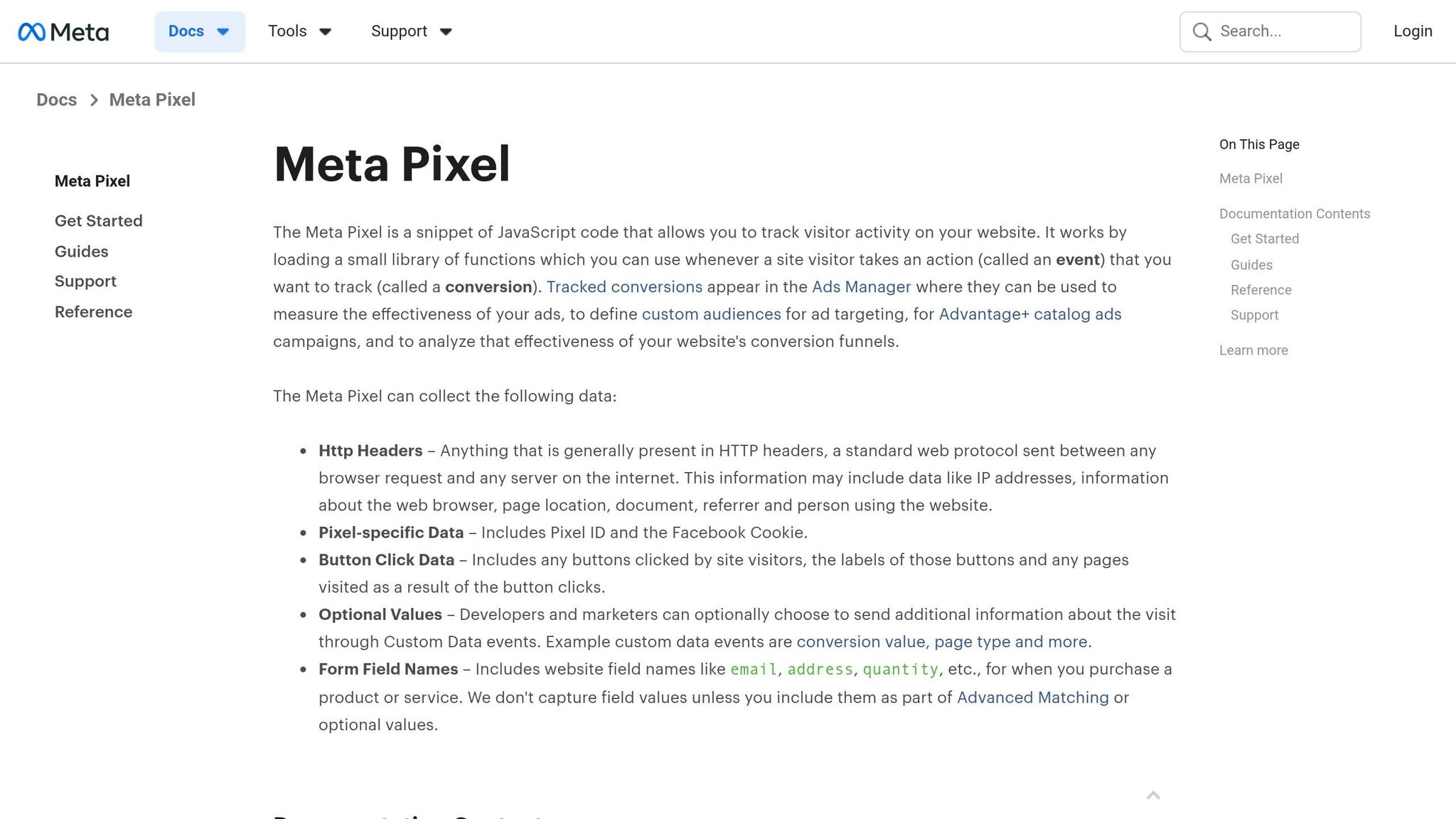
The Meta Pixel is your go-to tool for browser-side tracking. It captures user actions like visiting your site, viewing products, adding items to a cart, or completing purchases. To set it up, place the base pixel code in the <head> section of every page and use Meta's Event Setup Tool to configure standard events such as ViewContent, AddToCart, InitiateCheckout, and Purchase. This process doesn't require custom coding, making it relatively straightforward.
However, relying solely on the Pixel can be risky. Ad blockers, iOS privacy updates, and browser tracking restrictions can interfere, causing events to fail before they reach Meta. This is where the Conversions API (CAPI) steps in. CAPI works server-side, sending events directly to Meta, bypassing browser limitations. This ensures more reliable data for AI, which is crucial for quick budget adjustments or targeting decisions.
Meta suggests comparing Pixel vs. Conversions API to understand how they work together in a hybrid setup. To avoid duplicate data, both methods should share the same event_id, ensuring each event is counted only once. If you're using platforms like Shopify or WooCommerce, they offer built-in CAPI integrations, simplifying the setup process for most e-commerce teams.
Once these tools are in place, focus on standardizing your events to maintain consistent data quality.
Organizing and Standardizing Event Data
For AI to interpret data accurately, event definitions must be consistent. If the meaning of a "purchase" varies between your website, app, or server-side integrations, the resulting data could mislead AI.
For example, U.S. businesses should ensure all monetary values follow a uniform format, such as value: 129.99 and currency: "USD". Product identifiers (content_ids) must align exactly with your Meta product catalog. Custom events like DemoRequested or PlanUpgrade should also use standardized naming conventions across all teams. This consistency prevents errors that could disrupt the signals AI depends on.
After organizing your online data, incorporate offline data for a more complete picture.
Connecting Offline and First-Party Data
While online activity provides valuable insights, offline conversions - especially in longer sales cycles - are equally important. Meta's Offline Conversions feature, combined with CAPI, allows you to send offline outcomes back to Meta's platform.
To do this, sync your CRM or point-of-sale data using hashed identifiers like email addresses or phone numbers. This lets Meta connect in-platform actions, such as clicks, to real-world sales, helping the AI focus on actual revenue rather than just checkout initiations. Set up regular syncs - ideally hourly or daily - to keep the data fresh. The more up-to-date your offline data, the better AI can identify which audiences and creatives are delivering meaningful results.
How AI Analyzes and Classifies Audience Behavior
With a strong tracking system in place, AI takes the next step by transforming raw data into actionable insights for Meta ads.
Turning Raw Data into Actionable Signals
Metrics like page views, click-through rates, session lengths, and scroll depth often don’t tell the full story on their own. AI steps in to interpret these numbers, converting them into predictive insights such as likelihood of purchase, engagement probability, or churn risk. For example, consider a user who repeatedly visits a product page, spends several minutes reviewing it, but never adds it to their cart. This behavior sends a very different signal compared to a first-time visitor who quickly bounces off the page. AI uses these insights to fine-tune ad strategies, ensuring timely and targeted adjustments. These predictive signals are continually refined by AI models, driving more precise ad decisions.
AI Models Used for Behavior Analysis
AI relies on a mix of advanced models to analyze audience behavior in real time:
Classification models predict outcomes like purchase intent or churn likelihood.
Clustering algorithms group users into segments based on shared behaviors, without needing predefined categories.
Anomaly detection models identify unusual patterns, such as a sudden spike in AddToCart events without corresponding purchases, which might signal issues like technical glitches or bot activity.
These models constantly evolve, updating as new data flows in - often within minutes. This ensures a fresh and accurate understanding of audience behavior, enabling dynamic segmentation and real-time adjustments.
Dynamic Audience Segmentation
AI-driven segmentation goes beyond traditional demographics like age or location. Instead, it creates micro-segments based on user behaviors. Factors such as the sequence of pages visited, engagement patterns, time spent on specific product categories, and real-time intent signals are all taken into account. These segments aren’t static - they adapt as user behavior changes. For instance, someone initially classified as "just browsing" could shift into a "high-intent buyer" segment as their interactions deepen.
Feature | Manual Segmentation | AI-Driven Dynamic Segmentation |
|---|---|---|
Data Basis | Static demographics (e.g., age, location) | Behavioral clusters and real-time intent signals |
Granularity | Broad audience groups | Individual, impression-level targeting |
Update Speed | Periodic or manual | Real-time, with updates in minutes |
Signal Depth | Basic interest labels | Detailed patterns like page visit sequences and intent signals |
By leveraging first-party and server-side event tracking, AI ensures precise targeting even with browser-level restrictions. Tools like AdAmigo.ai further enhance this process by reallocating budgets in real time to focus on segments showing the strongest performance signals. These advanced segmentation techniques lay the groundwork for optimizing ad strategies.
"The algorithm finds the audience. You determine what's worth finding."
AdLibrary
Using Real-Time Insights to Optimize Meta Ads
Once you've captured and analyzed real-time signals, the next step is to use those insights to refine your Meta ads. By leveraging AI to classify and segment your audience in real time, you can make smarter decisions across budgets, creatives, and targeting.
Adjusting Budgets and Bids Using Live Data
AI takes the guesswork out of budget management by dynamically optimizing ad spend based on live data. Unlike manual budget tweaks, which can lag behind performance changes, AI reallocates budgets instantly. For instance, if a specific audience segment starts converting at a lower cost per acquisition (CPA), AI can shift more budget to that segment. Similarly, it can adjust bids on the fly to capitalize on high-performing placements or time slots.
Platforms like AdAmigo.ai automate this process. Their AI Autopilot monitors real-time behavioral data, scales successful ad sets, and pauses those underperforming - all without human intervention.
Updating Creatives and Messaging in Real Time
Creative fatigue - when ads lose their effectiveness - can drive up CPAs before traditional tools even catch on. AI, however, can identify early warning signs like changes in scroll velocity or day-over-day CPA increases, often spotting issues 3–5 days earlier.
A modular approach to ad design helps AI make quick adjustments. By breaking ads into components - such as headlines, visuals, calls-to-action, and social proof - Dynamic Creative Optimization (DCO) allows AI to test combinations and find what resonates most. Tools like AdAmigo.ai's Ad Factory use DCO to optimize creative elements in real time. Following the 60-30-10 rule - allocating 60% of your budget to proven creatives, 30% to variations, and 10% to new ideas - can keep your campaigns fresh and effective.
These real-time updates also set the stage for more accurate retargeting strategies.
Real-Time Retargeting and Audience Exclusions
Retargeting works best when it's fueled by up-to-date data. AI-powered retargeting continuously refreshes audience segments as new behavioral data comes in, replacing outdated static lists. For example, someone who views a product multiple times might receive personalized messages, while cart abandoners get different prompts. Recent converters can also be excluded automatically to avoid wasting your budget.
The quality of your seed audience is key. Instead of using an entire email list, focus on high-value customers - like those who made two purchases in six months - to create lookalike audiences. This approach produces more focused and effective clusters. Additionally, Meta's Audience Overlap tool can help ensure you prevent audience overlap so segments don’t compete against each other in the auction, which could inflate frequency and skew performance signals.
Governance and Privacy in AI Audience Tracking
Real-time AI optimization thrives on dependable, well-governed data, ensuring both campaigns and audiences are protected.
Meeting US Privacy Requirements
To support reliable AI optimization, it's essential to pair advanced tracking systems with strong governance and privacy measures. In the US, privacy compliance is a patchwork of state-specific regulations. Laws like the California Consumer Privacy Act (CCPA), Virginia's CDPA, and Colorado's CPA each outline unique rules regarding user consent, data access, and opt-out rights. It's important to remember that Meta's platform policies don't override these legal requirements - they complement them.
To meet these standards, implement tools like consent banners, a user preference center, and clear data retention policies. Collect first-party data and hashed identifiers (such as email addresses processed through the Conversions API) strictly for the purposes you've disclosed. Access to raw event data should be tightly controlled, limited to a small operations team, while the AI works with standardized, anonymized signals. To further safeguard data, encrypt it both in transit and at rest, and maintain detailed audit logs to track access.
Keeping Data Accurate and Reliable
AI can only perform effectively if it’s working with clean, accurate data. Issues like duplicate events, inconsistent naming, or time-zone mismatches can mislead optimization efforts, wasting budgets and distorting conversion tracking.
Some of the most common data quality problems include:
Duplicate events: Occurs when both Pixel and Conversions API fire without proper deduplication parameters.
Mismatched event names: When events are labeled inconsistently across data sources.
Delayed server-side uploads: Creates a lag between user actions and the data available for AI to process.
To avoid these pitfalls, ensure your data is accurate, deduplicated, and standardized. Conduct daily audits and set minimum event thresholds to filter out statistical noise. For example, requiring at least 20 clicks or 5 conversions before allowing the AI to act on a signal can prevent overreactions to insignificant fluctuations. These practices help establish a reliable foundation for controlled automation.
Setting Limits on AI Automation
While automation can streamline processes, leaving it unchecked introduces risks. The key is to let AI handle routine tasks while reserving critical decisions for human oversight.
A tiered approval system is an effective way to manage this balance. For example, allow the AI to make low-risk adjustments, such as tweaking bids within a defined range or pausing underperforming ads, without human intervention. However, more impactful actions - like launching new campaigns, expanding audiences, or significantly increasing budgets - should require human approval. Tools like AdAmigo.ai can facilitate this by offering a review-and-approve mode, where every action is queued for human sign-off, or a full autopilot mode once trust in the system is established.
Adding multiple budget caps - daily, lifetime, and account-wide - provides an additional layer of security. Strategic decisions, such as brand positioning, excluding sensitive audiences, and handling compliance exceptions, should always remain under human control. This approach ensures a thoughtful balance between automation and oversight, no matter how advanced the AI becomes.
Conclusion: Building Smarter Meta Ad Strategies with AI
Real-time AI tracking is changing the way Meta ads are managed. By analyzing behavior signals like add-to-cart actions, video views, and purchases in real time, AI can act on data within minutes. This means better cost efficiency and improved ROAS across your campaigns. While AI handles performance optimization 24/7 - even when your team isn’t monitoring - it allows your team to focus on strategy and creative direction instead.
This shift isn’t just about performance; it’s also reshaping how teams work. With tools like AdAmigo.ai, a single media buyer can manage far more accounts than traditional methods allow. Why? Because automated bid rules take care of repetitive tasks, freeing up time for higher-level work like refining offers, shaping strategies, and guiding creative decisions. For in-house teams, this means having the equivalent of a full-time media buyer without needing to expand your team.
Real-time insights also push your Meta ad strategy from reactive tweaks to a proactive, system-driven approach. The secret? Combine automation with clear boundaries. Define your KPIs upfront - like target ROAS, maximum CPA, and daily budget limits - and let the AI work within those parameters. Starting with a review-and-approve process can help build trust in the system’s decisions. Over time, as confidence grows, you can expand automation while keeping a log of all AI actions for transparency.
The advertisers who see the best results are those who stop micromanaging every ad set and instead focus on the big picture - setting the strategy, providing quality data, and letting AI handle the execution.
FAQs
What tracking setup do I need for real-time AI optimization on Meta?
To make real-time AI optimization work effectively on Meta, start by ensuring your data setup is on point. Install the Meta Pixel on all essential pages, enable advanced matching to capture more user data, and double-check that your event tracking is functioning as it should.
Next, link your Meta Business Manager account to your AI platform, such as AdAmigo.ai, using its official API. Before diving into optimization, record your baseline metrics - like CTR, CPC, CPA, and ROAS - to have a clear starting point. Finally, establish guardrails, set budget limits, and define target KPIs to maintain clear operational boundaries.
How does AI decide who sees my ads in real time?
AI decides who views your ads by examining real-time data like user interests, behaviors, and engagement trends. It pairs this with past performance data to build audience segments and align them with the most effective ad creatives. Platforms like AdAmigo.ai handle this process automatically, fine-tuning targeting, amplifying successful campaigns, and halting those that underperform. This ensures your ads connect with the ideal audience while quickly adjusting to shifts in the market.
How can I use automation safely without losing control or breaking privacy rules?
To keep automation safe, you can use human-in-the-loop workflows. This approach lets the AI suggest actions, but you get the final say before anything is executed. You can also set up custom guardrails, like financial limits and key performance indicators (KPIs), to ensure all activities stay within your defined boundaries.
Platforms like AdAmigo.ai integrate directly with Meta’s official API and compliance framework. This ensures privacy is protected and platform rules are followed, while still offering 24/7 autonomous management with complete oversight.