
Meta's Gambling Ad Rules: What Changed?
Meta tightened gambling ad approvals in 2025–2026: Business Suite verification, per-market licenses, and AI-driven enforcement. Learn what changed and how to stay compliant.
Meta made gambling ads harder to launch in 2025 and 2026. If I want to run these ads now, I need approval inside Meta Business Suite, license proof for each place I target, and clean landing pages that match the offer.
Here’s the short version:
Approval moved from email-based permission to Meta Business Suite
Approvals now attach to specific business accounts and ad accounts
Each target market needs its own license proof
Affiliates, aggregators, sweepstakes, and skill/prize offers can fall under the same rules
Meta reviews more than ad copy - it can check text, images, video, audio, landing pages, and redirect paths
Social casino ads must follow Meta's age-restricted content changes and use 18+ targeting
Since February 23, 2026, social casino and free-to-play gambling-style ads are banned in 19 markets
Meta removed 159 million scam ads in 2025, and 92% were caught before user reports
Fast budget jumps, weak account health, and mismatched landing pages can lead to rejection or delivery limits
What changed most is simple: Meta now checks the account, the market, and the destination page more closely before ads run. So if I’m buying media in gambling or gambling-adjacent offers, pre-launch checks matter more than ever.
Quick comparison
Area | Before 2025 | 2025–2026 |
|---|---|---|
Approval process | Written permission by email | Approval in Meta Business Suite |
Scope | Often broad across the advertiser | Tied to business accounts and ad accounts |
Market proof | General licensing review | License proof for each target area |
Affiliate treatment | Often less strict | Gambling-related pages and references can trigger review |
Enforcement | More report-led | More AI-led scanning before and after approval |
Social casino rules | More open in some places | Banned in 19 markets as of 02/23/2026 |
If I had to boil the whole update down to one line, it would be this: getting approved is no longer enough - the account setup, targeting, landing page, and review history all matter too. To stay compliant, teams should implement Meta ad policy training to prevent rejections.
Policy Timeline: From Legacy Approvals to the 2026 Framework
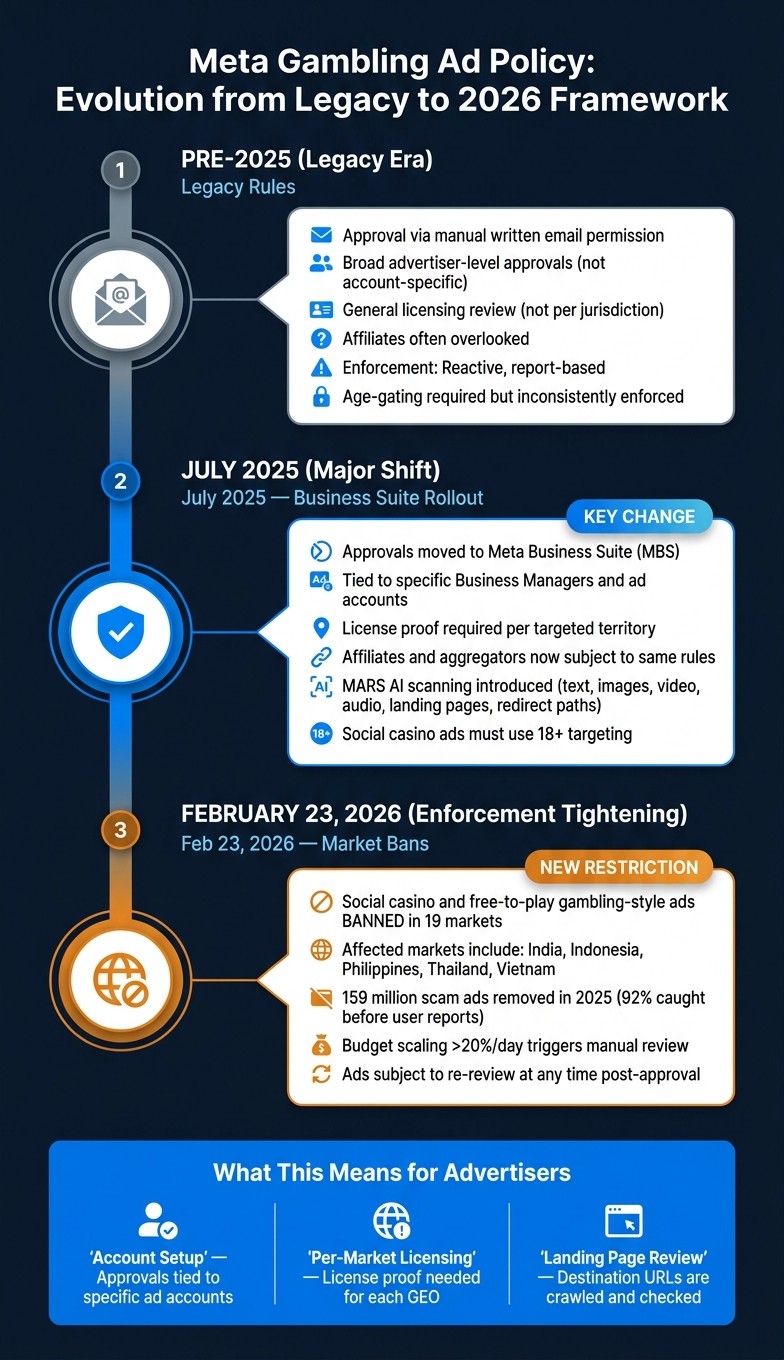
Meta Gambling Ad Policy: Key Changes from Legacy Rules to 2026 Framework
Meta shifted gambling approvals from email-based permissions to Business Suite verification, with the main rollout in July 2025. That change matters because the old system still explains a lot about how the 2026 rules work.
What the Older Rules Required
Before 2025, advertisers had to get prior written permission from Meta and hold valid licenses in every jurisdiction they wanted to target. Those legacy approvals were broad, uneven, and often not tied closely to individual accounts.
What Changed in 2025 and 2026
In July 2025, Meta moved gambling approvals into the Permissions and Verifications system inside Meta Business Suite (MBS). Instead of sitting at the advertiser level, approvals are now tied to specific Business Managers and ad accounts.
Then Meta tightened things again in 2026. On February 23, 2026, it banned social casino and free-to-play gambling-style ads in 19 markets, including India, Indonesia, the Philippines, Thailand, and Vietnam.
Early Rules vs. Current Policy: A Side-by-Side Comparison
Feature | Legacy Rules (Pre-2025) | 2025–2026 Framework |
|---|---|---|
Verification Method | Manual written permission via email | Centralized via the "Authorizations and verifications" tab in Meta Business Suite |
Required Documents | Valid licenses in targeted jurisdictions | Licenses and tighter documentation for each targeted territory |
Account-Level Approval | Often applied broadly to the advertiser entity | Tied to specific Business Managers and ad accounts |
Affiliate Treatment | Often overlooked if separate from the operator | Any gambling-related landing-page reference requires authorization |
Required, but inconsistently enforced | Creative still faces review even on age-gated campaigns | |
Geo Restrictions | General local law compliance | Social casino and free-to-play ads are prohibited in 19 markets |
Enforcement Model | Primarily reactive, report-based | Proactive AI scanning via MARS (text, visuals, audio, landing pages, and account history) |
Put simply, the old setup was loose. The newer one is tied much more closely to the exact accounts running ads, the places being targeted, and the landing pages behind the campaign. That shift shapes who now needs approval; the next section gets into which offers Meta treats as gambling.
What Now Counts as Gambling Under Meta's Rules
Meta's 2026 Online Gambling and Gaming policy covers a lot more than casinos and sportsbooks. It kicks in when people pay money, or anything of value, to enter. It also applies when they can win something of value in return. That's why authorization and landing page review matter so much.
Real-Money Operators, Sweepstakes, and Contest-Style Offers
Online casinos, sportsbooks, poker, bingo, and lotteries sit squarely inside the policy. But it doesn't stop there.
Fantasy sports contests, skill-based tournaments, sweepstakes casinos, and other prize contests can also fall under the same rules when users can win something with monetary value. Put simply, if there's money in, or something valuable out, Meta is likely to treat it as gambling-related.
Affiliates, Aggregators, and Landing Pages
This is where classification starts to matter most: during ad review, landing page checks, and redirect-path checks.
Affiliates and aggregators don't get a pass. If an ad or landing page mentions real-money play, bonuses, promo codes, or sends users to a gambling operator, Meta treats it as a gambling ad.
And here's the part many advertisers miss: Meta also crawls destination URLs. So even if your ad copy looks mild, a landing page that routes users to a gambling offer can still lead to rejection or account penalties.
Social Casino and Free-to-Play Ads
Social casino and free-to-play ads can still face review when they copy gambling-style mechanics, even if there's no cash payout.
That classification sets the stage for the approval, verification, and enforcement steps that come next.
Compliance, Enforcement, and Campaign Risk
New Approval Requirements for Licensed Advertisers
Once an offer lands under Meta's gambling policy, the big issue is no longer whether it fits the category. The issue becomes enforcement.
Meta does not treat gambling approval like a one-and-done box check. It treats these ads as subject to repeat review. As Chris Pollard, Founder, Ads Uploader, said:
"Ads can be reviewed again at any time, and may be rejected or restricted for violating our policies at any time."
That matters because MARS can look at approved ads again and remove them later if new issues show up. A weak Account Health score can slow down review times. If the score drops far enough, Restricted Delivery can kick in. Creative that looks too youthful can trigger teen-safety checks. Advertisers often use AI creative tools to iterate on visuals that meet these strict safety standards. On top of that, undeclared Special Ad Categories or restricted visuals can set off mapping or evasion flags. So while Meta's advertising policies may look straightforward on paper, the actual compliance work changes based on the kind of advertiser running the campaign.
Enforcement Gaps and Documented Bad-Actor Activity
Meta's enforcement scale is huge. In 2025, the company removed more than 159 million scam ads worldwide, and 92% were caught before users reported them.
Even with that level of review, gray-market operators still slip into the system. A common tactic is cloaking. They show Meta a compliant-looking safe page, then send users somewhere else entirely, including gambling offers.
Compliance Requirements by Advertiser Type
Approval rules change depending on who is advertising and what model they use.
Advertiser Type | Verification | License Proof | Age/Geo Limits | Main Disapproval Risk |
|---|---|---|---|---|
Real-Money Operators | Prior written permission from Meta | Active local regulatory license for each targeted GEO | 18+ (or local legal age); strict geo-fencing | Landing page lacks an active age-gate; scaling spend too fast triggers re-review |
Affiliates / Influencers | Prior written permission from Meta; safe page setups are often required | Operator's license documentation | 18+; must match offer GEO | Circumventing systems flags; cloaking detection; misleading outcome claims |
Sweepstakes Brands | Written permission if the prize has value | Compliance with local contest laws | 18+; varies by jurisdiction | Misleading "free" claims; fake urgency; phantom functionality |
Social Casino | Market-specific | Not required if no real money is won | 18+; prohibited in unsupported markets | Creative implies real-money wins; youthful aesthetic triggering teen-safety reviews |
There is also a scaling limit that can catch advertisers off guard. If you increase a single ad set's budget by more than 20% per day, Meta may trigger a manual review, and in some cases that can lead to account freezes.
For gambling advertisers, that small rule has outsized weight. These accounts already sit under tighter review, so scaling too hard, too fast can turn a working campaign into a compliance problem almost overnight.
Conclusion: What Advertisers Should Do Next
Meta's 2026 gambling ad framework is tighter now, requiring advertisers to adapt to policy changes across their entire account structure. With account-level approvals and proactive AI review, pre-launch compliance is where the real gatekeeping happens.
Before anything goes live, media buyers should handle four key actions. Submit regulatory documents in Meta Business Suite as early as possible, then confirm that the approved ad account is the same one running the campaign. Review every landing page before launch. Also make sure unsupported markets are excluded from targeting.
Landing-page copy needs its own review too. Avoid second-person claims on landing pages. Use third-person wording or aspirational framing instead.
For teams running a high volume of accounts, automation can cut down on manual review. If you're managing multiple accounts, AdAmigo.ai can automate policy checks and flag age, geo, and delivery issues before launch.
FAQs
Do affiliates need Meta gambling approval too?
Yes. Affiliates also need Meta’s prior written approval to run gambling ads on Meta in 2026.
They must also comply with the applicable licensing and regulatory requirements.
What documents are needed for each target market?
In 2026, advertisers that target online gambling must get Meta authorization first. They also need to show proof that they hold the right license, or that their business is lawful, in each market they target.
The documents you need depend on the jurisdiction. In some places, that may mean proof of licensing from a regulator. In others, it may mean proof that the business is legally established in that territory.
Why can approved gambling ads still get rejected later?
Even after initial approval, gambling ads can still get rejected later. That happens when Meta’s automated, multimodal review systems spot a policy issue.
A few common triggers are undisclosed AI-generated content and problems with targeting or landing page requirements.