
Claude for Meta Ads: What It Can Do With Meta’s MCP, What It Still Can’t Do, and the Best Business-Ready Alternative
Compare Claude's MCP-powered analysis with a business-ready ad automation platform for hands-off Meta Ads management.
Claude now connects directly to Meta Ads through the new Model Context Protocol (MCP), enabling faster campaign audits, live data analysis, and natural language interactions. It simplifies tasks like budget analysis and creative performance tracking but still requires manual approval for changes and lacks advanced execution features. For a hands-off solution, AdAmigo.ai automates ad management, including launching, optimizing, and monitoring campaigns. While Claude is free during beta and great for analysis, AdAmigo.ai suits those needing automated execution at $99/month per account.
Key Takeaways:
Claude + MCP: Best for teams needing advanced analysis and insights but willing to handle execution manually.
AdAmigo.ai: Ideal for businesses wanting automated ad management, creative uploads, and 24/7 optimization.
Quick Comparison:
Feature | Claude + MCP | AdAmigo.ai |
|---|---|---|
Cost | Free (Beta) | $99/account/month |
Setup | No-code, quick setup | Requires API key and onboarding |
Execution | Manual approval required | Automated with optional manual mode |
Creative Management | Text-based suggestions only | Bulk uploads, ad copy generation, media tools |
Analysis | In-depth, live data insights | Automated, cross-account performance tracking |
Automation | Limited to recommendations | Full execution: budgets, creative refreshes |
Claude fits teams prioritizing insights and manual control, while AdAmigo.ai is better for businesses seeking automated, large-scale ad management.
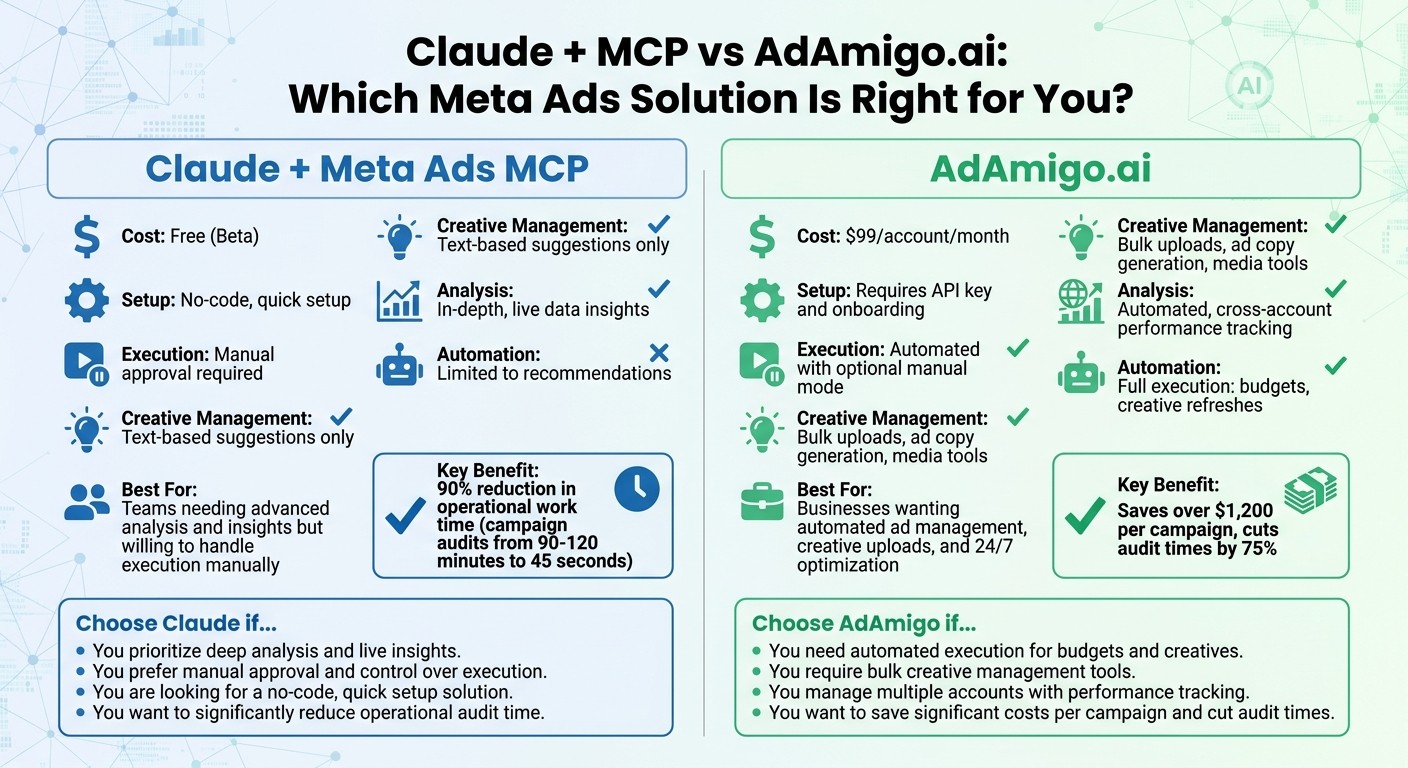
Claude + MCP vs AdAmigo.ai: Feature Comparison for Meta Ads Management
1. Claude + Meta Ads MCP
Capabilities
Claude connects with Meta Ads through the official MCP server, offering 29 tools across five categories: campaign management, product catalog operations, accounts and assets, datasets and tracking, and insights and benchmarks. These tools let users handle tasks like creating and editing campaigns, auditing product feeds, analyzing signal quality, and generating performance reports - all through natural language conversations instead of navigating Ads Manager.
Tasks that once took 90–120 minutes, like morning campaign audits across multiple accounts, can now be completed in just 45 seconds. For example, Advolve, a digital marketing automation company, saw a 90% reduction in operational work time and a 15% boost in customer ROAS after using Claude with Meta Ads MCP.
Unlike static CSV exports, Claude uses real-time API calls, allowing it to analyze live campaign data alongside creative text and landing page context. This means it can explain why an ad is performing well, not just report that it is. In April 2026, TripleDart's paid media team leveraged this feature to identify that a remarketing campaign achieved the highest CTR (1.77%) with the lowest CPC ($1.24), while a prospecting campaign generated 30 registrations at $77.08 per registration. This insight enabled quick budget reallocation decisions.
By combining campaign audits, catalog diagnostics, and signal monitoring into one conversation, Claude reduces the need for multiple tabs, spreadsheets, and dashboards. For teams familiar with AI workflows, this streamlines operations significantly.
However, there are some limitations. Claude cannot access cross-platform attribution data (e.g., TikTok or Google Ads) without additional MCP connections, nor can it create or edit visual assets like images or videos. Additionally, loading tool definitions consumes between 55,000 and 134,000 tokens, which can limit Claude's capacity for more complex reasoning tasks. Despite these constraints, its capabilities make campaign management far more efficient.
Optimization Workflow
Claude identifies opportunities for optimization by analyzing live data - metrics like CTR, ROAS, CPC, and frequency - without waiting for manual reviews. It can detect creative fatigue by spotting trends such as rising frequency paired with declining CTR, suggesting creative rotations before performance drops. It also performs audience overlap analysis, flagging ad sets that compete against each other and recommending exclusions to reduce CPMs.
In April 2026, a DTC fitness brand used Claude to track CTR trends. On day 6 of a campaign, Claude identified an 18% drop in CTR before the frequency reached 2.8. The team refreshed the creative on day 7, maintaining a 3.2x ROAS and avoiding a drop to 1.8x.
"Claude is an extremely capable analyst and operator who works at AI speed, but you are still the strategist."
Nikhil Tiwari, MCP Playground
The workflow operates on a human-in-the-loop approach. While Claude provides recommendations and drafts changes, any action - whether creating ads, adjusting budgets, or editing campaigns - requires user approval before execution. This ensures control over ad spend and account safety. Although Claude excels as an analyst, human oversight is essential to translate its insights into actionable strategies.
Creative Tools
Claude can suggest ad copy ideas and creative strategies based on performance data, but it doesn’t generate visual assets. While it can analyze which creatives are losing effectiveness and recommend rotations, creating images, videos, or graphics requires separate tools.
For teams handling high-volume ad creation, a Command Line Interface (CLI) is often preferred over MCP. Chris Pollard, Founder of Ads Uploader, explains:
"MCP is the protocol, handling connectivity. CLI is the execution model, handling control."
Chris Pollard, Founder, Ads Uploader
Using a CLI allows teams to maintain a "spec file" (JSON) for repeatable ad launches, providing a clear audit trail. Meanwhile, MCP is better suited for conversational reporting and real-time analysis. Though creative ideation is important, ensuring account safety and monitoring remains a top priority.
Monitoring and Safety
Claude helps monitor campaigns by detecting sudden CPA spikes and budget pacing issues, identifying creative fatigue,. It can also perform signal diagnostics, ensuring pixel and Conversions API data are accurate for informed optimization decisions.
"Safety comes from the app behind the MCP... the quality of that layer is what determines whether your account stays healthy."
Chris Pollard, Founder, Ads Uploader
To minimize risks, businesses can start with read-only permissions (ads_read) to explore reporting and analysis workflows without making changes to the account. Once confident in the process, teams can grant write access (ads_management) to enable campaign modifications.
Reliability heavily depends on the MCP server implementation. Tools developed by Meta Business Partners or those that have passed Meta's app review are generally more reliable than open-source scripts. For businesses testing write operations, Meta's Marketing API Sandbox offers a safe environment to avoid accidental spending or account issues. This is why many businesses lean toward productized solutions for large-scale media buying.
😱 How to use the OFFICIAL META ADS MCP with CLAUDE (Honest Review)
While Claude offers a manual way to interact with your data (though you should implement automation guardrails first), you can also explore more robust Meta ads automation strategies for scaling your campaigns.
2. AdAmigo.ai
AdAmigo.ai stands out as a comprehensive, ready-to-use Meta ads management platform, offering tools to streamline ad performance without the need for custom API integrations.
Capabilities
AdAmigo.ai takes the complexity out of managing Meta Ads by providing cross-account analytics, which enables agencies to track performance across multiple client accounts from one centralized dashboard. But it doesn’t stop at analysis. The platform’s closed-loop execution layer allows it to go beyond audits - it identifies underperforming ads, pauses them, and automatically launches replacements. This hands-free approach makes it easier to maintain consistent ad performance.
Let’s break down how AdAmigo.ai simplifies the optimization process with its multi-agent system.
Optimization Workflow
AdAmigo’s multi-agent architecture divides the media buying process into specialized tasks. For example:
The Creative Scout pinpoints top-performing creatives and detects signs of creative fatigue before it impacts results.
The Launch Agent builds campaign payloads and launches them directly into your Meta ad account.
This setup enables continuous, automated optimization. Users can choose between autopilot mode, where changes happen automatically, or manual mode, which requires approval for every action. To ensure the AI works within specific business goals, advertisers can set custom rules, KPIs, and budget limits. Additionally, the platform creates daily action plans, prioritizing tasks based on performance data specific to each account.
Creative Tools
AdAmigo offers robust tools for managing and generating ad creatives. For instance, its bulk creative management feature allows users to upload multiple assets at once. The Bulk Ad Launcher takes this a step further - users can upload assets to Google Drive, provide a brief, and the system generates ad copy, organizes campaigns, and directly publishes ads into Meta.
The Ad Factory analyzes both top-performing and competitor ads to craft new creative variations. It also includes automated media matching, which pairs thumbnails with video assets without requiring manual tagging. These tools make it easier to test and optimize creatives, especially for teams running large-scale campaigns.
While creative management is a key focus, AdAmigo also prioritizes monitoring and safety to ensure campaigns stay on track.
Monitoring and Safety
AdAmigo’s Protect feature continuously monitors account health, keeping an eye on performance trends, delivery issues, and unusual spending patterns. Unlike Claude, which requires users to ask specific diagnostic questions, Protect works proactively, sending alerts before problems escalate. It tracks campaign performance against KPIs, flags budget pacing issues, and ensures campaigns stay within predefined limits.
Every action taken by the platform is logged and explained in plain language, offering transparency and accountability - critical for agencies managing client budgets. By combining proactive monitoring with automated execution, AdAmigo minimizes operational overhead while maintaining strict control over ad spend.
Pros and Cons
The table below highlights the key strengths and weaknesses of Claude + Meta Ads MCP and AdAmigo.ai, showcasing how each tool serves different needs.
Aspect | Claude + Meta Ads MCP | AdAmigo.ai |
|---|---|---|
Strengths | • Natural language interface for querying ad data and performance analysis | • Operates autonomously 24/7 with bid adjustments and budget reallocations |
Weaknesses | • Requires manual approval for all actions - functions more as an analyst than an operator | • Higher cost compared to free MCP options |
These differences highlight how the platforms cater to distinct workflows and user preferences.
Claude + MCP excels in analysis and reporting but relies on manual execution for implementing changes. For example, one marketing agency noted its anomaly detection capabilities significantly streamlined their daily audit process.
On the other hand, AdAmigo.ai focuses on automation. It not only identifies opportunities but also acts on them - launching campaigns, reallocating budgets, and pausing underperforming ads automatically. Agencies have reported saving over $1,200 per campaign and cutting audit times by 75%. However, this level of automation comes with a higher price tag, starting at $99 per account per month, and a steeper learning curve.
For teams that prioritize in-depth analysis and are comfortable with manual workflows, Claude + MCP is a solid choice. But if you're looking for a tool that takes care of execution with minimal input, AdAmigo.ai transforms Meta advertising into a hands-off, fully managed process.
Conclusion
Claude + Meta Ads MCP offers a robust solution for analyzing, reporting, and exploring ad performance through conversations. It's particularly well-suited for technical teams, agencies juggling multiple client accounts, and performance marketers looking for real-time insights into areas like creative fatigue, audience overlap, or cross-account rollups.
If you have access to engineering resources, enjoy creating custom workflows, and need an intelligent analyst rather than an operational tool, the self-hosted MCP option is both free and highly adaptable.
That said, while Claude shines in analysis and reporting, it lacks operational capabilities. MCP is not built for large-scale execution or autonomous operations. As Chris Pollard, Founder of Ads Uploader, puts it:
"MCP is the protocol, handling connectivity. CLI is the execution model, handling control".
For tasks like launching hundreds of ads, managing local creative libraries, and ensuring 24/7 optimization, a platform like AdAmigo.ai is a better fit. AdAmigo offers a complete execution layer, including bulk ad launches, creative generation, automated budget rules, and account monitoring.
In summary, choose Claude + MCP if you're technically savvy, prioritize deep analysis, and prefer to avoid software fees by building your own workflows. On the other hand, opt for AdAmigo.ai if you need seamless daily optimization, efficient creative management, and scalable multi-account support.
For those aiming to balance both, an advanced modular strategy could work: use MCP for its analytical power and pair it with a specialized execution tool for high-volume ad management. This approach combines Claude's strengths in analysis with the operational reliability of dedicated media buying platforms.
Ultimately, the decision boils down to whether you prefer hands-on customization or a ready-to-go solution for managing Meta ads.
FAQs
How do I connect Claude to my Meta ad account with MCP?
To link Claude to your Meta ad account through MCP, here’s what you need to do:
Choose a compatible platform: Opt for a tool that supports MCP integration, ideally one that doesn’t require coding expertise.
Sign in to your Meta for Business account: Make sure you have the right permissions to proceed.
Set up the MCP connection: Enter the necessary credentials through the platform to establish the connection.
Once everything is configured, double-check the connection to confirm that Claude can securely access your Meta Ads data.
What can Claude not automate in Meta Ads yet?
Meta Ads campaign management cannot be fully automated using Claude. Tasks such as performing daily account audits, prioritizing necessary actions, optimizing campaigns on autopilot, handling multiple client accounts, or launching bulk ads require custom workflows or specialized systems. While Claude can help with tasks like analysis and reporting, it doesn't have the integrated workflows required for complete automation.
When should I use AdAmigo instead of Claude?
Use AdAmigo if you're looking for an AI-powered media buying platform that simplifies daily tasks like campaign management, optimization, creative generation, bulk launching, approvals, and monitoring. The best part? It works seamlessly without needing any custom setups.
On the other hand, Claude + MCP caters more to technical users who need support with reporting, analysis, or automating workflows. But if you're a business or agency focused on managing multiple accounts and campaigns effortlessly, AdAmigo offers a straightforward, plug-and-play solution.