
Multi-Format Ads: Scaling Strategies for 2026
Scale Meta ads with 9:16, 4:5 and 1:1 creatives, structured testing, and AI automation to increase reach and lower CPMs.
Meta ads in 2026 demand variety. Gone are the days when a single ad format could carry your campaign. Users move seamlessly between Reels, Stories, and Feed, and your ads need to keep up. By using a mix of formats - like videos, carousels, and vertical Reels - you can maximize reach, lower costs, and let Meta’s algorithm deliver the right ad to the right placement.
Key Takeaways:
Why it matters: Reels and Stories now make up 90% of Meta’s inventory. Sticking to one format limits your reach and increases costs.
What to do: Use 9:16 for Reels/Stories, 4:5 for Feed, and 1:1 for square placements. Provide 8–12 distinct ad variations per campaign.
AI tools help: Platforms like AdAmigo.ai automate testing, budget allocation, and creative updates, saving time and boosting performance.
Avoid common mistakes: Don’t rely on one format, spread budgets too thin, or neglect to refresh your ads regularly.
Bottom line: A multi-format strategy is essential for scaling Meta ads in 2026. Combine diverse formats, structured testing, and AI automation to achieve better results.
The EXACT System to Scale Facebook Ads Profitably (2026)
What Is Multi-Format Scaling in Meta Ads
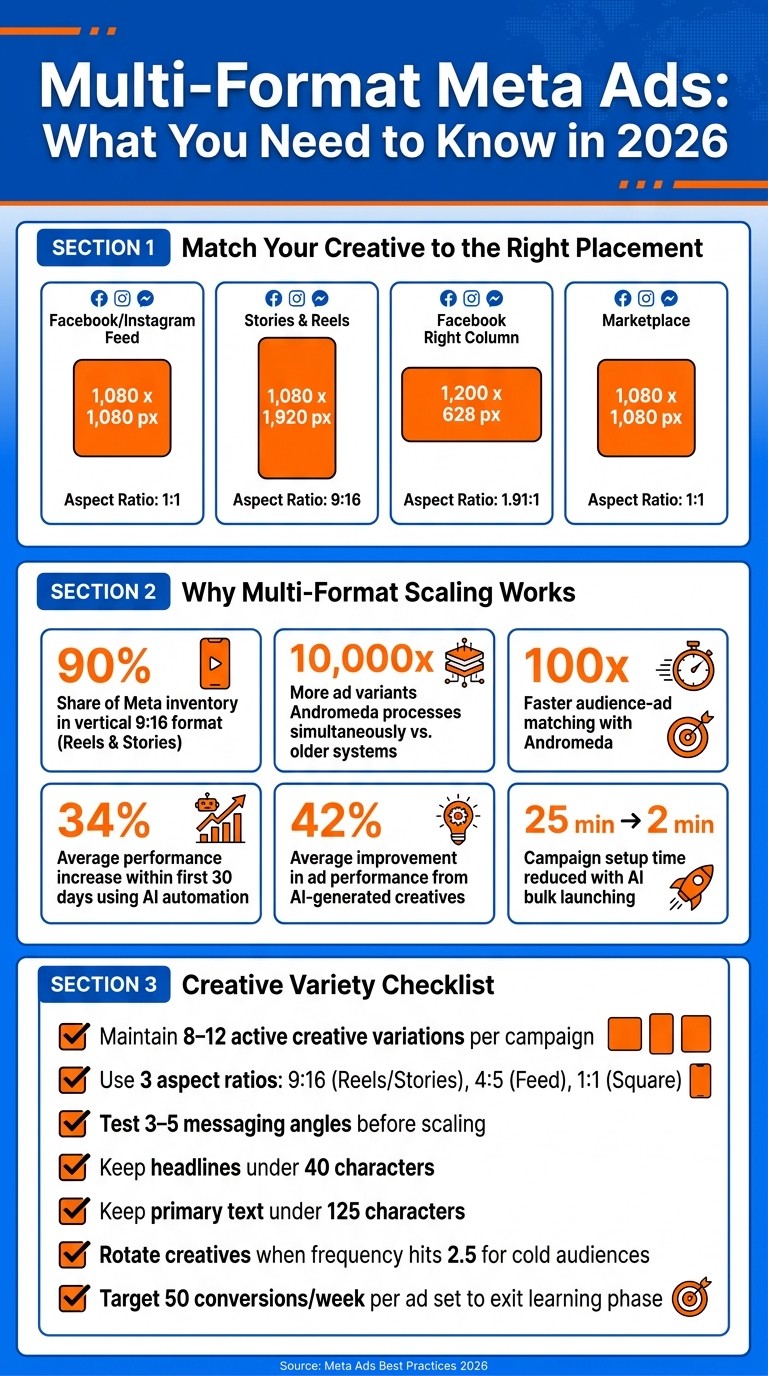
Meta Ads Multi-Format Strategy: Key Stats & Placements 2026
The Basics of Multi-Format Scaling
Multi-format scaling involves running campaigns with a mix of ad formats such as images, videos, carousels, and vertical Reels instead of sticking to just one type. This method allows Meta's system to automatically match the most suitable ad format to each placement.
At the heart of this strategy is creative liquidity - the ability to compete across all available placements with properly tailored assets. For example, relying solely on square images means you miss out on Reels and Stories placements, which now account for about 90% of Meta's inventory in the vertical 9:16 format. Skipping these placements can result in a significant loss of reach.
A lack of format variety can lead to less effective auctions and higher CPMs, a situation often referred to as the "monotony tax." By diversifying your ad formats, you open up more auction opportunities, which can lead to more efficient use of your budget.
This strategy of using diverse ad assets sets the stage for better campaign performance, especially when paired with advanced dynamic creative systems.
How Dynamic Creative Systems Improve Performance
Once you've established creative liquidity with a variety of ad formats, Meta's advanced algorithms take performance to the next level. Systems like Andromeda, Meta's current ad retrieval technology, are designed to optimize ad delivery more effectively.
Andromeda can process 10,000 times more ad variants simultaneously and is 100 times faster at matching ads to the right audience compared to earlier systems. If you only provide a single creative, the system’s ability to learn and optimize becomes limited.
"The brands that win are those that feed the system variety, not volume." - Anchour
This highlights why creative diversity outweighs creative volume. Instead of overwhelming your account with minor variations, focus on providing distinct formats and angles. This enables Andromeda to identify the best match for each viewer. Successful campaigns often maintain 8–12 active creative variations per campaign to ensure the system has enough options to work with. Distributing assets across key formats like 9:16 for Reels/Stories, 4:5 for Feed, and 1:1 for square placements allows Meta to automatically serve the most relevant version of your ad.
To make the most of Meta’s dynamic allocation, it's critical to use the right dimensions, as outlined below:
Placement | Recommended Size | Aspect Ratio |
|---|---|---|
Facebook/Instagram Feed | 1,080 x 1,080 px | 1:1 |
Stories & Reels | 1,080 x 1,920 px | 9:16 |
Facebook Right Column | 1,200 x 628 px | 1.91:1 |
Marketplace | 1,080 x 1,080 px | 1:1 |
Additionally, for Meta's system to fully optimize your ad delivery, each ad set typically needs around 50 conversions per week to move out of the learning phase. Multi-format scaling helps achieve this by broadening placement options, which accelerates the accumulation of conversion signals and keeps the algorithm learning effectively.
How to Build a Multi-Format Ad Strategy
The Right Mix of Ad Formats
A well-rounded ad strategy includes using 9:16, 4:5, and 1:1 aspect ratios. Each format serves specific placements and plays a role in driving conversions. Skipping any of these can limit your reach and impact.
But it’s not just about dimensions. Your chosen formats should align with the campaign's objective. Here's a quick guide to matching the copy style and CTA to your goal:
Objective | Primary Text Style | Headline Style | Recommended CTA |
|---|---|---|---|
Awareness | Brand story (2–3 sentences) | Intrigue or category claim | Learn More |
Traffic | Specific outcome (1 sentence) | Benefit-led, specific number | Sign Up / Learn More |
Leads | Pain point + resolution | Direct offer or free asset | Get Quote / Sign Up |
Conversions | Social proof + offer | Price anchor or urgency | Shop Now / Buy Now |
For Advantage+ Shopping Campaigns (ASC+), aim to create 6–8 copy variations spread across 2–3 creative angles. This variety allows Meta's algorithm to test and identify what resonates with different audience segments effectively.
Once your formats are set, shift your focus to creative testing to fine-tune performance.
How to Structure Creative Asset Testing
One of the biggest pitfalls in testing is changing too many variables at once. For instance, if you adjust the format, the hook, and the offer simultaneously, it becomes impossible to pinpoint which change made the difference.
Start by testing the angle first (try 3–5 variations). An "angle" refers to the core messaging approach - such as highlighting a problem versus showcasing an aspirational solution. Once a winning angle is identified, test how it performs across various formats and placements. This method ensures the Meta algorithm can optimize effectively.
To avoid truncation and ensure your message is clear across placements, keep your copy concise:
Headlines: Under 40 characters
Primary text: Under 125 characters
Descriptions: Under 30 characters
Also, avoid making edits to active ad sets during testing. Changes reset the learning phase and erase the data signals you've already gathered. Keeping tests clean and structured helps you identify top-performing creatives faster.
Allocating Assets Across Meta Placements
After testing reveals the best creative angles, the next step is distribution. Tools like Meta's Advantage+ Creative simplify this process by automatically detecting aspect ratios and assigning each asset to the best placement. For example, a 9:16 video will automatically go to Reels, while a 1:1 image will be placed in the Feed.
Timing is also critical. Rotate creative assets when frequency peaks - typically when it reaches 2.5 for cold audiences. At this point, performance often starts to dip, signaling the need for fresh creative.
"The workflow angle for automated ad copy generation for Meta isn't about replacing human strategy - it's about systematizing execution of a strategy you've already validated." - Murat Bock, Founder, AdLibrary
When targeting audiences, use broad hooks for Advantage+ Audiences and shift to highly specific messaging for custom or retargeting segments. The more defined the audience, the more tailored your messaging should be. This approach ensures your campaigns remain scalable and efficient as you plan for success in 2026.
AI-Driven Scaling: Automating Multi-Format Ad Optimization
How AI Improves Multi-Format Scaling
Once your creative distribution strategy is set, the next hurdle is managing the sheer volume of decisions needed to scale effectively. This includes tasks like budget adjustments, creative rotations, and audience targeting - all happening across multiple formats. AI automation steps in to handle these real-time complexities.
AI tools take on the heavy lifting of scaling across formats. They can automatically detect creative aspect ratios (like 9:16, 4:5, or 1:1) and group them into a single ad, assigning each asset to its ideal Meta placement. What used to take about 25 minutes to set up manually - one campaign with three ad sets and nine ads - now takes just 2 minutes using AI-assisted bulk launching. This streamlined process builds directly on your existing creative strategies. By automating these rotations, teams can effectively solve creative fatigue that often stalls scaling efforts.
Advertisers adopting AI automation platforms have reported an average 34% performance increase within the first 30 days. Beyond speeding up launches, AI tools monitor accounts 24/7, spotting setup errors, broken links, or overspending before they become costly. Without this safeguard, teams typically face 5–6 critical errors monthly; with AI anomaly detection, that number drops to zero.
Using AdAmigo.ai for Autonomous Campaign Scaling
Specialized tools like AdAmigo.ai take these benefits even further by combining faster decision-making with advanced error detection. Its AI Autopilot continuously audits your account, identifies high-impact opportunities, and executes optimizations - whether that’s scaling successful ads, pausing underperformers, or reallocating budgets without losing ROAS.
For creative scaling, Ad Factory analyzes your best-performing ads alongside competitor trends to generate high-impact creatives. Meanwhile, the Bulk Ad Launcher structures and publishes campaigns at a speed 10x faster than manual setups. This ensures your multi-format assets maintain strong performance as the AI adjusts to live data. On average, AI-generated creatives improve ad performance by 42%.
The impact on teams is game-changing. A single media buyer who could previously manage 4–6 accounts manually can now handle 15–25+ accounts with AdAmigo's automation. G2 users highlight the benefits:
"Our budgets are controlled, our spend is being smartly allocated and our ROAS is up massively." - Rochelle D.
"These AI actions go beyond simply suggesting actions; they provide valuable insights and justifications. This not only improves my results but also deepens my understanding of campaign optimization." - Verified User, G2 Review
For agencies or in-house teams managing large-scale, multi-format campaigns, the combination of speed, accuracy, and continuous optimization offered by AI tools is hard to match manually.
Common Mistakes in Multi-Format Scaling and How to Fix Them
Relying Too Heavily on One Ad Format
Sticking to just one ad format can severely limit your campaign's reach. Different placements require different formats - Reels work best with a 9:16 ratio, Feed posts perform better at 4:5 or 1:1, and Stories fall somewhere in between. A single format simply can't do justice across all these placements.
But there's an even bigger issue: Meta's optimization systems thrive on variety. For example, Advantage+ Shopping campaigns need at least 6–8 copy variations paired with 2–3 distinct creative angles to perform effectively. Without this variety, the algorithm struggles to identify what resonates with different audience segments.
Another red flag is frequency. When the same audience sees the same creative too often, engagement rates drop, and costs start climbing. The solution? Use multi-format grouping to ensure 9:16, 4:5, and 1:1 assets are automatically placed where they fit best. Additionally, set up creative rotation triggers to prevent overexposure before frequency becomes an issue.
Running Creative Tests Without a Clear Process
Creative diversity is important, but without a structured testing process, it’s easy to end up with results that don’t guide your next steps. Testing should focus on specific messaging angles to uncover what drives the best performance.
"Automation without a validated angle is just faster noise." - Murat Bock, Founder & Fullstack Developer
Another common mistake is spreading budgets too thin. Meta ad sets generally need around 50 conversions per week to move beyond the learning phase. If you divide your budget across too many variations - say, 15 or more - none of them may get enough traction to reach that threshold, leaving the algorithm stuck in limbo.
Scaling Without a Plan to Refresh Creatives
Scaling a successful creative without planning for refreshes is a recipe for stagnation. Audience fatigue is inevitable, but it doesn’t have to be a campaign-ending problem.
The key is to prepare before performance dips. Establish a continuous creative pipeline that keeps your campaigns fresh. This can include analyzing competitor trends, iterating on top-performing creatives, and creating format-specific variations. AI-generated creatives, built using performance data rather than guesswork, have been shown to deliver an average 42% improvement in performance. This proactive approach ensures your campaigns stay scalable and effective, rather than scrambling to recover after a slowdown.
Conclusion: Building a Meta Ad Strategy That Holds Up in 2026
Key Takeaways
To succeed with Meta ads in 2026, incorporating a mix of creative formats isn't optional - it’s essential. Success hinges on multi-format scaling, which ensures Meta’s algorithm has the variety it needs to deliver the right creative (in ratios like 9:16, 4:5, and 1:1) to the best placements.
The campaigns that thrive are those built on structured testing and fueled by a steady flow of fresh creative. And AI? It’s no longer a luxury - it’s the engine that keeps everything running efficiently.
Next Steps for Advertisers
The first step is a reality check: audit your current creative assets. Are all three key ratios covered? If not, that’s your starting point. From there, the focus shifts to building a repeatable process - not just running ads in isolation.
Here’s a practical way to get started:
Expand your creative formats. Ensure you have assets in 9:16, 4:5, and 1:1 ratios to seamlessly cover Reels, Feed, and Stories placements.
Streamline campaign setup. Use tools like a bulk launcher to speed up tasks like campaign structuring, UTM tagging, and ad set configuration. What used to take 25 minutes can now be done in just 2 minutes.
Leverage AI for optimization. Let AI handle repetitive tasks like daily budget tweaks and creative rotation and testing. This allows you to focus on higher-level strategy while staying in a review-and-approve role.
For those managing Meta ads at scale, platforms like AdAmigo.ai can be game-changers. Its AI Autopilot keeps your account running smoothly by auditing performance, scaling high-performing ads, pausing underperformers, and providing daily action plans - all tailored to your KPIs. With AdAmigo, a single media buyer can manage 15–25 ad accounts, compared to just 4–6 accounts when working manually.
"Our budgets are controlled, our spend is being smartly allocated and our ROAS is up massively." - Rochelle D.
FAQs
How many ad variations do I need per campaign?
For the best outcomes, create 3-5 ad variations per angle and focus on 2-3 angles per campaign. This approach gives you a total of 6-15 ad variations, striking a balance between providing enough data for optimization and avoiding overloading the algorithm.
What’s the simplest way to test creatives without resetting the learning phase?
The simplest way to test creatives without interrupting the learning phase is by using AdAmigo's bulk launch feature. This handy tool allows you to upload multiple creatives and combine them into a single ad with different aspect ratios - like 9:16, 4:5, and 1:1 - for testing all at once. On top of that, AdAmigo's AI analyzes brand and competitor insights to create high-performing creatives, helping you maintain the learning phase while optimizing your ad performance.
When should I refresh Meta ad creatives to avoid fatigue?
Refreshing your Meta ad creatives regularly is key to keeping engagement high and avoiding ad fatigue. Tools such as AdAmigo can simplify this process by analyzing your top-performing ads and automatically creating new variations. This approach helps your campaigns stay effective without requiring constant manual updates.