
How Meta's Copyright Review Process Works
Platform ad copyright checks combine automated matching and human review to remove infringing ads, enforce penalties, and allow appeals.
Meta reviews every ad on Facebook and Instagram to ensure compliance with copyright laws. This process combines automated tools like Rights Manager and Audible Magic with manual oversight by a global team of over 15,000 reviewers. Ads flagged for potential copyright violations go through a structured review, including checks for originality, fair use, and market impact. Violations can result in ad rejection, account restrictions, or permanent bans. Repeat offenders face stricter penalties under Meta's Repeat Infringer Policy. To avoid issues, advertisers should use original or licensed content and audit their creative assets thoroughly. Using a Meta ad policy checker can help identify issues before submission. Appeals are possible if content is flagged, with decisions typically resolved within 48 hours.
How Meta Detects Copyright Infringements
Meta uses a combination of automated systems and human oversight to keep track of copyright infringements across millions of Facebook and Instagram ads every day. These methods play a key role in the broader review and enforcement processes Meta employs to handle intellectual property violations.
Automated Copyright Detection Tools
Meta relies heavily on automated tools to scan ad content both before and after it goes live. Tools like Brand Rights Protection focus on identifying trademark violations, counterfeit goods, and copyright issues. This system uses saved reference images to flag potential violations across ads, Marketplace listings, and Instagram accounts. Meanwhile, Rights Manager is designed for video and audio content. Rights holders upload reference files, and the system matches these files to content on the platform, allowing them to block, monitor, or claim ad revenue from flagged material.
For audio-related infringements, Meta uses Audible Magic, a third-party service that detects unauthorized use of copyrighted audio. Even background music in videos can trigger a flag through this system.
Meta provides some insight into how these automated tools operate:
"In order to identify potential violations, we use various automated detection tools that take into consideration a range of different signals, including but not limited to: insights from machine learning models, the presence of certain keywords associated with piracy and counterfeit activity and prior IP violations from problematic accounts." Proper ad account setup for compliance can help advertisers avoid being flagged as problematic. - Meta Platforms, Inc.
In November 2025, Meta introduced Facebook Content Protection, a mobile-first tool specifically for Reels. It uses the same matching technology as Rights Manager to detect when original Reels are reused without permission.
While these tools are highly effective, they aren’t perfect. That’s where human input comes into play, particularly for cases that require more nuanced judgment. Meta also encourages users to report potential violations, adding another layer of oversight.
User-Reported Violations and Manual Reviews
When automated tools fail to catch an infringement, Meta relies on reports from users and rights holders. Dedicated online forms for Facebook and Instagram allow rights holders to report violations, or they can contact Meta’s designated DMCA agent.
Once a valid report is received, Meta typically removes or restricts the content quickly - often within a day or less. In these cases, the uploader may not be notified beforehand. Meta also shares the rights owner's name, email, and report details with the content poster, enabling them to resolve the issue or file an appeal.
Manual reviews are essential for handling cases where automated tools can’t make a definitive call. As Meta explains:
"Ads may be rejected after being reported to us by an intellectual property rights holder or because there are signs that the ad may infringe the rights of a third party."
Meta’s global team of over 15,000 reviewers works diligently to investigate flagged content and validate claims. Filing false or misleading copyright reports is taken seriously - those responsible can face account termination or legal action under the DMCA.
This combination of automated detection, user reports, and manual review ensures that Meta can tackle copyright infringements effectively, even across its massive user base.
Steps in Meta's Copyright Review Process
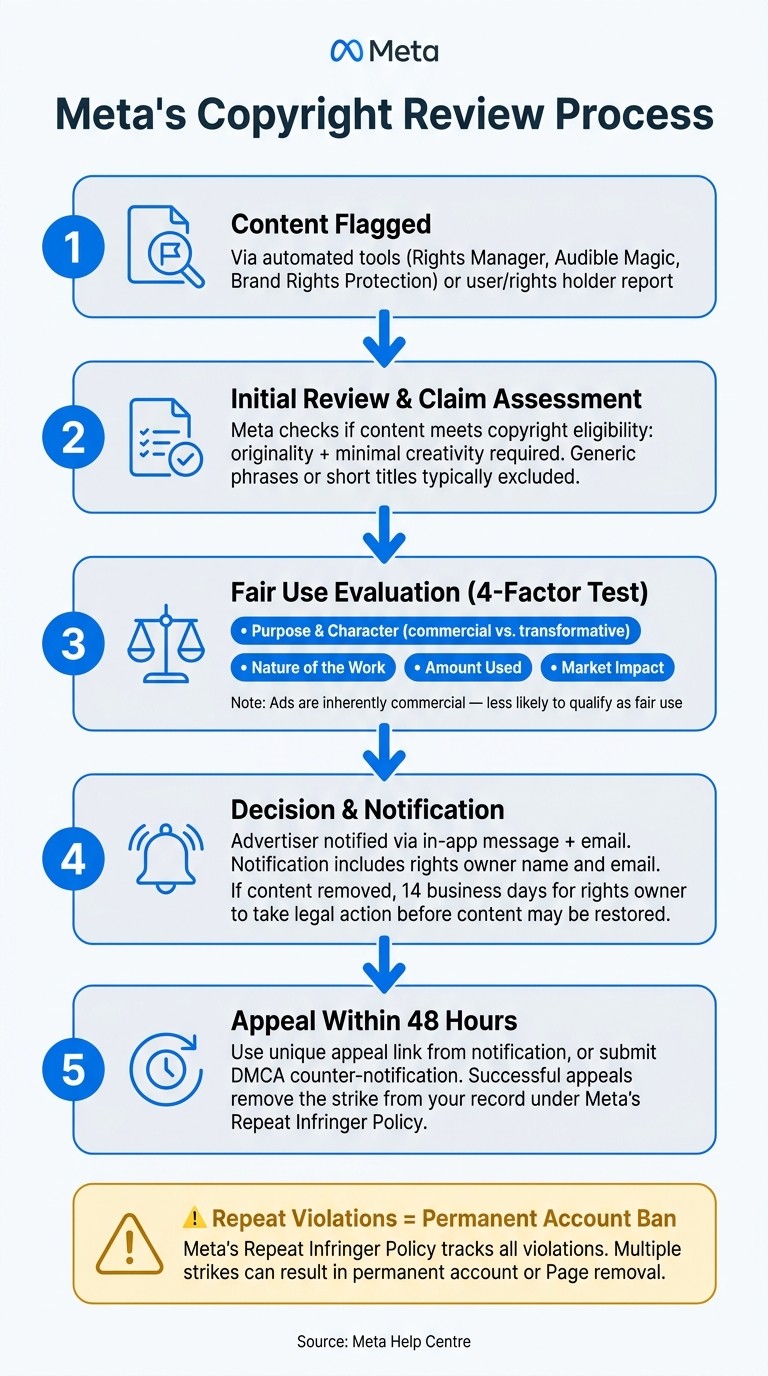
Meta's Copyright Review Process: Step-by-Step Guide
When Meta flags potential copyright infringement, whether through automated detection or user reports, it follows a structured process. Many advertisers now use AI compliance tools to identify potential issues before they trigger these reviews. Knowing these steps can help you understand what happens behind the scenes and what to expect if your ad is flagged.
Here’s how Meta handles copyright claims:
Initial Review and Claim Assessment
The first step is determining if the flagged content qualifies for copyright protection. Meta evaluates whether the content shows originality and a minimal level of creativity. Generic names, short phrases, or common titles typically don’t meet the criteria, but unique images, videos, or audio usually do. If a valid report is received, Meta often removes or blocks the content immediately - sometimes without notifying the advertiser beforehand.
"To be original enough for copyright protection, a work needs to be created by the author themselves and have some minimal amount of creativity." - Meta Help Centre
Once Meta confirms the content is eligible for copyright protection, it moves on to assess whether the use of the material falls under fair use.
Fair Use and Transformative Use Considerations
Not all uses of copyrighted material are violations. Meta applies a four-factor fair use test, as outlined in U.S. copyright law, to evaluate flagged content:
Fair Use Factor | What Meta Looks At |
|---|---|
Purpose and Character | Is the use transformative? Is it for commercial purposes or educational? |
Nature of the Work | Is the original work factual or highly creative? |
Amount and Substance | How much of the work was used? Was it the most important part? |
Effect on Market | Does the use compete with or replace the need to purchase the original work? |
The first factor - purpose and character - is particularly tricky for advertisers. Since ads are inherently commercial, they’re less likely to qualify as fair use. For example, using a copyrighted song in the background of a product ad, even for just a few seconds, is unlikely to pass this test.
It’s worth noting that giving credit to the original creator or adding a "no infringement intended" disclaimer doesn’t influence Meta’s decision. These actions are entirely disregarded during the review process.
How Meta Communicates Review Decisions
After completing its review, Meta informs advertisers of the decision. If your content is removed, you’ll receive a notification via in-app messaging on Facebook or Instagram, as well as an email sent to your account’s primary email address. This notification includes the name and email of the rights owner who filed the claim, enabling you to contact them directly to resolve the issue or request a retraction.
"If we remove content that you posted because of an intellectual property report... you'll receive a notification from Meta that may include the name and email address of the rights owner who made the report." - Meta
If the flagged content was posted on a Page, all Page admins will receive the notification. Implementing Meta ad policy training can help teams avoid these flags. It will also identify which admin originally posted the content. Meta provides instructions for monitoring compliance and submitting a formal appeal or filing a DMCA counter-notification. If the rights owner doesn’t take legal action within 14 business days, Meta generally restores the removed content.
Consequences of Copyright Violations on Meta
When it comes to copyright violations, Meta enforces strict penalties. These range from rejecting a single ad to imposing account restrictions, and in extreme cases, even account termination.
Ad Disapprovals and Account Restrictions
The first and most immediate consequence is ad rejection. If a copyright holder files a report or Meta's automated system flags your content as high-risk, the ad in question is pulled from delivery.
But it doesn’t stop there. Depending on the severity, Meta may impose restrictions on your account. These account restrictions can disrupt your entire advertising workflow. This could mean a temporary block on posting photos or videos or losing access to certain platform features. In some cases, rights holders using Meta's Rights Manager can take it a step further by blocking the infringing content entirely, making it visible only to the account that posted it.
Repeated violations carry even heavier consequences, as explained below.
Escalation for Repeat Violations
One violation is serious, but multiple infractions can lead to much harsher penalties. Meta's Repeat Infringer Policy tracks these violations over time, and continued offenses could result in your account being permanently disabled.
"If you repeatedly post content that infringes someone else's intellectual property rights... your account may be disabled or your Page removed." - Meta Help Centre
There is some room for redemption. If you successfully appeal a decision and Meta restores your content, or if the rights holder withdraws their report, that specific violation is removed from your record.
However, submitting false copyright reports can backfire. Meta takes fraudulent claims seriously and may terminate accounts involved in such activities.
How to Avoid Copyright Issues on Meta
Preventing copyright issues is much easier than dealing with rejected ads or restricted accounts. A few consistent habits can help you steer clear of most violations.
Auditing Creative Assets for Compliance
Before submitting an ad, take a moment to evaluate every creative element - images, videos, audio, and written content - by asking these three key questions:
Did I create this content myself?
Do I have written permission or a proper license for anything I didn’t create?
Does the content fall under a legal exception like fair use, or is it in the public domain?
"The best way to help make sure that what you post to Meta platforms, such as Facebook and Instagram, doesn't violate copyright law is to only post content that you've created yourself." - Meta Help Centre
It’s important to remember that disclaimers or giving credit won’t protect you from copyright issues. For example, background music in a video recorded at an event could still result in a violation, even if it was unintentional. Don’t forget to review all elements on your landing page as well - unlicensed content there can also lead to ad rejections. By auditing your assets thoroughly, you can reduce the chances of running into problems during Meta's automated or manual reviews.
Setting Up Internal Review Processes
In addition to auditing your assets, having internal systems in place ensures long-term compliance. A simple checklist can be a game-changer. Before any ad goes live, confirm that all content is either original, properly licensed, or legally cleared for use. Keep written documentation on hand - if you’re using third-party content, make sure the license or permission is stored and accessible.
Train your team to review not just the visuals but also the video and audio components carefully. If you work with freelancers or contractors, ensure your contracts clearly outline who owns the rights to the work they produce. For in-house teams, confirm that employee agreements assign ownership of creative works to your company. Remember, copyright protects original creative works like photos and music, while trademarks cover brand names and logos - both need to be checked under Meta’s policies.
Using AdAmigo Protect for Account Monitoring
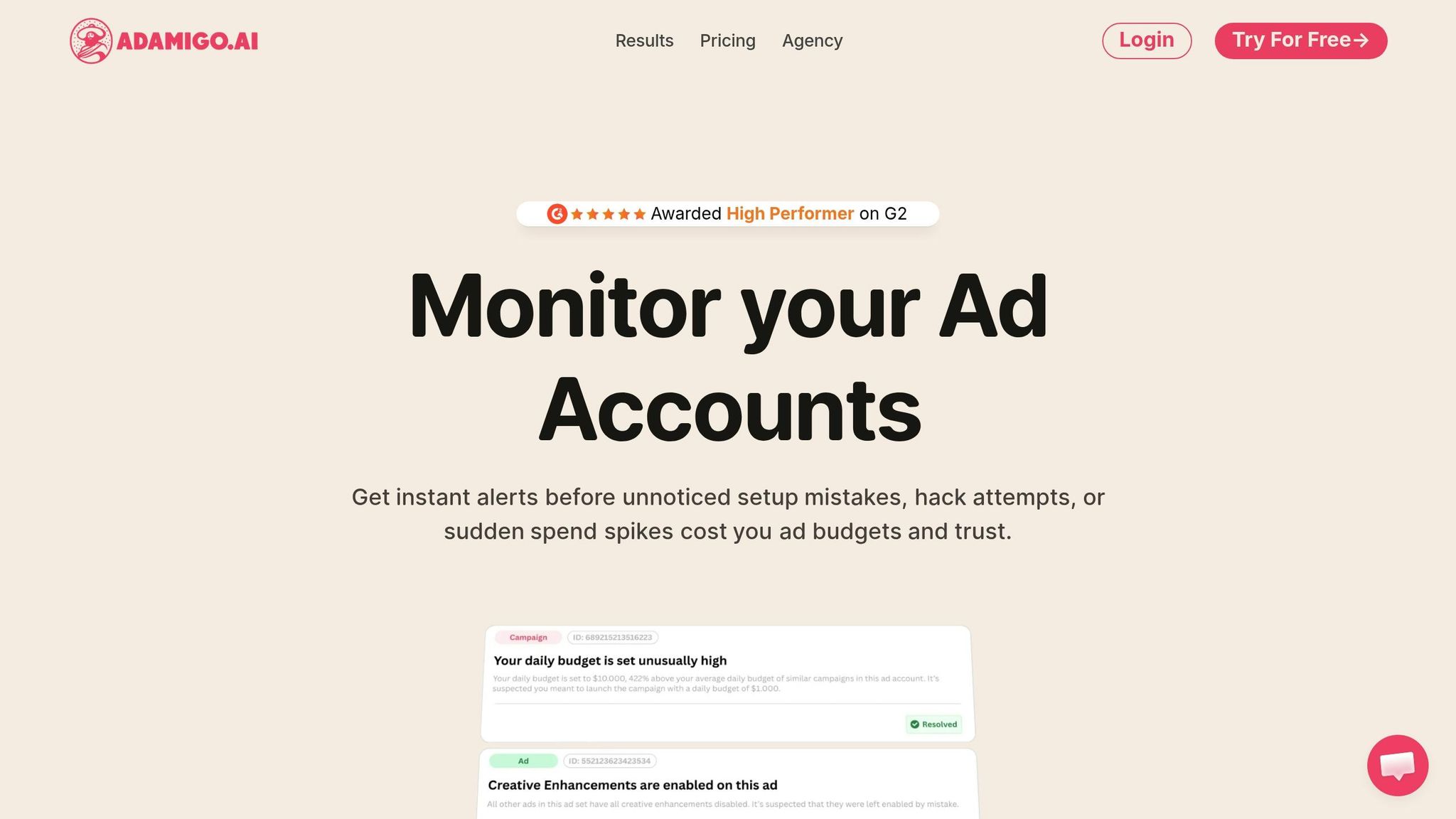
Internal processes are essential, but ongoing monitoring can catch issues before they escalate. AdAmigo Protect is a tool designed specifically for Meta ad accounts. It continuously tracks account health and ad performance using AI tools for Meta ad account analysis, flagging unusual activity, delivery problems, or other issues early on - giving you time to address them before they grow into bigger challenges.
Instead of manually checking for warning signs, AdAmigo Protect works in real-time to identify risks. This is especially helpful for advertisers juggling multiple campaigns or managing large volumes of creative content. With this kind of oversight, you can quickly address compliance issues and maintain your account’s standing.
How to Appeal a Copyright Decision on Meta
If Meta removes your content or rejects an ad due to a copyright claim, you have the option to appeal. The process begins with the removal notification you receive, which outlines the flagged content and provides instructions for next steps.
How to Submit an Appeal to Meta
The removal notification from Meta is your guide. It specifies the content in question and includes instructions for filing an appeal. Carefully review this notification to understand why the content was flagged and how to proceed.
The appeal process differs depending on the type of removal:
For posts on Facebook or Instagram, use the unique appeal link provided in the notification.
If your content was removed under the U.S. DMCA, submit a formal DMCA counter-notification following the steps outlined in the message.
It's important to note that only the original poster can file an appeal. For instance, group admins cannot appeal on behalf of a group member.
Alternatively, you can try to resolve the issue directly with the rights owner. Meta often includes the rights owner's email in the notification. For ad-related problems, you can use AI automation platforms for managing Meta ads or head to the Account Quality dashboard in Meta Business Manager, where you can request a review of restricted business assets and ensure compliance with governance tools.
"If we remove content that you posted because of an intellectual property report... you'll receive a notification from Meta that may include the name and email address of the rights owner who made the report." - Meta Help Centre
Meta generally resolves standard ad appeals within 48 hours. However, more complex cases requiring manual review may take additional time.
If you believe your content falls under fair use, you can strengthen your appeal by building a structured argument based on the guidelines below.
Building a Fair Use Argument for Your Appeal
When you believe your use of copyrighted material is legally justified, a fair use argument can be a strong defense. Meta acknowledges fair use for purposes such as criticism, commentary, parody, satire, news reporting, teaching, and research. To make your case, address the following four fair use factors:
Fair Use Factor | What to Address |
|---|---|
Purpose of use | Did your use transform the original by adding new meaning, commentary, or context? |
Nature of the original work | Was the source material factual rather than highly creative? |
Amount used | Did you use only a small, non-essential portion of the original work? |
Market impact | Did your use have little to no effect on the original work's commercial value? |
If you have licensed the content or obtained written permission, include those documents with your appeal. The more specific and well-documented your evidence, the better your chances of success. Another important point: if your appeal is approved, the original removal won’t count against you under Meta’s Repeat Infringer policy, so your account remains unaffected.
Conclusion and Key Takeaways
Meta's approach to copyright enforcement is both swift and heavily automated. With a team of over 15,000 content reviewers and advanced tools like Rights Manager, infringing content is identified and removed almost immediately.
To avoid violations, ensure every element of your ad content is either fully original or properly licensed. This includes checking details like background music, stock footage, fonts, and images before publishing.
Intentions won't save you. Simply crediting the original creator or adding disclaimers won't shield you from violations. Meta's Repeat Infringer policy is strict - multiple strikes can lead to permanent account bans or the removal of your Page. Taking a proactive stance is essential to keep your campaigns running smoothly.
Tools like AdAmigo Protect can act as a safeguard, offering automated monitoring to detect unusual activity, delivery issues, or performance drops. Addressing potential problems early allows you to act quickly - whether that means removing flagged content, filing appeals, or preventing disruptions to your campaigns. Ultimately, understanding Meta's copyright policies and staying ahead of potential issues is critical for safeguarding your advertising efforts.
FAQs
What types of ad content are most commonly flagged for copyright?
Ad content that frequently gets flagged for copyright violations typically involves counterfeit goods or unauthorized copies of protected materials. This includes items like pirated videos, music, books, TV shows, and movies. Ads promoting or selling these types of infringing products are especially at risk. To steer clear of penalties, always ensure your content adheres to copyright laws.
How can I prove I have the rights to use music, images, or video in my ads?
To show you have permission to use music, images, or video in your ads, you’ll need to provide documentation or proof of a license or authorization from the rights holder. Meta’s policies require all ads to respect intellectual property rights, including copyright laws.
What should I include in an appeal to improve my chances of reinstatement?
To boost your chances of getting reinstated after a copyright issue, focus on providing the following:
Proof of rights: Include licenses, permissions, or any documentation showing you have the legal right to use the content.
Corrective actions: Explain what steps you've taken to resolve the issue, such as removing the infringing material.
Commitment to compliance: Clearly state your intention to adhere to copyright rules moving forward.
Keep your appeal straightforward and honest. Attach all relevant documents to back up your claim - strong evidence makes a big difference.