
Global Privacy Laws Impacting AI in Ads
Global privacy laws are forcing advertisers to redesign AI-driven targeting, consent and labeling or face heavy fines.
AI is transforming digital advertising, but global privacy laws are tightening restrictions on how personal data can be used for targeted ads. With 137 countries enforcing data protection laws, businesses face increasing fines and operational challenges for non-compliance. Key regulations like the EU’s GDPR, California’s CCPA/CPRA, and the EU AI Act demand stricter consent, transparency, and accountability from advertisers.
Key Takeaways:
GDPR fines have exceeded €5.88 billion, and the EU AI Act imposes penalties up to €35 million or 7% of global revenue.
U.S. advertisers targeting international audiences must comply with local laws, such as California’s ADMT regulations and Colorado AI Act (effective June 2026).
Privacy risks include AI profiling sensitive data and purpose creep, where data is repurposed without user consent.
Upcoming laws in India, South Korea, Brazil, and Australia introduce stricter AI labeling, consent rules, and bans on certain practices.
To avoid fines, advertisers must adopt geo-aware consent tools, implement a Meta Ads privacy strategy, ensure transparency in AI profiling, and align with region-specific compliance standards. Privacy compliance isn’t just legal - it's critical for maintaining user trust and ad performance.
AI Privacy Risks in Digital Advertising
How AI Processes Ad Data
Modern advertising platforms rely heavily on data transformation. AI systems in advertising operate on two main levels: training data and operational data. Training data includes massive datasets sourced from social media feeds, forum discussions, and behavioral signals. These datasets are used to develop predictive models, such as those estimating click-through rates. On the other hand, operational data refers to real-time inputs like page visits, online purchases, and app interactions, which help make instant decisions for bidding and targeting.
In today’s cookie-less landscape, AI's approach to audience building has shifted significantly. By extracting data from unconventional sources like social media comments and Reddit threads, AI can create look-alike audiences without relying on traditional tracking methods. However, this new approach introduces fresh data flows that often fall outside the scope of the original user consent agreements. This shift highlights the growing privacy concerns tied to evolving data practices.
Privacy Risks of AI-Driven Ads
AI-powered ad targeting introduces risks not only from the data it collects but also from the inferences it generates. For example, AI can deduce sensitive information, such as health conditions, financial status, or political beliefs, from seemingly harmless data like location history. These insights are often invisible to users, leaving them unaware of why they’re being targeted and making the system nearly impossible to audit or contest.
"To the GDPR, such behind-the-scenes profiling could foster discrimination and infringe on legal rights, while potentially even prying on people's vulnerabilities." - Kevel Team
Another concern is purpose creep, where data initially shared for one purpose is later repurposed for AI training without obtaining fresh consent from users. These practices pose significant compliance challenges, especially when they conflict with legal frameworks designed to regulate AI-driven advertising.
Why U.S.-Based Meta Advertisers Are Affected

U.S. advertisers face global privacy regulations whenever their ads reach consumers in jurisdictions with stringent privacy laws. Compliance requirements are determined by the consumer’s location, not the advertiser’s. For instance, in May 2023, the Irish Data Protection Commission fined Meta €1.2 billion for transferring EU user data to U.S. servers without proper authorization. This record-breaking fine underscores the risks tied to cross-border data transfers, which are central to Meta’s ad targeting operations. Beyond the financial penalties, such breaches disrupt essential data flows, creating additional operational challenges and reinforcing the importance of compliance as a critical business priority.
Key Global Privacy Laws Affecting AI in Ads
GDPR and AI Advertising in the EU
The General Data Protection Regulation (GDPR) is a cornerstone privacy law impacting AI-driven advertising across the EU/EEA. One of its key requirements is explicit opt-in consent before initiating non-essential tracking, such as tools like Meta Pixel or Conversions API. With GDPR fines exceeding €5.88 billion, failure to comply carries serious financial consequences.
A particularly relevant aspect for AI advertising is Article 22, which grants users the right to human intervention and the ability to challenge decisions made entirely by automated systems. This means that AI-driven targeting and bidding processes must not only be transparent but also open to scrutiny. Ignoring these rules can lead to hefty fines and a potential 20–40% reduction in PPC efficiency, as critical features like Smart Bidding signals and Customer Match could be impacted.
Interestingly, U.S. privacy laws take a different approach, relying on opt-out mechanisms, which present unique compliance challenges.
CCPA/CPRA and U.S. State Privacy Laws
In the United States, California leads the way with privacy regulations that differ significantly from the EU model. The CCPA/CPRA gives consumers the right to opt out of data being sold or shared. For advertisers on platforms like Meta, this means prominently offering a "Do Not Sell or Share My Personal Information" option and honoring Global Privacy Control (GPC) browser signals as legitimate opt-out requests.
Penalties under these laws can reach up to $7,500 per intentional violation, adding a layer of risk for non-compliance. California also addresses AI specifically through its Automated Decision-Making Technology (ADMT) regulations, which require businesses to conduct risk assessments for AI systems involved in profiling consumers. Meanwhile, Colorado is breaking new ground with its AI Act, set to take effect on June 30, 2026, making it the first comprehensive state-level AI law. This law will require clear disclosure when generative AI tools are used in consumer interactions.
Feature | GDPR (EU) | CCPA/CPRA (California) |
|---|---|---|
Primary Mechanism | Opt-in (explicit consent) | Opt-out (right to stop sale/share) |
AI Specifics | Article 22 (automated decisions) | ADMT regulations (risk assessments) |
Max Penalty | 4% of global annual revenue | $7,500 per intentional violation |
The EU AI Act and What It Means for Ads
The EU AI Act, effective August 1, 2024, is the first legal framework dedicated to regulating AI systems globally. It employs a risk-based structure, with higher-risk applications facing stricter requirements. As of February 2, 2025, the Act bans AI practices that rely on subliminal manipulation or deceptive tactics. By August 2026, high-risk AI systems, such as those used in employment or credit advertising, will need to comply with rigorous transparency, human oversight, and documentation standards. Non-compliance with these prohibited practices could result in fines of up to €35 million or 7% of global annual revenue, whichever is greater.
Other Global Laws That Apply to AI in Ads
Outside the EU and U.S., other regions are also enforcing privacy laws that impact AI in advertising. Brazil’s LGPD closely resembles GDPR, requiring opt-in consent for ad tracking, along with a Portuguese-language consent interface for Brazilian users. India’s DPDP Act, expected to be fully enforced by mid-2027, demands specific, informed opt-in consent and parental consent for users under 18. Non-compliance could result in penalties of up to ₹250 crore (~$30 million USD) per violation.
AI labeling is another growing trend globally. For example, laws in South Korea (effective January 2026), China (effective September 2025), and India (effective February 2026) require clear disclosure of AI-generated ad content. China’s regulations go a step further, mandating both visible labels and embedded metadata for AI-generated materials.
As Mengyi Xu, Competition Counsel at Anthropic, explains:
"Fragmentation in and of itself is not really the problem. It's where you get inconsistent or mutually exclusive technical requirements."
This regulatory patchwork creates significant challenges for advertisers running AI-driven campaigns across multiple jurisdictions, particularly on platforms like Meta.
Transparency and Accountability in AI Advertising
Disclosure Rules for AI Profiling
Regulators worldwide are pushing for transparency in how AI profiling is disclosed. For example, GDPR Articles 13 and 14 and EU AI Act Article 50 require businesses to clearly explain the logic behind automated profiling , such as behavioral clustering, and notify users when interacting with AI-generated content.
This push for transparency isn't limited to Europe. California's SB 942 (AI Transparency Act), set to take effect in August 2026, will make it mandatory to disclose the origins of AI-generated content. South Korea enforces similar rules, requiring "AI-made" labels on all AI-generated or AI-assisted ads starting January 2026. Meanwhile, China has taken it a step further by mandating both a visible label and embedded machine-readable metadata for AI-produced content. A key technical standard for embedding metadata is C2PA (Coalition for Content Provenance and Authenticity), which uses cryptographic signatures to verify AI involvement.
Legal tech strategist Rahul Beladiya emphasizes the importance of a unified approach:
"A single explanation template that covers logic, factors, contestation rights, and human review pathways usually satisfies the core obligation across regimes."
These evolving disclosure rules are crucial for managing user consent across varying legal landscapes.
Consent and User Rights
Transparency alone isn't enough - obtaining proper user consent is just as critical. Consent rules differ from region to region, and mistakes can lead to hefty penalties. For instance:
EU and Brazil: Users must give opt-in consent before any non-essential tracking begins.
U.S. (CCPA/CPRA): Operates on an opt-out model, where users must actively decline tracking.
California's upcoming ADMT regulations (effective January 2027) introduce additional responsibilities. Businesses using automated decisions that affect significant consumer outcomes will need to provide pre-use notices and offer clear opt-out options. For advertisers targeting global audiences, a location-aware Consent Management Platform (CMP) can simplify compliance by applying the correct consent rules for each region.
When it comes to sensitive data - like health information, financial records, or children's data - stricter rules apply. For example, India's DPDP Act requires parental consent for users under 18, while Brazil's ANPD holds platforms accountable as "co-authors" of harmful AI-generated content if they fail to act on it.
Governance and Human Oversight
Strong governance ensures that disclosure and consent practices are effectively monitored. For example, GDPR Article 35 mandates a Data Protection Impact Assessment (DPIA) before implementing high-risk AI systems, such as large-scale ad targeting tools. Similarly, the EU AI Act requires a Fundamental Rights Impact Assessment for high-risk AI deployments. It also mandates registration in EU databases and insists that human reviewers have the authority to override or shut down AI decisions when necessary.
For organizations operating across multiple jurisdictions, frameworks like the NIST AI Risk Management Framework (RMF) and ISO/IEC 42001 provide a helpful foundation for governance programs that meet diverse regulatory requirements. Keeping detailed, time-stamped logs of user consent, data flows, and AI configurations can further demonstrate compliance. Integrating human-in-the-loop checkpoints ensures that AI decisions remain subject to meaningful human oversight.
How AI and Marketing Are Reshaping Consumer Privacy and Digital Advertising
How to Build Privacy-Compliant AI Ad Workflows
When dealing with privacy risks in AI-driven advertising, it's crucial to secure your workflows. Here's how you can do it effectively.
Data Minimization and Purpose Limitation
The golden rule for privacy compliance is simple: only collect what you absolutely need. Gathering unnecessary data increases your risk exposure. Under GDPR, failing to follow principles like data minimization could result in fines as high as €20 million or 4% of your global annual revenue.
One practical approach is to separate operational data (used for real-time ad delivery) from the data used for training or refining AI models. Legal tech strategist Rahul Beladiya emphasizes:
"AI training and inference must each rest on a valid basis."
This is important because data collected for ad delivery cannot automatically be repurposed for AI training. Doing so requires either a new legal basis or an assessment of compatibility. To manage this, implement server-side tracking (sGTM), which allows you to control data flows. As Matt, Tracking & Data Lead at SteerAds, explains:
"Server-side GTM (sGTM) lets you control exactly what data leaves your environment to ad platforms. You can redact PHI/PII server-side."
Additionally, sensitive identifiers like email addresses or phone numbers should be hashed with SHA-256 before syncing with any ad platform. This simple step can significantly reduce your exposure.
Now, let’s dive into how to implement these controls using Meta Pixels and audience tracking.
Setting Up Meta Pixels and Audiences for Compliance
Configuring your Meta Pixel correctly is where compliance becomes actionable. Start by mapping all data flows - this includes pixel triggers, CAPI calls, and more - so you know exactly what’s being collected and where it’s going.
Next, configure Aggregated Event Measurement (AEM) in Meta Events Manager. Prioritize your top 8 events per domain to ensure that measurement remains functional, even when data use is limited by consent restrictions. Pair this with the Conversions API and use the data_processing_options parameter to signal how user data should be handled based on location. For instance, enable Restricted Data Processing (RDP) for users in California who opt out under CCPA/CPRA.
Your Consent Management Platform (CMP) should be geo-aware, automatically switching between GDPR opt-in flows for EU visitors and CCPA opt-out flows for U.S. visitors based on their IP address. Ensure your CMP is certified for frameworks like IAB Europe's TCF 2.2 and blocks pixel or CAPI scripts until consent is granted. It’s also important to honor Global Privacy Control (GPC) signals, as several U.S. states now recognize GPC as a valid opt-out request.
When building lookalike audiences, make sure to use only hashed, consented data as your source. Keep detailed logs of every consent decision to serve as evidence for regulatory compliance.
Choosing and Using AI Ad Tools Responsibly
Once your data flows are secured, focus on selecting AI ad tools that align with compliance standards.
Not all AI ad platforms are designed with privacy in mind. When evaluating tools, ensure they work through the platform's official API, have transparent data retention policies, and provide clear explanations of their actions.
For example, AdAmigo.ai integrates through Meta's official API and adheres to its permissions, rate limits, and guidelines. Its AI Autopilot feature includes a human-in-the-loop option, allowing you to review and approve every optimization before execution. This supports GDPR Article 35 and the EU AI Act's human oversight requirements. Additionally, the platform provides plain-language explanations for every AI action, meeting GDPR's mandate to share "meaningful information about the logic involved" in automated decision-making.
Prioritize tools that offer explainability and auditability. Setting up a multi-region compliance system can be costly, with initial configurations ranging from $15,000 to $60,000 and ongoing costs between $1,000 and $3,500 per month for CMP licensing and server-side hosting. However, as Matt at SteerAds wisely notes:
"Compliance is cheaper than fines."
What to Expect from AI Privacy Regulation
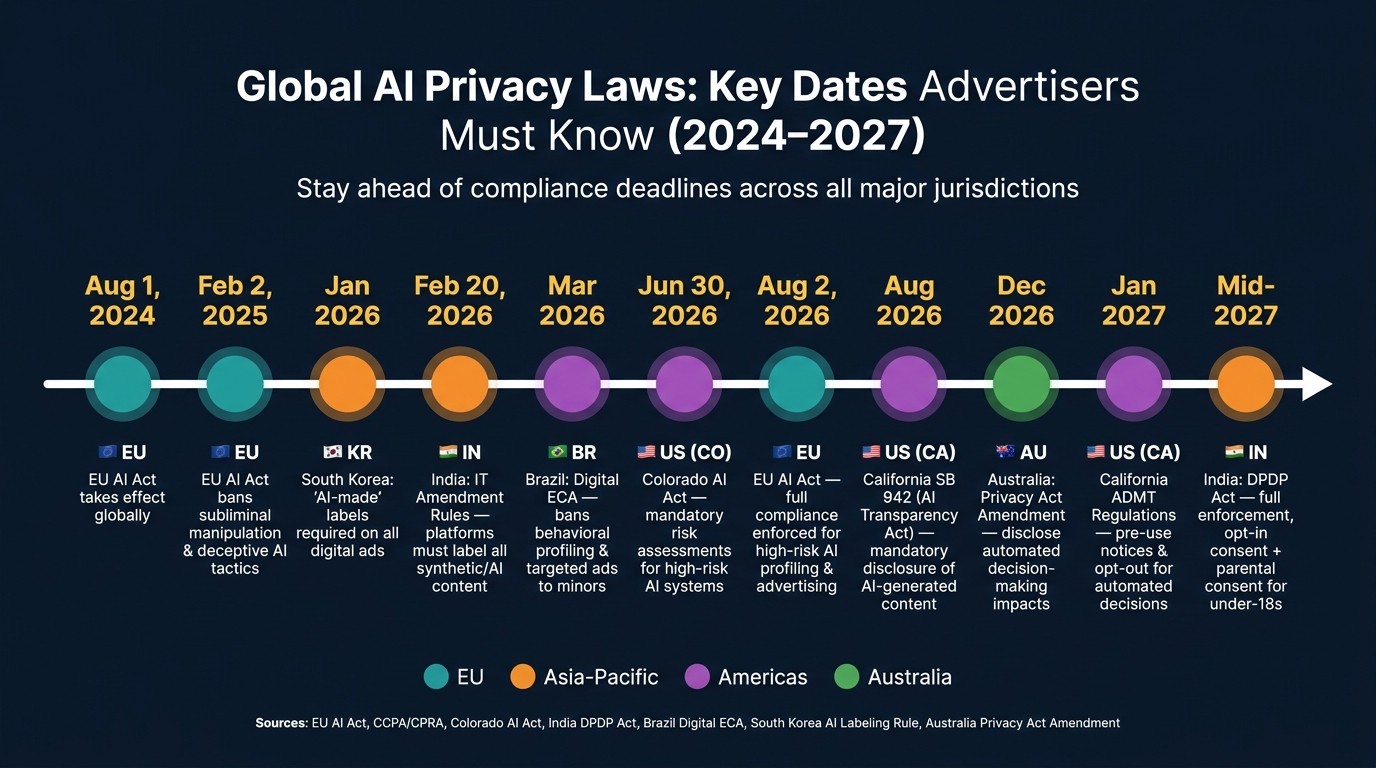
Global AI Privacy Laws Timeline: Key Dates for Advertisers (2024–2027)
Emerging Trends in AI Privacy Regulation
AI privacy regulations are evolving fast, and 2026 is shaping up to be a pivotal year. Key laws like the Colorado AI Act will take effect on June 30, 2026, requiring mandatory risk assessments for high-risk AI systems. Similarly, the EU AI Act will enforce strict compliance for high-risk profiling and advertising systems starting August 2, 2026. In December 2026, Australia will implement amendments to its Privacy Act, compelling companies to disclose when automated systems significantly impact individuals.
AI labeling is also gaining momentum. South Korea now mandates "AI-made" labels on digital ads, a rule that began in January 2026. India has introduced similar requirements under its IT Amendment Rules, effective February 20, 2026, which demand that synthetic content be labeled. Brazil's Digital ECA, effective March 2026, has gone a step further by outright banning behavioral profiling and targeted ads aimed at minors.
Here's a breakdown of upcoming and active regulations:
Region | Regulation | Effective Date | Key Impact on AI Ads |
|---|---|---|---|
South Korea | AI Labeling Rule | Jan 2026 | Requires "AI-made" labels on digital ads |
India | IT Amendment Rules | Feb 2026 | Platforms must label all synthetic content |
Brazil | Digital ECA | Mar 2026 | Prohibits behavioral profiling and ads targeting minors |
Colorado (US) | Colorado AI Act | Jun 2026 | Risk assessments required for high-risk AI systems |
EU | EU AI Act | Aug 2026 | Enforces compliance for high-risk profiling and ads |
Australia | Privacy Act Amendment | Dec 2026 | Mandates disclosure for automated decision-making |
Beyond labeling, regulators are putting more emphasis on algorithmic accountability. This includes binding requirements for external audits and ensuring traceability of AI training data. As Mengyi Xu, Competition Counsel at Anthropic, aptly noted:
"Fragmentation in and of itself is not really the problem. It's where you get inconsistent or mutually exclusive technical requirements."
For global advertisers, the challenge isn't just about staying updated on these laws. It's also about navigating conflicting requirements across different jurisdictions. These developments mean advertisers must continuously adapt their compliance strategies to avoid falling behind.
Getting AI Ad Operations Ready for What's Next
Adapting to these regulations requires a proactive approach. Start by asking your AI ad vendors to provide a governance map updated quarterly. This map should include details about their data sources, compliance status, and the jurisdictions they operate in. With liability increasingly shifting toward agencies and advertisers - especially when AI operates on client-side infrastructure - it's crucial to have documented proof that your tools meet the latest standards.
From a technical standpoint, adopting privacy-by-design principles is essential. This involves integrating features like consent logic, data minimization, and retention limits directly into your campaign workflows, rather than treating them as afterthoughts.
Additionally, ensure your AI creative pipeline meets labeling requirements. If you're running AI-generated ads in countries like South Korea, India, or Canada, proper disclosures - such as visible "AI-generated" labels or embedded metadata - must be in place before deployment. Staying ahead of these requirements can save time and resources, preventing costly last-minute adjustments. This forward-thinking approach aligns with the global push for greater transparency and accountability in AI advertising.
Conclusion
Privacy compliance in AI advertising is more than a legal requirement - it's a business necessity. A striking 69% of U.S. consumers have abandoned transactions over concerns about how their data was used. With regulations like the EU AI Act set to take effect in 2026, ignoring compliance could lead to rising costs and lost opportunities. Advertisers should follow a GDPR and CCPA checklist to mitigate these risks.
But here’s the good news: prioritizing privacy doesn’t mean sacrificing ad performance. By implementing clean tracking methods, properly configured consent mechanisms, and strict safeguards, advertisers can gather higher-quality data. This not only reduces costs but also improves campaign outcomes. On the flip side, poor compliance can lead to hefty fines and underwhelming ad results.
Take AdAmigo.ai as an example. Built on Meta's official API, it offers a feature called AdAmigo Protect, which keeps a close eye on your ad account. It flags configuration errors, anomalies, and delivery issues, while its automated audit trail slashes review times from hours to just minutes.
As regulations grow stricter, the advertisers who succeed will be those who see compliance as an ongoing effort, not a one-and-done task. By embedding privacy into their operations, they’ll earn consumer trust and maintain strong ad performance - ensuring long-term success in an evolving landscape.
FAQs
Do I need to follow GDPR if my business is in the U.S.?
If your U.S.-based business provides goods or services to individuals in the EU or tracks their online behavior, you are required to comply with the General Data Protection Regulation (GDPR). This regulation applies to any organization handling the personal data of EU residents.
For businesses running Meta ad campaigns, tools like AdAmigo.ai can simplify compliance. These tools help automate consent management and data processing settings, ensuring alignment with GDPR and other global privacy regulations.
How can I run AI targeting without using sensitive data?
Privacy-Enhancing Technologies (PETs), such as homomorphic encryption and federated learning, are powerful tools that let you extract valuable insights without needing direct access to personal data. To stay compliant, it's crucial to map out your workflows carefully, ensuring you monitor how data is processed at every stage. Automated compliance tools can also help by flagging potential profiling violations before they become an issue.
Platforms like AdAmigo.ai, which integrates seamlessly with Meta's official API, offer a way to set up custom rules and privacy safeguards. This ensures your AI-driven targeting strategies remain both secure and in line with privacy regulations.
What do I need to label as 'AI-generated' in ads?
The rules for disclosing AI-generated content differ depending on the region, but transparency is often required. For instance, in Canada, any content created or significantly modified by AI must include clear labels such as #MadeWithAI or #AIcreated. Similarly, AI influencers are expected to use tags like #VirtualInfluencer to inform audiences about their artificial nature.
In the United States, some states, including California and Utah, mandate disclosure when interacting with AI systems, such as chatbots. These regulations are designed to ensure users are aware they are engaging with AI rather than a human. To stay compliant, always use accurate disclosures and avoid practices like misleading claims or "AI-washing."