
5 Steps To Optimize Meta Ads Conversion Funnels
Full-funnel Meta ads—from TOFU to BOFU—boost conversions by aligning audiences, creatives, landing pages, and using automated testing.
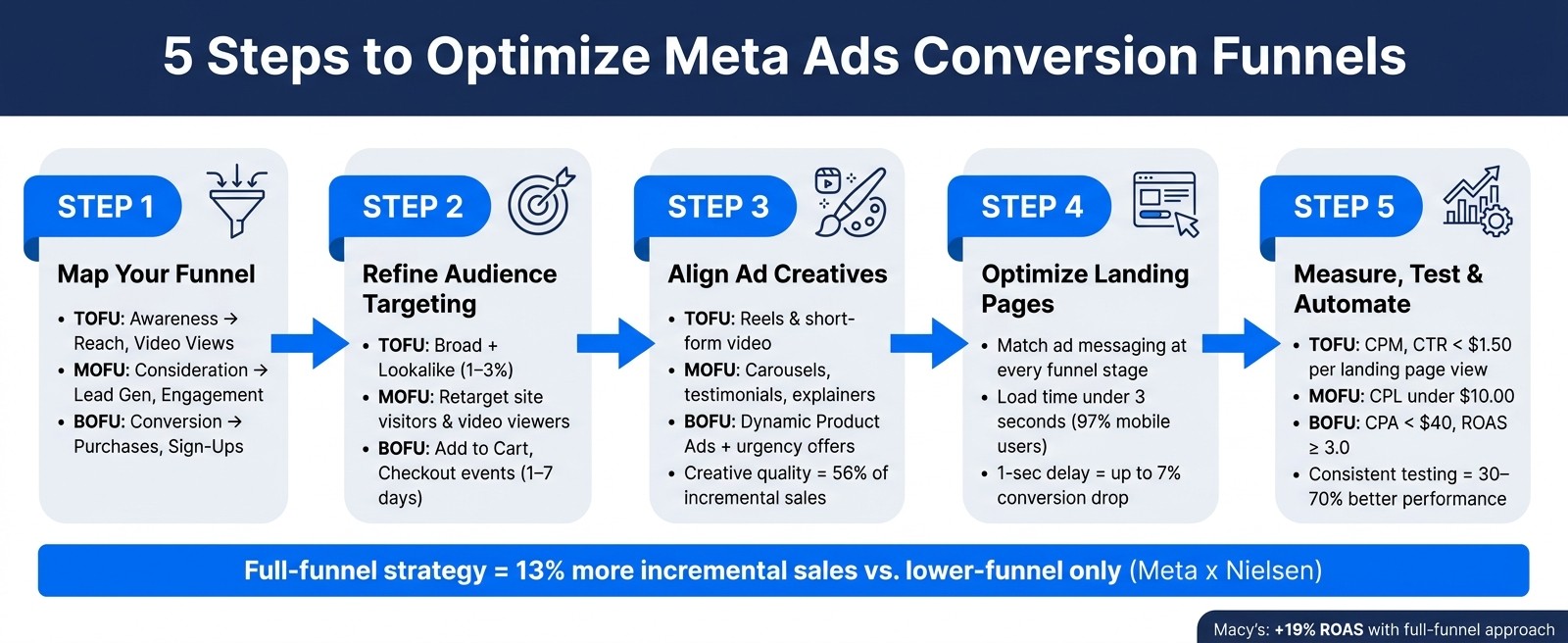
Want better results from your Meta ads? The secret lies in a full-funnel Meta ads setup that guides users from awareness to conversion. Here's a quick breakdown of the 5 steps to optimize your Meta Ads conversion funnel:
Map Your Funnel: Define three stages - TOFU (Awareness), MOFU (Consideration), and BOFU (Conversion). Each stage targets specific audiences with tailored goals and metrics.
Refine Audience Targeting: Use broad targeting at TOFU, retarget engaged users at MOFU, and focus on high-intent actions like Add to Cart at BOFU.
Align Ad Creatives: Match your messaging and formats to the funnel stage. TOFU grabs attention, MOFU builds trust, and BOFU drives action.
Optimize Landing Pages: Ensure your landing pages align with your ad messaging, load quickly, and fit the user's funnel stage.
Measure, Test, Automate: Track the right metrics, run structured tests, and use AI tools to optimize performance.
Pro Tip: Macy’s saw a 19% ROAS increase by adopting a full-funnel strategy. Follow these steps to improve CTR, reduce CPA, and boost conversions.
5 Steps to Optimize Meta Ads Conversion Funnels
Facebook Ads Funnel Explained: From Clicks to Conversions
Understanding the journey from initial awareness to final purchase is key to full-funnel Meta ads optimization.
Step 1: Map Your Meta Ads Conversion Funnel
Mapping out your funnel is crucial for aligning audience targeting, ad creative, and landing pages. Before diving into optimizing your audience or ad copy, you need a clear understanding of how your funnel operates. This clarity helps you spot where users drop off and enables you to fine-tune audience targeting and creative strategies effectively.
Define Your Funnel Stages
Every Meta ads funnel operates through three main stages, each serving a specific purpose:
Funnel Stage | Objective | Audience Type | Campaign Focus |
|---|---|---|---|
TOFU (Awareness) | Build brand recognition | Cold / Broad / Lookalike | Reach, Video Views, Traffic |
MOFU (Consideration) | Nurture interest, build trust | Warm / Engagers / Site Visitors | Lead Gen, Engagement, Traffic |
BOFU (Conversion) | Close the sale | Hot / Cart Abandoners / Subscribers | Purchases, Sign-Ups, Demos |
TOFU (Top of Funnel): This stage focuses on creating brand awareness. It introduces your brand to new audiences using campaigns like reach, video views, or traffic ads.
MOFU (Middle of Funnel): Here, the goal is to re-engage users who have already interacted with your brand - like video viewers or page engagers. Content at this stage builds trust and addresses potential objections.
BOFU (Bottom of Funnel): This stage targets high-intent users - those who are most likely to convert. Ads here should feature direct offers, such as discounts or urgency-driven messages, to close the deal.
In 2026, Banch Marketing shared a case study about a skincare eCommerce brand that implemented this three-stage funnel. They used TOFU "before/after" videos that racked up 1.2 million views, MOFU carousel ads offering discounts to engaged users, and BOFU dynamic ads emphasizing urgency. The result? A conversion rate jump from 1.5% to 4.7%, a CPA drop from $55 to $18, and a ROAS of $9.80 - far above the industry average of $3.20.
Once your funnel stages are defined, the next step is to track the right metrics to evaluate performance at each stage.
Identify Key Metrics for Each Stage
One of the biggest mistakes advertisers make is using the wrong metrics to evaluate funnel performance. For instance, expecting a high ROAS at the awareness stage (TOFU) is unrealistic since this stage focuses on building brand recognition, not direct sales.
Here’s what to track at each stage:
TOFU: Use metrics like CPM, video view rate, and CTR to measure how effectively you’re capturing attention and engaging new audiences.
MOFU: Focus on cost per lead (CPL) and landing page conversion rate to see how well you’re nurturing interest and driving potential customers further down the funnel.
BOFU: At this stage, ROAS, CPA, and purchase conversion rate become the key metrics for evaluating how well your ads are converting high-intent users.
"The CPA x 50 rule: each ad set needs roughly 50 conversion events per week to exit Learning Limited and let Meta's algorithm optimize delivery effectively." - Matt Pru, Stackmatix
If your BOFU campaigns aren’t hitting that 50-conversion threshold, Meta’s algorithm won’t fully optimize, leading to inconsistent results.
Audit Your Current Funnel Performance
After defining your stages and metrics, it’s time to audit your funnel’s current performance. Use Ads Manager to analyze data for each campaign layer. Filter campaigns by objective to separate TOFU, MOFU, and BOFU campaigns.
Look out for the "Learning Limited" status on any ad sets - this indicates that Meta doesn’t have enough conversion data to optimize effectively. Some common issues to look for include:
A high CTR at TOFU but an unusually high CPL at MOFU, which might signal a weak transition between these stages.
Rising CPA at BOFU, which could mean your retargeting audience has shrunk below 10,000 users. This often happens when TOFU and MOFU campaigns aren’t generating enough traffic to feed into the BOFU stage.
Step 2: Refine Audience Targeting by Funnel Stage
Once you’ve mapped out your funnel and identified where users are dropping off, the next step is refining your audience targeting. This ensures your ads align with each stage of the buying journey. Effective audience targeting isn’t just about demographics - it’s about understanding where users are in their decision-making process. Here’s how to tailor your strategy for each funnel stage: TOFU, MOFU, and BOFU.
Set Up TOFU Prospecting Audiences
At the top of the funnel (TOFU), your main focus is expanding awareness. Keep your targeting broad to maximize reach and let Meta’s Advantage+ audience do the heavy lifting. Use minimal restrictions, like a wide age range (e.g., 25–54), the United States as your location, and relevant gender targeting. This approach allows Meta's system to leverage historical pixel data to identify users likely to convert.
For stronger results, consider creating lookalike audiences from high-quality seed lists, such as past purchasers, high-lifetime-value customers, or trial sign-ups. A 1%–3% lookalike audience in the U.S. often outperforms a long list of stacked interests. If you do include interests, stick to one to three broad categories rather than overcomplicating it.
If your campaign has geographic limitations - like regional shipping or state-specific licensing - use DMA/metro area targeting (e.g., "Chicago DMA") or state-level targeting. For local businesses, a 5–15 mile radius around your location works well. Otherwise, nationwide targeting gives Meta’s algorithm the flexibility it needs to optimize effectively.
Build MOFU Retargeting Audiences
MOFU (middle-of-the-funnel) audiences are made up of users who already know about your brand but haven’t converted yet. These audiences might include:
Website visitors (e.g., those who viewed product or pricing pages in the last 14–30 days)
Video viewers (e.g., those who watched 50–75% of your video ads in the last 30–90 days)
Social engagement audiences (e.g., users who interacted with your Facebook or Instagram profiles in the last 30–90 days)
For products with shorter decision cycles, use a 7–14 day retargeting window. For higher-ticket items or B2B offers, extend this to 30–90 days, especially if you’re using sequential messaging. For example, start with educational content, follow up with social proof, and finish with a direct offer. Always exclude recent purchasers to avoid wasting ad spend on users who’ve already converted.
Once you’ve optimized MOFU audiences, it’s time to focus on high-intent users at the bottom of the funnel.
Create BOFU High-Intent Audiences
BOFU (bottom-of-the-funnel) audiences are your most valuable group - users who are closest to making a purchase. Build these audiences from actions like Add to Cart, Initiate Checkout, or Add Payment Info events, typically within the last 3–7 days. For lead-based businesses, include CRM lists of warm leads, such as people who requested a quote, attended a webinar, or downloaded a resource but haven’t yet purchased.
Dynamic Product Ads (DPAs) are especially effective here. They automatically show users the exact products they viewed or added to their cart. Pair these ads with urgency-driven messaging, like limited-time discounts or free shipping. Keep retargeting windows short (1–7 days) for aggressive offers, but expand to 14–30 days with softer messaging for users who need more time to decide.
To streamline your funnel, use nested exclusions. For example, exclude MOFU and BOFU audiences from TOFU campaigns, and BOFU audiences from MOFU campaigns. This prevents overlapping messages and makes it easier to measure results by funnel stage. In mature Meta ad accounts, retargeting audiences (a mix of MOFU and BOFU) typically account for 10–30% of ad spend but drive 40–60% of revenue, highlighting the importance of segmentation.
To keep your targeting sharp, tools like AdAmigo.ai can automatically audit and adjust your audiences in real time, ensuring your campaigns stay aligned with user intent.
Step 3: Align Ad Creatives With Each Funnel Stage
Your ad creatives need to match the stage of the funnel your audience is in. Imagine showing a hard-sell ad to someone who has never heard of your brand - it’s not just ineffective, it’s a waste of resources. On the flip side, showing an awareness video to someone who’s already added your product to their cart can miss the mark entirely. The creative is what does the heavy lifting here. In fact, Meta’s research reveals that creative quality accounts for 56% of a campaign’s incremental sales, outranking both targeting and reach.
Set Creative Goals for Each Funnel Stage
Each funnel stage serves a unique purpose, and your creatives should reflect that:
TOFU (Top of Funnel): The goal here is to grab attention and spark curiosity. Use creatives that address pain points or aspirations and pair them with low-commitment CTAs like “Learn more.”
MOFU (Middle of Funnel): At this stage, you’re building trust with people who already know your brand. Social proof is key - use case studies, testimonials that tackle objections, and explainers to show how your product or service works.
BOFU (Bottom of Funnel): The focus now is on removing friction and driving action. Be direct and outcome-focused with your messaging, emphasizing guarantees, time-to-value, and urgency. Offers like limited-time discounts or free trials work well here.
By tailoring your creative goals to each stage, you guide users seamlessly along the conversion path.
Match Ad Formats to Funnel Stages
The format of your ad isn’t just about aesthetics - it’s about how much attention you’re asking for. Different formats work better at different stages. Here’s a quick breakdown:
Funnel Stage | Effective Formats | Why They Work |
|---|---|---|
TOFU | Reels, short-form video, in-feed video | Captures attention quickly and builds awareness with minimal effort from the viewer |
MOFU | Carousel ads, Collection ads, 30–90 sec explainer video | Provides room for storytelling, product comparisons, and addressing objections |
BOFU | Dynamic Product Ads (DPA), lead ads, single image with offer | Tailors to user intent and reduces barriers to conversion |
For MOFU carousels, think of each card as a chapter in a story. For example: Card 1 highlights the problem, Card 2 introduces your solution, and Card 3 backs it up with proof. Meta’s data also shows that combining video and static image formats in a campaign can boost conversion lift by 31% compared to using static ads alone. So, diversify your formats at every stage and keep your creatives fresh to maintain performance.
Refresh Creatives to Prevent Fatigue
Even the best-performing ads lose their impact over time. Watch for signs of ad fatigue like rising frequency and CPMs paired with falling CTR and ROAS. Many performance teams use frequency thresholds to identify when it’s time to act - 3–5+ impressions per user in prospecting and 7–10+ in retargeting are common benchmarks.
To keep your campaigns effective, plan to refresh your creatives every 2–4 weeks, especially if you’re running high daily ad spend. You don’t need to reinvent the wheel - rotate in new hooks and angles based on your top-performing concepts. This approach keeps what works while giving the algorithm fresh content to test. Tools like AdAmigo.ai can help automate this process with features like the Ad Factory, which analyzes your best-performing creatives and generates new variations to keep your campaigns running smoothly.
Step 4: Optimize Landing Pages for Funnel Continuity
Your landing pages play a crucial role in completing the conversion funnel. They need to pick up where your ads leave off, ensuring a smooth and cohesive experience. A strong landing page can turn clicks into conversions, but even the most compelling ad won't succeed if the landing page is slow, cluttered, or inconsistent.
"A high-performing landing page is essential - even the best ad creative can't overcome a slow, cluttered, or mismatched landing page." - Matt Pru, Stackmatix
Match Landing Page Messaging to Your Ads
Consistency is key. If your landing page doesn't align with your ad's headline, offer, and visuals, users will lose trust and leave. Everything from the headline to the hero image should reassure visitors they're in the right place. Even a one-second delay in load time can cut conversions by up to 7%, so eliminating friction is non-negotiable.
Tailor Landing Pages to Each Funnel Stage
Just like your ad creatives change depending on where users are in the funnel, your landing pages need to adapt as well. Sending a cold audience to a checkout page won't work, just like sending someone ready to buy to a blog post wastes their intent.
Funnel Stage | Landing Page Focus | Key Elements |
|---|---|---|
TOFU (Awareness) | Education & Problem-Solving | Informational content, brand story, educational resources |
MOFU (Consideration) | Trust & Comparison | Case studies, testimonials, lead magnets, webinars |
BOFU (Conversion) | Urgency & Direct Action | Checkout pages, limited-time offers, discount codes, reviews |
For TOFU audiences, avoid using urgency-driven tactics like countdown timers or "last chance" messaging. These strategies can feel off-putting to someone unfamiliar with your brand. Save them for BOFU, where they support the decision-making process.
Improve Mobile Usability and Page Speed
With around 97% of Facebook users accessing the platform on mobile, your landing page experience must prioritize mobile optimization. A page that looks great on a desktop but loads slowly or has hard-to-tap buttons on mobile will quietly undermine your efforts.
Keep these tips in mind for mobile success:
Load times under 3 seconds are ideal.
Use large, tappable call-to-action (CTA) buttons.
Minimize form fields - every extra field increases the likelihood of drop-offs.
For TOFU and MOFU campaigns, consider Instant Experience ads. They load 15 times faster than standard mobile sites, making them a smart choice when first impressions matter most.
Next, focus on integrating measurement and automation to fine-tune these landing page experiences. Using AI automation platforms can further streamline this process by connecting ad performance data directly to funnel optimizations.
Step 5: Measure, Test, and Automate Funnel Improvements
Once you've nailed down optimized creatives and landing pages, the next step is to focus on measurement, testing, and automation to keep your funnel performing at its best. It's not enough to just set up your campaigns - you need a system to track performance, test changes, and implement improvements to see consistent results.
Set KPIs and Benchmarks for Each Stage
Every stage of your funnel needs its own metrics for success. Judging all campaigns by purchases alone won't give you the full picture. Here's a breakdown of what to focus on at each stage:
TOFU (Top of Funnel): Pay attention to CPM, CTR, and cost per landing page view. For U.S. advertisers, aim for landing page views under $1.50 and a CTR above 1.5%.
MOFU (Middle of Funnel): Track cost per lead (CPL) and add-to-cart rates. A reasonable CPL target would be under $10.00.
BOFU (Bottom of Funnel): Focus on CPA, ROAS, and purchase conversion rates. A good starting point for a DTC brand might be a CPA under $40.00 and a ROAS of at least 3.0.
To set realistic benchmarks, analyze 3–6 months of historical data in Meta Ads Manager, broken down by funnel stage. Use this data to calculate the median for each KPI, ignoring outliers like Black Friday spikes. Then, create three target tiers:
Baseline: Matches your current performance.
Improvement: Aiming for 10–20% better results.
Stretch: Shooting for 30–40% better outcomes.
Keep these benchmarks updated every quarter to ensure you're always pushing for better results. These targets will also guide your testing efforts, helping you refine your targeting and creative strategies.
Run Structured Funnel Tests
With benchmarks in place, it's time to test. The key to effective testing is isolating one variable at a time - whether it's your audience, creative, or landing page - and tying it to a specific KPI. For example, you might hypothesize: "Switching BOFU retargeting from 180-day to 30-day website visitors will reduce CPA by 20%."
To ensure reliable results:
Gather at least 1,000–2,000 impressions per ad variant and 50–100 conversion events before deciding on a winner.
Run tests for 7–14 days to account for Meta's learning phase and smooth out daily fluctuations.
When you identify a winning strategy, scale its budget gradually - 10–20% per day - to avoid disrupting ad delivery.
Document every test, including the hypothesis, setup, results, and decisions. This way, your team builds a knowledge base and avoids repeating the same experiments.
A Meta-commissioned Nielsen study revealed that brands that consistently test their advertising can achieve 30–70% better performance over time compared to those that don’t test systematically.
Use AI Tools to Automate Ongoing Optimization
There’s only so much a human media buyer can handle. Reviewing campaigns, spotting issues, and launching tests manually has its limits. That’s where AI tools come in to streamline the process.
AdAmigo.ai is an AI-powered media buying tool designed for Meta ads. It offers features like:
AI Autopilot: Automatically audits your account, adjusts budgets, pauses underperforming ads, and scales winners either independently or with your approval.
AI Chat Agent: Provides data-backed answers to questions like "Why did ROAS drop yesterday?" and suggests actionable steps.
Ad Factory: Analyzes your top-performing ads and generates new creative variations to prevent ad fatigue before it impacts performance.
AdAmigo users have reported up to a 30% performance boost in the first month and cases of 83% ROAS increases. For agencies, this tool can be a game-changer - allowing a single media buyer to manage 3–5× more client accounts by automating repetitive tasks.
The secret to effective automation is setting clear boundaries. Define your target CPA, minimum ROAS, budget caps, and frequency limits so the AI can optimize aggressively while staying within your guidelines.
Conclusion
Improving a Meta ads conversion funnel isn't a one-and-done task - it’s a continuous process where each of the five steps works hand in hand. Mapping your funnel helps identify where users drop off, stage-based audience targeting ensures your budget focuses on the right people at the right time, aligned creatives guide users with tailored messages, landing page continuity minimizes post-click drop-offs, and structured measurement with ongoing testing keeps everything evolving.
One common pitfall is treating these steps as isolated tasks. When your audience targeting, ad creatives, and landing pages don’t work together, you risk wasting money on low-intent traffic, neglecting upper-funnel growth, and misreading your campaign results. A Meta-commissioned Nielsen study shows that a balanced full-funnel strategy yields 13% more incremental sales compared to focusing solely on lower-funnel tactics. That’s a noticeable difference, especially when your monthly ad spend is in the thousands.
This strategy thrives on repetition and refinement. Think of it as a cycle you revisit regularly - map → target → create → align pages → measure and test → repeat. Each cycle builds on the last, creating momentum over time. Tools like AdAmigo.ai can amplify these efforts, offering efficiencies that manual management simply can’t match.
The goal isn’t to nail everything on day one but to create a system your team can reliably follow, test, and scale. Whether you’re managing one account or dozens, this unified approach ensures that every piece of your Meta ads strategy - from targeting to creatives to landing pages - works together to deliver better results over time.
FAQs
How should I split my budget across TOFU, MOFU, and BOFU?
Allocating your Meta ads budget wisely across the funnel stages - TOFU (Top of Funnel), MOFU (Middle of Funnel), and BOFU (Bottom of Funnel) - is key to achieving your campaign goals. A typical breakdown might look like this:
20-30% for TOFU: Focus on creating awareness and attracting a broader audience.
40-50% for MOFU: Engage and nurture potential customers who have shown interest.
20-30% for BOFU: Target those ready to convert and finalize their purchase.
Tools like AdAmigo.ai can help fine-tune these allocations in real time, ensuring your budget delivers the best possible ROI.
What retargeting windows work best for my business?
There’s no universal retargeting window that works for everyone - it all hinges on your specific conversion cycle and the performance data you gather. Platforms like AdAmigo.ai leverage artificial intelligence to monitor engagement trends and audience behavior in real time. By performing ongoing audits of your account, it pinpoints high-value segments and automatically updates retargeting lists. This way, your ads are served to the right people at the most opportune moments, aligning perfectly with user intent.
How can I fix “Learning Limited” in my BOFU ad sets?
To get your BOFU (Bottom of Funnel) ad sets out of the "Learning Limited" status, you need to ensure each ad set generates at least 50 conversion events per week. Here are a few approaches to help you hit that goal:
Combine smaller ad sets: Merging smaller audiences can help increase signal density, giving the algorithm more data to work with.
Increase your budget: Allocating more budget to your ad sets can accelerate the pace of conversions.
Expand your targeting: Using broader audience pools allows the algorithm to perform better by accessing a larger data set.
Keep a close eye on your ad set performance and make adjustments as needed to consistently hit the conversion threshold.