
Common Multi-Touch Attribution Challenges and Fixes
Fix Multi-Touch Attribution: clean tracking, choose proper windows, use CAPI + triple-source measurement, and automate recalibration.
Multi-Touch Attribution (MTA) assigns credit to every interaction in a customer’s journey, unlike traditional models that focus on the last click. It’s essential for Meta advertisers to understand how different touchpoints influence conversions. However, implementing MTA comes with challenges like poor data quality, mismatched models, and signal loss from privacy changes. Here's how to address these issues:
Fix Data Gaps: Standardize tracking systems, consolidate data, and use tools like automated auditing to catch errors early.
Choose the Right Model: Test attribution windows (e.g., 7-day vs. 30-day) to match your sales cycle and avoid overemphasizing final clicks.
Handle Privacy Restrictions: Use Meta’s Conversions API alongside pixels to improve tracking and combine MTA with broader measurement methods like Media Mix Modeling (MMM).
Acting on MTA insights is equally important. Use data to make small, strategic budget adjustments and ensure stakeholders understand the results. Regularly recalibrate models to keep up with platform changes and market trends. Tools like AdAmigo.ai can simplify these processes, helping teams manage campaigns efficiently while minimizing errors.
Marketing Measurement for Beginners | Part 2 - Data-Driven MTA (Multi-Touch Attribution)
Key Multi-Touch Attribution Challenges and How to Fix Them
Building on earlier insights, advertisers can refine their Multi-Touch Attribution (MTA) strategies by addressing critical challenges. Even with a solid framework, active management is essential. Below are three common roadblocks Meta advertisers face and practical ways to tackle each one.
Challenge 1: Data Quality and Tracking Gaps
Poor data can sabotage your MTA efforts. Issues like duplicate events, misconfigured conversion windows, and broken destination links can skew attribution data. Without reliable data, even the best attribution models will fail to deliver accurate insights.
To address this, consolidate your data sources from platforms like Meta and Google into a single dashboard. Standardize UTM naming conventions to ensure traffic is accurately tracked across platforms. This setup makes it easier to detect cross-platform Return on Ad Spend (ROAS) anomalies before they distort your reporting.
Adding 24/7 automated auditing tools can further strengthen your data foundation. For instance, AdAmigo.ai continuously monitors your Meta ad account for issues like pixel status changes or broken links, catching problems before they escalate. This proactive approach ensures smoother transitions into more complex attribution challenges.
Challenge 2: Attribution Model Mismatches
Relying too heavily on last-touch attribution can misrepresent campaign performance. This model tends to overemphasize the final click, ignoring earlier interactions that contribute to building purchase intent. As a result, you might end up pausing campaigns that are actually critical to your overall strategy.
The solution begins with mapping your customer journey. By testing ROAS over different attribution windows - such as 7-day, 14-day, and 30-day - you can identify which timeframe aligns best with your actual sales cycle. The goal is to select a window that reflects reality, rather than one that artificially inflates performance metrics.
Additionally, tools offering dynamic, context-aware analyses can provide deeper insights than static models. These tools can explain why a specific model change impacts ROAS, helping you make informed decisions. Fixing model mismatches also lays the groundwork for tackling signal loss issues.
Challenge 3: Privacy Restrictions and Signal Loss
Privacy regulations have significantly reduced the availability of user signals. For example, Apple’s App Tracking Transparency (ATT) has weakened Meta’s pixel tracking, and ongoing regulatory changes in the U.S. and beyond are likely to tighten these restrictions further.
A layered measurement strategy can help mitigate these challenges. Start by implementing Meta’s Conversions API (CAPI) alongside the pixel to send server-side events directly to Meta, bypassing browser-level limitations. Regularly monitor your CAPI and pixel Event Match Quality (EMQ) scores - an EMQ score below 6.0 indicates a moderate issue that could affect attribution accuracy.
To complement this, combine MTA with Media Mix Modeling (MMM). MMM is especially useful for validating trends in upper-funnel activities, where individual-level tracking is less effective.
In the "Andromeda" era, Meta’s algorithm increasingly relies on creative content for audience targeting, replacing traditional micro-targeting methods. This shift makes first-party data and a steady flow of high-quality creative assets your best defense against signal loss - not just improved tracking systems.
Turning MTA Insights into Action
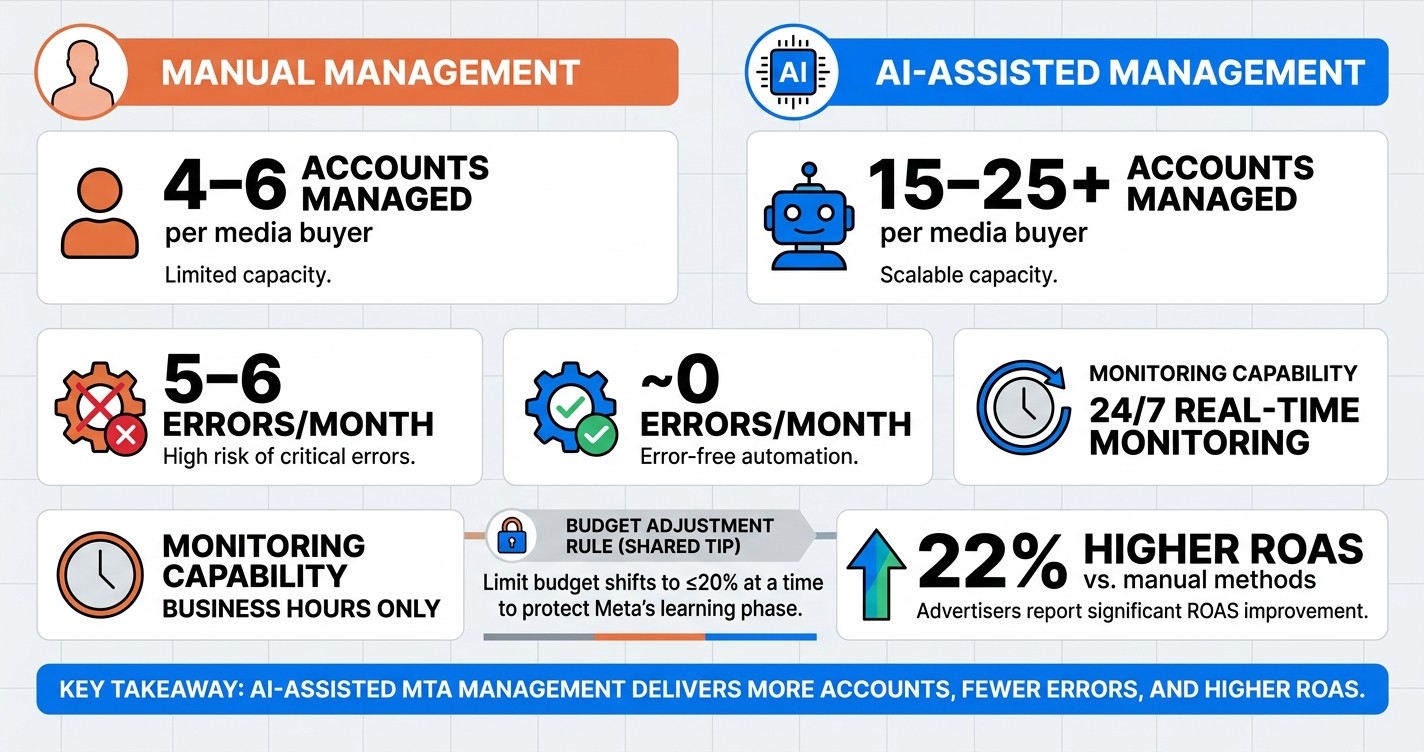
Manual vs. AI-Assisted MTA Management: Key Performance Metrics
Having attribution data is just the beginning - what really matters is how quickly and effectively you act on those insights.
Closing the Gap Between Insights and Execution
One common misstep marketers make is treating MTA (multi-touch attribution) reports as the final step rather than a starting point. If your data shows a clear winner - like a mid-funnel awareness campaign that consistently drives assisted conversions - don’t hesitate. Act on those insights right away.
Here’s a practical tip: limit budget shifts to no more than 20% at a time. Larger reallocations can disrupt the Meta Ads learning phase, wiping out valuable conversion data the algorithm has already collected. By making smaller, strategic adjustments, you can leverage your MTA data without losing the algorithm’s momentum.
Automation can make this process even more efficient. Tools like AdAmigo.ai offer an AI Autopilot feature that reads performance signals and makes real-time adjustments. This includes reallocating budgets, pausing underperforming campaigns, and scaling successful ones - either automatically or with your approval. While a media buyer managing accounts manually can handle 4–6 accounts, AI automation enables them to manage 15–25+ accounts with far fewer errors. For context, manual management typically results in 5–6 critical errors per month, whereas automation reduces this to near zero.
Once you’ve acted on your insights, the next step is ensuring everyone involved understands the results.
Aligning MTA Reporting with Stakeholder Expectations
Finance teams and executives don’t think in terms of assisted conversions or attribution windows. Their main concern is straightforward: is the ad spend delivering results? To bridge this gap, you need reporting that translates MTA insights into clear business outcomes.
Keep in mind that data quality issues or mismatched models can distort insights. To address this, use triple-source measurement by combining data from the Meta API, GA4, and an adjusted GA4 figure. This approach helps translate attribution findings into actionable business metrics. Additionally, setting clear ROAS targets, CPA limits, and budget caps can prevent concerns about AI decisions being too opaque or "black box."
A good practice when introducing new attribution or optimization tools is to start in read-only mode for one to two weeks. This lets you validate the tool’s recommendations against stakeholder KPIs before allowing it to make changes in your accounts.
Keeping MTA Models Current Over Time
Once you’ve streamlined execution and aligned reporting, it’s crucial to keep your models updated to reflect market changes. Attribution models can quickly become outdated due to seasonality, new product launches, creative updates, or platform algorithm changes. A model that worked in Q1 might not be reliable by Q3.
The solution? Build continuous recalibration into your process. AI platforms like AdAmigo.ai are designed to adapt in real time, using fresh performance data and updated KPIs to improve optimization over time. These systems also log decisions in plain language, so your team can review what changed and why - keeping everyone informed without requiring constant manual oversight.
A Practical Multi-Touch Attribution Playbook
Step-by-Step Implementation Guide
Implementing Multi-Touch Attribution (MTA) isn't about achieving perfection on day one - it's about laying the groundwork effectively.
Start with data hygiene. Ensure that your Meta Pixel and Conversions API (CAPI) signals are functioning properly. Once you're confident in your tracking setup, move to triple-source measurement. This involves pulling data from the Meta API, GA4, and an adjusted GA4 figure to achieve accurate attribution. After collecting enough data (about 90 days), calibrate your model before making any major decisions based on its results.
Another critical but often overlooked step is consolidating creatives into Atomic Creative Units. This means grouping together images, URLs, product references, and copy throughout the optimization process. This step directly addresses data fragmentation issues, helping you avoid misinterpreting which creative combinations are driving performance.
From there, assign roles and choose the right tools to streamline the process and ensure everything runs smoothly.
Roles, Tools, and Responsibilities
A well-structured team and the right tools are essential for maintaining an effective MTA setup.
Agent Role | Responsibility | Data Sources |
|---|---|---|
Orchestrator | Oversees optimization cycles and makes key decisions | All agent intelligence |
Data Analyst | Analyzes performance, computes triple-source metrics | Meta API + GA4 |
Creative Analyst | Tracks creative fatigue and develops replication strategies | Performance data |
Campaign Monitor | Conducts live optimization checks around the clock | Real-time API signals |
Smaller teams may not have the resources to fill all four roles individually. In such cases, tools like AdAmigo.ai can help by automating key tasks. For example, its AI Autopilot feature can take on both the Campaign Monitor and Data Analyst roles. This allows a single media buyer to manage 15–25+ accounts compared to just 4–6 accounts under manual oversight.
For reporting, simple solutions like pairing Google Sheets with Slack or WhatsApp alerts can keep stakeholders in the loop without requiring them to log into ad platforms.
Once your MTA setup is live, the next focus is on keeping it accurate and up to date.
Monitoring and Maintaining Your MTA Setup
After launching your MTA framework, the priority shifts to maintaining its accuracy. Attribution models can drift over time as campaigns, creatives, or platform algorithms change. For instance, Meta's Andromeda update in late 2025 adjusted its algorithm to place greater emphasis on creative signals rather than micro-targeting, which could make models calibrated before the update less reliable.
To stay ahead of such shifts, schedule monthly recalibrations. Regularly compare your triple-source metrics to identify inconsistencies early. Tools like AdAmigo.ai's Protect feature can help by monitoring account health and flagging issues like spend spikes, broken links, or unusual delivery patterns before they escalate.
"Patience during learning is one of the highest-leverage skills in media buying." - Wevion
Allow your recalibrated models time to stabilize, and remember: consistent monitoring is the backbone of reliable attribution.
Conclusion: Moving Past MTA Challenges for Better Meta Ad Results
Multi-touch attribution (MTA) comes with its fair share of challenges, but the issues at its core are both well-understood and manageable. Practical solutions - like using Meta Pixel and CAPI for clean tracking or employing triple-source measurement - offer ways to address these hurdles. These approaches build on the strategies already discussed earlier.
AI-assisted workflows have transformed how advertisers tackle MTA. Advertisers who lean on AI-driven tools report a 22% higher ROAS compared to those relying on manual methods. This boost is largely due to the speed and consistency AI provides - it can monitor signals, identify anomalies, and adjust campaigns 24/7, something no human team could realistically achieve.
That said, everything hinges on reliable data. Successful MTA depends on clean, accurate tracking. Faulty data leads to flawed optimization, no matter how advanced the AI is. Tools like AdAmigo.ai illustrate this point perfectly, offering features such as AI Autopilot and Protect to ensure accurate, AI-driven campaign management.
Achieving precise multi-touch attribution isn’t a one-and-done task. It requires constant data validation, model recalibration, and adaptability to platform updates. Regularly refining models ensures your strategies stay aligned with market trends. Teams that prioritize data integrity and automate repetitive tasks with the right tools are better equipped to make smarter decisions and get the most out of their Meta ad budgets.
FAQs
How can I ensure my tracking data is clean enough for MTA?
To ensure your multi-touch attribution data is accurate, start by double-checking your event tracking setup. Make sure the Meta Pixel is installed on all relevant pages of your site. This is non-negotiable for capturing the right data. Also, enable advanced matching to improve the quality of your tracking and link it directly to your Business Manager account.
Once that's in place, use tools to keep an eye on a few key things:
Event match quality: Ensure the data captured aligns with what’s expected.
Duplicate events: Spot and fix any issues where the same event might be recorded more than once.
Conversion windows: Check that these are configured correctly to prevent tracking errors.
For those managing campaigns across multiple channels, platforms like AdAmigo.ai can simplify things. They help integrate attribution data from different sources and validate its accuracy across your systems. This ensures your decisions are based on reliable insights.
Which attribution window should I use for my sales cycle?
The ideal attribution window varies based on your sales cycle and business model. Typically, businesses track 7-day, 14-day, and 30-day windows to get a complete view of the conversion journey. Shorter windows are great for fast, impulse-driven purchases, while longer windows are better suited for more involved sales cycles. Tools like AdAmigo.ai can help by analyzing your data to uncover trends and suggest the best window for your specific needs.
When should I add Conversions API to my Meta Pixel setup?
Adding the Conversions API (CAPI) alongside your Meta Pixel can significantly improve the quality and reliability of your tracking data. Relying solely on browser-based tracking often leads to data loss, thanks to privacy regulations and technical glitches.
CAPI works by sending conversion events directly from your server to Meta, ensuring a steady and accurate data flow. To keep things running smoothly, tools like AdAmigo.ai can monitor your CAPI health in real time. This helps you catch and address any signal drops or performance issues before they impact your campaigns.