
Interest Layering Strategies for ECommerce Ads
Interest layering refines targeting to cut wasted ad spend and scale performance—five Meta ad strategies explained.
Getting your Meta ads in front of the right audience is harder than ever, but interest layering can help. This strategy refines targeting by combining interests, behaviors, and demographics, allowing Meta's algorithm to find potential buyers more effectively. It’s especially useful for reducing wasted ad spend - research shows 30–40% of budgets are lost on audiences that don’t convert.
Here’s a quick breakdown of strategies covered:
Broad Targeting & Advantage+ Shopping: Simplifies scaling by relying on Meta’s AI, ideal for established brands with high conversion data.
Static Interest Layering: A manual approach for new brands with limited data, combining interests and demographics.
Purchase Intent First: Focuses on behavioral signals like "Engaged Shoppers" for higher purchase likelihood.
Interest-to-Lookalike: Starts with interest targeting, then shifts to lookalike audiences as conversion data grows.
Sequential Warm-Up: Engages users with top-of-funnel campaigns before targeting them with conversion-focused ads.
Each method aligns with specific business needs, whether you're launching a new product, scaling a mature brand, or improving ROAS. For best results, choose a strategy based on your account's data maturity and campaign goals.
Single vs Multiple Interest Targeting: The Facebook Ads Winner Will Surprise You
1. Broad and Advantage+ Shopping Targeting
This strategy allows Meta's algorithm to work without constraints, either by using broad targeting (removing interest filters) or by implementing Advantage+ Shopping Campaigns (ASC), which automate audience selection, placements, and creative matching. Both methods rely heavily on Meta's AI to identify potential buyers, offering a stark contrast to more detailed, interest-based targeting approaches covered later.
Targeting Precision
Broad targeting removes most filters, relying only on basic parameters like age, gender, and location. Meta's algorithm uses real-time signals to identify likely buyers. ASC takes this one step further with Meta's Andromeda ranking system (introduced in late 2025), which matches ads to users based on creative inputs and diversity rather than manual audience selection. However, it's crucial to note that pixel data should hit 50–100 purchase events per week before fully depending on these strategies.
Scalability
Broad targeting eliminates the limitations of audience segmentation, making it easier to scale campaigns without running into frequency issues. Monitoring ad frequency benchmarks is essential to prevent creative fatigue as you scale. ASC is designed for rapid scaling but may not perform as well as manual broad campaigns when targeting completely new audiences. Both setups simplify scaling by reducing audience configuration. To scale effectively, increase daily budgets by 20–30% every 3–5 days, giving the algorithm time to adjust.
Setup Complexity
Compared to intricate, interest-based setups, this approach focuses on simplicity to harness Meta's advanced algorithms. Both broad targeting and ASC require a streamlined campaign structure: one campaign, one ad set, and 30–50 varied creatives. Skaleit Agency's "Meta Andromeda" strategy is a prime example of this method.
"Andromeda does not reward fragmentation. It rewards consolidation, creative diversity, and clean signal." - Antonio Ventre, Founder, Skaleit Agency
In May 2026, Skaleit used this strategy for a client, spending $60,000 to generate $220,000 in revenue - a 3.62x ROAS. Another client saw even better results, spending $210,000 and achieving $831,000 in revenue with a 3.95x ROAS.
Performance Metrics (CPA, ROAS)
The table below compares ROAS across different account types, offering insight into when to use broad/ASC versus interest-based strategies, based on 2026 audit data:
Account Type | Interest ROAS | Advantage+ ROAS | Winner |
|---|---|---|---|
New brand (<3 months, <30 purchases/week) | 2.1x | 1.4x | Interests |
Mature brand, mass category | 1.6x | 2.4x | Advantage+ |
Mature brand, niche category | 2.3x | 1.9x | Interests |
Mature brand, broad apparel | 1.5x | 2.6x | Advantage+ |
For established accounts, ASC consistently delivers 12–17% lower CPA compared to manual campaigns. Similarly, broad targeting with a well-trained pixel achieves 12% lower CPA than interest-based targeting. For instance, JNPR Spirits, a DTC brand, saw remarkable results over a year: their ROAS climbed from 2.8x to 4.6x, acquisition costs dropped by 41%, and revenue grew by 265% year-over-year.
If you're unsure which strategy will work best for your account, try running a 14-day test. Use one ad set with stacked interests and another Advantage+ Shopping ad set without audience input, and let the results guide your decision.
2. Static Interest Layering and Multi-Layered Audiences
Static interest layering offers new eCommerce brands a way to provide controlled input to Meta's algorithm when automated broad targeting isn’t yet viable. This method involves manually selecting interests, behaviors, and demographics within Meta Ads Manager, using AND/OR/EXCLUDE logic to define the audience. It’s a practical starting point for brands with fewer than 100 conversions per month, where the pixel lacks enough data to allow Meta’s algorithm to function independently.
Targeting Precision
One of the key advantages of static layering is the level of control it provides. For instance, using AND logic, you can combine criteria like "Skincare AND Beauty AND Sephora" to focus on high-intent shoppers. However, narrowing the audience too much can backfire. Over-stacking criteria - such as combining 10+ interests to create an audience of just 45,000 people - can either stall delivery or cause CPMs to spike significantly.
Meta’s Detailed Targeting Expansion (DTE) is enabled by default, meaning the platform’s algorithm may override manual targeting choices about 70% of the time. As Murat Bock, Founder of AdLibrary, explains:
"The algorithm treats detailed targeting as a starting-point signal, not an instruction."
That said, exclusions remain unaffected by DTE, so it’s essential to exclude existing customers or recent purchasers to ensure your acquisition budget is used effectively. This precision, while useful, limits how scalable static layering can be.
Scalability
Static layering comes with inherent scaling challenges. Once your cold traffic frequency reaches 2.0–2.5, the audience becomes saturated. To avoid this, aim for an audience size between 500,000 and 5 million users. This range gives Meta’s algorithm enough room to optimize while keeping the audience relevant. Mixing unrelated interests - like "Fitness + Marketing" - within a single ad set can confuse the algorithm, making it harder to identify which segment is driving results.
Setup Complexity
Creating effective static layers requires careful research and planning. Interests need to be grouped logically, AND/OR logic must be structured correctly, and audience sizes should be monitored. A good rule of thumb is to stick to one interest cluster per ad set - such as "Fitness + Bodybuilding" - instead of combining unrelated categories. Each ad set typically needs a daily budget of $20–$50 and at least 50 purchase events per week to exit the Meta Ads learning phase. Spreading budgets too thin across multiple ad sets can lead to longer learning phases and a 25–35% increase in CPMs.
This complexity can make static layering less cost-efficient, especially when compared to broader targeting strategies.
Performance Metrics (CPA, ROAS)
When it comes to performance, heavy interest stacking often struggles at scale. In 63% of eCommerce split tests, broad targeting outperformed narrow, layered audiences in terms of cost per purchase. For accounts spending over $500 per day or achieving 50+ weekly conversions, the benefits of static layering diminish significantly. However, for new brands or niche products with limited pixel data, static interest layering still provides a critical foundation that broad targeting alone can’t offer without sufficient conversion history.
Scenario | Recommended Approach |
|---|---|
New account, no conversion data | 1–3 tight interest clusters (AND logic) |
Spend under $200/day | Detailed targeting with behavioral clusters |
Spend $500+/day, 50+ weekly conversions | Transition to broad targeting or Advantage+ |
Niche hobby or specialty product | 1–2 interest clusters to anchor creative |
3. Purchase Intent First, Category Interest Second
This strategy takes a different approach by focusing on purchase signals rather than just content engagement. The goal is to prioritize users who are actively showing buying intent over those who simply engage with content.
Why does this matter? Standard interest targeting often highlights preferences without indicating readiness to buy. For instance, someone who follows skincare influencers or interacts with beauty-related content might not be planning to make a purchase anytime soon. This disconnect between engagement and intent is why relying solely on category targeting can fall short in direct-response campaigns.
"Interest categories are not behavioral... The gap between content engagement and purchase intent is enormous. That's why interest-only targeting fails on direct-response campaigns." - Murat Bock, Founder, AdLibrary
The Intent-First Approach
This method flips the script. Instead of starting broadly with a category like "Skincare" and trusting the algorithm to do the rest, you anchor your targeting with behavioral signals and then layer category interests on top. A key signal here is Meta's "Engaged Shoppers" - a behavior-based audience that includes users who clicked a "Shop Now" button in the past week. Unlike inferred interests, this signal is rooted in real actions, making it more reliable, even after privacy changes like Apple's iOS 14 updates.
Targeting with Precision
Using "Narrow Audience" logic (AND targeting) combines behavioral qualifiers with category interests for better precision. For example, targeting "Skincare" AND "Engaged Shoppers" filters out casual browsers, focusing on users who are actively considering a purchase. However, there's a trade-off: stacking too many conditions can shrink your audience size, potentially dropping it below the recommended 200,000–500,000 range. To avoid this, limit your targeting to one behavioral layer and one or two closely related interests.
Scaling Without Dilution
This approach supports what’s often called horizontal expansion. Once you’ve identified a high-intent audience that converts well, you can increase your budget for that specific structure rather than broadening into less focused interest categories. This allows you to scale effectively by sticking with proven signals instead of risking performance drops with noisier data.
Technical Setup and Challenges
To make this strategy work, you need a properly configured Meta Pixel and Conversions API (CAPI). These tools ensure you’re capturing intent signals accurately. Without CAPI, conversion tracking can drop by 15–30% compared to browser-only tracking. It’s also critical to optimize for the "Purchase" event from the start. As Faisal Hourani, Founder of WebMedic, explains:
"Optimizing for Add to Cart... trains the algorithm to find people who add to cart but never buy. You are literally paying Meta to find window shoppers."
Performance Metrics: CPA and ROAS
Focusing on purchase intent from the beginning leads to better results over time. Campaigns built around these signals tend to deliver a Return on Ad Spend (ROAS) of 2.5–3.5x, compared to 0.8–1.2x for campaigns with unstructured targeting. Cost Per Acquisition (CPA) also stabilizes at a lower rate as ad spend increases. Tools like AdAmigo.ai can further refine this process by automating audience testing and optimization, ensuring your Meta ad campaigns remain efficient and effective as they scale.
4. Interest-to-Lookalike Sequential Narrowing
This strategy builds on earlier interest-layering methods by evolving from interest signals to more refined lookalike audiences (LLAs). The approach begins with interest-based ad sets to gather conversion data and transitions to LLAs as your Meta Pixel collects enough information. Over time, this two-phase process delivers greater accuracy.
Targeting Precision
Interest targeting relies on Meta's analysis of user behavior, making it more of an educated guess. On the other hand, LLAs are created using actual customer data, which provides a much clearer signal. For example, a seed audience of 500 recent purchasers generates better results than one with 10,000 general site visitors.
"A 1% lookalike of 500 recent purchasers outperforms a 1% lookalike of 10,000 site visitors in most cases because the signal quality of the seed is higher." - AdLibrary
To get the most out of this strategy, focus on creating seed lists with high-value customers, like those in the top 25% of lifetime value (LTV) or repeat buyers. Avoid using an entire email list, as including low-intent users can dilute the algorithm's effectiveness.
Scalability
For newer brands without much conversion history, interest targeting is a great way to gather initial signals. As your account grows and reaches 100+ conversions per month, LLAs become a better option for scaling. You can start with a 1% lookalike and expand to 3% or 5% as your initial audience becomes saturated. A good rule of thumb: if your frequency on a cold audience exceeds 2.5 per week, it’s time to broaden your targeting.
Setup Complexity
To implement this strategy successfully, you'll need the right technical setup. Using the Conversions API (CAPI) alongside your Meta Pixel ensures accurate data collection. Aim for at least 50 purchase events per week to move beyond Meta's learning phase. Without CAPI, your seed data might be incomplete, which can undermine the effectiveness of your LLAs.
Performance Metrics
High-quality LLAs can significantly improve campaign efficiency. For example, lookalike audiences based on the top 25% of customers by LTV often result in a 35% lower cost per acquisition (CPA) compared to those built from a general customer list. Additionally, a 1% lookalike of purchasers typically delivers a 20–40% lower CPA at similar volumes compared to broad or interest-only targeting.
One key operational tip: always exclude existing customers and recent purchasers from your LLA prospecting campaigns. Meta respects these exclusions, even when Detailed Targeting Expansion is enabled. This careful setup lays the groundwork for even more precise targeting strategies down the line.
5. Sequential Warm-Up with Engagement-Based Layers
Instead of directing cold audiences straight to a purchase page, this strategy takes a more thoughtful approach. It qualifies potential buyers based on their engagement behaviors and then targets them with conversion-focused ads once they’ve shown genuine interest. Think of it as a two-step process: grab their attention first, then guide them toward the sale.
Targeting Precision
Engagement-based layers rely on meaningful actions - like watching 75% of a video or interacting with an Instagram profile - to identify users who are genuinely interested. These signals are much more reliable than broad interest categories, which often capture people passively consuming content rather than actively considering a purchase.
"The gap between content engagement and purchase intent is enormous. That's why interest-only targeting fails on direct-response campaigns: you're reaching people who like the topic, not people who buy in the category." - Murat Bock, Founder, Adlibrary
Here’s where your ad creative becomes a powerful tool. A well-crafted hook that addresses a specific pain point will naturally attract the right audience. Meta’s algorithm then uses the engagement signals from those who respond to find similar users. This concept, called "creative as targeting," turns your ad content into a built-in filter for audience selection. Once you’ve identified engaged users, the next step is scaling this strategy effectively.
Scalability
Scaling conversion campaigns can be tricky, especially with Meta’s learning phase requiring around 50 purchase events per week per ad set to stabilize delivery. Engagement-driven campaigns at the top of the funnel help speed up this process by feeding the pixel with high-quality engagement signals before you move to conversion-focused ads. This approach helps you build momentum and gather data more efficiently.
For example, if you’re running a conversion campaign with a $40 cost per acquisition (CPA) goal, you’d need to budget about $286/day to hit 50 weekly conversions. By starting with a warmed-up audience, you can reach these numbers more efficiently and avoid wasting ad spend.
Setup Complexity
This strategy works best when implemented through a three-stage funnel architecture:
Top of Funnel (ToF): Use Video Views or Engagement objectives to build social proof and identify interested users.
Middle of Funnel (MoF): Target those who have watched 75%+ of your video or engaged with your profile using benefit-driven creative.
Bottom of Funnel (BoF): Focus on cart abandoners and checkout initiators with urgency-focused messaging.
During the warm-up phase, use Ad Set Budget Optimization (ABO) to ensure all creative concepts get equal spend, allowing for a fair comparison. Once you find the winning ads, transition them into a CBO or Advantage+ Shopping campaign for scaling. To avoid overlap, exclude recent purchasers and higher-funnel audiences from lower-funnel campaigns, preventing your ads from competing against each other in the same auction.
Performance Metrics (CPA, ROAS)
Engagement-focused campaigns tend to run at 15–22% lower CPMs compared to campaigns restricted to specific placements like Instagram Feed. These lower CPMs make building warm audiences more cost-effective, which in turn boosts efficiency when those audiences convert at higher rates in the BoF stage.
For video-based warm-up campaigns, aim for a hook rate (percentage of 3-second views relative to impressions) above 25%. If your hook rate exceeds 40%, your creative is doing its job, and any issues are likely with your offer or CTA rather than your audience.
A real-world example? JNPR Spirits, a DTC non-alcoholic spirits brand, used this structured approach - combining prospecting, retargeting, and testing - and saw a 41% drop in acquisition costs over 12 months. By leveraging lower CPMs and stronger engagement signals, they achieved measurable savings while scaling effectively.
Pros and Cons
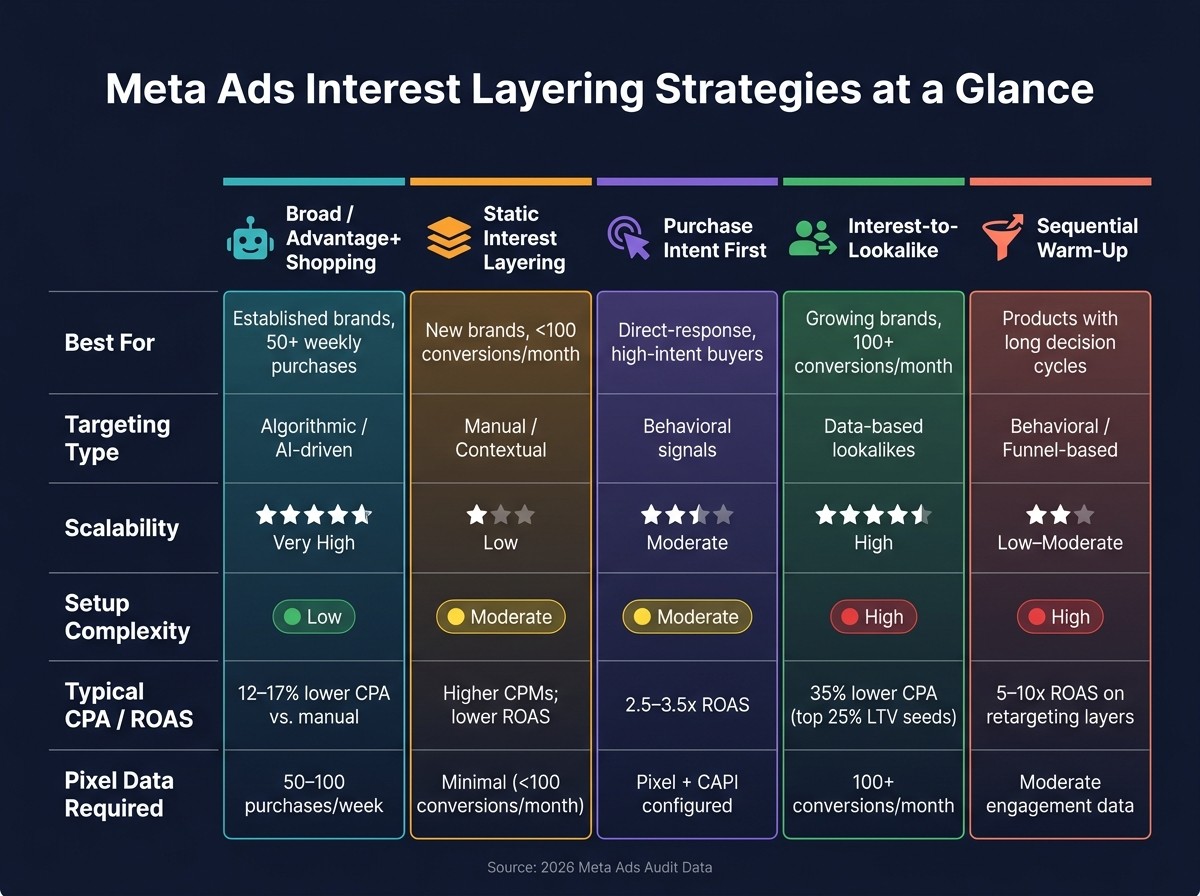
Meta Ads Interest Layering Strategies: Comparison Guide for eCommerce
When it comes to ad strategies, there’s no one-size-fits-all solution. The best approach depends on factors like the size of your product catalog, the volume of pixel data available, and how much time you can dedicate to managing campaigns. Here’s a breakdown of the strengths and weaknesses of different strategies to help you decide which aligns with your account's current stage and goals.
Strategy | Targeting Precision | Scalability | Setup Complexity | Typical CPA/ROAS |
|---|---|---|---|---|
Broad / Advantage+ Shopping | Algorithmic | Very High | Low | 12–17% lower CPA compared to manual |
Static Interest Layering | Manual/Contextual | Low | Moderate | Higher CPMs; lower ROAS |
Purchase Intent First | Behavioral | Moderate | Moderate | Higher initial CPA; stronger LTV |
Interest-to-Lookalike | Data-based | High | High | 35% lower CPA (top 25% LTV seeds) |
Sequential Warm-Up | Behavioral/Funnel | Low–Moderate | High | 5–10x ROAS on retargeting layers |
Each strategy has its trade-offs, so it’s important to adapt as your pixel data and conversion history develop.
Broad and Advantage+ Shopping is a standout choice for scaling. It’s simple to set up and delivers excellent results - once your pixel has enough data to optimize effectively. However, for newer accounts or those with limited pixel data, Static Interest Layering can be a better starting point. This approach works well for niche products but can lead to smaller audiences and higher CPMs over time.
To address these limitations, Interest-to-Lookalike narrowing offers a powerful alternative. By using high-quality seed data from your best customers, you can replace manual interest stacks with audiences that are statistically similar, often resulting in better performance.
"The combinatorial AND logic [in interest layering] creates a signal bottleneck the algorithm cannot route around." - Murat Bock, Founder, AdLibrary
For products with longer decision-making cycles, Sequential Warm-Up stands out. While it’s resource-intensive and challenging to scale beyond existing site traffic, it delivers impressive ROAS on retargeting layers - often 5–10x.
"A Facebook ecommerce ads strategy is a structured system... Stores using a structured approach average 2.5–3.5x ROAS compared to 0.8–1.2x for stores boosting posts." - Faisal Hourani, Founder, WebMedic
The key takeaway? Align your strategy with your account’s data maturity. Start with interest stacking to gather initial pixel data, shift to lookalikes as your conversion volume grows, and integrate Advantage+ Shopping once you hit 50+ weekly purchases. For products with longer consideration periods, reserve sequential warm-up to nurture leads effectively.
Conclusion
Select an interest layering approach that aligns with your store's current growth stage. For newer stores generating fewer than 50 weekly conversions, it’s best to stick with 1–3 thematic interest clusters per ad set. From the start, aim to optimize for "Purchase" events - even with a modest budget of $1,500–$3,000 per month. On the other hand, established brands spending $500 or more daily with robust pixel data should move away from manual interest stacking. Broad targeting and Advantage+ Shopping Campaigns tend to deliver better results, and the performance gap only increases as your conversion history expands.
"Interest targeting beats lookalikes in 2026 for new product launches with no conversion data... Trying to build a lookalike off 50 early purchasers does more harm than starting broad with interest layered in." - Aditya Chaturvedi, Founder, BTB Audits
Think of interest layering as a starting point - a way to guide the algorithm in its early learning phase. Once your campaigns hit around 500+ monthly purchase events, it’s time to phase out interest layers and let broader, AI-driven delivery take over. As your campaigns mature, automating your campaign management becomes increasingly advantageous. Tools like AdAmigo.ai can handle tasks like account audits, budget adjustments, creative testing, and scaling winning ads. This automation lets you focus on refining your overall strategy while the heavy lifting happens in the background.
FAQs
How do I choose between interest layering and Advantage+ Shopping?
When deciding between interest layering and Advantage+ Shopping, it all comes down to your specific goals, budget, and how developed your account is.
Interest layering is perfect for reaching niche audiences. By combining interests, behaviors, or demographics, you can zero in on a specific group. This approach works well for niche products, smaller budgets, or when you're in the early stages of testing.
Advantage+ Shopping, on the other hand, relies on broad targeting and Meta’s algorithm to identify potential buyers. It tends to shine when you have a larger budget or a more mature account with plenty of pixel data.
The best strategy? Use both approaches thoughtfully to get the most out of your campaigns.
What’s the minimum purchase volume needed to go broad or use lookalikes?
To make the most of broad targeting or lookalike audiences on Meta, aim to achieve at least 50 purchase events per week. To gather sufficient data for the platform to optimize effectively, you’ll generally need a monthly budget of $1,500–$2,000.
How many interests should I stack before the audience becomes too small?
When targeting cold traffic, it's best to limit your ad set to 1–4 interests. Adding more than 3–4 interests can shrink your audience too much, making it less effective. To achieve optimal performance and reach, aim for an audience size of 500,000 to 3 million. This balance helps ensure your ads are seen by enough people while staying relevant.