
How Engagement Data Improves Meta Ad Targeting
Explains how clicks, video views, and site actions power Meta's targeting, Custom Audiences, and Advantage+ tools for better conversions.
Meta's ad targeting thrives on engagement data. Every click, video view, or post save refines how ads are delivered, moving beyond demographics to focus on user behavior. This shift enables advertisers to target people based on actions like video watch time, landing page visits, or ad interactions.
Key takeaways:
Engagement metrics (e.g., clicks, video views, comments) feed Meta’s AI systems, like the Generative Ads Recommendation Model (GEM), which analyzes behavior patterns to predict future actions.
Tools like Advantage+ Audience and Advantage Lookalike dynamically identify high-intent users, improving ad conversions by 5% on Instagram and 3% on Facebook Feed in 2024.
Custom Audiences built from specific engagement events (e.g., 95% video viewers, recent cart adders) allow advertisers to segment users effectively and tailor ads for better performance.
For advertisers, this means better targeting, lower costs, and higher conversions. By leveraging tools like AdAmigo.ai, campaigns can be automated and optimized in real-time, saving time and improving results.
How Meta Uses Engagement Data in Ad Targeting and Delivery
Engagement Data as an Input to Meta's Auction Model
Meta's ad auction system relies on a combination of factors to determine which ads win: the bid, ad quality, and an estimated action rate. That estimated action rate predicts how likely a user is to take a specific action, and engagement data plays a big role here. Meta analyzes how users with similar behaviors have interacted with your ads - whether they watched, clicked, or converted - and uses that history to predict future actions at the impression level.
This means ads with strong engagement histories can gain an edge. Even if the bid is moderate, a higher estimated action rate can help those ads win auctions and lower their effective costs. Essentially, engagement metrics aren't just numbers to look at - they directly influence who sees your ads and what you pay. This predictive approach is the backbone of Meta's advanced targeting capabilities.
Advantage+ and Engagement-Driven Products
Meta's Advantage+ Audience and Advantage Lookalike tools take this concept further. Instead of relying on narrow interest-based targeting, these tools use engagement and conversion data to dynamically identify likely converters. Here's how they work:
Advantage+ Audience: You provide broad parameters like location, age, language, and the type of event you want to optimize for. Meta then adjusts your reach based on users who behave like your past engagers or converters.
Advantage Lookalike: This tool uses a "source audience" (e.g., people who purchased or watched most of a video) to find others with similar behavior patterns. For example, a source audience of users who watched 75–95% of a product video and then purchased is usually more effective than one based on casual page likes.
This shift from static demographics to behavior-driven targeting shows how much weight Meta places on engagement. Advertisers can also fine-tune these tools by creating custom audiences based on specific engagement events.
Custom Audiences Built from Engagement Events
Engagement data is also the foundation for building Custom Audiences, which update dynamically as new interactions occur. Common sources for these audiences include:
Video viewers segmented by how much they watched (e.g., 25%, 50%, 75%, or 95%)
Users who interact with your Facebook Page or Instagram profile
People who open lead forms
High-intent website visitors tracked via the Meta Pixel or Conversions API, such as those who add items to their cart or start the checkout process
The most valuable segments tend to be tied to high-intent actions. For instance, someone who watches 95% of an explainer video and clicks through to your product page is a much stronger prospect than someone who just likes a post. Treating these groups the same can waste your budget and confuse Meta's optimization system.
To get the most out of Custom Audiences, it’s important to consider timing. Shorter lookback windows (e.g., 7 days) focus on high-intent users, while longer windows expand your reach but reduce precision. By creating separate audiences based on both recency and engagement depth - like comparing visitors who added to cart in the past 7 days versus the past 30 days - you can adjust your bids, creatives, and exclusions for different stages of the funnel. This gives Meta clearer signals to deliver your ads more effectively.
What Research Shows About Engagement-Based Targeting
High-Engagement Audiences vs. Cold Audiences
Studies consistently reveal that warm audiences - those who have already interacted with your brand - outperform cold, interest-based groups. These engagement-based audiences provide stronger signals, allowing for better-matched impressions and more efficient targeting. This shift in strategy is closely tied to findings on conversion likelihood and the importance of recency in optimization.
Engagement Quality and Conversion Probability
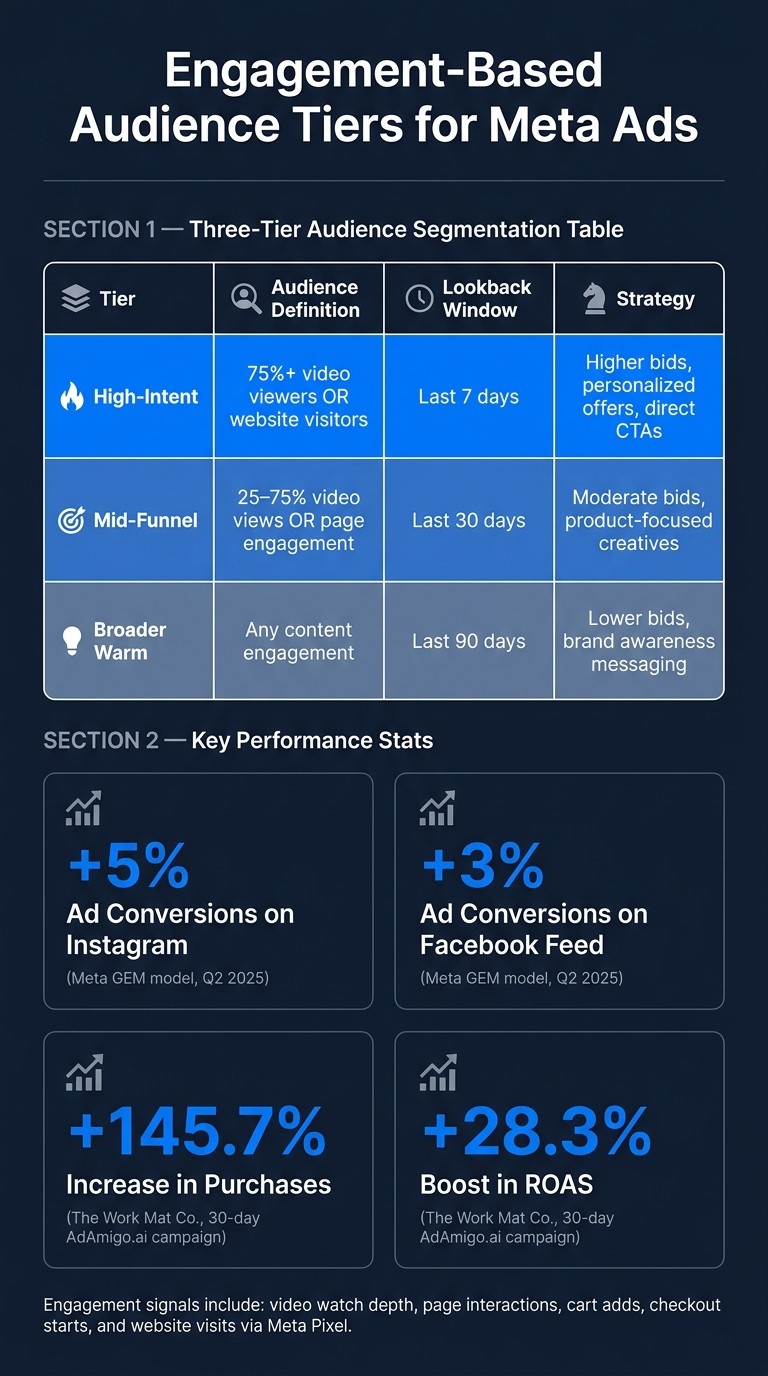
Meta's Generative Ads Recommendation Model (GEM) uses "sequence features", which analyze patterns in user actions to better understand the customer journey. This approach, powered by the InterFormer architecture, improved ad conversions by 5% on Instagram and 3% on Facebook Feed during Q2 2025. These advanced engagement signals pave the way for AI audience segmentation, a key component of dynamic and precise targeting.
Lookback Windows and Audience Recency
Research highlights the importance of audience recency in targeting strategies. Shorter lookback windows, such as 7 days, focus on users with the highest intent to act, while longer windows (30 or 90 days) expand reach but risk reducing precision. By segmenting audiences based on recency and tailoring bids and creatives accordingly, marketers can achieve better results. AI-driven systems excel here, as they can make these adjustments in real time, unlike manual processes that remain static.
The ULTIMATE Custom Audience Guide for Meta Ads in 2026
How Advertisers Can Act on Engagement Data
Meta Ad Targeting: Engagement-Based Audience Tiers & Performance Data
Building Dynamic Engagement-Based Audiences
Meta's automated audience creation offers a solid foundation , though AI vs manual audience creation remains a key debate for scaling ROAS, but advertisers can take it further by segmenting audiences based on how deeply users engage. For instance, users who watch most of a video demonstrate higher interest and can be grouped accordingly.
A tiered strategy works well here. For example:
High-intent group: Users who watch 75%+ of a video or visit your website within the last 7 days.
Mid-funnel group: Users with 25–75% video views or page engagement in the past 30 days.
Broader warm group: Anyone who has engaged with your content in the last 90 days.
By assigning unique ad sets, creative strategies, and bid tactics to each tier, you can tailor your messaging to match each group's behavior. Regularly refining these audience definitions based on performance data ensures your targeting remains aligned with real-time user activity.
Allocating Budgets and Creatives Based on Engagement Data
Once you've segmented your audiences, the next step is to allocate your budget and creative resources strategically. High-intent audiences - those recently engaged - are often more cost-efficient to convert, making them worth higher bids and increased spending. On the other hand, broader or older engagement groups are better suited to softer, brand-focused messaging, typically aimed at achieving lower CPAs.
Your creative approach should also reflect the engagement level. High-intent users might respond well to personalized offers or direct calls to action, while lighter engagers may need broader awareness campaigns to nurture interest.
Using AdAmigo.ai to Automate Engagement-Based Targeting
Managing these processes manually can be time-consuming and prone to errors. That’s where AdAmigo.ai steps in, automating every step of engagement-based targeting. The platform processes 50,000 data points daily to fine-tune audience segmentation and bidding strategies in real time.
AdAmigo.ai uses micro-segmentation to identify the best-performing audience groups at any moment. It also tracks creative fatigue, automatically introducing new variations when engagement levels start to dip. For example, between February and March 2025, The Work Mat Co. used AdAmigo.ai for their Meta campaigns. In just 30 days, the AI executed 270 automated actions, including building 16 audiences and creating 158 ads. The result? A 145.7% increase in purchases, a 28.3% boost in ROAS, and 33 hours of manual work saved.
"The fact that you can launch campaigns through text or voice commands feels like magic! It handles everything from creating lookalike audiences to adjusting budgets with just a few prompts." - Jakob K., Verified User
For those new to AI-powered campaign management, it's best to start with AdAmigo's recommendation mode. This allows you to review and approve AI-generated actions before they’re implemented. Once you're comfortable, you can switch to full Autopilot. To ensure smooth operation, set clear guardrails from the beginning, like CPA limits and budget caps, so the system stays aligned with your goals.
Conclusion: Getting More from Meta Ads with Engagement Data
Key Points Recap
Engagement data is a game-changer for targeting in Meta ads. It helps identify audiences that are genuinely interested, moving away from broad targeting strategies that rely more on guesswork. By focusing on real signals - like video watch depth, page interactions, and website visits - you can build smarter, more precise audiences.
Meta itself leverages engagement signals through tools like its Generative Ads Recommendation Model (GEM) to improve ad delivery. When you layer your own engagement-based strategies on top of these systems, you can boost targeting efficiency even further.
The secret lies in relevance. Using tiered audience segmentation with tailored creatives and strategic bidding transforms engagement data into better performance. These dynamic strategies allow you to refine your campaigns continuously, leading to stronger results over time.
Next Steps for Advertisers
Start by auditing your current approach and shifting from interest-based targeting to engagement-based custom audiences. A good starting point is to create a simple three-tier engagement audience structure.
The real challenge? Keeping these audiences updated and ensuring your bidding aligns with performance trends. Doing this manually can be time-consuming, but tools like AdAmigo.ai make it easier. They automate audience segmentation, refresh creatives before fatigue sets in, and process performance data in real time - helping you optimize campaigns without the heavy lifting.
FAQs
Which engagement signals matter most for Meta ad targeting?
Meta’s recommendation engines focus on key engagement signals such as clicks and conversions, while also factoring in long-term user behavior patterns like past ad views and interactions. This helps the platform assess purchase intent more effectively. Advertisers rely on metrics including CTR (Click-Through Rate), CPC (Cost Per Click), frequency, and ROAS (Return on Ad Spend) to fine-tune their targeting strategies. Tools like AdAmigo.ai further enhance this process by analyzing trends in real time, identifying micro-segments based on details like when users are active or specific interest clusters - insights that manual targeting might overlook.
How should I choose a 7-, 30-, or 90-day lookback window?
When selecting a lookback window, consider your campaign objectives and how quickly you receive feedback. Shorter windows, like 7 days, are great for spotting recent trends or evaluating how a specific creative is performing. On the other hand, longer windows - 30 to 90 days - offer a broader view, helping you understand historical patterns and refine your strategy accordingly.
Keep in mind, ad performance can change rapidly, especially with creative fatigue. That’s why many AI tools focus on real-time data to make adjustments and deliver optimal results, no matter the window you choose.
What’s the best way to tier audiences by engagement depth?
To effectively segment audiences based on engagement depth, AI-powered tools can make the process seamless and precise. Platforms like AdAmigo.ai use real-time data and performance metrics to automatically adjust targeting strategies. Instead of manually sorting audiences into cold, warm, or hot categories, these tools analyze user behavior to:
Create lookalike audiences based on engagement patterns.
Refine targeting by interests and activity levels.
Build dynamic retargeting lists that evolve with user behavior.
This approach ensures your audience groups stay relevant as engagement trends shift, saving time and improving targeting accuracy.