
EU vs. US Data Rules for Meta Ads
EU's strict opt-in privacy rules cap ad tracking and personalization, while U.S. opt-out laws enable broader targeting and simpler compliance.
Running Meta ads in the EU and US is governed by vastly different regional data privacy rules. The EU enforces strict regulations like GDPR, requiring explicit opt-in consent and limiting data transfers outside its borders. In contrast, the US operates under a more relaxed, fragmented system of state-level privacy laws, often relying on opt-out mechanisms. These differences impact how data is collected, personalized, and tracked for advertising.
Key Takeaways:
EU Ads: Require opt-in consent, stricter tracking limits, and compliance with GDPR. Average CPM: ~Average CPM: ~$10.0.
US Ads: Use opt-out models, allowing broader tracking. Average CPM: ~$20.
Meta Compliance: In the EU, Meta offers limited personalization options; in the US, fully personalized ads are standard unless users opt out.
Fines: EU penalties are far higher, up to €20M or 4% of global revenue, compared to varying state-level enforcement in the US.
Understanding these rules helps advertisers avoid penalties and tailor strategies to each region effectively.
EU Data Privacy Rules and Their Impact
Core Principles of GDPR
The General Data Protection Regulation (GDPR) prioritizes user rights and corporate accountability. It grants EU citizens important rights, including access to their data, the ability to request corrections, the option to have data erased, and the right to object to marketing practices. For Meta advertisers, this means obtaining active opt-in consent from users before processing their data. GDPR isn’t limited to EU-based companies; it applies to any organization handling data from EU citizens, no matter where it operates. So, if you’re running Meta ads from the U.S. targeting EU users, you’re required to comply.
The penalties for non-compliance are steep. Organizations face fines of up to €20 million or 4% of their global annual revenue - whichever is higher. Additionally, if a data breach involving personal information occurs, authorities must be notified within 72 hours. These regulations set a high bar for data protection, forming the foundation for the strict rules governing cross-border data transfers.
Cross-Border Data Transfer Restrictions
When transferring data outside the EU, organizations must follow strict legal safeguards, such as using Standard Contractual Clauses (SCCs) or adhering to the Data Privacy Framework. If you're using tools like Meta Pixel or Custom Audiences, you share the role of "joint controller" with Meta. This means you bear equal responsibility for ensuring that any data sent to Meta's servers in the U.S. aligns with GDPR requirements.
A key aspect of compliance is obtaining explicit opt-in consent before tracking begins. Consent banners must clearly inform users that their data may be transferred to the U.S. Additionally, GDPR’s principle of data minimization restricts the type of data that can be transferred, particularly sensitive information like health records, political views, or religious beliefs. These tight restrictions have led to major enforcement actions against Meta, which we’ll explore next.
Meta's GDPR Fines and Compliance Issues

Meta has faced significant penalties for failing to meet GDPR standards. In May 2023, the company was fined $1.3 billion for repeatedly transferring data from the EU to the U.S. without adequate safeguards. Andrea Jelinek, Chair of the European Data Protection Board, emphasized the severity of the issue:
The EDPB found that Meta IE's infringement is very serious since it concerns transfers that are systematic, repetitive and continuous.
Meta was given six months to stop these transfers, a deadline it addressed by certifying under the new Data Privacy Framework in September 2023.
Earlier in January 2023, Meta was fined $414 million for requiring users to accept behavioral ads as a condition of using its services. This prompted a major policy shift. Starting in January 2026, EU users will be able to choose between fully personalized ads or a "less personalized" experience, which involves limited data sharing. These developments signal a significant change in how Meta operates within the EU.
US Data Privacy Rules and Their Impact
US Privacy Laws Overview
The United States takes a piecemeal approach to privacy regulations, relying on state and industry-specific laws. By the end of 2025, 20 states, with California leading the way through its CCPA/CPRA framework, will have implemented comprehensive privacy laws.
The CPRA, which came into effect on January 1, 2023, introduced stronger consumer protections. It established the California Privacy Protection Agency (CPPA) - the first dedicated U.S. privacy enforcement body - and empowered individuals to restrict the use of sensitive personal data, such as biometric details and precise geolocation. Other states, like Nebraska and New Hampshire, are rolling out their own privacy laws, set to take effect in late 2024 and 2025.
One key difference between U.S. laws and the EU's GDPR lies in the opt-out model. While GDPR mandates explicit consent before any data collection, U.S. regulations typically allow data collection and usage for purposes like targeted advertising unless a consumer actively opts out. For advertisers on Meta platforms, this means they can track and target U.S. users by default, provided they offer clear options for opting out of data sharing or sales. However, public concern about data use is growing. Surveys show that 81% of American adults feel the risks of corporate data collection outweigh the benefits, and 79% are worried about how their data is handled.
This fragmented regulatory environment underscores the challenges advertisers face in the absence of a unified federal privacy law.
No Federal Privacy Law
The lack of a nationwide privacy law complicates advertising efforts for those running campaigns on Meta across multiple states. Instead of adhering to a single standard, advertisers must navigate varying definitions, thresholds, and enforcement mechanisms depending on their audience's location. Samuel Levine, Director of the FTC's Bureau of Consumer Protection, emphasized the risks in specific contexts like healthcare:
"When consumers visit a hospital's website or seek telehealth services, they should not have to worry that their most private and sensitive health information may be disclosed to advertisers and other unnamed, hidden third parties."
Enforcement responsibilities are split between the FTC, state attorneys general, and specialized agencies like California’s CPPA. This fragmented approach creates compliance challenges, as practices permitted in one state might violate laws in another. Proposed federal legislation, such as the American Privacy Rights Act (APRA), aims to establish a uniform standard. However, until such a law is passed, advertisers must adapt to an ever-changing legal landscape.
This complexity has led Meta to implement state-specific compliance measures and consent management tools for its advertising platforms.
How Meta Complies with US Privacy Laws
To address the varied U.S. privacy regulations, Meta has adopted a state-focused approach, offering privacy controls tailored to the laws of each state. For users in states with comprehensive privacy laws, Meta provides tools that allow them to exercise rights like deleting personal data or opting out of data sales. These options can be accessed through the Ad Preferences settings on Facebook and Instagram, where users can manage how their behavioral data is used for ad targeting.
Unlike the EU, where Meta offers "less personalized" contextual ads to comply with GDPR, U.S. users continue to receive fully personalized behavioral ads unless they choose to opt out. This difference significantly impacts advertising costs. The average CPM for Meta ads in the U.S. is about $20, compared to $10 in European markets like the UK and Germany, largely due to the more extensive tracking capabilities available to advertisers in the U.S..
GDPR vs. US Data Privacy Legislations: Which is Proving More Successful and Why
EU vs. US Data Privacy Rules
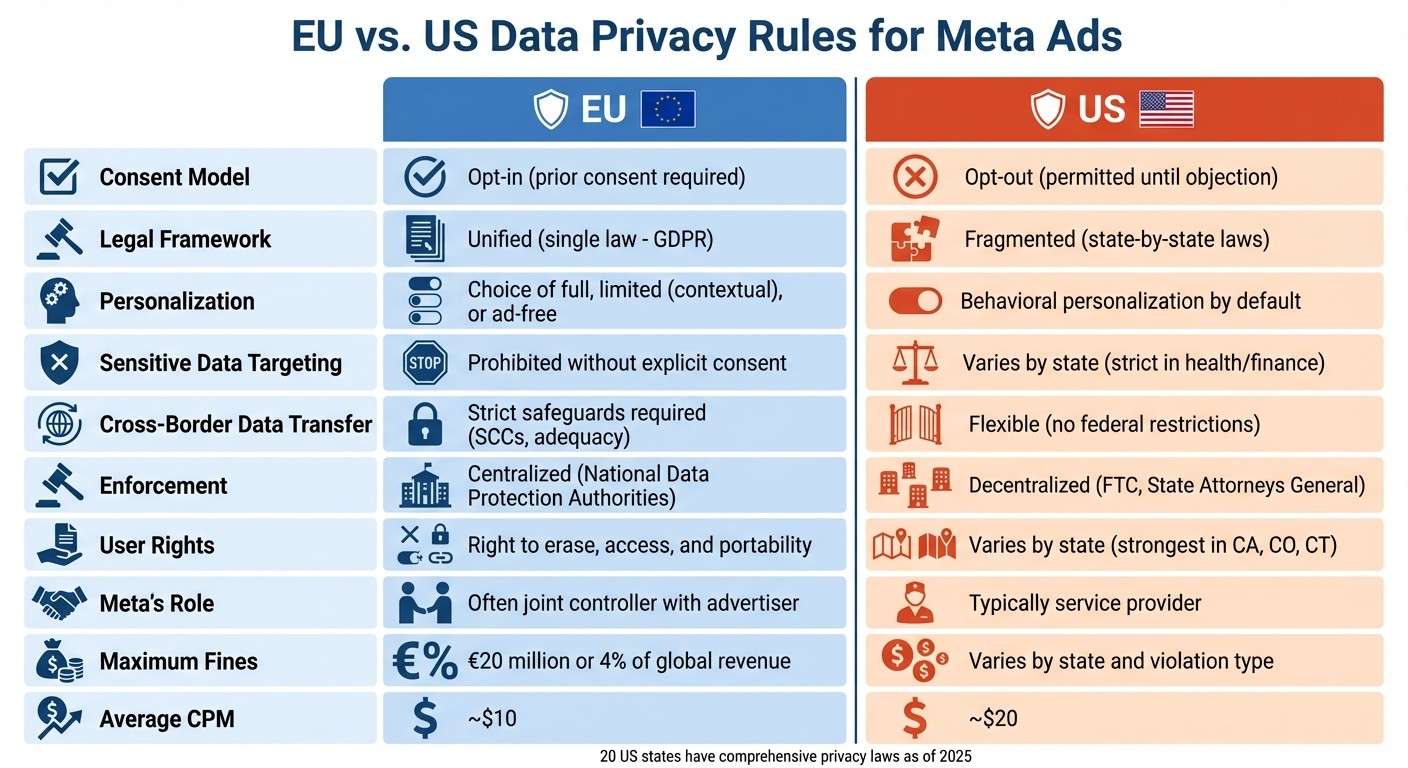
EU vs US Meta Ads Data Privacy Rules Comparison
Consent and Personalization: Opt-In vs. Opt-Out
One of the most striking contrasts between EU and US privacy rules lies in how and when advertisers can begin tracking users. In the EU, under GDPR, companies like Meta must secure explicit user consent before deploying tracking pixels or gathering behavioral data. This is known as an opt-in model, where data collection only starts once users actively agree. On the other hand, the US typically operates on an opt-out model, allowing tracking and personalization by default unless users take action to disable it.
This difference in consent protocols highlights a broader divergence in regulatory philosophies, which also extends to how each region handles cross-border data transfers.
Cross-Border Data Transfer Differences
When it comes to moving data across borders, the EU and US take very different approaches. The EU treats such transfers as inherently risky and requires strict safeguards. GDPR mandates mechanisms like Standard Contractual Clauses (SCCs) or an adequacy decision to ensure data protection when transferring information outside the European Economic Area. Moreover, in the EU, Meta and its advertisers are often classified as joint controllers, sharing legal responsibility for safeguarding user data. This requires them to meticulously document their agreements and responsibilities.
In the US, the rules are far less rigid. There are no federal restrictions on transferring data across state lines, and Meta typically operates as a service provider rather than a joint controller. While emerging state laws are beginning to introduce more stringent requirements, the overall US framework remains far more relaxed compared to the EU.
For advertisers working with Meta, this patchwork of regulations means campaigns must be carefully tailored to meet the GDPR and CCPA rules of each region. For example, in the EU, the data minimization principle limits Meta to collecting only data necessary for a specific purpose. In contrast, the US has traditionally allowed broader data collection, though newer state laws are starting to impose similar limitations.
Side-by-Side Comparison Table
Feature | EU (GDPR / DMA) | United States (Fragmented) |
|---|---|---|
Consent Model | Opt-in (prior consent required) | Opt-out (permitted until objection) |
Legal Framework | Unified (single law for all sectors) | Fragmented (sector-specific + state laws) |
Personalization | Choice of full, limited (contextual), or ad-free | Behavioral personalization by default |
Sensitive Data Targeting | Prohibited without explicit consent | Varies by state (strict in health/finance) |
Cross-Border Data Transfer | Strict safeguards required (SCCs, adequacy) | Flexible (no federal restrictions) |
Enforcement | Centralized (National Data Protection Authorities) | Decentralized (FTC, State Attorneys General) |
User Rights | Right to erase, access, and portability | Varies by state (strongest in CA, CO, CT) |
Meta's Role | Often joint controller with advertiser | Typically service provider |
Maximum Fines | €20 million or 4% of global revenue | Varies by state and violation type |
These differences make it essential for advertisers to stay informed and adjust their strategies to navigate the unique regulatory environments in each region effectively.
How to Stay Compliant with Meta Ads
Setting Up Consent Banners and Geo-Fencing
To ensure compliance, start by implementing robust consent management auditing. For traffic originating from the European Union (EU), you’ll need a Consent Management Platform (CMP) that blocks all tracking scripts - like Meta Pixel and Conversions API - until users explicitly give their consent. In the United States, where an opt-out model is more common, tracking can begin immediately. However, it’s still essential to provide clear disclosures about the data being collected and offer users the ability to disable tracking.
It’s also helpful to separate EU and non-EU traffic into distinct ad sets. This allows you to monitor and adjust metrics like CPM, CTR, and conversion rates independently for each region.
Transparency is key, so make sure your privacy disclosures are thorough and follow best practices. Here’s a quick guide to what’s required and what’s recommended:
Disclosure Type | Minimum Requirement | Recommended Best Practice |
|---|---|---|
Data Collected | List general categories (e.g., email, IP) | Specify exact data points (e.g., Meta Pixel, Lead Ads) |
Purpose | State general purposes | Detail specific purposes per campaign |
Legal Basis | Identify lawful basis (e.g., Consent) | Explain how consent is obtained and why it applies |
Data Sharing | Name third parties (e.g., Meta) | Describe joint controller status and arrangements |
International Transfers | Disclose if data leaves the EU/EEA | Explain safeguards like SCCs or Data Privacy Framework |
To streamline compliance, consider using Meta's API to automate these tasks across your campaigns.
Using Meta's API for Compliance Automation
Meta’s API offers tools to help automate compliance while maintaining campaign performance. You can use it to manage consent signals, adjust targeting parameters based on local regulations, and ensure only the necessary data is collected for each campaign purpose.
Starting January 15, 2026, ad sets using outdated granular targeting will no longer deliver, as indicated by black banners in Ads Manager. Meta is moving toward AI-driven tools like Advantage+, which emphasize creative variety and vertical 9:16 formats - these now account for 90% of ad inventory in 2026. Automating updates to your targeting parameters using the API can help you align with these changes and stay compliant.
For an even more streamlined approach, advanced AI tools can further enhance compliance efforts.
AdAmigo.ai for Privacy-Compliant Optimization

AdAmigo.ai is an AI-driven platform designed to ensure your ad campaigns comply with regulations before they even launch. It scans for issues like prohibited language, discriminatory targeting, and missing disclosures. The platform also labels AI-generated content as "Synthetic" and adjusts targeting to meet transparency standards, saving you hours of manual work.
AdAmigo.ai adapts campaigns to meet geo-specific rules, which is especially useful in regions like the EU, where 24 official languages complicate localization efforts. The platform automates this process while maintaining GDPR-compliant consent practices. By minimizing data collection, it aligns with GDPR principles, reducing legal risks without compromising ad performance.
Here’s how it compares to manual management:
Feature | Manual Management | AdAmigo.ai (AI-Driven) |
|---|---|---|
Review Timing | Reactive (post-rejection) | Proactive (pre-launch scanning) |
Response Time | Hours or days to resolve | Instant detection and fixes |
Monitoring | Periodic or weekly reviews | 24/7 real-time monitoring |
Efficiency | Standard workload per buyer | 1 buyer manages 4–8× more accounts |
Policy Updates | Requires manual research | Automatically updated to latest standards |
AdAmigo.ai connects to your Meta ad account in just five minutes, automatically adjusting compliance settings based on regional rules and performance goals. It’s a powerful tool for navigating the complex world of ad compliance efficiently.
Conclusion and Key Takeaways
The differences between EU and US data privacy rules create unique challenges for advertisers in each region. In the EU, the GDPR mandates explicit opt-in consent for tracking and grants consumers extensive rights, such as accessing, correcting, and deleting their personal data. Centralized authorities enforce these rules, with fines reaching up to €20 million or 4% of global revenue. Meanwhile, the US relies on a patchwork of state-level privacy laws - 20 states now have their own regulations - most of which follow an opt-out model, allowing tracking until consumers actively object.
These contrasting regulations directly affect Meta ad performance. In the US, advertisers benefit from broader tracking capabilities and smoother optimization processes, leading to an average CPM of about $20. In comparison, stricter targeting limits in the EU result in CPMs closer to leading to an average CPM of about $20. In comparison, stricter targeting limits in the EU result in CPMs closer to $10 in countries like Germany and the UK0 in countries like Germany and the UK. For advertisers, this means navigating more complex compliance requirements in Europe while leveraging more flexible tracking in the US.
To stay compliant across regions, consider separating EU and US traffic into distinct ad sets. For EU campaigns, use a robust Consent Management Platform and privacy-first consent mechanisms to block tracking until explicit consent is obtained. For US audiences, ensure transparency by providing clear disclosures and opt-out options.
Automation can help streamline compliance efforts. Meta’s API allows advertisers to manage consent signals and adjust targeting settings programmatically. For those managing multiple accounts or cross-border campaigns, tools like AdAmigo.ai can monitor compliance issues and fine-tune campaigns based on regional requirements.
As regulations continue to evolve, advertisers must remain flexible. The proposed American Privacy Rights Act could unify privacy standards across the US, potentially simplifying compliance. Until then, treat compliance as an ongoing process to protect your ad spend and maintain effective campaigns in both regions.
FAQs
Do I need a separate Meta ad account for EU vs. US campaigns?
No, you don’t need a separate Meta ad account for running campaigns in the EU versus the US. However, it’s important to note that data privacy regulations vary significantly between these regions. The EU’s GDPR imposes strict consent requirements and rules for data transfers, while Meta’s Data Privacy Framework is designed to help advertisers stay compliant.
That said, many advertisers choose to set up separate accounts or campaigns for each region. This approach can make it easier to manage privacy settings, tailor targeting strategies, and ensure compliance with legal standards - especially given the heightened enforcement of GDPR in the EU.
How can I use Meta Pixel and still comply with GDPR in the EU?
To stay in line with GDPR when using Meta Pixel in the EU, you need to secure explicit, opt-in consent from users before gathering any personal data. A Consent Management Platform (CMP) can help you clearly inform users about data collection practices and obtain their permission.
Make sure to keep data collection to the essentials, steer clear of processing sensitive information without specific consent, and revise your privacy policy to clearly explain how data is handled and shared. Transparency is key to maintaining compliance.
What happens if EU user data is transferred to the US without safeguards?
Transferring user data from the EU to the US without proper safeguards can lead to violations of GDPR. This puts data controllers at risk of hefty fines and legal challenges. Taking steps to ensure GDPR compliance is essential to mitigate these risks.