
CDP-Driven Lookalike Audiences: Best Practices
Use enriched CDP seed lists, value-based syncing, and tiered 1%–5% lookalikes to boost ROAS, reduce overlap, and scale efficiently.
Want better results from Meta Ads? Start with high-quality lookalike audiences powered by your CDP (Customer Data Platform). These audiences help you find new customers who closely resemble your best ones. Here’s the short version of how to nail this strategy:
Why CDPs Matter: They enrich your seed audience with data like lifetime value (LTV), purchase frequency, and preferences. Better data = better results through AI audience segmentation.
Best Seed Audiences: Focus on top customers, like the top 10% by LTV or repeat buyers. Aim for at least 1,000–2,000 profiles.
Sync Directly to Meta: Use tools like Segment or Klaviyo to send enriched data directly, avoiding manual uploads.
Optimize Lookalike Tiers: Start with a 1% lookalike for precision, then scale to 3–5% as needed. Use exclusions to prevent overlap.
Track & Refine: Monitor ROAS, CPA, and CTR. Refresh your seed data monthly or quarterly to keep performance strong.
CDP-driven lookalike audiences deliver 15–30% better ROAS when done right. Keep reading for step-by-step tips to make your campaigns work harder for you.
Preparing High-Quality Seed Segments in Your CDP
Data Hygiene and Prerequisites
Start by creating unified customer profiles using AI audience profiling. This means removing duplicates and merging data from all available sources to enhance identity signals like email, phone number, name, and location. The goal here is to achieve the highest possible match rates. Why? Because the more identity signals you provide - email address, phone number, first and last name, city, state, and ZIP code - the better Meta can identify your customers and build accurate models. Relying on incomplete profiles, such as those with just an email address, will reduce match rates and weaken audience modeling efforts.
To further strengthen these profiles, enrich them with behavioral data like purchase history, total lifetime value (LTV), product preferences, subscription tiers, and engagement recency. This additional information gives Meta's algorithm a clearer picture of your audience.
Once your profiles are clean and enriched, you can start crafting seed audiences that align with your specific business objectives.
Designing Seed Audiences Around Business Goals
The effectiveness of a seed audience depends on how well it matches your goals. Below is a quick guide to common seed types, their quality, and their best applications:
Seed Type | Signal Quality | Recommended Size | Best Use Case |
|---|---|---|---|
Top 10–25% LTV customers | Highest | 1,000+ | High-ROAS acquisition, VIP prospecting |
Repeat purchasers (2+ orders) | Very High | 1,500+ | Scaling proven brand loyalty |
Recent purchasers (30–90 days) | High | 2,500+ | Current profile matching, upselling |
Add-to-cart / initiated checkout | Medium-High | 500–2,000 | Scaling when purchaser data is thin |
Email subscribers | Medium | 5,000+ | Early-stage prospecting, awareness |
When designing seed segments, match them to your campaign goals. For example, acquisition campaigns benefit from focusing on the top 10–20% of customers by LTV. On the other hand, upselling or cross-selling campaigns are better served by targeting recent purchasers from the last 90 days, as they reflect your most current customer base.
Here’s a key takeaway to guide your strategy:
"The seed should represent the outcome you want more of, not just the traffic you happened to collect." - AdStellar
If you're running campaigns in multiple countries, create separate seed lists for each. Customer behavior and spending habits vary by region, and combining data from different markets can confuse Meta's modeling process.
Best Practices for Managing CDP Segments
Keeping your segments dynamic and high-quality is essential for long-term success. Refresh these segments every 30–60 days, and use recency filters to focus on active, high-value customers. For instance, limit a "high-LTV customers" segment to those who made purchases in the last 12 months.
To avoid wasted ad spend and mixed signals, use exclusion logic to prevent overlap between segments. For example, if you're running separate campaigns for new customer acquisition and upselling, ensure that your acquisition seed excludes any existing customers. Most CDPs, such as Segment, Bloomreach, and Klaviyo, offer tools for managing dynamic segments that update automatically based on predefined rules, making this process much easier to scale.
Lastly, when building value-based seeds, include a customer_value column in your export. This column should detail each customer's total LTV or revenue, enabling Meta to prioritize higher-value customers in its lookalike models. This small adjustment often results in 15–30% better ROAS compared to standard lookalike audiences.
Syncing CDP Audiences with Meta Ads
Connecting Your CDP to Meta Ads
Top CDPs like Segment, Bloomreach, and Klaviyo come with built-in connectors for Meta Ads, making it simple to send audience segments directly to your Meta Business account - no need for manual CSV uploads. If your CDP doesn’t have a ready-made integration, Meta’s Marketing API lets you create a custom pipeline. This is especially handy for automating syncs on a set schedule.
When setting up data field mapping, aim to include as many identity signals as possible: email, phone number, first name, last name, city, state, and ZIP code. Each extra field increases Meta’s ability to match your data with user accounts. For even better results, enable server-side syncing using the Conversions API (CAPI). This method can capture an additional 20–30% of conversions compared to relying solely on browser-based pixels, giving Meta stronger data to work with.
Use real-time sync for dynamic segments, like cart abandoners, where timing is key. For more stable audiences, like those based on lifetime value (LTV), opt for batch syncs on a daily or weekly basis. Once your data is synced, you can move on to building custom audiences in Meta Ads.
Setting Up Custom Audiences in Meta
When creating a Customer List Custom Audience, use a clear and consistent naming format. For example, names like Purchasers_180D_US or LAL_1%_HighLTV_US_Jan2026 make it easy to identify the audience’s source, recency, geography, and tier. If you include an LTV or total purchase value column, you can enable value-based lookalike modeling, which often delivers better return on ad spend (ROAS) than standard lookalikes.
Once your custom audiences are ready, double-check that all data transfers meet privacy standards.
Compliance and Privacy Requirements
Before uploading any customer data to Meta, all personal identifiers must be hashed using SHA-256. This applies to fields like emails, phone numbers, and names. However, fields like event names, currency, and order IDs don’t require hashing.
Identifier | Hashing Required | Format |
|---|---|---|
Email ( | Yes (SHA-256) | Lowercase, no spaces |
Phone ( | Yes (SHA-256) | Include country code, digits only |
First/Last Name | Yes (SHA-256) | Lowercase |
Currency | No | ISO 4217 (e.g., |
Order ID | No | Unique string or number |
It’s also crucial to have a lawful basis for data use, typically through explicit consent. This consent must cover data sharing with third parties, not just permissions for marketing emails. Be sure to exclude disputed accounts, opt-outs, and any sensitive data before uploading. Regularly update your seed lists - monthly or quarterly - to reflect current opt-out preferences.
"Meta does not need more data. It needs better data. Your top 10% of customers can become the signal that helps the system find the next generation of high-value buyers." - Anthony Paulino, CEO, Infinite Media Resources
How to Create a Lookalike Audience on Meta in 2026 (The Right Way)
Building and Optimizing Lookalike Audiences on Meta
CDP-Driven Lookalike Audience Tiers: ROAS, Size & Best Use Cases
Creating Lookalikes from CDP-Synced Audiences
To create a lookalike audience in Ads Manager, navigate to Audiences → Create Audience → Lookalike Audience, select your CDP-synced custom audience, and choose your target country. It's important to create country-specific lookalikes rather than combining multiple countries. Why? Because blending markets can weaken the signal due to varying buying behaviors.
Start with a 1% similarity range, which covers about 2.7 million users in the U.S. If possible, enable value-based lookalike modeling to zero in on high-spending prospects. This approach often boosts ROAS by 15–30% compared to standard lookalikes, as Meta's algorithm prioritizes users who resemble your top spenders instead of just any converters.
Once your lookalike audience is ready, organize them into structured campaign tiers to maximize efficiency.
Structuring Campaigns with Lookalike Tiers
To get the most out of your lookalike audiences, set up campaigns using a tiered structure. Relying on a single lookalike tier limits both learning opportunities and scalability. Instead, create tiered ad sets with exclusion rules. This ensures that each ad set targets a distinct percentage range while excluding the tiers below it. By keeping these groups separate, you avoid having your ad sets compete against each other in the same auction.
Here’s an example of how you can structure your tiers:
Ad Set 1: Targets the 1% lookalike.
Ad Set 2: Targets the 1–3% range (excluding the 1%).
Ad Set 3: Targets the 3–5% range (excluding 1–3%).
Using Campaign Budget Optimization (CBO) is a smart move here. It allows Meta to automatically allocate your budget to the best-performing tier on any given day.
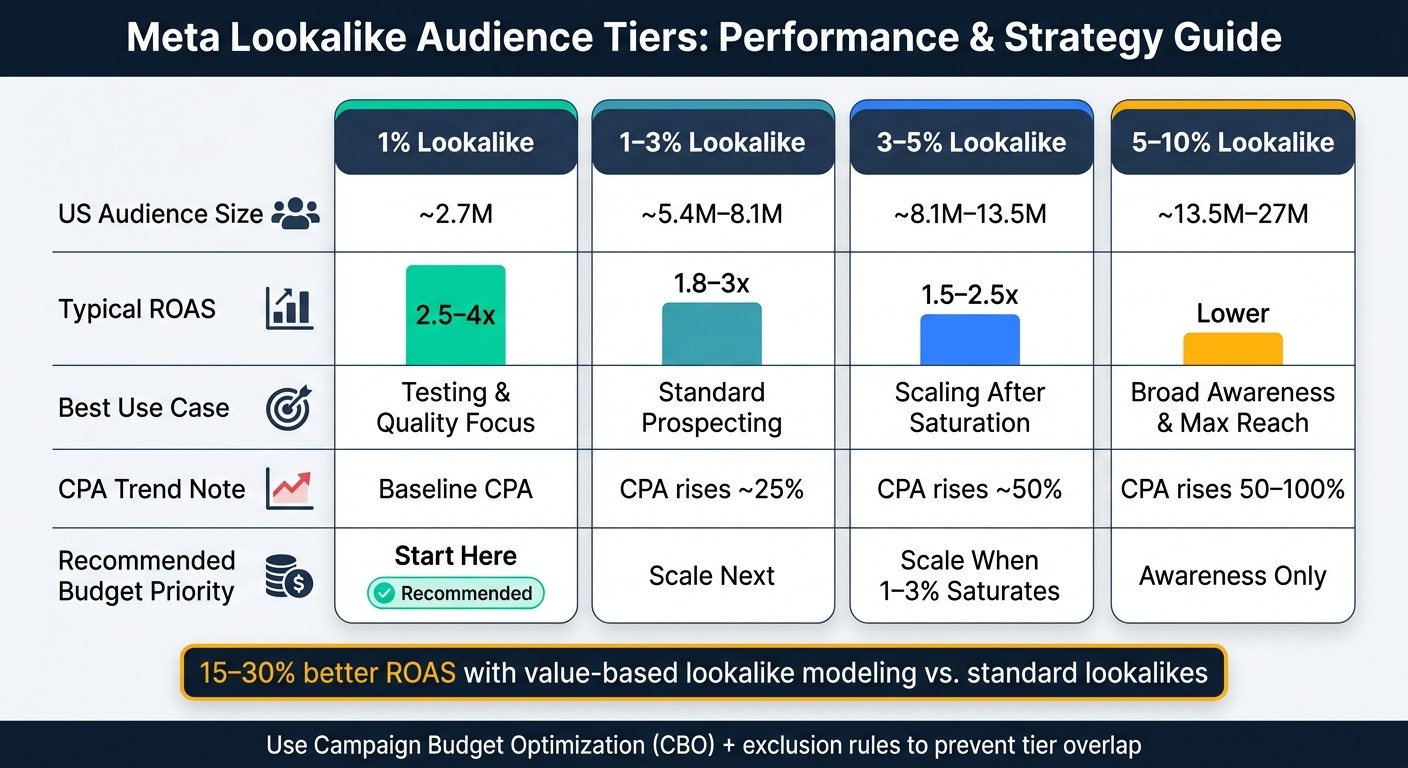
Here’s a quick breakdown of what to expect from each tier:
Lookalike Tier | US Audience Size | Typical ROAS | Best Use Case |
|---|---|---|---|
1% | ~2.7M | 2.5–4x | Testing, quality focus |
1–3% | ~5.4M–8.1M | 1.8–3x | Standard prospecting |
3–5% | ~8.1M–13.5M | 1.5–2.5x | Scaling after smaller tiers saturate |
5–10% | ~13.5M–27M | Lower | Broad awareness, maximum reach |
Interestingly, the 1% tier isn’t always the top performer. Sometimes, targeting a broader tier - like the 11–25% LTV cohort - provides better results. This is because larger audiences can still be high-value while offering more scale.
Reducing Audience Overlap
To ensure your tiered structure works effectively, you need to reduce audience overlap. Overlapping audiences are a common reason for underperforming campaigns. When your ad sets compete with each other, it drives up CPMs and skews your performance metrics.
Start by excluding overlapping groups. For example, exclude existing customers and recent converters from all lookalike ad sets. Sync these groups from your CDP and apply them as exclusions across your prospecting campaigns.
To double-check your exclusions, use Meta's Audience Overlap tool in Ads Manager. Select two audiences, click "Show Audience Overlap", and review the percentage. If the overlap exceeds 20–25%, tighten your exclusion rules.
Finally, keep an eye on Meta's evolving tools. By 2026, Advantage+ Audience will treat lookalikes as flexible guidelines rather than strict boundaries. This means the quality of your seed audience will carry even more weight, making the choice between AI and manual audience creation critical, as Meta’s AI could expand beyond your defined percentage if it predicts better results.
Measuring and Refining Lookalike Performance
Key Metrics to Track
Once your campaigns are up and running, tracking the right metrics is essential for fine-tuning performance. Focus on both platform metrics - like CTR (Click-Through Rate), CPC (Cost Per Click), and CPM (Cost Per Mille) - and business metrics such as ROAS (Return on Ad Spend), CPA (Cost Per Acquisition), AOV (Average Order Value), and 30-day repurchase rate. Instead of looking at overall results, compare performance across specific audience segments.
A critical part of this process involves evaluating seed types and lookalike tiers. For instance, compare how a "Top 10% LTV" seed performs against an "All Purchasers" seed within the same tier. According to Benly.ai's 2026 benchmarks, CPA can rise by 50–100% as you move from a 1% to a 10% lookalike, while ROAS may drop from 2.5–4× to 1–2× in the same range. Be on the lookout for three key signs that a lookalike audience is becoming less effective: rising CPM, declining CTR, and increasing CPA.
Using Performance Data to Improve CDP Segments
The results from your campaigns provide valuable feedback for refining your CDP (Customer Data Platform) segments. For example, if a lookalike audience based on your "Top 10% LTV" segment consistently outshines one built from "All Purchasers", it’s a sign to narrow your seed further. To do this, focus on isolating the top 10–20% of customers by metrics like LTV or AOV, and filter out negative contributors such as bargain hunters, high-refund customers, or low-margin accounts that dilute the quality of your seed audience.
"Meta does not need more data. It needs better data. Your top 10% of customers can become the signal that helps the system find the next generation of high-value buyers." - Anthony Paulino, Infinite Media Resources
For businesses experiencing rapid growth, refresh your seed audiences monthly. For more stable businesses, quarterly updates should suffice. Stale seeds can lead Meta’s algorithm to target users who no longer align with your ideal customer profile, resulting in less effective campaigns.
Once you’ve refined your segments, the next step is testing these adjustments to maximize their impact.
Testing and Automation Approaches
When it comes to testing lookalike tiers, there are two main strategies to consider:
Stacked Testing with Exclusions: Run multiple tiers (e.g., 1%, 3%, and 5%) simultaneously while applying exclusions to prevent audience overlap. This method delivers quick comparative data but requires careful setup to avoid internal competition.
Staggered Testing (Sequential): Expand gradually, testing one tier at a time before moving to broader tiers. This approach provides cleaner, more reliable data but takes longer to yield insights.
Testing Approach | Pros | Cons | Best For |
|---|---|---|---|
Stacked Testing with Exclusions | Rapid comparisons and reduced overlap | Complex to set up | Medium-to-high budgets |
Staggered (Sequential) | Clean data with no overlap | Slower insights | Limited budgets, methodical scaling |
To simplify these tasks, automated tools can be a game-changer. Platforms like AdAmigo.ai can automate much of the process. AdAmigo’s AI Autopilot continuously monitors campaign performance, identifies underperforming lookalike tiers, and adjusts budgets, pauses weaker ad sets, or scales up winning ones. You can choose to let it run automatically or approve changes manually. Their AI Chat Agent also allows you to quickly query metrics like “Which tier has the lowest CPA this week?” and get actionable insights without digging through Ads Manager.
Conclusion: Key Takeaways for CDP-Driven Lookalike Success
When it comes to CDP-driven lookalike success, everything starts with quality seeds, accurate data, reliable syncing, and consistent refinement. The quality of your seed audience is the cornerstone. For instance, a seed of 2,000 high-LTV customers will outperform a larger, less targeted list of 50,000 every time. This is because Meta's algorithm depends entirely on the data you provide.
"A lookalike doesn't create quality. It extends whatever quality already exists in the seed." - AdStellar
This quote underscores the importance of starting with strong, high-value data. By using value-based weighting, such as including LTV data with your customer list, you give Meta the tools to focus on customers who spend more, not just those who make occasional purchases. Brands using this approach often report 15–30% higher ROAS and 20–30% higher AOV on initial purchases compared to standard campaigns.
But it’s not just about the seed - it’s also about the connection. A solid, accurate data sync is non-negotiable. Server-side connections with hashed identifiers and non-expiring System User Tokens ensure a smooth, uninterrupted data flow. Even small sync errors can hurt performance, so getting this right is crucial.
Lastly, lookalike audiences require ongoing attention. If you notice rising CPM or declining CTR, it’s likely time to refresh your seed or update your creative assets. High-growth brands should aim to refresh seeds monthly, while more stable brands can do so quarterly. Pairing this with tiered testing and tools like AdAmigo.ai helps fine-tune budgets and avoid unnecessary spend. You can also leverage AI-driven segmentation to further optimize these high-value audiences.
FAQs
What’s the best seed audience if I don’t have 1,000+ purchasers yet?
If your customer base is under 1,000, it's better to prioritize quality signals rather than chasing large numbers. This helps maintain the effectiveness of the algorithm. Focus on smaller, high-intent seed audiences like:
Users who added items to their cart
People who initiated the checkout process
Highly engaged email subscribers
Visitors who showed strong interest, such as viewing product pages
Tools like AdAmigo.ai can assist in pinpointing valuable opportunities and automating audience strategies. This allows you to concentrate on growth while the platform fine-tunes your campaigns around the clock.
How do I choose between a standard lookalike and a value-based lookalike?
If your customers share similar characteristics - like with early-stage brands or lower-priced products - opt for a standard lookalike audience. This approach works well when customer value doesn't vary much across the board.
On the other hand, a value-based lookalike audience is perfect for brands dealing with diverse purchase values, subscription models, or higher-priced items. This method uses purchase data or lifetime value (LTV) metrics to focus on targeting users who are likely to bring in more value over time.
What if you don’t have detailed LTV data? No problem. You can assign relative values to different customer groups to approximate their worth. Plus, tools like AdAmigo.ai can step in to automate and refine these audience segments, ensuring your targeting stays sharp and effective.
How can I reduce overlap between lookalike tiers and retargeting audiences?
To avoid overlap between lookalike tiers and retargeting audiences, make sure your audience groups don’t intersect. Use the Audience Overlap tool in Meta Ads Manager to review audience segments before launching campaigns. If you’re stacking lookalike percentages (like targeting 1–3%), exclude smaller tiers (such as 1%) from your targeting to keep things clean. For a hands-off approach, tools like AdAmigo.ai can handle these optimizations for you, continuously auditing performance and fine-tuning targeting around the clock. This helps cut down on wasted ad spend and boosts campaign efficiency.