
What Is an AI Media Buyer? How AI Agents Are Changing Meta Ads
AI media buyers automate Facebook & Instagram ads, improve ROAS, lower CPA, and shift media buyers toward strategic roles.
AI media buyers are software tools that automate the management of Facebook and Instagram ad campaigns. These systems connect directly to Meta's Marketing API, handling tasks like budget adjustments, creative testing, and performance monitoring without requiring constant human input. Unlike rule-based tools, AI media buyers use advanced reasoning to analyze campaign data in context, making decisions that go beyond simple “if-then” rules.
Here’s why they matter:
Time Savings: Reduce daily ad management from hours to minutes.
Improved Results: Advertisers report up to 15% higher ROAS and 12% lower CPA.
Autonomous Execution: AI takes actions like pausing underperforming ads or reallocating budgets automatically.
Context Awareness: AI evaluates trends, such as creative fatigue or learning phase performance, before acting.
AI media buyers outperform both rule-based systems and Meta's built-in automation (Advantage+) by integrating external data, offering transparency, and protecting campaigns from unnecessary resets. While ideal for larger ad accounts with sufficient data, they may struggle with limited budgets or niche markets. Tools like AdAmigo.ai, Revealbot, and Smartly.io cater to different needs, from small businesses to enterprise-level advertisers.
What Is an AI Media Buyer and What Can It Do?
Defining an AI Media Buyer
An AI media buyer is a specialized software agent that integrates directly with the Meta Marketing API to autonomously handle ad campaigns on Facebook and Instagram. Unlike traditional tools, it doesn't just suggest changes - it takes action. From pausing underperforming ads to reallocating budgets and refreshing creatives, it manages campaigns without waiting for human intervention.
What makes AI media buyers stand out is their ability to use contextual reasoning. Instead of merely reacting to raw data, they leverage large language models (LLMs) to interpret performance trends. For instance, if the cost per action (CPA) suddenly spikes, a rule-based system might immediately halt the ad set. However, an AI media buyer evaluates the situation first, checking whether the ad is in its learning phase or showing signs of improvement before making a decision. Beyond these strategic moves, they also handle a wide range of operational tasks, as detailed in their core functions.
Key Functions of an AI Media Buyer
AI media buyers excel at streamlining ad operations, as shown in the table below:
Core Function | What It Does in Practice |
|---|---|
Budget Management | Increases budgets by 10–20% when return on ad spend (ROAS) targets are met; pauses ad sets overspending (1.5× target CPA) without conversions |
Creative Testing | Cycles through 20–50 creative variations, pausing those with high frequency or click-through rates (CTR) below 1% |
Anomaly Detection | Identifies and flags issues like cost-per-thousand impressions (CPM) spikes or drops in Conversions API (CAPI) signals before they cause major losses |
Account Audits | Continuously monitors audience saturation and overlap to avoid performance declines |
Stop-Loss Execution | Automatically pauses ad sets that spend $50 without generating any sales |
The efficiency gains are impressive. AI systems can reduce 3–4 hours of daily ad management to just a 15-minute review. Brands using these tools on Meta platforms have reported a 12% drop in CPA and a 15% boost in ROAS compared to manual campaign management.
For example, in May 2026, Advolve, a marketing platform, shared that deploying Claude AI with the Meta Ads MCP server resulted in a 90% reduction in operational workload and a 15% increase in client ROAS. Their team of three expanded from managing 8 client accounts to 20 - without hiring additional staff.
"The role of the Media Buyer is shifting from button-pushing to High-Level Strategy. AI handles 90% of the volume, but the human must provide the vision." - Stormy AI
However, there’s a critical dependency: the system's effectiveness relies on having enough data to work with. Accounts need at least 50 optimization events per ad set per week for the AI to accurately identify patterns and distinguish meaningful signals from noise. Without this, even the most advanced AI struggles to make reliable decisions.
This combination of precise decision-making and data-driven management is what sets AI media buyers apart from older, rule-based systems and other automation tools.
Replace Your Meta Media Buyer with OpenClaw (Meta, FB, IG)
How AI Media Buyers Compare to Other Tools
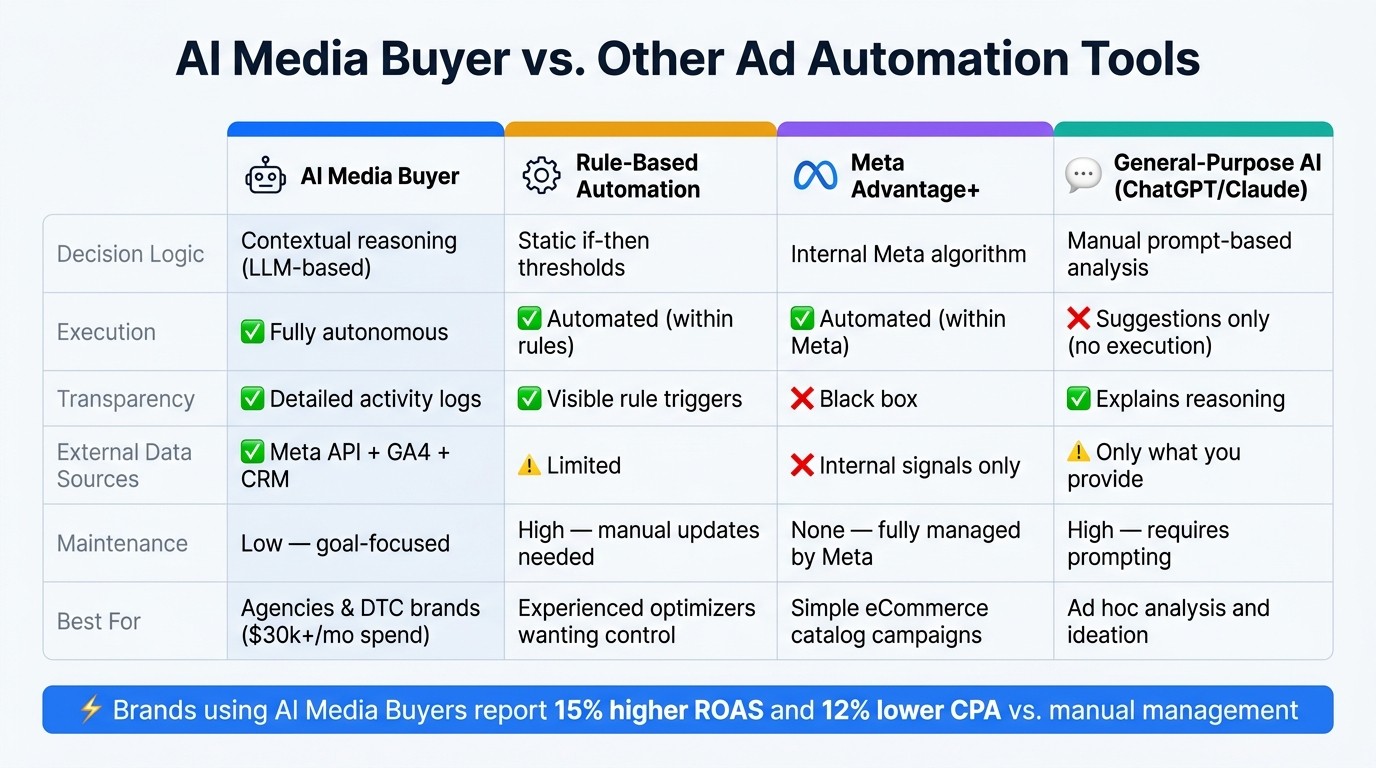
AI Media Buyer vs. Rule-Based Automation vs. Meta Advantage+ vs. ChatGPT
AI Media Buyers vs. Rule-Based Automation
Rule-based automation tools, like Revealbot, rely on if-then logic to make decisions: if the CPA (cost per acquisition) exceeds $50, pause the ad. While this sounds straightforward, real-world campaigns are rarely that simple. For example, a CPA spike during the learning phase might look just like a performance drop, but rule-based systems can’t distinguish between the two.
AI media buyers, on the other hand, approach decisions with context in mind. They evaluate factors like whether an ad set is still in its learning phase, whether a cost increase is just temporary, and whether pausing the ad might actually hurt overall performance. These systems don’t just react - they manage the entire campaign lifecycle. This includes stopping ads that aren’t performing, launching new ad sets, and reallocating budgets, all while staying aligned with your broader goals instead of rigid, predefined rules.
Another key difference is maintenance. Rule-based systems demand constant manual updates to keep up with changing conditions. For example, if Meta adjusts its delivery behavior, you’d need to rewrite the rules. AI media buyers eliminate this hassle by operating on high-level instructions, adapting automatically without constant intervention.
Feature | Rule-Based Automation | AI Media Buyer |
|---|---|---|
Decision Logic | Static if-then thresholds | Contextual reasoning (LLM-based) |
Maintenance | High - manual updates needed | Low - goal-focused instructions |
Adaptability | Low - ignores market context | High - dynamically reads signals |
Scope | Single-trigger reactions | Multi-step autonomous workflows |
Next, let’s see how AI media buyers stack up against Meta Advantage+, Meta’s built-in automation tool.
AI Media Buyers vs. Meta Advantage+
Meta Advantage+ uses a different approach compared to rule-based systems. It’s built directly into the platform and doesn’t cost extra to use. This tool automates bidding, placements, and creative combinations by leveraging Meta’s internal signals. For ecommerce campaigns with a clean product catalog, Advantage+ can deliver solid results. Meta even reports a 5% median decrease in cost per result for Advantage+ Shopping campaigns.
However, there’s a major downside: Advantage+ operates as a black box. You don’t get to see why it made a particular decision, and you can’t override its logic with external data. It also lacks awareness of key factors like your CRM data, competitor strategies, or performance trends across multiple accounts. Worse, it can unintentionally reset the learning phase when making aggressive spending adjustments.
AI media buyers address these gaps by sitting outside Meta’s delivery system. They integrate external data sources - like Google Analytics 4 - into their decision-making, flag risks before edits are made, and provide detailed logs explaining every action. As Matteo Lombardi from Stratega puts it: "An AI without brand context makes generic recommendations. An AI with deep context thinks like a strategist."
Feature | Meta Advantage+ | AI Media Buyer |
|---|---|---|
Transparency | Low - no reasoning exposed | High - detailed activity logs |
Customization | Very low - fully algorithmic | Full - custom logic and guardrails |
Data Sources | Internal Meta signals only | Meta API + external sources (e.g., GA4) |
Learning Phase Protection | Can reset via aggressive edits | Protected through logic-based guardrails |
AI Media Buyers vs. General-Purpose AI Tools Like ChatGPT
Using general-purpose AI tools like ChatGPT or Claude to optimize Meta ads is like asking someone to coach a live game using old stats. While these tools can analyze data and offer suggestions, they rely entirely on whatever information you provide - like a CSV file or a screenshot - and lack a live connection to your ad account.
The biggest limitation here is execution. General-purpose AI can recommend changes, but it can’t implement them. Dedicated AI media buyers solve this with a Read-Decide-Write system: they pull live data from the Meta Marketing API, analyze it, and make changes automatically - 24/7.
There is, however, a middle ground. In 2026, the Model Context Protocol (MCP) allowed tools like Claude to connect directly to Meta’s API, giving general-purpose AI an execution layer. Advolve, for instance, used this setup to integrate Claude with Meta’s Marketing API. The result? A 90% reduction in operational workload and a 15% increase in client ROAS.
"A black-box agent that takes actions without surfacing its reasoning is a liability on any account above $10k/month." - Murat Bock, Founder, AdLibrary
Another advantage of dedicated AI media buyers is their consistency. They follow structured guardrails every time, eliminating the need for prompt engineering or manual intervention. This ensures reliable, repeatable results.
When to Use or Avoid an AI Media Buyer
When an AI Media Buyer Is a Good Fit
AI media buyers thrive when there's enough spending and conversion data to work with. For example, having at least 50 conversion events per week allows the AI to move past its learning phase and start optimizing effectively.
Here are a few scenarios where AI media buyers shine:
Agencies juggling multiple accounts: AI can handle up to 90% of tasks like reporting, auditing, and budget adjustments. This means agencies can manage more clients without needing to expand their team.
DTC and eCommerce brands with monthly ad spends of $30,000+: These businesses often see returns on AI tool investments within 60 days. lower cost-per-acquisition (CPA) and quicker creative testing are key drivers of this success.
Creative-heavy teams: If your campaigns test 20–50 creative variants, AI can automate creative rotation and detect fatigue. This keeps click-through rates (CTRs) steady without requiring constant manual intervention.
In fact, brands that use AI-driven automation report 12% lower CPAs and 15% higher ROAS compared to manual management methods. But AI isn't a one-size-fits-all solution, and there are situations where it struggles to deliver results.
When an AI Media Buyer Is Not the Right Choice
AI media buyers aren't the best option for every situation. If you're working with limited data or have strict constraints, the results might fall short. For instance, new brands with little ad spend or conversion history lack the data foundation AI needs to optimize effectively. Similarly, campaigns targeting narrow B2B markets or small geographic areas often don't generate enough data for reliable decision-making.
Industries with strict regulations - like finance, health, or housing - also require a human touch. These fields have complex ad policies that AI may struggle to navigate. As Mike Hauptman, CEO of AdLib, explains:
"Handing everything over [to AI] and just saying 'go' puts the burden on the brand and the advertiser to make it work."
To mitigate risks, it's wise to run a new AI agent in read-only mode for one to two weeks. During this period, let it suggest changes without implementing them. Once you're confident in its recommendations, you can grant it full control over your campaigns.
Best AI Media Buyer Tools for Meta Ads
Let's dive into how specialized AI tools are reshaping Meta ad management and why they’re worth considering.
What to Look for in an AI Media Buyer Tool
AI media buyer tools aren’t all created equal. Before committing to one, make sure it checks a few key boxes:
Meta Business Partner status: This ensures reliable API access and the permissions needed to make real-time changes.
Autonomous execution: Look for tools that can act on their own, not just suggest changes.
Creative support: Features like asset generation and fatigue detection are game-changers.
Transparency: Clear explanations for recommendations are essential.
24/7 monitoring: Tools should flag budget anomalies or other issues before they snowball.
If you focus solely on Meta ads, a tool built specifically for that platform often delivers better outcomes than broader, multi-platform options.
AdAmigo.ai: Full-Service AI Media Buyer for Meta Ads
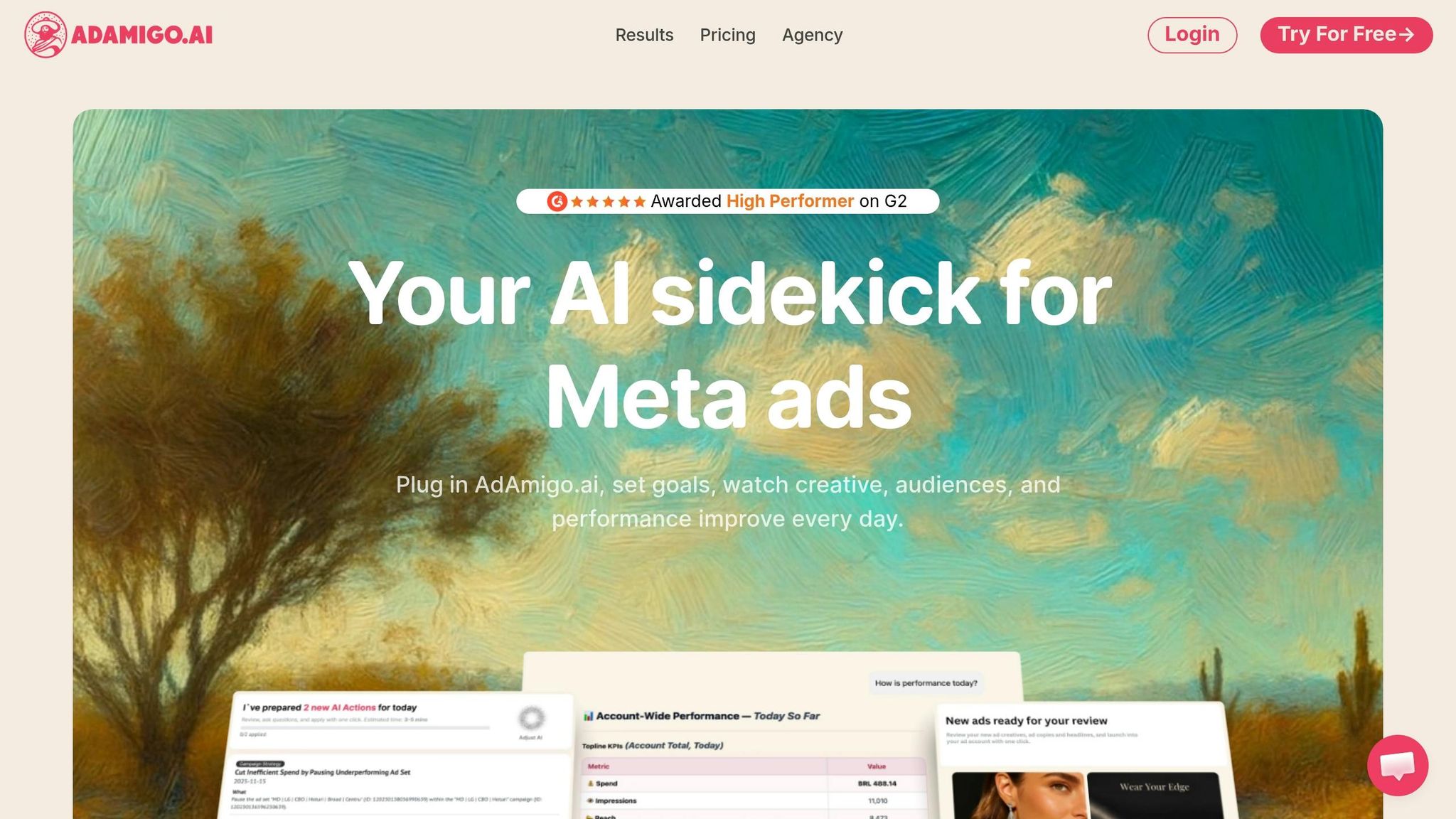
AdAmigo.ai stands out as a full-stack AI solution tailored for Meta ads. Its AI Autopilot feature audits your account, identifies opportunities, and makes KPI-driven adjustments. You can choose between semi-auto or full autopilot modes, where you either approve changes or let the AI handle tasks, which handles tasks like scaling high-performing ads and pausing underperformers while scaling Meta ad budgets efficiently.
The AI Chat Agent makes account management conversational. You can ask questions like why your ROAS dropped, request a new retargeting campaign, or pull performance summaries - all without opening Ads Manager. Meanwhile, the Ad Factory creates new creatives by analyzing top-performing ads and competitor strategies. For ongoing oversight, AdAmigo Protect monitors your campaigns continuously, catching issues like disapproved ads or broken links.
Users report an average 28% ROAS increase in the first month. One G2 reviewer summed it up:
"Agencies charging 7 times the cost of AdAmigo have been put to shame quite frankly!" - Rochelle D., G2 Reviewer
Pricing starts at $99/month for the Signals plan, which includes daily recommendations and AI Chat access. For full automation, unlimited spend, and a dedicated account manager, the Full Access plan costs $349/month. Custom pricing is available for agencies managing five or more accounts.
Other AI tools for Meta ads to consider
If AdAmigo.ai isn’t the perfect fit, here are two other options worth exploring:
Revealbot: Ideal for experienced media buyers, this tool focuses on rule-based control across Meta and other platforms. Plans start at $99/month and scale with ad spend.
Smartly.io: Designed for large enterprises spending over $100,000 monthly, it offers multi-channel support and dynamic creative personalization. Pricing starts around $2,000/month, making it better suited for bigger teams.
Tool | Best For | Differentiator | Starting Price |
|---|---|---|---|
AdAmigo.ai | SMBs & performance agencies | Agentic execution, creative generation | $99/month |
Revealbot | Experienced optimizers | Granular rule-based control | $99/month |
Smartly.io | Enterprise brands ($100k+/mo) | Multi-channel, dynamic personalization | ~$2,000/month |
Conclusion: Where AI Media Buyers Are Headed in Meta Advertising
The shift to AI-driven ad management is reshaping how advertisers approach campaigns on Meta. By late 2024, nearly 60% of US ad buyers have either adopted or plan to adopt AI-powered buying tools. Looking ahead, about two-thirds of advertisers aim to prioritize agentic ad buying by 2026. These trends highlight a clear pivot in how advertisers are structuring their strategies.
One of the most notable changes is the evolving role of media buyers. Instead of spending time on daily campaign tweaks, their focus has shifted to guiding AI systems and crafting strong creative strategies. With creative content now acting as the main targeting tool on Meta, this change is crucial. Success will come to those who use AI to maintain a steady stream of high-quality creative while staying aligned with their brand’s goals and broader strategy.
On top of these strategic shifts, the technology itself is advancing rapidly. For instance, AI tools can now identify performance dips up to 48 hours earlier than manual monitoring. Advertisers using agentic workflows are also seeing a 22% higher ROAS compared to those relying on manual campaigns. These benefits align with the broader trend of combining automation with transparency - allowing advertisers to understand and trust AI's decision-making before fully relying on it.
Whether managing a single account or dozens, the direction is unmistakable: spend less time buried in Ads Manager and more time focusing on strategy and creative vision. AI is not just a tool - it’s becoming the cornerstone of modern Meta advertising.
FAQs
How do I know an AI media buyer won’t hurt performance?
To keep an AI media buyer from negatively affecting performance, it's important to set clear boundaries and actively monitor its actions. Start by using scope limits to control access, ensuring the AI only works on specific campaigns. Keep an eye on key metrics like learning phases and frequency data to catch any unusual trends early.
On top of that, create structured rules. For instance, you can set alerts for high cost-per-lead (CPL) or low click-through rates (CTR). Always review critical decisions, such as changes to ad creatives, to ensure they align with your goals. With regular oversight and well-defined parameters in place, the AI can work more efficiently without risking your results.
What data do I need before using an AI media buyer?
To make the most of an AI media buyer, you’ll need accurate and well-organized data from both your advertising efforts and customer journey touchpoints. Start with at least 90 days’ worth of campaign performance data - things like impressions, clicks, conversions, and costs. This historical data helps the AI understand trends and optimize effectively.
Equally important is proper conversion tracking. This ensures you can tie revenue back to specific campaigns, giving the AI the insights it needs to allocate your budget wisely.
A solid first-party data strategy is also key. This means pulling together data from CRM systems, website activity, and offline conversions into a single, unified data warehouse. When your data is consolidated and accurate, it sets the stage for better decision-making and results.
Can I start in read-only mode before turning on autopilot?
Yes, you can start in read-only mode and slowly transition to enabling write permissions and autopilot. This method gives you the chance to review proposals upfront, ensuring they match your objectives before moving to full automation.