
Ultimate Guide to Meta Ad Copy Length Testing
Test short, medium, and long Meta ad copy across placements and audiences to improve CTR, ROAS, and lower CPA.
Want better-performing Meta ads? The length of your ad copy - primary text, headline, and description - can make or break your campaign. Here's the key takeaway: shorter copy works best for quick actions like traffic or conversions, while longer copy suits awareness and retargeting ads.
Key Insights:
Primary Text: Keep it under 125 characters to avoid truncation on mobile feeds.
Headlines: Stick to 40 characters or less for clarity.
Descriptions: Aim for 30 characters to reinforce your call-to-action (CTA).
Placement Matters: Reels and Stories need concise text, while Feed ads allow for more detail.
Audience Intent: Cold audiences prefer short, sharp hooks; warm audiences respond better to detailed, specific messaging.
Testing Strategy:
Create short, medium, and long copy versions for each ad.
Use Meta’s A/B testing tools to test key variables and measure performance.
Focus on metrics like CTR, ROAS, and CPA to identify winners.
Pro Tip: Always lead with your strongest hook in the first 6 words - this is your chance to grab attention before users scroll past.
Let’s dive deeper into how to match copy length to objectives, placements, and audience intent.
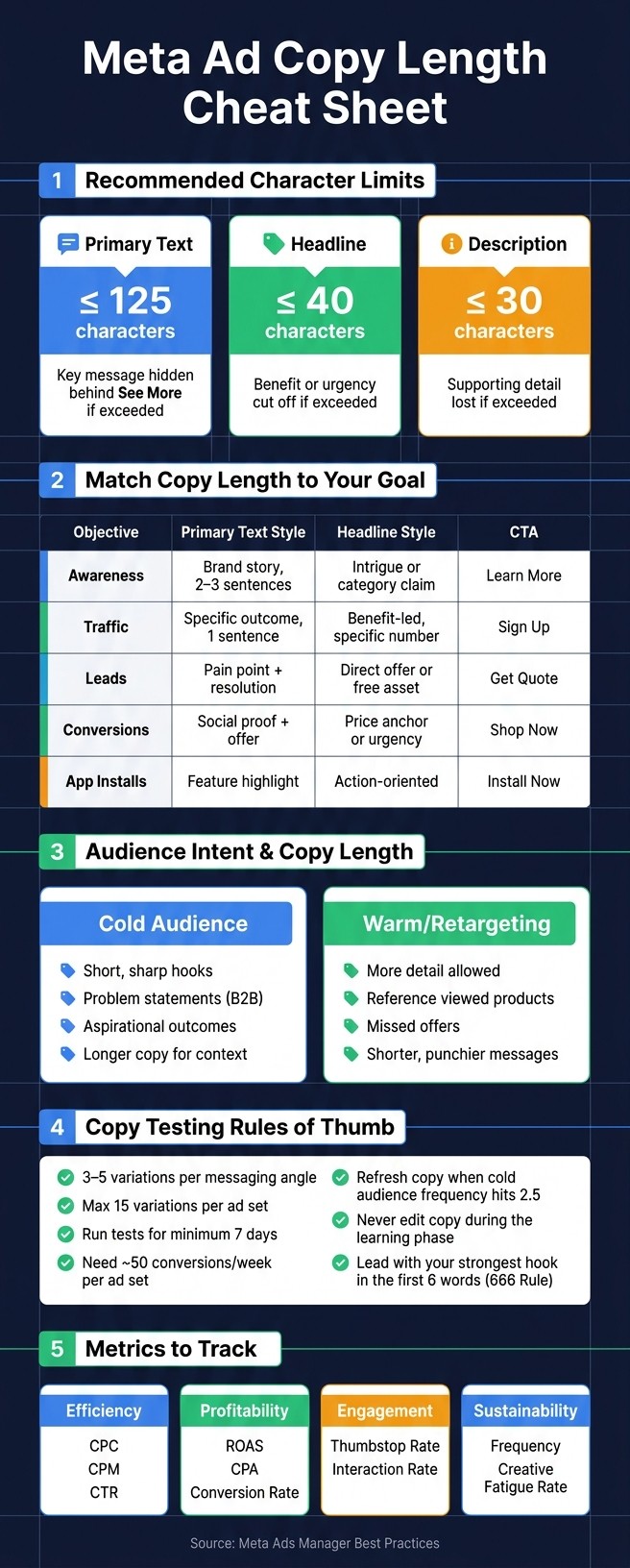
Meta Ad Copy Length Cheat Sheet: Specs, Goals & Testing Rules
Ad Copy Length Specs for Meta Placements
Character Limits for Primary Text, Headlines, and Descriptions
When creating ad copy for Meta placements, it's essential to stay within the recommended character limits to prevent truncation. While exceeding these limits won’t result in rejection, it can cut off critical parts of your message - like your key hook or offer. To avoid this, make sure to highlight essential details within the first 125 characters of your primary text and the first 40 characters of your headline.
Here’s a quick breakdown of the recommended limits:
Field | Recommended Limit | Impact When Exceeded |
|---|---|---|
Primary Text | ≤ 125 characters | Key message hidden behind "See More" |
Headline | ≤ 40 characters | Benefit or urgency cut off |
Description | ≤ 30 characters | Supporting detail lost |
To maximize visibility, lead with your most important hook, offer, or benefit right at the start. This ensures your message lands, no matter the placement. Let’s dive into how these limits play out across various placements.
How Copy Length Affects Different Placements
Meta’s placements - such as Feed, Stories, and Reels - display text differently, so your copy needs to adapt. For example, Feed ads on Facebook and Instagram allow for slightly longer primary text, making them ideal for more detailed messaging. On the other hand, Stories and Reels focus on visuals, with text playing a minor but immediate role. Keep overlays short and impactful in these formats.
Meta’s system automatically adjusts your creative based on the placement’s aspect ratio - 9:16 for Stories and Reels, and either 4:5 or 1:1 for Feed. However, what looks great in a Feed ad might feel cluttered in a Reels format. To simplify this, Meta’s Advantage+ Creative feature can optimize your ad for different placements, ensuring your message doesn’t get cut off or lost in translation.
These placement differences also influence how much information your audience can absorb - something that ties closely to their intent.
Matching Copy Length to Audience Intent
Your audience’s familiarity with your brand should guide how much detail you include in your copy. For cold audiences - those encountering your brand for the first time - stick to short, sharp hooks. These could be problem statements for skeptical viewers (common in B2B) or aspirational outcomes for desire-driven audiences.
For warm or retargeting audiences, who already know your brand, you can afford to add more detail. Reference the product they’ve viewed, the offer they missed, or the results they’re looking for.
Here’s a table to help align your copy with campaign goals:
Objective | Primary Text Style | Headline Style | Recommended CTA |
|---|---|---|---|
Awareness | Brand story (2–3 sentences) | Intrigue or category claim | Learn More |
Traffic | Specific outcome (1 sentence) | Benefit-led, specific number | Learn More / Sign Up |
Leads | Pain point + resolution | Direct offer or free asset | Get Quote / Sign Up |
Conversions | Social proof + offer | Price anchor or urgency | Shop Now / Buy Now |
App Installs | Feature highlight | Action-oriented | Install Now |
A helpful way to structure your copy is by using the FAB framework: focus on your product’s features → advantages → benefits. Prioritize communicating the benefits over merely listing features. Murat Bock, Founder of AdLibrary, suggests this approach can boost performance by 20–30% when targeting cold audiences.
How to Set Up and Run Copy Length Tests
Writing Short, Medium, and Long Copy Variations
When testing different copy lengths, it's crucial to keep elements like the hook, offer, creative, and tone consistent. This way, any changes in performance can be attributed to the copy length itself.
Develop three versions of your copy - short, medium, and long - for each messaging angle. Keep the total number of variations manageable, ideally between 3 and 5 per angle. Testing more than 15 variations within a single ad set can dilute the learning signal, making it harder for Meta's system to achieve statistical significance.
Once you've created these variations, use Meta's A/B testing tools to evaluate their performance effectively.
Using Meta's A/B Testing Tools in Ads Manager
Meta's Ads Manager includes a built-in A/B testing tool that allows you to isolate copy length as the only variable. To set this up, duplicate your ad set and adjust only the primary text length while keeping everything else - such as audience, budget, placement, and creative - exactly the same.
With Advantage+ Creative, Meta automatically optimizes your copy for different placements, like Feed and Reels, so there's no need to create separate versions for each. It's important not to make any edits to the ad sets once the test is live. Changes during the learning phase reset the optimization process, wasting valuable data.
Test Duration and Budget Guidelines
For reliable results, Meta's system requires around 50 conversions per week per ad set. For example, if your cost per conversion is $25, you should allocate at least $1,250 per week per ad set.
Let your tests run for a minimum of 7 days before drawing any conclusions. For B2B advertisers dealing with longer sales cycles, analyzing 180 days of historical data instead of 90 days can provide a more accurate baseline. If you're running Advantage+ Shopping campaigns, include 6–8 copy variations across 2–3 messaging angles. This gives Meta's system enough data to optimize effectively. Additionally, when your cold audience frequency hits 2.5, introduce a new copy variation to maintain performance.
How to Read and Act on Copy Length Test Results
Metrics to Use When Evaluating Copy Length
After running your test for seven days, it’s time to dig into the results. Not all metrics tell the same story, so it’s helpful to organize them by what they measure:
Metric Type | Primary Metrics | What It Tells You |
|---|---|---|
Efficiency | CPC, CPM, CTR | How well the copy grabs attention and drives clicks |
Profitability | ROAS, CPA, Conversion Rate | The financial impact of each copy length |
Engagement | Thumbstop Rate, Interaction Rate | How well the opening hook captures interest |
Sustainability | Frequency, Creative Fatigue Rate | How quickly the copy loses its effectiveness over time |
Start by focusing on profitability metrics like ROAS and CPA - these directly reflect what’s driving business results. Then, use engagement metrics, such as thumbstop rate, to uncover why one length might be performing better than another. For instance, if a short copy variation shows a high CTR but a weak conversion rate, it’s likely pulling in clicks but failing to provide enough context to seal the deal.
Once you’ve analyzed these metrics, you’ll be in a better position to decide when - and how - to scale the winning copy length.
When a Winning Copy Length Is Ready to Scale
Seeing strong early results is promising, but it doesn’t mean the copy is ready for scaling yet. Before increasing your budget, make sure the ad set has hit around 50 conversions per week. This is the threshold Meta’s system needs to leave the learning phase. Scaling too early risks acting on incomplete or unreliable data.
Next, check your Pixel or Conversions API EMQ score. It should be at least 6. If the score is lower, it could indicate that the data feeding Meta’s algorithm isn’t clean or accurate, which might lead to scaling the wrong variation.
Don’t forget to monitor frequency. When it climbs above 2.5, performance often starts to drop. If this happens, consider introducing a fresh copy angle instead of simply cutting back on spend.
Breaking Down Results by Audience and Placement
Profitability and engagement metrics are just the beginning. Copy length effectiveness often depends on your audience and placement. For example:
Cold audiences tend to respond better to longer, more detailed copy that provides context.
Retargeting audiences, on the other hand, usually prefer shorter, punchier messages.
The stage of the funnel also matters. Awareness campaigns often benefit from longer, narrative-driven copy that tells a brand story. Conversely, conversion campaigns thrive on concise, benefit-focused copy or social proof.
Always segment your results by audience type and placement before deciding on a winning copy length. This ensures your copy resonates with specific groups and performs well across different placements, not just overall.
Applying and Scaling Copy Length Learnings
Setting Internal Copy Length Rules by Objective
Once you’ve figured out the ideal copy lengths for your campaigns, it’s time to turn those insights into a reliable system. Instead of starting from scratch with every campaign, create a straightforward internal guide that ties copy length and style to specific objectives. This approach saves time and ensures consistency.
Here’s a quick reference table to guide your campaigns:
Objective | Primary Text Style | Headline Style | Recommended CTA |
|---|---|---|---|
Awareness | Brand story, 2–3 sentences | Intrigue or category claim | Learn More |
Traffic | Specific outcome, 1 sentence | Benefit-led, specific number | Sign Up |
Leads | Pain point + resolution | Direct offer or free asset | Get Quote |
Conversions | Social proof + offer | Price anchor or urgency | Shop Now |
App Installs | Feature highlight | Action-oriented | Install Now |
Stick to character limits for maximum delivery across placements: headlines at 40 characters, primary text at 125 characters, and descriptions at 30 characters. These rules provide a strong foundation for scaling your campaigns effectively.
Once your guidelines are set, use Meta ads automation to streamline testing and maintain consistency across campaigns.
Using Automation to Run Continuous Copy Tests
Manual testing can be a time drain, especially when managing multiple campaigns. This is where automation tools like AdAmigo.ai come in handy. AdAmigo’s AI Autopilot simplifies the process by auditing your Meta ad account, identifying underperforming copy, and generating new test variations - either automatically or with your approval.
Here’s what AdAmigo.ai offers:
AI Autopilot generates 3–5 targeted copy variations for each creative angle.
Automates testing while preserving learning signals, so you don’t lose valuable data.
As Murat Bock, Founder of AdLibrary, explains:
"Automation without a validated angle is just faster noise."
AdAmigo’s Ad Factory takes it a step further by analyzing your top-performing ads and iterating on those concepts. This keeps your testing pipeline active without requiring constant manual effort.
Refreshing Copy to Avoid Creative Fatigue
Even the best-performing copy will eventually lose its impact. The trick is knowing when to refresh it - don’t wait for performance to drop significantly. Use performance metrics like CTR, ROAS, and CPA to decide when it’s time for a change. Reviewing these metrics weekly ensures your copy stays fresh and effective.
If you’re using AdAmigo, the AdAmigo Protect feature can help by monitoring for performance issues in real time. It alerts you to potential problems before they lead to wasted ad spend.
A key tip: avoid editing copy on active ad sets during the learning phase. Any changes will reset Meta’s optimization process, requiring another 50 conversions per week to stabilize. Schedule updates after the ad set has exited the learning phase to maintain data integrity.
Your Facebook Ad COPY is Too Long. THIS is Better...
Conclusion and Key Takeaways
We've covered testing methods, metrics, and scaling strategies, so let's break down the main points.
Testing Meta ad copy length is a continuous process. Align your copy length with audience intent and let your data guide every decision you make.
Keep the "666 Rule" in mind: grab attention within the first 6 words. Stick to recommended character limits to ensure clarity across placements, and structure your tests with 3–5 variations per angle, keeping it under 15 variations per ad set. Avoid tweaking live copy during the learning phase, and switch to a new copy angle when cold audience frequency reaches 2.5.
Effective automation works best when paired with strong creative strategies:
"Automation scales your execution; it doesn't fix a weak angle." - AdLibrary
Regularly review recent data to pinpoint winners and guide your next steps. This proactive mindset helps your campaigns adapt to audience behavior, distinguishing stagnant campaigns from those that continue to grow and improve.
FAQs
How do I pick short vs. long copy for my goal?
Deciding whether to use short or long copy often hinges on your audience's mindset and where they are in their purchase journey. For audiences that tend to be more skeptical - like those in B2B sectors or making high-stakes decisions - starting with a clear problem statement can be effective. On the other hand, if you're targeting aspirational audiences, it’s better to emphasize the end goal or the outcome they’re striving for.
To find what works best, testing is key. Dive into your historical performance data, or leverage tools like AdAmigo.ai. These tools can help you run A/B tests, create multiple variations, and refine your approach in real-time, ultimately boosting conversion rates and improving your ROAS (Return on Ad Spend).
How much budget do I need for a copy length test?
To maximize your ad performance, try applying the 60-30-10 rule to your budget:
60% goes to your top-performing ads (the proven winners).
30% is allocated to variations of those winning ads.
10% is set aside for testing entirely new ideas.
This approach balances stability with experimentation, ensuring you capitalize on what works while still exploring fresh opportunities.
How long should you run tests? Aim for 48-72 hours. During this time, gather enough data to hit 10-15 conversions per ad set - this ensures your results are statistically reliable.
For added efficiency, tools like AdAmigo.ai can take the guesswork out of budget adjustments and creative testing. These tools help you meet your CPA (Cost Per Acquisition) and ROAS (Return on Ad Spend) goals while avoiding issues like auction overlap.
When should I refresh copy to avoid fatigue?
When your ad performance begins to dip, creative fatigue might be the culprit - this typically happens within 7 to 14 days. Video ads, in particular, tend to wear out about 40% faster than static images. To keep things fresh, consider using tools like AdAmigo.ai to regularly update your messaging and roll out new variations. Keep an eye on key metrics such as CPC (cost per click) and conversion rates to spot fatigue early and ensure your campaigns stay on track.