
Third-Party Data Sharing: Key Questions
Understand the privacy, legal, and campaign risks of sharing third‑party data with Meta, plus practical fixes: use first‑party data, server‑side tagging, and audits.
Third-party data sharing in Meta advertising involves sending user data from your site or servers to Meta using tools like the Meta Pixel or Conversions API. While this boosts ad performance, it comes with risks like legal violations (e.g., HIPAA, CCPA) and campaign disruptions if mismanaged. Meta has strict policies to ensure compliance, especially for sensitive data like health information. Advertisers must focus on first-party data strategies, server-side tagging, and regular audits to avoid penalties and improve campaign reliability.
Key Points:
Risks: Privacy violations, legal fines, account restrictions.
Meta's Policies: Restrictions on sensitive data, compliance monitoring via Events Manager.
Best Practices:
Use first-party data with clear user consent.
Implement server-side tagging to filter sensitive info.
Conduct regular audits to ensure compliance.
Tools: Platforms like AdAmigo.ai help balance compliance with performance by automating privacy-focused campaign adjustments.
Staying on top of Meta’s policies and adopting secure data practices is critical to avoid legal and financial setbacks while maintaining effective advertising.
Risks of Third-Party Data Sharing
Data Privacy and Regulatory Violations
Sharing data with Meta comes with serious compliance concerns. Once your data leaves your servers, you lose control over how it's stored, processed, or used in the future. Meta’s privacy policies - covering areas like device details, geolocation, biometric data, cross-platform tracking, and retention periods - are often vague. This lack of clarity increases the risk of regulatory fines and potential lawsuits for stakeholders.
For healthcare advertisers, the stakes are even higher. Sharing Protected Health Information (PHI) without proper authorization can lead to severe HIPAA penalties. These compliance failures not only result in legal consequences but can also negatively affect the success of your campaigns.
Impact on Campaign Performance
The fallout from third-party data sharing isn’t just legal - it can directly hurt your campaigns. Violations often lead to account restrictions, higher costs, slower delivery, and extended learning phases, all of which can derail your advertising efforts.
There’s also a competitive risk. Meta has previously used third-party interaction data - like signals from competitor ads - to improve its own services, such as Marketplace. This practice led to regulatory action from the U.K.’s Competition and Markets Authority. Advertisers face similar challenges, where trust is eroded, and overall campaign performance suffers as a result. To mitigate these risks, advertisers must learn how to disclose data use transparently to maintain user trust.
Stop Tracking Sensitive Data! Fix Meta Pixel & CAPI parameters for MEDICAL Content on WordPress
Meta's Policies on Third-Party Data Sharing
Meta has implemented strict policies to address risks associated with sharing third-party data.
Data Categories and Restrictions
Meta organizes data sources into three main categories: core setups, event restrictions, and outright bans. Core setups involve standard first-party tracking, like consented Meta Pixel activity. Event restrictions come into play for sensitive areas, such as health and wellness. In these cases, Meta may block custom events like "Purchase" if they involve protected health information (PHI), such as prescription details. Outright bans cover raw personally identifiable information (PII) or PHI, including email addresses, phone numbers, or medical diagnoses, unless they are properly hashed and shared with explicit consent.
In November 2024, Meta introduced additional enforcement measures targeting industries like healthcare and other sensitive sectors, set to take effect in early 2025. These measures allow Meta to analyze the origin of data and impose partial or full restrictions if sensitive information is detected flowing through Meta Business Tools. Advertisers will see these restrictions reflected in their Events Manager, where data sources are categorized based on compliance. Restricted sources cannot be fully optimized or measured, which could hurt campaign performance unless adjustments like server-side tagging or anonymized data flows are implemented. These categorizations also guide Meta’s compliance alerts.
Compliance Monitoring and Tools
Meta uses Events Manager as the central hub for compliance monitoring. The platform identifies restricted events with warning banners, icons, diagnostics, and email notifications. These alerts provide detailed information about violations and outline the steps needed to resolve issues before campaigns are disrupted.
This marks a shift in responsibility. Previously, advertisers were expected to self-regulate their data sharing under Meta’s Business Tools Terms. Now, Meta automatically detects and blocks sensitive or non-compliant data. Events Manager has evolved into a diagnostics tool that highlights rejected events, restricted parameters, and offers step-by-step guidance for remediation. For example, if a healthcare website sends sensitive data through the Pixel or Conversions API, real-time alerts will flag blocked events and explain why they were restricted. Understanding and adhering to these policies is essential for staying compliant and ensuring your campaigns perform effectively.
Best Practices to Reduce Third-Party Data Sharing Risks
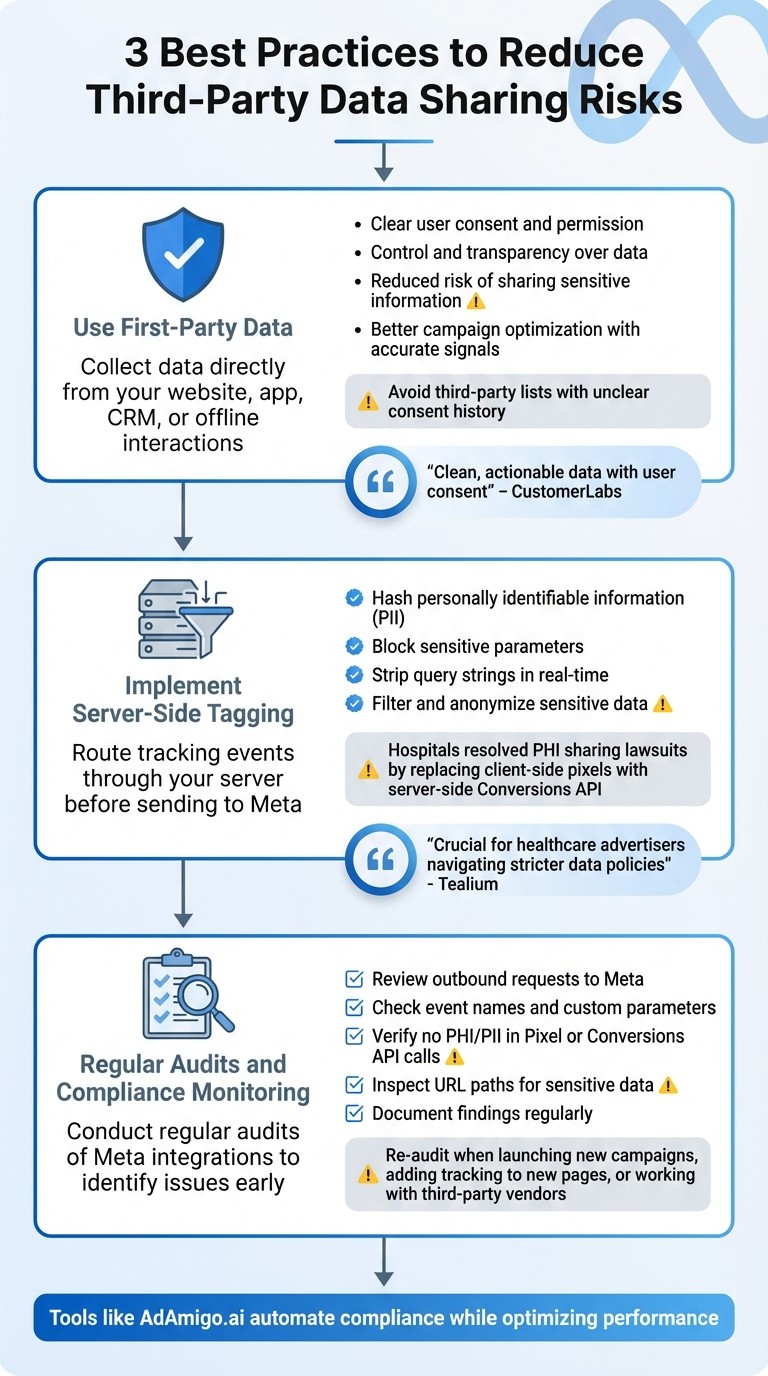
Meta Data Sharing Compliance: 3-Step Risk Reduction Framework
To safeguard your Meta campaigns from the risks of data sharing, it’s crucial to rethink how you collect and handle data. By focusing on three key practices, you can stay compliant with global privacy rules while ensuring your campaigns perform effectively. These steps align with Meta's compliance tools, helping you maintain secure and efficient data-sharing processes.
Use First-Party Data
In light of Meta's data restrictions, prioritizing first-party data is essential. This type of data - gathered directly from your website, app, CRM, or offline interactions - offers both control and transparency. Unlike third-party data, which often comes with unverifiable consent, first-party data ensures you have clear user permission. This reduces the risk of unintentionally sharing sensitive information through external tracking tools or aggregated sources.
When you create audiences using your own consented data, Meta’s algorithms can optimize campaigns with accurate and actionable signals. This is a significant advantage compared to third-party data, which has become less reliable in the post-cookie landscape.
According to CustomerLabs, first-party data provides "clean, actionable data with user consent, reducing dependency on third-party sources."
Avoid using or importing third-party lists where consent history is unclear. These lists not only pose compliance risks but may also trigger Meta’s restrictions on sensitive data categories.
Implement Server-Side Tagging
Server-side tagging is a powerful way to minimize data exposure. By routing tracking events through your server before sending them to Meta, you can filter and anonymize sensitive information. This method helps prevent the sharing of details like IP addresses, user agents, or protected health information (PHI) that client-side pixels might inadvertently capture.
With server-side tagging, you can hash personally identifiable information (PII), block sensitive parameters, and strip query strings in real time. For example, some hospitals facing lawsuits over Meta Pixel’s sharing of PHI resolved these issues by replacing client-side pixels with the server-side Conversions API and implementing robust filtering.
Tealium emphasizes that server-side tagging is crucial for healthcare advertisers navigating Meta’s stricter data policies.
This approach not only protects sensitive data but also ensures campaign performance by delivering cleaner, deduplicated events - helping you avoid the data leaks that could lead to ad account restrictions.
Regular Audits and Compliance Monitoring
Conducting regular audits of your Meta integrations is key to identifying and resolving issues before they impact your campaigns. Utilize tools like network inspectors, tag managers, or compliance scanners to review outbound requests to Meta. This ensures that no PHI, PII, or prohibited parameters are included in Pixel or Conversions API calls.
Pay close attention to event names, custom parameters, URL paths, and any values that could contain sensitive information. Document your findings and update your privacy program on a regular basis. It’s also a good idea to revisit your setup whenever you launch new campaigns, add tracking to new pages, or work with third-party vendors who might alter your tagging configuration.
How AdAmigo.ai Supports Compliance and Optimization
Running effective Meta campaigns requires tools that not only enhance performance but also address Meta ads AI privacy concerns. AdAmigo.ai tackles this dual challenge by combining secure architecture with automation, allowing advertisers to optimize their campaigns while staying compliant with data privacy regulations.
Server-Side Operations for Data Privacy
AdAmigo.ai aligns with Meta's data privacy policies by offering secure integration with your Meta ad account. It analyzes campaign performance and implements changes without exposing sensitive user data to unnecessary third-party access. This approach ensures that advertisers can take advantage of autonomous optimization while maintaining strict privacy controls.
The platform respects all budget, pacing, geolocation, and placement rules, as well as your data usage preferences. Whether you prefer to manually approve changes or let the system operate autonomously, you remain in full control of your AI Media Buyer.
Connected Optimization and Compliance
AdAmigo.ai doesn’t just focus on isolated campaign elements. Instead, it treats creatives, targeting, bids, and budgets as interconnected components. This unified approach ensures that optimization decisions are made with data privacy in mind, reducing risks associated with third-party data sharing. The system’s learning agent continuously adapts to performance trends, all while adhering to compliance standards.
Rochelle D., in her G2 review, shared:
We are achieving remarkable results! Our budgets are controlled, our spend is being smartly allocated and our ROAS is up massively.
This highlights that optimizing campaigns with privacy in mind doesn’t mean compromising on outcomes. For instance, AdAmigo.ai has achieved ROAS increases of up to 83% while maintaining secure data practices.
Automated Tasks for Advertisers
Automation is another key feature of AdAmigo.ai, helping advertisers save time while staying compliant. The platform’s AI Actions feature generates a daily to-do list, prioritizing impactful adjustments across creatives, audiences, budgets, and bids. Meanwhile, the AI Chat Agent allows users to conduct account audits, develop new strategies, and launch campaigns in bulk - all through text or voice commands. And all of this is done with secure data handling at its core.
Jakob K. praised this functionality in his G2 review:
The fact that you can launch campaigns through text or voice commands feels like magic! It handles everything from creating lookalike audiences to adjusting budgets with just a few prompts. It saves so much time!
This level of efficiency is especially valuable when navigating strict compliance requirements while scaling campaigns. It helps reduce the burdens of compliance, even as the 2024 FTC report highlights Meta’s extensive data collection practices.
Consequences of Non-Compliance
Failing to meet compliance standards can lead to immediate disruptions in operations and expose businesses to legal risks. Understanding these outcomes pushes advertisers to address compliance issues before they spiral out of control.
Ad Account Restrictions and Campaign Interruptions
Meta keeps a close eye on data sources and takes action against accounts that share prohibited information. When violations occur, the platform can impose restrictions or completely suspend data sharing from websites and apps. This might include labeling data sources as high-risk or even halting ad accounts altogether. Such actions can abruptly pause campaigns and limit the reach of active ads. For instance, healthcare organizations face particularly strict scrutiny. If Meta detects protected health information (PHI), it may impose partial or full restrictions on data usage through Meta Business Tools, severely impacting campaigns.
Legal and Financial Liabilities
The risks don’t stop at ad restrictions. Non-compliance also brings serious legal and financial consequences. With global privacy regulations like GDPR, HIPAA, and CCPA, companies are held accountable for data mishandling - even when breaches are accidental. Privacy experts caution that unintentional data sharing via tracking tools like pixels creates widespread vulnerabilities. Forrester highlights the importance of collaboration between marketing and risk teams to mitigate fines, account suspensions, and data breaches. Beyond penalties, suspended accounts and legal battles can drain resources and cut into revenue. Publicized data breaches can further damage a company’s reputation, eroding customer trust and making future marketing efforts more difficult. Taking proactive steps toward compliance is crucial to avoid these cascading setbacks.
Key Takeaways on Third-Party Data Sharing
Sharing third-party data in Meta advertising comes with serious risks to privacy, campaign performance, and financial outcomes. It involves transferring data collected through tracking tools to Meta or other vendors. This practice has already resulted in sensitive data breaches, including incidents that violated HIPAA regulations. Such violations can lead to severe consequences, like Meta suspending data sharing, restricting ad accounts, or even pausing campaigns entirely. To navigate these risks, adopting a privacy-first strategy is crucial.
Start by implementing privacy-focused practices. For example, server-side tagging and strict access controls can help minimize data leaks. Share only the data necessary for measurement and optimization, and ensure collaboration across legal, risk, and marketing teams. Regularly review Meta’s policy updates to stay compliant and avoid disruptions.
Tools like AdAmigo.ai (https://adamigo.ai) offer a way to balance compliance with performance. By leveraging high-quality first-party data, AdAmigo.ai optimizes creatives, targeting, bids, and budgets through a connected system. Its adaptive learning agent continually adjusts strategies in real time as Meta’s policies and practices change.
Staying compliant doesn’t mean sacrificing performance. By limiting data exposure, using privacy-enhancing strategies, and relying on intelligent tools, you can protect your ad account from penalties while keeping your campaigns effective.
FAQs
What are the risks of sharing third-party data with Meta for advertising?
Sharing third-party data with Meta comes with its fair share of risks. One major concern is the potential for privacy violations, especially if sensitive information isn’t handled with care. There’s also the threat of data breaches, where unauthorized individuals could gain access to shared information. Beyond that, failing to adhere to regulations like the GDPR or CCPA can lead to hefty legal penalties and tarnish your business’s reputation.
Perhaps even more damaging is the loss of consumer trust. If customers believe their data is being mishandled or shared without clear communication, it can seriously erode your brand’s credibility. To avoid these pitfalls, it’s crucial to thoroughly understand data-sharing policies and enforce strict compliance measures to safeguard user information.
What steps can advertisers take to comply with Meta's data sharing policies?
To align with Meta's data sharing policies, advertisers need to take a few critical steps. First, ensure that any data shared complies with Meta's guidelines. This means obtaining proper user consent and putting strong privacy controls in place to protect user information. It's also important to regularly review Meta's policies and stay informed about updates to maintain compliance.
On top of that, using tools like AI-powered ad platforms can be a game-changer. These tools can simplify campaign management while ensuring your data practices meet both Meta's requirements and legal standards. They help you stay efficient and compliant at the same time.
How does server-side tagging help protect sensitive data?
Server-side tagging improves data security by handling and processing information on secure servers rather than depending on client-side scripts. This approach reduces the risk of vulnerabilities, such as data breaches or unauthorized access.
With sensitive data managed in a controlled server environment, businesses can strengthen compliance with privacy regulations and safeguard user information more effectively.