
How Meta AI Enhances Custom Conversion Reporting
Automated AI reporting replaces slow, error-prone manual conversion reporting with precise, real-time insights.
Meta's AI tools are reshaping how advertisers manage custom conversion reporting, saving time and improving accuracy. The key updates include:
One-click Conversions API (CAPI): Simplifies setup, reduces technical barriers, and prevents double-counted conversions.
AI-Powered Pixel: Recovers 10–20% of lost conversion data due to browser issues.
Predictive Anomaly Detection: Detects issues like creative fatigue 3–5 days earlier than manual checks.
Updated Attribution Model: Separates "click-through" (link clicks) from "engage-through" (5-second video views) for more precise reporting.
Manual reporting in Ads Manager, while detailed, is time-consuming and prone to errors. AdAmigo.ai, a Meta Business Technology Partner, offers a faster alternative by automating optimization tasks, refreshing data every 15–30 minutes, and delivering actionable insights. This allows advertisers to focus on strategy rather than repetitive tasks.
Feature | Manual Reporting | Meta AI Tools | AdAmigo.ai |
|---|---|---|---|
Time Required | 3.5 hours/report | Automated | ~12 minutes/report |
Data Updates | Static snapshots | Real-time | Every 15–30 minutes |
Error Risk | High | Low | Low |
Optimization | Manual | Limited automation | Full automation |
Meta's AI tools and platforms like AdAmigo.ai simplify ad reporting, optimize campaigns, and help advertisers achieve better results with less effort.
How I fixed TERRIBLE results with the Meta Conversions API
1. Meta AI-driven Custom Conversion Reporting
Meta has simplified custom conversion reporting with its AI tools. Since May 2026, the one-click Conversions API (CAPI) and AI-powered Pixel setup have eliminated the need for technical expertise or manual upkeep. These tools recover the 10–20% of conversion events often lost due to browser limitations. Plus, with automatic event deduplication, Pixel and CAPI events are no longer double-counted, avoiding inflated ROAS figures. This streamlined process paves the way for quicker and more detailed insights.
"One‑click setup genuinely is a click. The harder question for DTC operators is when to migrate to it." - Alex Neiman, Marketing Consultant
Meta AI builds on this efficiency to deliver faster reporting and sharper strategic insights. AI agents analyze over 50 campaign metrics simultaneously, producing results in just 30–60 seconds - a massive improvement compared to the 2–3 hours it takes manually. But it’s not just about speed. Meta's AI also enables value-based optimization by tying actual transaction amounts to custom conversion events. This shifts the focus from raw conversion counts to identifying users most likely to drive high-value outcomes.
Another key feature is predictive anomaly detection, which identifies creative fatigue 3–5 days earlier than manual checks. It also flags mismatches between objectives and key performance indicators (KPIs) - like an awareness campaign running without conversion tracking - catching errors that can be easily overlooked. Additionally, Meta has refined its attribution model. As of May 2026, it separates "click-through" (link clicks) from a new "engage-through" category, triggered by 5-second video views. This change makes conversion attribution more accurate and reduces over-counting.
2. Manual Reporting in Ads Manager
Manual reporting gives you complete control over your data, but it comes at a steep cost - your time. Take this example: a small account report might take 3.5 hours to complete manually, but with AI, that same task can be done in just 12 minutes. When scaled, the numbers get even more daunting. On average, ad strategists spend 39.75 hours each month on repetitive manual campaign tasks.
The biggest issue? Fragmentation. Ads Manager scatters essential data across four main areas: campaign objectives, ad set performance, targeting configurations, and device/platform breakdowns. Unfortunately, there’s no built-in way to consolidate these into a single export. Analysts are left exporting multiple CSVs, merging data manually, and reformatting everything before they can even start analyzing. By the time the report is ready, the data is often outdated. These delays not only slow decision-making but also hide insights that could boost ROI.
"Meta Ads Manager was designed for campaign management, not cross-campaign analytics." - Sudharshan Narasimhan, Director of US Ops, TripleDart
This lag in reporting creates serious blind spots. For instance, averages at the campaign level can mask critical issues at the ad-set level. You might have one ad set burning through your budget without delivering conversions, while another performs well - but the averages won’t show you that. Standard reporting views also fail to reveal audience overlap or cross-ad-set frequency, which can lead to inflated CPMs and obscure your account’s true performance.
Another issue lies in the metrics that manual dashboards prioritize. They often focus on surface-level numbers like CPM and CTR because they’re easier to pull, while more actionable metrics, like incremental ROAS, get overlooked. As marketing consultant Alex Neiman points out:
"The mistake most teams make is building dashboards that answer 'what happened' when the real question is 'what should I do next.'" - Alex Neiman, Marketing Consultant
Meta’s May 2026 attribution update adds even more complexity. The update splits "click-through" into link clicks only, moving other engagements into a new "engage-through" bucket. If manual reporters don’t update their column sets to reflect this change, they risk misinterpreting results. A perceived performance drop might actually just be a reporting glitch.
These challenges highlight why AI-powered tools, like those from AdAmigo.ai, are gaining traction. They simplify conversion reporting by following custom conversion reporting best practices and help marketers optimize campaigns more effectively.
3. AdAmigo.ai-assisted Optimization
AdAmigo.ai takes the complexity out of conversion reporting with an automated approach that outpaces both manual reporting and Meta's native AI tools. Unlike sifting through endless CSV files with manual processes, AdAmigo.ai - an official Meta Business Technology Partner - connects directly to Meta's Marketing API in just 5 minutes. After setup, all you need to do is define your KPIs (like "Increase spend by 30% while maintaining 3x ROAS"), and the platform begins optimizing immediately.
AdAmigo.ai doesn't just save time - it delivers results faster. By identifying optimization opportunities 3–7 days earlier than human analysts and refreshing campaign data every 15–30 minutes, it ensures decisions are always based on the latest numbers. While human analysts spend time piecing together scattered data, AdAmigo.ai is already making adjustments. This automation slashes the time spent on budgeting tasks by 63% and cuts optimization time nearly in half - by 51%.
The platform’s AI Autopilot takes care of the entire optimization process, including scaling high-performing ads, pausing underperformers, adjusting budgets, and initiating new tests. These actions can be executed automatically or with user approval. When scaling campaigns, AdAmigo.ai suggests a gradual budget increase of 20–30% at a time, which helps avoid resetting Meta's learning phase and keeps performance steady.
Here’s a quick comparison of AdAmigo.ai against other technical solutions:
Feature | AdAmigo.ai | Direct API Polling | Conversions API (CAPI) |
|---|---|---|---|
Setup Time | 5 minutes | High (requires dev team) | Medium (server configuration needed) |
Maintenance | Low (platform-managed) | High (token updates/rotation) | Medium |
Refresh Rate | 15–30 minutes | Varies by polling interval | Near-instant |
Optimization | Autonomous learning | Manual or rule-based | Enhances attribution accuracy only |
Best For | Agencies or brands scaling quickly | Teams with custom algorithms | Improving data signals |
AdAmigo.ai doesn’t just optimize individual pieces of your campaign; it fine-tunes the entire system - creatives, audiences, budgets, bidding strategies, and campaign structures - working as a cohesive unit. This holistic approach ensures you’re measuring and improving true ROI, not just surface-level metrics.
Pros and Cons
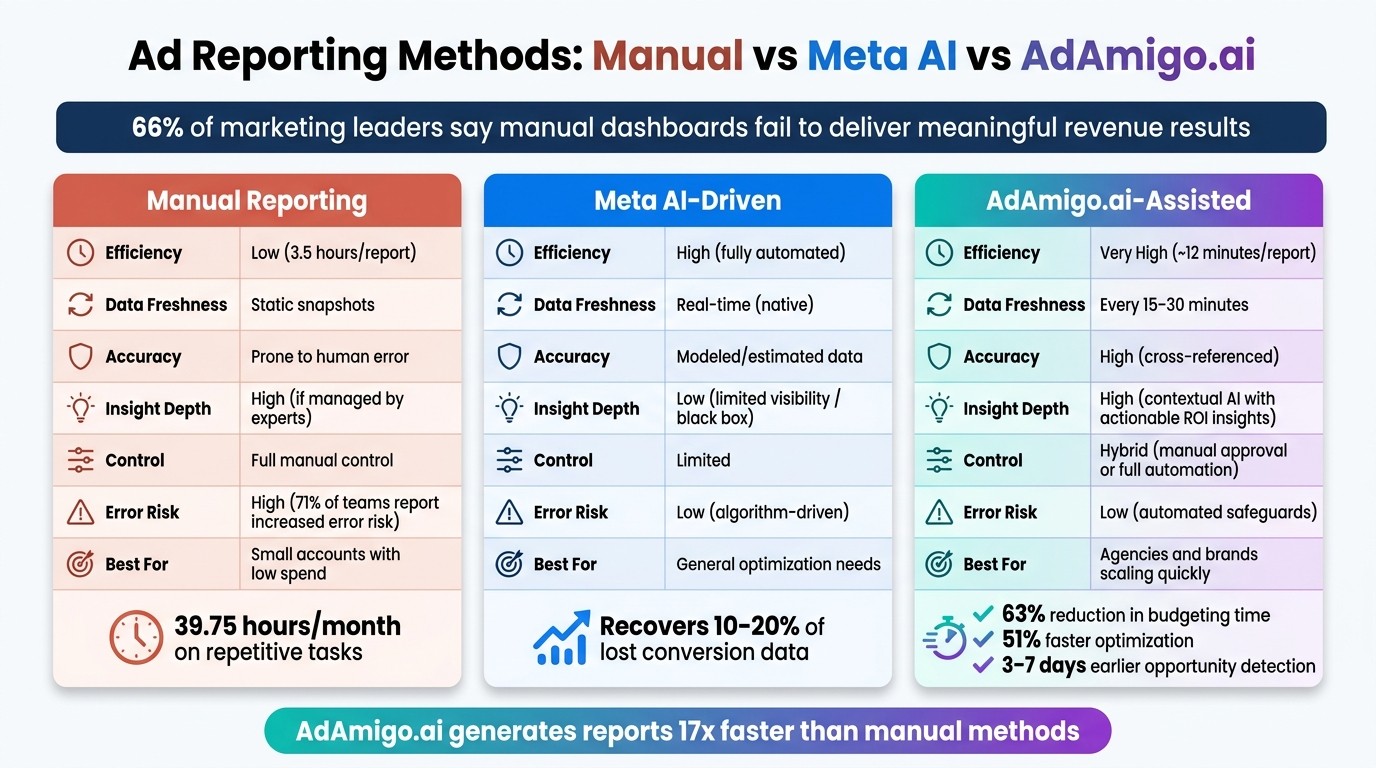
Manual vs Meta AI vs AdAmigo.ai: Ad Reporting Compared
Each reporting method comes with its own strengths and weaknesses. Choosing the right one depends on factors like your team's size, budget, and the time you can realistically dedicate to managing campaigns.
Manual reporting gives you complete control, but it’s resource-intensive. In fact, 71% of ad operations teams admit manual processes increase the risk of critical campaign errors, and 66% of marketing leaders say manual dashboards often fail to deliver meaningful revenue results.
Meta's built-in AI tools, such as Advantage+, streamline processes by automating tasks. For a deeper dive, see our Meta ads automation guide. However, they often function as a "black box", offering little visibility into decision-making or how issues like double-counted conversions are handled.
Here’s a breakdown of how the three methods compare:
Feature | Manual Reporting | Meta AI-Driven | AdAmigo.ai-Assisted |
|---|---|---|---|
Efficiency | Low (requires hours of work) | High (fully automated) | Very high (reports generated in ~12 minutes) |
Data Freshness | Static snapshots | Real-time (native) | Real-time (refreshes every 15–30 minutes) |
Accuracy | Prone to human error | Modeled/estimated data | High (cross-referenced for precision) |
Insight Depth | High (if managed by experts) | Low (limited visibility) | High (contextual AI explanations offering actionable insights to boost ROI) |
Control | Full manual control | Limited | Hybrid (manual approval or full automation) |
Error Risk | High | Low (algorithm-driven) | Low (automated with built-in safeguards) |
Best For | Small accounts with low spend | General optimization needs | Agencies and brands that require scalability |
"Most Meta ads dashboards track vanity metrics that never change decisions. AI-powered reporting systems surface incremental ROAS, creative fatigue, and contribution margin." - Alex Neiman, Growth Consultant
This comparison highlights how these methods influence campaign management and ROI, setting the stage for a deeper evaluation of their impact.
Conclusion
Manual reporting might give you complete control, but spending 3.5 hours on it eats up valuable time that could be used for strategic planning. On the other hand, Meta's built-in AI tools can streamline general campaign management, but their "black box" nature limits transparency. This lack of visibility can make it tough to fully trust the data - especially when you're making critical budget decisions.
These challenges highlight why automated solutions are becoming more appealing. For agencies and in-house teams aiming to scale efficiently, AdAmigo.ai stands out. Its AI Autopilot handles optimizations across budgets, audiences, creatives, and bidding as one interconnected system. This means a single media buyer can manage 3–5× more client accounts by letting the AI take care of much of the execution. This integrated approach ties back to the article’s main idea: achieving better ROI through smarter, streamlined reporting.
AdAmigo.ai offers flexible pricing to meet different needs. Entry-level advertisers can start with the $99/month Signals plan, which provides daily AI-driven recommendations and easy one-click actions. For teams seeking full-scale automation, the $349/month Full Access plan delivers end-to-end campaign management.
Regardless of the reporting tools or methods you choose, one technical step is non-negotiable: always integrate the Meta Pixel with the Conversions API (CAPI). Use a consistent event_id to match events, avoid double-counting conversions, and maintain clean optimization data across the board.
FAQs
When should I switch to one-click CAPI?
Switch to the one-click Conversions API (CAPI) if you're looking for better event tracking and more accurate attribution - without needing any custom development. This can be a game-changer, especially if browser restrictions or privacy settings are causing gaps in your conversion data.
By pairing CAPI with your Meta Pixel, you enable server-side tracking to capture conversions that browser-based pixels might overlook. This ensures Meta’s algorithms have access to complete data, helping to fine-tune performance and enhance tools like lookalike audiences.
How do I stop Pixel and CAPI double-counting?
To avoid double-counting with Pixel and Conversions API (CAPI), you need to use event deduplication. Meta automatically filters out duplicate events when both the Pixel and CAPI send the same event_name and event_id within a set time window.
To make this work, generate a consistent event_id on the client side (like right after a purchase) and include it in both the Pixel and CAPI events. Skipping this step can lead to inflated conversion metrics, making optimization efforts less accurate.
What’s the difference between click-through and engage-through?
The search results don't clearly outline the difference between click-through and engage-through. Instead, they emphasize Meta ad metrics such as click-through rate, conversion reporting, and the role of tools like AdAmigo.ai in campaign optimization.
AdAmigo.ai functions as an autonomous AI media buyer, handling tasks like account audits, budget management, and creative optimization around the clock. This allows users to focus on strategic planning while the AI takes care of the execution.