
How AI Improves Creative Performance Reporting
Save hours on ad reporting with AI that analyzes creative elements, detects issues early, and recommends optimizations.
AI-powered tools are transforming ad performance reporting by saving time and delivering actionable insights. Here's how they help:
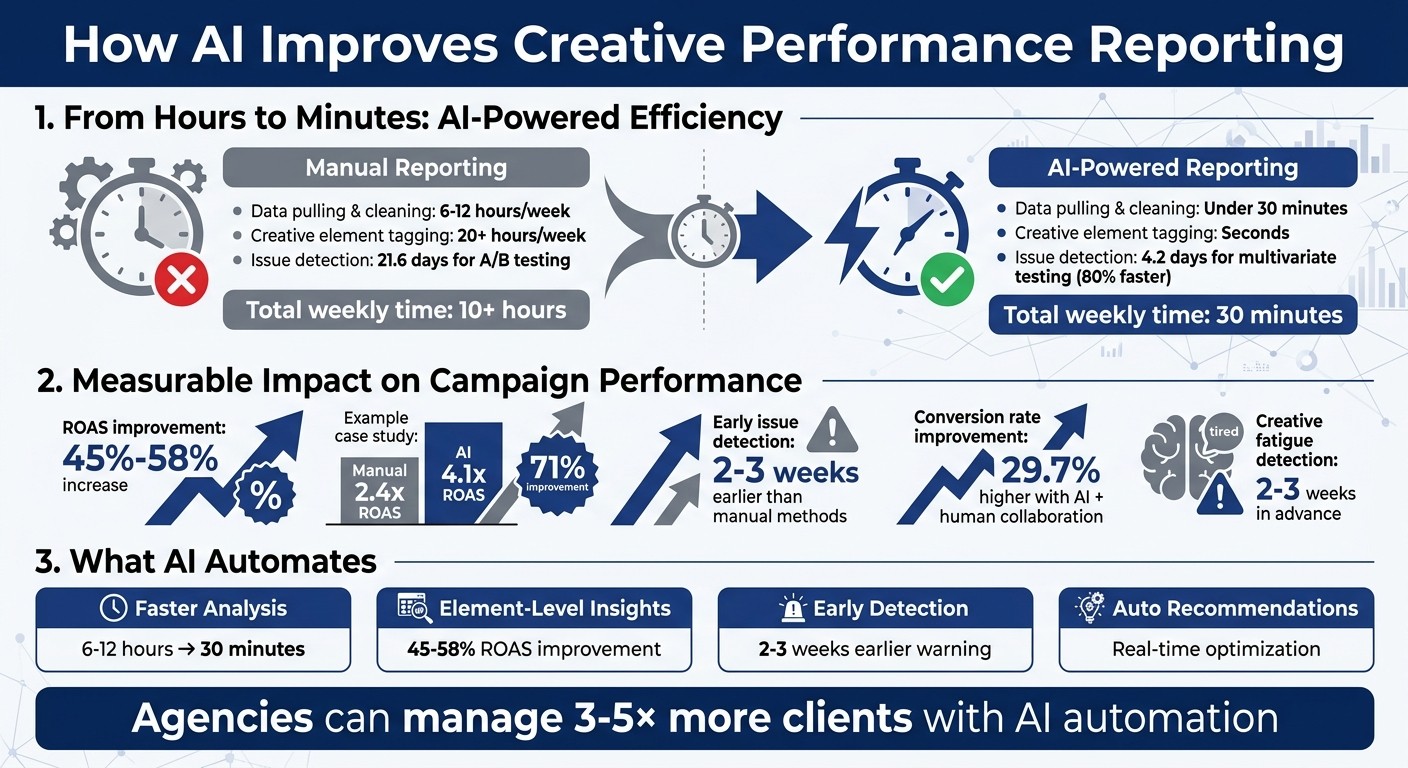
Faster Analysis: Tasks that took 6–12 hours, like analyzing ad components or cleaning data, now take under 30 minutes with AI.
Element-Level Insights: AI evaluates elements like headlines, visuals, and CTAs to identify what drives results, improving ROAS by 45%-58%.
Early Issue Detection: AI spots performance issues (e.g., creative fatigue) 2–3 weeks earlier than manual methods.
Automated Recommendations: AI suggests optimizations, such as adjusting budgets or replacing underperforming ads, based on real-time data.
Platforms like AdAmigo.ai automate campaign management further, handling everything from analysis to execution. This reduces manual work, allowing marketers to focus on strategy while boosting ad performance.
AI vs Manual Creative Performance Reporting: Time Savings and Performance Improvements
How AI Transformed Creative Strategy for Winning Facebook Ads (The 2025 Evolution)
How AI Improves Creative Performance Reporting
AI takes the heavy lifting out of data analysis, speeding up reporting and delivering insights that deepen our understanding of creative performance. By replacing manual processes with AI-powered systems, teams can uncover opportunities and trends that might otherwise go unnoticed.
This shift also paves the way for smarter optimization strategies.
Automated Data Analysis
AI integrates directly with advertising platforms like Meta, Google, and TikTok through their APIs. It automates the tasks of pulling, cleaning, and normalizing data, completely removing the need for manual CSV exports and spreadsheets - a process that often eats up 6–12 hours a week.
Simultaneously, AI tags creative elements like hooks, CTAs, visual styles, pacing, and even background music. Each element is then mapped to performance metrics such as ROAS (Return on Ad Spend) and CTR (Click-Through Rate). What used to require over 20 hours of manual tagging per week now happens in mere seconds.
AI also keeps an eye on your campaigns 24/7, flagging unusual patterns like sudden CPM spikes or CTR drops. These issues are identified 3–7 days earlier than they would be through manual monitoring.
With this level of detailed analysis, AI can deliver optimization recommendations that are both precise and actionable.
AI-Generated Optimization Recommendations
AI doesn’t just tell you what happened - it explains why it happened and what steps to take next. For example, it can reveal unexpected correlations, like how a specific background color paired with a certain text overlay speed impacts completion rates.
Built-in statistical tests ensure decisions aren’t made too soon. AI-driven multivariate testing, for instance, achieves statistically significant results in just 4.2 days, compared to the 21.6 days traditional A/B testing typically requires. That’s an 80% reduction in time-to-insight.
AI also tracks early signs of creative fatigue, such as small CTR declines or rising CPMs, alerting teams 2–3 weeks before performance takes a serious hit. This early detection allows marketers to rotate out underperforming creatives in time to maintain strong ROAS.
These insights free up teams to focus on strategy rather than manual reporting tasks.
Reduced Time Spent on Reporting
The time saved by automating reporting tasks enables marketers to shift their focus from spreadsheets to strategic planning and creative innovation. Sarah K., a Paid Media Manager at an e-commerce agency, shared her experience:
"We went from spending 10 hours a week on bid management to maybe 30 minutes reviewing Ryze's recommendations. Our ROAS went from 2.4x to 4.1x in six weeks."
With natural language querying, teams can ask straightforward questions like "Show top 10 creatives by ROAS" and get instant answers - no need to wrestle with pivot tables.
How to Use AI for Creative Performance Reporting
Getting started with AI-powered creative reporting is simpler than you might think. It boils down to three main steps: connecting your ad platforms, setting up monitoring, and acting on the insights. With AI handling the heavy lifting of data processing, you can start seeing results in no time.
Step 1: Connect Your Data Sources
The first step is to integrate your data sources seamlessly. Use OAuth to connect your ad accounts - this ensures your data refreshes automatically without the hassle of manual updates. Make sure you have the proper permissions: Admin/Standard for Google Ads and Account Admin for Meta Ads. A strong data foundation is key for effective AI-driven reporting.
To improve ROAS calculations, set up the Meta Conversions API or Enhanced Conversions (Google) during the initial configuration. These steps ensure the AI works with high-quality conversion data rather than relying solely on pixel tracking. If you’re running mobile app campaigns, link Mobile Measurement Partners like AppsFlyer or Adjust to unify attribution across platforms. After setup, run test reports to check for issues such as timezone mismatches or currency conversion errors.
Step 2: Monitor Performance with AI Tools
Once your data is connected, AI tools can continuously analyze performance, saving you from manual reporting. Set thresholds for anomalies - such as 2.5 to 3 standard deviations - to catch performance issues without being overwhelmed by false alarms.
You can also use natural language queries to make data retrieval easier. For instance, ask, "Which creatives have a CTR below 1%?" and get instant insights. Some tools, like AdAmigo.ai's AI Chat Agent, even allow you to ask questions like, "Why did ROAS drop yesterday?" and receive both explanations and actionable suggestions.
Set up alerts to notify you of significant changes, such as a creative’s CTR dropping more than 20% or a CPA exceeding your target range. Once flagged, these insights can guide adjustments to improve performance.
Step 3: Update Creatives Based on AI Insights
AI can identify which creative elements - such as hooks, visuals, pacing, or CTA placement - are driving better results. Use this information to create more effective, data-driven briefs. For example, if AI finds that question-based hooks perform 35% better than benefit-led hooks, focus on that format for your next set of creatives.
To avoid wasted ad spend, pause underperforming ads within the first 24 hours if their hook rates fall below 30–40% or their CTR is under 1.5%. Additionally, if audience frequency exceeds 3–4 and CTR starts to decline, replace the creative promptly to solve creative fatigue.
While AI provides valuable insights, it’s important to review its recommendations in light of your specific business context - like upcoming product launches, seasonal trends, or brand guidelines - before making changes. This balance between AI-driven data and human strategy ensures your campaigns stay aligned with your broader marketing goals. AI might excel at spotting patterns, but human input remains essential for maintaining brand consistency and crafting compelling stories.
How AdAmigo.ai Automates Creative Performance Reporting
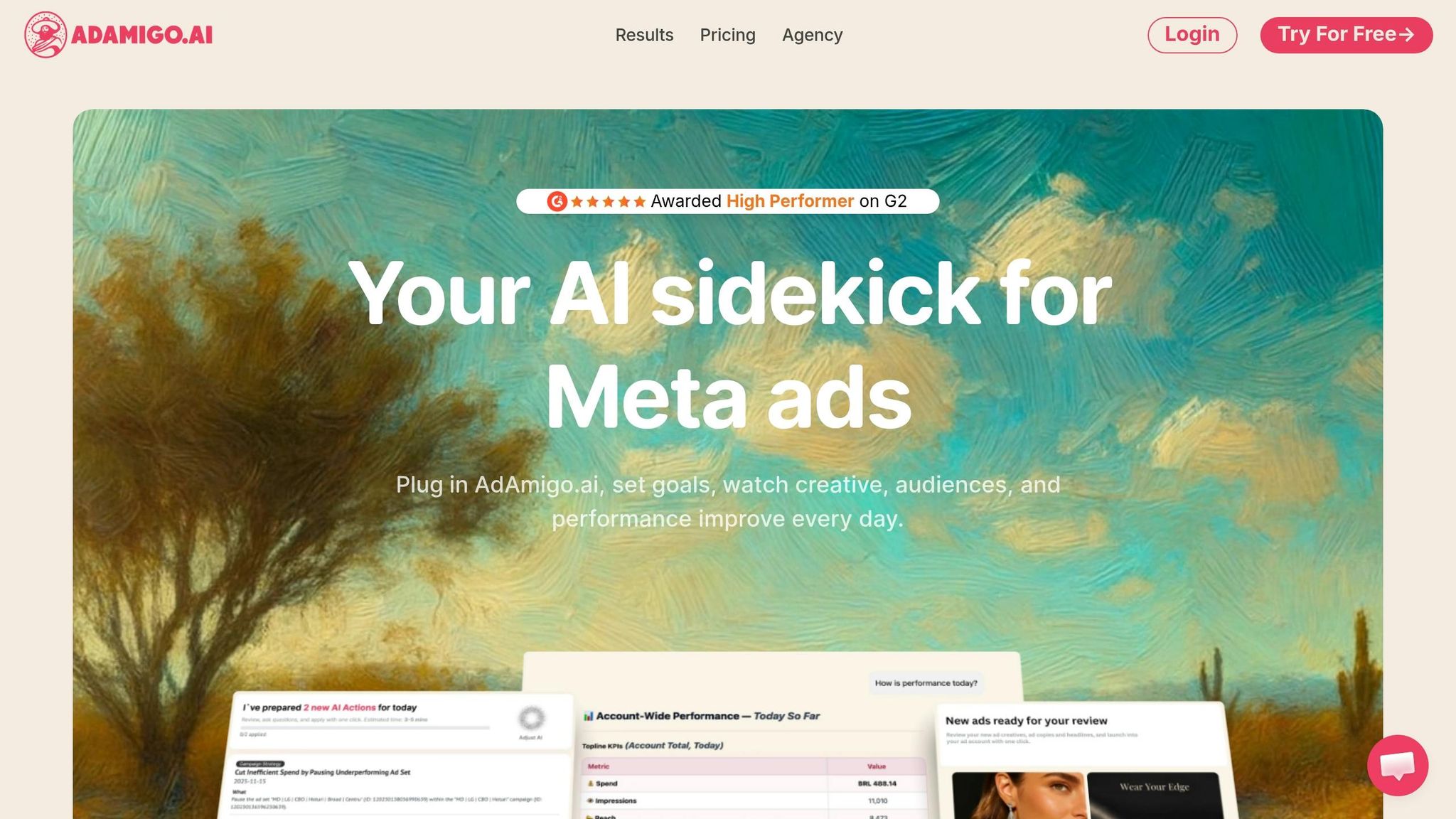
AdAmigo.ai simplifies creative performance reporting by acting as an autonomous AI media buyer for Meta ads. Instead of spending hours manually analyzing data in Ads Manager, this platform audits your account, identifies areas for improvement, and fine-tunes performance around the clock. It’s a complete solution that automates the entire process of creative performance reporting.
AdAmigo.ai Features for Creative Reporting
The platform is packed with tools that streamline ad management and reporting:
AI Autopilot: This feature is the backbone of AdAmigo.ai. It evaluates performance across creatives, audiences, budgets, and campaign structures, providing daily optimization recommendations with clear explanations. You can let it execute changes automatically or approve them first. Tasks like launching tests, reallocating budgets, pausing underperforming ads, and refining targeting are all handled using real-time data.
AI Chat Agent: Managing ad accounts becomes as easy as chatting. Ask questions like, "Why did ROAS drop yesterday?" or "Which creatives performed best this week?" The AI analyzes your data, explains the trends, and can even take action directly from the conversation. You can give instructions like, "Launch AI-powered retargeting" or "Increase budgets on top-performing ads", and the AI will handle the rest.
Ad Factory: Creative fatigue can cripple campaign performance, as creative elements account for approximately 70% of outcomes. Ad Factory studies your top-performing ads and generates new variations to keep things fresh. It can spot performance dips 2–3 weeks earlier than manual monitoring, allowing you to rotate creatives before they underperform. The Bulk Ad Launcher speeds up deployment by handling everything from copy generation to campaign setup when you upload creatives and a brief.
AdAmigo Protect: This feature acts as a safety net, monitoring your account around the clock for issues like spend anomalies, broken links, disabled ads, or delivery problems. It catches these issues early, saving you from costly mistakes that often go unnoticed with manual checks.
Results from Using AdAmigo.ai
AdAmigo.ai can cut ad account optimization time down to under 5 minutes per week, compared to the hours typically spent on manual adjustments. Users have shared impressive feedback:
"Our budgets are controlled, our spend is being smartly allocated and our ROAS is up massively. Agencies charging 7 times the cost of AdAmigo have been put to shame quite frankly!" - Rochelle D., G2 reviewer
"The AI actions are spot-on, so I can make adjustments fast and see results right away. It's like having an extra set of super-smart hands helping me hit my KPIs." - Sherwin S., G2 reviewer
The platform has also earned High Performer recognition on G2, with users consistently praising its ability to not only suggest optimizations but also explain the reasoning behind them. This clarity helps marketers better understand their campaigns while achieving measurable improvements.
What Makes AdAmigo.ai Different
AdAmigo.ai goes beyond basic analytics or recommendations by delivering full campaign automation. It doesn’t just suggest what to do - it takes action. From launching campaigns to adjusting budgets, testing creatives, and optimizing performance, the AI handles it all. It continuously learns from your data and adapts to your KPIs, preferences, and account trends, becoming more effective over time.
You stay in control with customizable automation rules. Define your KPIs, budget limits, targeting preferences, and guardrails. Decide whether the AI should operate autonomously or require approval before making changes. Fully integrated with Meta’s official API, the platform ensures compliance while optimizing every aspect of your campaigns - creatives, audiences, budgets, bidding, and structure - as one cohesive system.
For agencies, this means a single media buyer can manage 3–5× more clients by automating repetitive tasks. For eCommerce brands and in-house teams, it’s like having a tireless AI media buyer that boosts performance without the need for a large paid media team.
Conclusion
AI is transforming the way creative reporting is done by drastically reducing the time it takes to analyze data, detect issues, and deliver actionable insights. While manual reporting can consume 6–12 hours each week, AI tools cut this process down to less than 30 minutes. This time-saving shift allows marketing teams to focus on strategic planning and creative innovation instead of drowning in spreadsheets. Following a Meta ads conversion optimization checklist can further streamline this transition.
The numbers speak for themselves. AI doesn’t just report metrics - it breaks down performance changes by analyzing creative elements like hooks, CTAs, and visuals. It even predicts creative fatigue well before it impacts results. Marketers can also audit ad creative with AI to identify these weak spots instantly. Campaigns that combine human expertise with AI see conversion rates that are 29.7% higher than those managed solely by humans. These advantages make a strong case for adopting automated platforms.
For businesses running Meta ads, platforms such as AdAmigo.ai take automation even further. These tools not only analyze performance but also handle optimizations automatically - comparing manual vs AI budget testing, launching tests, reallocating budgets, and refreshing creatives. Agencies can manage three to five times more clients, and eCommerce brands gain the equivalent of a full-time media buyer without increasing their team size. In today’s fast-changing advertising world, this level of automation is becoming essential for staying competitive.
FAQs
What data do I need to connect for AI reporting to be accurate?
To get precise AI-driven reporting, link performance metrics like CTR (Click-Through Rate), ROAS (Return on Ad Spend), and Conversion Rate from platforms such as Meta, Google, and TikTok. Additionally, incorporate tracking tools like Meta Ads Manager to gather critical metrics for evaluation. This integration ensures the AI can analyze a full spectrum of data and offer actionable insights.
How does AI identify which creative elements drive ROAS?
AI helps identify which creative elements directly influence ROAS by diving deep into performance data at the asset level, rather than just sticking to campaign or ad set analysis. Tools like AdAmigo.ai use advanced features such as AI tagging and performance tracking to assess individual components - whether it's headlines, images, videos, or CTAs - and their effect on metrics like ROAS, CTR, and conversions. This allows marketers to zero in on the creative aspects that truly connect with their audience.
How can I use AI insights without hurting my brand guidelines?
To make the most of AI insights while keeping your brand identity intact, it’s crucial to choose AI tools that offer adjustable controls. For instance, platforms like AdAmigo.ai allow you to define specific rules, KPIs, and boundaries. This ensures that any optimizations remain aligned with your brand's unique style and values.
AI can also evaluate the performance of your creative elements - such as visuals and messaging - and provide suggestions to improve outcomes. The best part? These recommendations can boost results without straying from your brand’s established voice. By combining AI-driven insights with clearly defined parameters, you can make data-backed decisions that stay true to your brand's identity.