
Cross-Border Meta Ads: Privacy Compliance Guide
Practical guide to privacy-compliant cross-border Meta ads: consent flows, data transfers, targeting limits, and monitoring.
When running Meta ads internationally, managing privacy compliance is a critical challenge. Different regions enforce unique data laws, from GDPR in the EU to CCPA in California, making cross-border campaigns complex. Here's what you need to know:
Meta's Privacy Rules: All data collected must have clear user consent and comply with local laws.
Cross-Border Data Transfers: Use frameworks like SCCs, the EU-US Data Privacy Framework, or UK IDTA to legally transfer data.
Consent: Ensure user opt-ins meet local standards (e.g., opt-in required in the EU, opt-out in California).
Targeting Restrictions: Avoid using sensitive data like health or political opinions; rules vary by region.
Monitoring: Regularly review campaigns for compliance, track opt-ins, and audit targeting settings.
Automated tools like AdAmigo.ai can simplify compliance by monitoring campaigns, managing exclusions, and flagging issues. Staying compliant isn't just about avoiding fines - it's essential for keeping your campaigns running smoothly and effectively.
Meta's Privacy and Advertising Standards
Before diving into the complexities of international privacy laws, it's crucial to grasp Meta's global standards. These policies apply universally, no matter where your campaigns are running or where your audience is located.
Meta's Core Privacy Policies
Meta mandates that all data collected - whether through the Pixel, Conversions API, or Custom Audience uploads - must be gathered with clear user consent and comply with relevant laws.
Recent changes, like those introduced with iOS 14.5 privacy changes and stricter privacy regulations, have shifted the focus away from detailed audience segmentation. Now, ad creative plays a leading role in defining audience selection. This shift reduces reliance on personal data, which helps lower compliance risks for cross-border campaigns. It also simplifies adherence to regulations such as GDPR or LGPD by encouraging broader targeting strategies.
This framework is a key starting point for understanding how Meta enforces its content and advertising rules globally.
Prohibited and Restricted Ad Content
Meta prohibits ads featuring deceptive claims, illegal products, or discriminatory material. Meanwhile, some content is classified as restricted, which is especially important for international campaigns. Restricted categories include:
Financial services
Health-related claims
Political messages
Ads targeting minors
These categories often undergo stricter review processes. In some cases, advertisers may need explicit certification from Meta before running these ads, depending on the region.
It’s important to note that an ad approved in one region might be blocked in another due to local regulations. Conducting compliance checks before launching campaigns can help avoid delays and unexpected costs. This regional variability ties directly into broader issues like cross-border data transfer rules and differing regulatory environments, which will be discussed further in the next section.
Cross-Border Data Transfer Rules
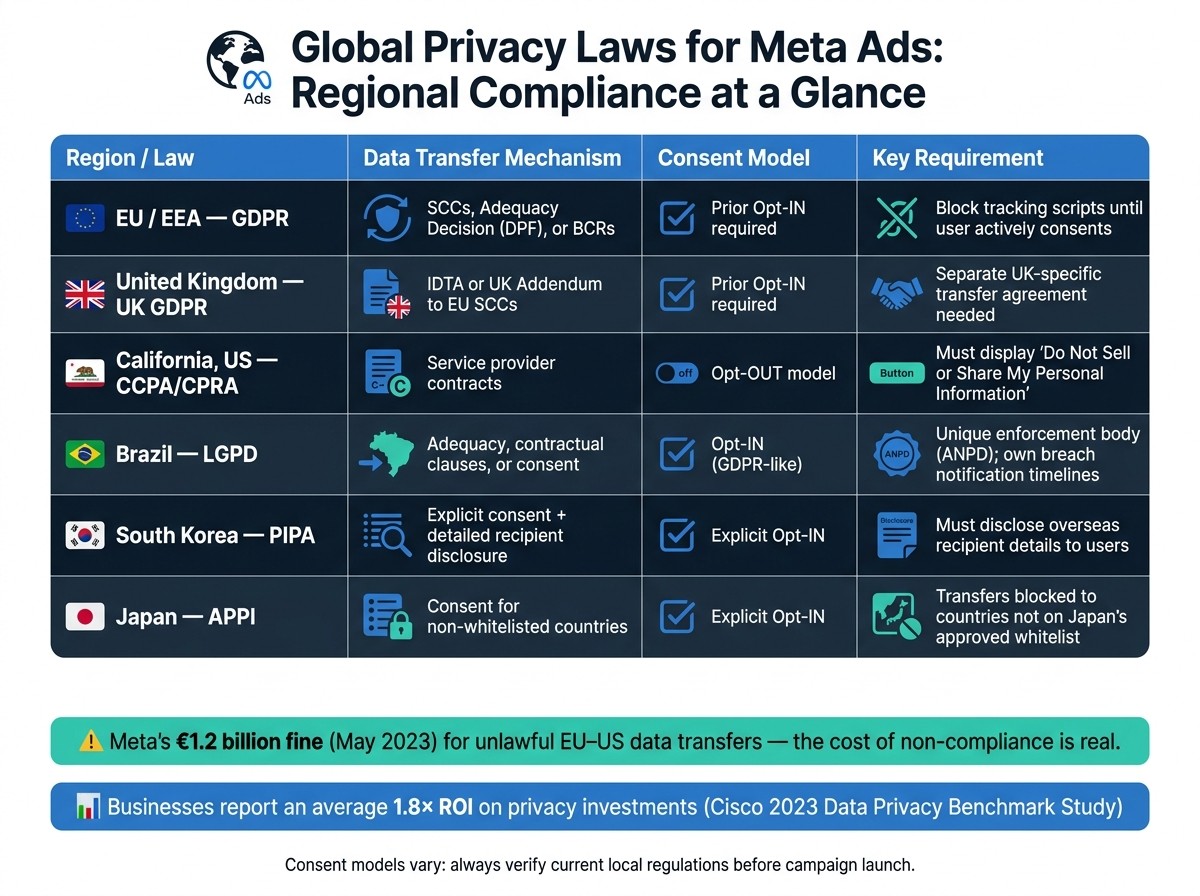
Global Privacy Laws for Meta Ads: Regional Compliance Comparison
Every time a Meta Pixel is triggered on a European website or a hashed customer email is uploaded as a Custom Audience from a Brazilian CRM, personal data is crossing borders. Each of these transfers isn’t just a technical process - it’s a legal event. Under regulations like GDPR, these transfers come with specific obligations, separate from the initial data collection. Advertisers need to think in two steps: why the data is being processed and how it’s being transferred internationally.
Legal Mechanisms for Cross-Border Data Transfers
In July 2020, the EU–US Privacy Shield was invalidated under the Schrems II ruling, forcing businesses to adopt alternative methods for data transfers. Standard Contractual Clauses (SCCs) became the primary replacement, holding data recipients to GDPR standards. These SCCs are embedded in Meta's Data Processing Terms and Data Transfer Addendum, which advertisers agree to when using tools like Meta Pixel, Conversions API, or Custom Audiences.
Fast forward to July 2023, the EU–US Data Privacy Framework (DPF) reinstated a formal adequacy mechanism for certified US companies. If Meta or any other ad-tech vendor you use is DPF-certified, this certification can replace SCCs for those particular transfers. For UK-based data, the UK International Data Transfer Agreement (IDTA) or a UK Addendum to the EU SCCs serves a similar purpose.
Advertisers are also required to perform a Transfer Impact Assessment (TIA) to evaluate risks related to surveillance laws in destination countries. Post-Schrems II, EU regulators demand that organizations relying on SCCs document their evaluations of these laws. For campaigns involving Meta, this means identifying what data is being sent (like pixel events, hashed emails, or app events), assessing risks tied to US government access laws (such as FISA 702), and detailing safeguards like encryption or data minimization. These steps are critical to avoid disruptions and ensure compliance. Meta’s €1.2 billion fine in May 2023 for unlawful EU–US transfers is a stark reminder of how seriously these regulations are enforced.
These frameworks provide the foundation for navigating regional privacy requirements and understanding how Meta handles consent across its platforms.
Regional Privacy Law Differences and Common Challenges
Advertisers often recognize GDPR and CCPA/CPRA as the key frameworks, but these laws operate very differently. GDPR focuses on controlling the movement of data across borders and requires legal transfer mechanisms. In contrast, CCPA/CPRA centers on whether personal data is being "sold" or "shared" for cross-context behavioral advertising, triggering opt-out rights and specific contractual obligations with service providers like Meta.
Other regions present their own challenges. Brazil’s LGPD mirrors GDPR by requiring adequacy, contractual clauses, or explicit consent for cross-border transfers. Canada’s PIPEDA emphasizes transparency about offshore processing. In APAC, South Korea’s PIPA mandates explicit consent and detailed disclosures about overseas recipients, while Japan’s APPI requires consent for transfers to countries not on its whitelist. The real challenge for advertisers isn’t just understanding one specific law - it’s managing the overlap of rules across multiple markets.
Here’s a quick overview of some key regional laws and their approaches to data transfer:
Region | Key Law | Transfer Approach |
|---|---|---|
EU / EEA | GDPR | SCCs, adequacy decision (DPF), or BCRs required |
United Kingdom | UK GDPR | IDTA or UK Addendum to EU SCCs |
California, US | CCPA / CPRA | Opt-out of "sale/sharing"; service provider contracts |
Brazil | LGPD | Adequacy, contractual clauses, or consent |
South Korea | PIPA | Explicit consent + detailed recipient disclosure |
Japan | APPI | Consent for non-whitelisted countries |
Setting Up Consent and Data Collection for Compliance
Create systems that effectively collect data and secure valid consent across all markets you operate in.
Best Practices for First-Party Data Collection
First-party data is your most dependable resource for running cross-border campaigns on Meta. This type of data comes directly from sources like sign-up forms, checkouts, lead ads, or CRM integrations, giving you full control over the consent process.
The guiding principle here is data minimization: only request the information you truly need. For example, if you're managing a newsletter campaign, an email address and country should suffice. If you're building a Custom Audience based on purchase data, focus on purchase identifiers - not browsing history or inferred demographics that haven’t been disclosed. Every field you include should have a clear justification to reduce compliance risks.
Documentation is also critical. For every data collection point feeding into Meta - whether it’s Pixel events, Conversions API calls, offline conversion uploads, or customer list imports - you need to answer key questions: What personal data is being collected? What’s the legal basis for collecting it? Where are the users located? Are there any cross-border data transfers? Beyond being good practice, this documentation forms the backbone of a Data Protection Impact Assessment (DPIA), which regulators may require. According to Cisco’s 2023 Data Privacy Benchmark Study, businesses report an average 1.8× return on privacy investments, showing that the cost of compliance often pays for itself.
These steps establish a strong foundation for building effective consent flows.
How to Build Clear Consent Flows
Consent flows must meet the specific GDPR and CCPA requirements of each region. For instance, in the EU/EEA, tools like the Meta Pixel and Conversions API used for personalized ads require prior opt-in. This means those scripts must be blocked until a user actively agrees to advertising cookies. In contrast, most U.S. states follow an opt-out model, but California’s CCPA/CPRA laws demand a clear “Do Not Sell or Share My Personal Information” option.
Stick to these rules: Use separate, unticked checkboxes for different purposes. For example, newsletter subscriptions, personalized ads, and third-party sharing should each have their own checkbox. The EU Court of Justice’s Planet49 ruling made it clear that pre-checked boxes do not count as valid consent. Avoid using dark patterns, such as hiding “Reject all” options behind multiple clicks, as regulators explicitly disapprove of these tactics.
Your cookie banner should prominently display three choices: Accept, Reject non-essential, and Customize. Under the Customize option, clearly outline Meta tools under an “Advertising” header with straightforward descriptions like “We use Meta (Facebook/Instagram) tools to measure ad performance and show personalized ads.” Additionally, ensure users can easily access and adjust their consent settings at any time, and keep a record of every choice to demonstrate compliance.
Deloitte research shows that 79% of consumers are willing to share relevant personal data in exchange for clear benefits, provided they understand how their data will be used and trust the company.
This insight isn’t just about staying compliant - it also impacts your campaign results. Transparent and user-friendly consent flows tend to yield higher opt-in rates, which helps maintain larger Custom Audiences and healthier retargeting pools over time.
Targeting and Delivery Restrictions by Region
Once you’ve set up your consent flows, the next step is figuring out how to effectively reach your audience while staying within regional rules. Even with compliant consent in place, fine-tuning your targeting and delivery is critical. Meta applies a multi-layered system of targeting restrictions, which can vary widely by country. Understanding these rules is crucial to avoid wasted ad spend, rejected campaigns, or potential account issues.
Sensitive-Category Targeting Limits
Meta has global restrictions on targeting based on sensitive personal attributes, but the specific rules differ by region. For instance, in the European Union, advertisers are generally barred from targeting users based on inferred traits like health conditions, political opinions, religious beliefs, or sexual orientation. This means that trying to target audiences dealing with specific health issues by combining related interest groups could violate both Meta’s policies and local regulations like the GDPR compliance rules for Meta.
To navigate these restrictions, you can leverage creative-led targeting, introduced in Meta's late 2025 Andromeda update. This approach involves providing a variety of compliant creative assets and letting Meta’s algorithm determine the most suitable audience automatically.
Country-Level Delivery Restrictions
In addition to sensitive-category limits, some countries impose strict rules on where Meta ads can be delivered. For example, Meta’s platforms are blocked in China, so ads targeting users with Chinese IP addresses won’t run.
In countries like India and Brazil, while Meta operates without restrictions, local data laws can complicate audience management. For instance, Brazil’s LGPD shares similarities with the GDPR but has its own enforcement body (ANPD) and unique timelines for data breach notifications. Ignoring these regional specifics, especially when running campaigns across Latin America, can lead to compliance headaches.
The best way to handle these country-level rules is by incorporating geo-exclusions directly into your campaign setup. Create separate ad sets for each region, apply explicit country exclusions, and enable automated delivery alerts to flag unexpected drops in reach. These steps, combined with a robust privacy strategy, can help you stay ahead of compliance challenges and avoid disruptions.
Compliance Monitoring and Risk Management
Running cross-border campaigns means navigating a maze of changing policies, updated laws, and unpredictable ad performance. To stay ahead, teams need more than a one-time pre-launch review - they need a consistent and thorough monitoring workflow. This is how you avoid compliance pitfalls and keep campaigns running smoothly.
Pre-Launch Compliance Checklist
Before launching, ensure your review process covers these four critical areas: consent tracking, data transfer mechanisms, targeting configuration, and creative compliance.
Consent Tracking: Verify that your Consent Management Platform (CMP) properly logs regional opt-ins. Make sure tools like Meta Pixel or Conversions API are only triggered for users who have given consent.
Data Transfers: Confirm that the right legal frameworks are in place for cross-border data flows. For instance, European Union data often requires Standard Contractual Clauses (SCCs). Your privacy policy should clearly outline how data moves across borders.
Targeting Configuration: Double-check that sensitive-category audiences are excluded where necessary, and apply geo-exclusions correctly at the ad set level.
Creative Compliance: Carefully review ad copy and visuals to ensure they don’t imply targeting based on prohibited attributes, such as health conditions or political opinions.
Once these checks are complete, don’t stop there - ongoing vigilance is key.
Monitoring Campaigns and Staying Current with Policy Changes
After your campaign goes live, the real work begins. Compliance isn’t something you can set and forget. Platforms like Meta frequently update their advertising policies, and privacy laws like the GDPR or Brazil’s LGPD can shift enforcement priorities without warning. To stay ahead, schedule monthly compliance reviews. These should include checking for new Meta policy updates, analyzing ad disapproval rates, and auditing consent logs.
In addition to scheduled reviews, set up alerts for signs of trouble, such as ad disapprovals, unexpected spending spikes, or sudden drops in reach by region. These red flags often signal compliance issues that need immediate attention before they escalate into bigger problems. A centralized dashboard that aggregates data across all regional accounts can help you quickly identify recurring risks without sifting through individual campaign reports.
AI tools can also play a big role here. They can spot anomalies like sudden spending increases, broken tracking links, or unusual account activity. By catching these issues early, you can address them before they disrupt your campaigns.
Using AI Tools for Privacy-Safe Campaign Execution
Managing compliance across multiple regions is no small feat. With frequent policy updates, varying consent requirements by country, and the risk of misconfigured targeting settings causing ad disapprovals, manual oversight can quickly become overwhelming. That’s where AI tools come in, automating complex tasks and building on existing compliance strategies to simplify cross-border campaign management.
How AdAmigo.ai Supports Compliance
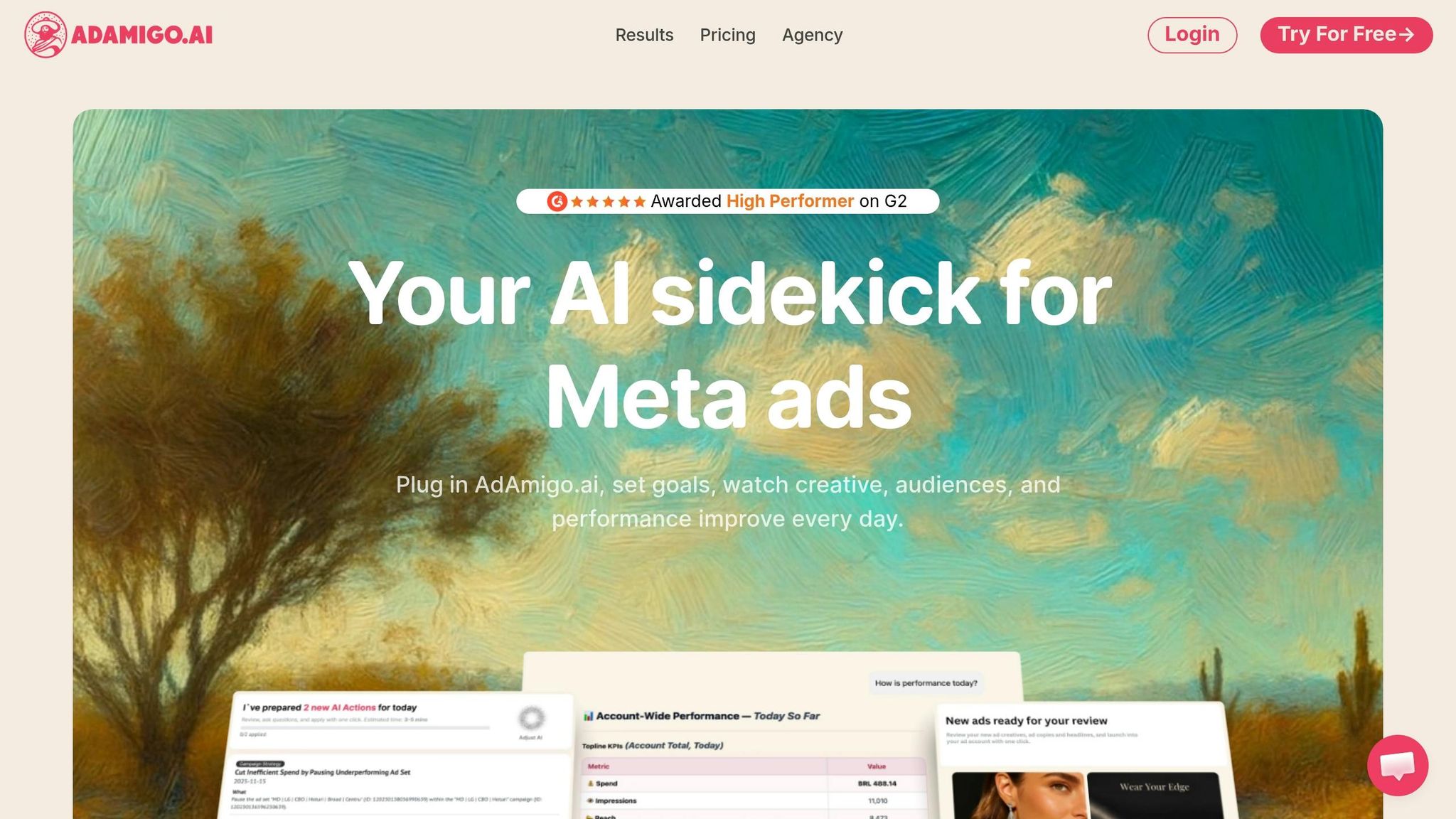
AdAmigo.ai is designed to make privacy compliance easier and more efficient. Built using Meta's official API, it automates key actions within platform permissions while enforcing strict rules through its Policy & Constraint Engine. For example, if you need to exclude certain regions from a campaign involving sensitive content, you simply set the parameters once, and the AI ensures they are consistently applied across all campaigns.
The platform also features AdAmigo Protect, which provides 24/7 monitoring for issues like unexpected spend spikes, delivery problems, or unusual account activity. You can set custom thresholds to receive immediate alerts for anomalies, helping you address potential problems before they escalate. Every action taken by the AI is logged in a comprehensive audit trail, documenting drafts, edits, and approvals - an invaluable resource during privacy reviews.
For teams hesitant to hand over full control to AI, AdAmigo offers a human-in-the-loop mode. In this setup, every AI recommendation requires your approval before implementation, making it an ideal option for entering new markets with unfamiliar regulations. Once you’re comfortable with how the AI handles compliance in that region, you can switch to full Autopilot for even greater efficiency.
Time and Performance Gains with AI Tools
The benefits of AI-driven oversight are clear. While a media buyer managing accounts manually is limited to overseeing 4–6 accounts during business hours and may encounter 5–6 major errors each month, AI tools change the game. With AI, a single media buyer can manage 15–25+ accounts, monitor activity around the clock, and reduce errors to nearly zero.
This shift isn’t just about reducing mistakes - it’s about freeing up time. Tasks like monitoring, exclusion checks, and budget adjustments are handled by the AI, allowing teams to focus on higher-value activities like creative strategy, legal reviews, and market research. AdAmigo even simplifies scaling into new regions by supporting multilingual ad generation. It handles localized copy creation as part of the campaign launch process, ensuring compliance settings and creative assets are aligned from the start.
Conclusion: Running Privacy-First Cross-Border Campaigns
Running Meta ads across borders comes with its fair share of compliance hurdles. From managing user data to crafting ad creatives, every detail must align with global privacy regulations.
To tackle these challenges, it’s crucial to adopt a system that integrates privacy into every step of your campaign. Think of privacy as an ongoing process, not just a box to check off. Since 2025, Meta’s algorithms have placed more emphasis on creative quality for targeting. This means your ad assets must meet regional standards - not just for compliance, but to ensure they perform well. Skipping a thorough creative review can hurt both your campaign’s delivery and its legal standing. By embedding creative checks into your workflow, you can keep your ads effective and compliant at the same time.
Regular monitoring is another must. Problems like unexpected spending spikes, broken pixels, or incorrect audience exclusions can pop up anytime - even outside office hours. Using tools like AdAmigo.ai for automated, 24/7 monitoring can help you catch and fix these issues quickly. This not only keeps your campaigns compliant but also ensures they run smoothly and efficiently.
FAQs
Do I need a Transfer Impact Assessment (TIA) for Meta ads?
Whether or not you need a Transfer Impact Assessment (TIA) depends entirely on your specific data transfer practices and the legal requirements that apply to your situation. For example, tools like AdAmigo.ai function within Meta’s official API and compliance framework. However, they don’t offer specific advice or guidance on TIAs.
To determine if your cross-border data transfers require a TIA - especially under regulations like GDPR - it’s essential to consult with legal counsel. They can provide tailored advice based on your compliance needs and regulatory obligations.
How do I handle consent when my ads run in both the EU and California?
When running Meta ads in the EU and California, it's crucial to align with privacy laws specific to each region. In the EU, you’ll need to comply with the General Data Protection Regulation (GDPR), while in California, adherence to the CCPA/CPRA (California Consumer Privacy Act/California Privacy Rights Act) is required.
One tool that simplifies this process is AdAmigo.ai. By leveraging Meta’s official API, it automates compliance tasks, ensuring you stick to permissions, rate limits, and guidelines. This means you can handle data transfers and privacy policies efficiently, allowing you to focus on refining your cross-border ad strategies.
What Meta targeting options are most likely to violate privacy rules?
Stricter data privacy laws and high opt-out rates - such as 62% to 80% of iPhone users declining tracking - have made micro-targeting less effective. While the specifics of Meta's targeting options that might violate privacy rules aren't detailed, the industry is shifting toward creative-based targeting. This approach relies on Meta's algorithm to use creative signals to identify audiences. Tools like AdAmigo.ai assist in maintaining compliance by managing campaigns through Meta's official API.