
AI Scaling for Meta Ads: Best Practices 2026
Scale Meta ads with AI: set up Pixel + CAPI, optimize creatives, automate budgets, and enforce guardrails for profitable campaigns.
Scaling Meta ads in 2026 is all about leveraging AI to maximize ad performance while minimizing manual effort. Thanks to advancements like Meta's "Andromeda" update, the focus has shifted to creative assets and predictive algorithms that dynamically adjust campaigns in real time. Here's what you need to know:
AI Scaling Defined: AI tools now handle budget allocation, creative testing, and audience targeting, predicting outcomes instead of relying on rigid rules.
Key Changes in 2026: Meta prioritizes creative assets over traditional audience strategies. Automation is essential for managing the volume of creative variations required.
Core Practices for Success:
Ensure accurate data tracking with Meta Pixel and Conversions API.
Define clear profitability metrics (e.g., ROAS, CPA).
Consolidate campaigns to hit optimization thresholds (50+ events per week per ad set).
Use AI tools for budget scaling, creative testing, and audience targeting.
Implement financial and performance guardrails to scale safely.
AI scaling is no longer optional - it’s the standard for staying competitive. By automating repetitive tasks and focusing on high-impact areas, you can scale your campaigns effectively and maintain profitability in a fast-evolving ad landscape.
The NEW Way to Use AI to Scale Meta Ads in 2026

Building the Foundation: Data, Tracking, and Scaling Readiness
Before scaling, it’s crucial to lay a solid groundwork. Scaling with AI doesn’t just amplify what’s working; it also magnifies any flaws in your system. If your data is messy or your profitability benchmarks are unclear, those problems will only get bigger.
Setting Up Accurate Data Tracking
Accurate data tracking is the cornerstone of any scaling effort. To do this effectively, use both Meta Pixel and CAPI (Conversions API) together. These tools work in tandem - Meta Pixel tracks browser-side behavior, while CAPI sends data directly from your server. This dual approach helps bypass privacy challenges like ad blockers and iOS restrictions. After Apple’s iOS 14.5 update, browser-only tracking under-reported purchases by as much as 20–40%. CAPI can help recover much of this lost data.
To avoid double-counting, make sure both Meta Pixel and CAPI use the same event_id. This allows Meta to correctly deduplicate events. Standardize your event tracking by using Meta’s predefined events - like Purchase, AddToCart, InitiateCheckout, and Lead - and ensure consistent parameters such as value, currency (in USD), and content_ids. In Meta’s Events Manager, prioritize your top eight events for Aggregated Event Measurement, with Purchase or your primary conversion goal at the top. Then, run a quality assurance (QA) check by comparing Meta’s purchase data with your backend numbers. Aim for a variance of no more than ±10–20%.
If you want to automate this process, tools like AdAmigo.ai can continuously audit your event tracking. These tools ensure your data remains clean, deduplicated, and ready for AI optimization.
Once your data tracking is solid, the next step is to define clear profitability metrics.
Defining Your Profitability Metrics
Scaling without clear profitability goals is like driving without a map - you risk wasting your budget. Start by calculating two essential metrics:
Break-even ROAS (Return on Ad Spend): This is 1 ÷ your profit margin. For example, if your net profit margin is 25%, your break-even ROAS is 4.0. In other words, you need $4 in revenue for every $1 spent on ads just to break even.
Break-even CPA (Cost Per Acquisition): This equals your average gross profit per conversion. If your average profit per order is $50, you can’t afford to spend more than $50 to acquire a customer.
To account for attribution gaps and performance fluctuations, set your targets 20–30% above these break-even points. Additionally, track your Marketing Efficiency Ratio (MER), which is total revenue divided by total ad spend across all channels. Another key metric is your payback window - whether it’s 30, 60, or 90 days. For example, a subscription brand might accept a first-purchase ROAS of 1.2 if their 90-day lifetime value (LTV) is 3–4× the initial order value. On the other hand, a single-purchase eCommerce brand may need a 3× ROAS within 30 days to stay cash-flow positive.
These metrics act as the boundaries within which your AI can operate effectively.
Structuring Your Account for AI Learning
How you structure your account plays a huge role in how well Meta’s AI can learn and optimize. If your campaigns are too fragmented, the algorithm doesn’t get enough data to work with. Meta’s system typically needs about 50 optimization events per week per ad set to function effectively, though 100–200+ events per week is ideal for consistent scaling.
To hit these thresholds, consolidate your campaigns. This ensures each ad set gathers enough data. Use tools like Campaign Budget Optimization (CBO) to allocate your budget more efficiently across ad sets. A typical scaling structure in the U.S. might include:
1–3 Advantage+ Shopping Campaigns for broad prospecting.
1–2 retargeting campaigns using first-party data (e.g., customer lists or past purchasers).
A few dedicated testing campaigns for experimenting with new creatives or offers.
Meta’s case studies show that Advantage+ Shopping Campaigns can deliver 10–30% lower costs per result compared to traditional manual setups. However, avoid making major changes - like adding new ad sets or swapping audiences - while a campaign is in the learning phase. Doing so resets the learning process and delays stable performance.
With these foundational steps in place, you’ll be well-positioned to scale effectively.
AI-Driven Budget Scaling and Bidding
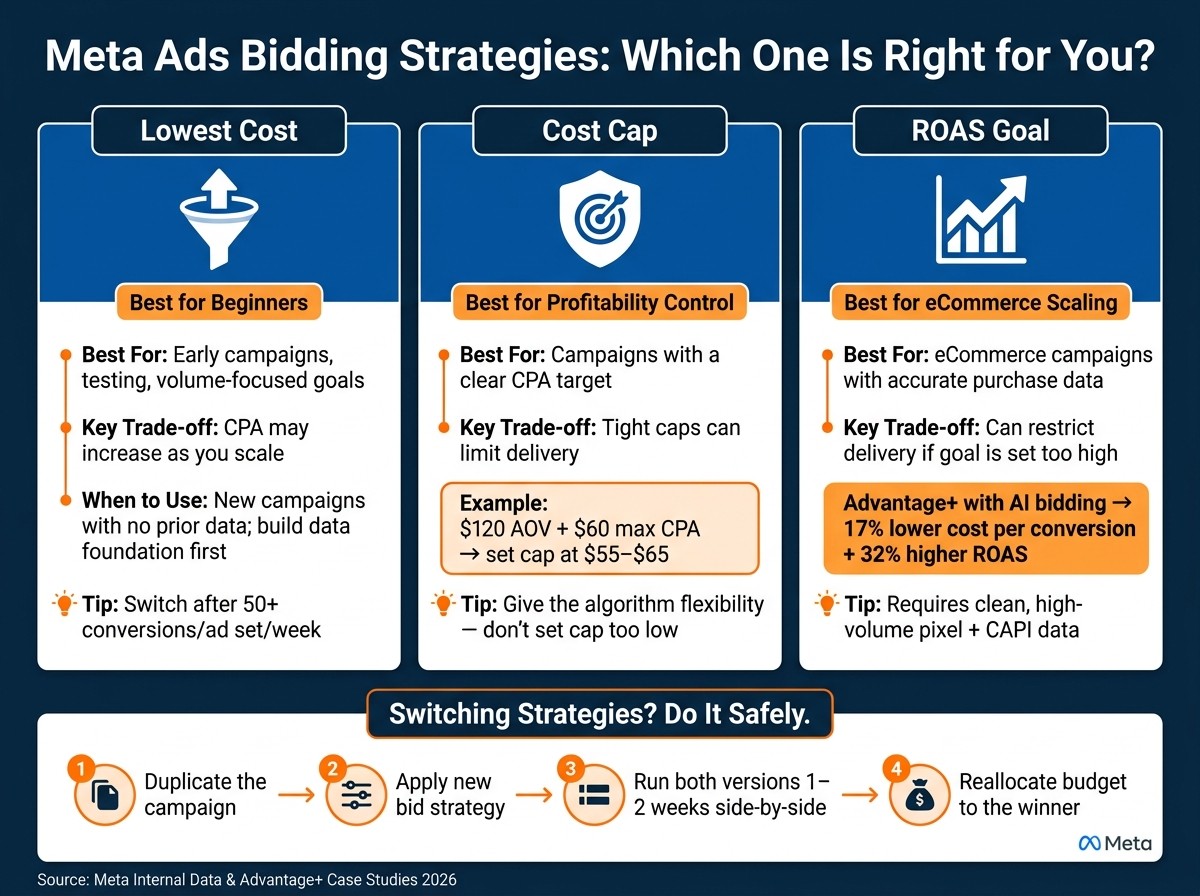
Meta Ads Bidding Strategies Compared: Lowest Cost vs Cost Cap vs ROAS Goal
Once your account structure and tracking are solid, the next step is scaling your ad spend without compromising your ROAS. Scaling too quickly can throw off Meta's learning phase and disrupt the performance you've worked hard to achieve.
How to Scale Budgets Without Hurting Performance
There are two main ways to scale budgets: vertically or horizontally.
Vertical scaling involves increasing the budget on campaigns that are already outperforming your CPA targets. For example, if a campaign is spending $200/day with a $40 CPA (below your $50 target), you can increase the budget to $240–$250/day. The key is to make small adjustments - 10–20% increases every 5–7 days - and give the campaign 48–72 hours to stabilize before making another change. Jumping to $400/day too quickly risks resetting the learning phase and driving up your CPA.
Horizontal scaling is better when you're noticing signs of saturation, like high frequency or inconsistent performance across audiences. Instead of increasing spend on a single ad set, you can duplicate a winning campaign to target a new audience, launch a fresh creative approach, or set up an Advantage+ Shopping Campaign to highlight a different product catalog.
One golden rule: avoid making multiple major changes at once. For instance, if you adjust the budget, switch creative, and tweak the bid strategy all on the same day, you won’t know which change caused the results to shift. Focus on one adjustment at a time, monitor the impact, and then proceed.
Once you’ve chosen your scaling strategy, it’s time to align your bidding approach to optimize performance further.
Choosing the Right Meta Bidding Strategy
The right bidding strategy depends on your campaign goals. Here’s a quick breakdown:
Bidding Strategy | Best For | Key Trade-off |
|---|---|---|
Lowest Cost | Early campaigns, testing, or volume-focused goals | CPA may increase as you scale |
Cost Cap | Campaigns with a clear CPA target | Tight caps can limit delivery |
ROAS Goal | eCommerce campaigns with accurate purchase data | Can restrict delivery if the goal is set too high |
Lowest Cost is a great starting point for new campaigns. It allows Meta’s algorithm to focus on finding conversions without restrictions, helping you build a solid data foundation. Once you’ve gathered enough data - usually after a few weeks and at least 50 conversions per ad set per week - you can introduce more control.
Cost Cap works well when you have clear profitability thresholds. For example, if your product has a $120 AOV and a $60 maximum CPA, you could set a cost cap between $55–$65. This gives the algorithm some flexibility while keeping your costs in check. Setting the cap too low could restrict delivery, while setting it too high might hurt profitability.
ROAS Goal is ideal for eCommerce campaigns with reliable purchase value data. Meta’s internal data shows that Advantage+ Shopping Campaigns using AI bidding can achieve a 17% lower cost per conversion and 32% higher ROAS compared to non-Advantage+ setups. However, these results hinge on having clean, high-volume purchase data feeding into your pixel and CAPI (Conversions API).
When transitioning between strategies, don’t make abrupt changes. For example, instead of switching directly from Lowest Cost to ROAS Goal on a live campaign, duplicate the campaign, apply the new bid strategy, and run both versions side-by-side for 1–2 weeks. This approach allows you to compare performance before reallocating budget to the better-performing campaign.
Once your bidding strategy is set, advanced AI tools can take over to manage budgets dynamically across campaigns.
Using Third-Party AI for Budget Management
Meta’s AI focuses on optimizing individual campaigns, but third-party tools like AdAmigo.ai can manage budgets across your entire account. Their AI Autopilot monitors key performance metrics - ROAS, CPA, CPM, conversion volume, and frequency - and adjusts budgets to align with your goals. It can automatically scale high-performing ad sets, reduce spend on underperforming ones, and flag issues like CPM spikes or pixel outages. You can choose to let the tool make changes automatically or approve adjustments before they go live.
For agencies, this kind of automation is a game-changer. It allows a single media buyer to handle 3–5× more client accounts without sacrificing decision quality.
The biggest advantage? Speed and consistency. While a human media buyer might check campaigns once or twice a day, an AI system monitors performance 24/7. It can catch a sudden CPA spike at 2 a.m. and act on it immediately - something manual management simply can’t match at scale.
AI-Powered Creative Testing and Iteration
Relying solely on budget and bidding strategies isn't enough to drive success. Research from Meta and Nielsen shows that creative contributes to about 56% of sales lift in digital advertising - outperforming targeting, reach, or bidding strategies. In other words, your creative pipeline is the most powerful tool for scaling your campaigns.
How to Use Meta Advantage+ Creative
Meta’s Advantage+ Creative takes the guesswork out of ad optimization. It automatically adjusts elements like cropping, text placement, brightness, and templates to suit placements such as Feed, Reels, and Stories. To make the most of it, start by uploading high-quality base assets in recommended aspect ratios (1:1, 4:5, 9:16). From there, Meta’s system handles the adjustments.
To maximize results, provide a variety of inputs: multiple headlines, text options, and descriptions. The broader the input range, the more combinations Meta can test across auctions. Allow the system to evaluate performance over 7–14 days, as its effectiveness grows over time. Once a winning combination is identified, scale campaign budgets by 20–30% every 2–3 days using automated bid rules. This gradual increase lets the system allocate delivery to the best-performing placements.
Building a Creative Testing Framework
Creative testing isn’t a one-and-done task - it’s an ongoing process. A good framework has three layers:
Baseline Winners: These are 2–5 creatives that consistently meet your target CPA or ROAS. They form the backbone of your daily spending and serve as benchmarks.
Iterative Variants: These involve small changes, like tweaking the hook, headline, or call-to-action, to identify what drives performance shifts.
New Concepts: These explore fresh ideas, such as user-generated content (UGC), testimonials, product demonstrations, or entirely new value propositions. Allocate 10–20% of your daily spend to test these.
Set clear rules for testing: pause any creative that exceeds your target CPA by 30–50% over 3–5 days (with at least 3 conversions), and promote creatives that outperform targets by 20% or more over 7 days. Using 3-day and 7-day moving averages instead of same-day metrics helps you avoid reacting to normal fluctuations.
As spending increases, creative fatigue can appear within 7–14 days. Typical signs include a 20–40% drop in CTR and rising CPMs. To combat this, maintain a creative calendar that introduces fresh assets every 1–2 weeks. This ensures you’re always ahead of fatigue.
Automating this cycle helps keep your campaigns efficient and scalable.
Automating Your Creative Pipeline with AI
As campaigns grow, manual management becomes overwhelming. AI tools like AdAmigo.ai simplify the process. Its Ad Factory analyzes your top-performing ads, breaking them down by hook, format, angle, and audience. It uses these insights to generate new creative ideas and copy variations. The tool even reviews competitor ads to identify successful formats in your niche.
Once new assets are ready, AdAmigo’s Bulk Ad Launcher streamlines the process. It pulls creatives from Google Drive, generates copy based on your brief, organizes campaigns, and uploads everything to your Meta account in minutes. Performance data is fed back into the system, continuously improving future recommendations. This creates a self-sustaining creative engine that keeps your ads fresh and your pipeline running smoothly - without the need for constant manual effort.
AI-Driven Audience Targeting and Campaign Optimization
Targeting effectively is just as important as having great creative. To scale efficiently in 2026, it's time to embrace Meta's AI systems instead of relying on overly complicated manual setups.
Broad Targeting and Meta's Advantage+ Systems
One of the biggest changes in Meta advertising in recent years has been the shift from narrowly defined interest groups to broad, AI-driven audiences. By running fewer, broader campaigns with minimal restrictions, you can let Meta's machine learning do the heavy lifting to identify your ideal buyers.
Take Advantage+ Shopping Campaigns (ASC) as an example. These campaigns often deliver results like 12% lower cost per action and a 20–30% boost in ROAS when there’s enough conversion volume. ASC combines prospecting and remarketing, dynamically allocating impressions where conversions are most likely to happen.
A good starting point is a broad U.S. campaign targeting ages 21+ in English, with Advantage+ Audience expansion enabled. Keep exclusions simple - like recent purchasers - and let Meta’s algorithm analyze thousands of signals per impression to find the people most likely to convert at your target CPA or ROAS.
The secret to making this approach work? High-quality conversion signals. Meta recommends hitting at least 50 conversion events per ad set per week for the algorithm to optimize effectively. To achieve this, use both Meta Pixel and Conversions API to ensure your data is as robust as possible.
Once your broad targeting is set up, enhance it with high-quality first-party data to refine your remarketing efforts.
Using First-Party Data for Remarketing
First-party data is a goldmine for remarketing. Data like customer lists, site visitors, and purchase histories are some of the most powerful tools you can feed into Meta’s system.
Start by ensuring your data is clean and standardized. This means normalized email addresses, phone numbers with country codes, and USD purchase values. A higher Event Match Quality score (on Meta's 0–10 scale) directly correlates with better optimization and performance. Most accounts begin with scores in the 3–6 range, but improving data quality can lead to significant performance gains.
Segment your remarketing audiences based on intent and recency:
Cart abandoners (1–3 days): Use urgency-driven messaging.
Product viewers (4–14 days): Focus on benefits and handle objections.
Lapsed customers (90–180 days): Re-engage with softer messaging, such as "welcome back" discounts or free shipping offers.
Tailor your creative and offers to each segment. For example, provide clear pricing in "finish checking out" reminders or offer USD-based discounts for returning customers.
Additionally, your top 20% of customers by lifetime value (LTV) can serve a dual purpose. Use this high-LTV list to create value-based lookalike audiences, helping Meta find similar high-value prospects. Sync these lists daily from your CRM or eCommerce platform to keep the data fresh and the algorithm informed.
Full-Funnel Optimization with AI
To tie it all together, successful Meta accounts integrate prospecting, remarketing, and retention into a unified system. AI takes the lead in dynamically reallocating budgets to the most promising opportunities across the funnel.
Platforms like AdAmigo.ai make this process seamless. Their AI Autopilot monitors performance across all funnel stages, scaling budgets for top-performing prospecting campaigns, shifting spend toward remarketing when conversion rates spike, and adjusting bids based on your KPIs. Instead of manually managing every campaign layer, AI works around the clock to optimize results. The AI Chat Agent even allows you to ask cross-funnel questions like "Why did my remarketing CPA go up this week?" and receive actionable insights - or make changes - directly from the conversation.
This AI-driven approach accelerates learning and reduces wasted impressions. By automating budget allocation - whether through Meta’s Campaign Budget Optimization (CBO) or third-party tools - you can move through the learning phase faster and see compounding improvements over time.
Governance and Continuous Optimization with AI
Setting Guardrails for Safe Scaling
Scaling quickly without proper boundaries is a recipe for overspending with little to show for it. Before allowing any AI system to make decisions on its own, you need to establish clear limits for its operation.
Two key areas to focus on are financial caps and performance thresholds. Financially, create strict rules such as limiting daily campaign spend increases to no more than 30% and setting a total daily account spend cap - say $20,000 - that requires manual approval to exceed. On the performance side, establish clear "scale or kill" criteria: for example, increase a campaign's budget by 20% if it achieves target ROAS for three consecutive days with at least 50 conversions. Conversely, if CPA exceeds the target by 30% for two days, cut the budget by 30% and flag the campaign for review.
Don't overlook the learning phase. Avoid scaling an ad set prematurely. Wait until it achieves at least 50 optimization events per week and maintains stable performance for three to five days. Scaling too early can disrupt learning and lead to inconsistent results.
Tools like AdAmigo Protect, a feature of AdAmigo.ai, automate these guardrails. It continuously monitors your account for anomalies - such as sudden spikes in CPM, pixel outages, or drops in conversion volume - and intervenes to prevent further losses. This kind of anomaly detection often identifies issues 60–70% faster than manual checks, saving both time and budget in large-scale ad accounts.
Once these financial and performance safeguards are in place, the next step is ensuring compliance and transparency.
Staying Compliant and Transparent
Beyond setting financial and performance limits, maintaining compliance and transparency is essential for scaling safely. In 2026, compliance goes beyond avoiding disapproved ads - it’s about creating systems that are auditable, explainable, and aligned with Meta’s policies and U.S. regulations.
Every AI-driven action - whether it’s a budget adjustment, a new campaign launch, or an audience update - should be logged with details like timestamps, changed parameters, and performance outcomes. This audit trail is invaluable for client reviews, internal audits, and regulatory checks. According to McKinsey, companies with structured AI governance and monitoring experience up to 20% fewer policy violations and brand safety incidents compared to those without such systems.
For AI-generated creatives, transparency is non-negotiable. Keep a detailed record of any ads created or significantly modified by AI tools. If your campaigns use synthetic media - like AI-generated faces, voices, or endorsements - disclosure is mandatory. The FTC has issued specific guidance on synthetic content, and Meta’s policies are becoming stricter in this area. A good rule of thumb: if a human didn’t create it entirely, log and verify it before publishing.
Platforms like AdAmigo.ai, built on Meta's official API, operate within Meta's compliance framework, reducing the risk of policy violations caused by automation. Its activity log provides an exportable record of every AI-driven action, which is valuable for client reporting, legal reviews, or simply understanding what changes were made and why.
Building a Repeatable Learning Process
With guardrails and compliance protocols in place, the next step is to create a system for continuous learning and improvement. Successful teams don’t just run effective campaigns - they build effective learning processes. A Nielsen study for Meta revealed that advertisers running consistent, structured testing achieve 20–30% higher ROAS compared to those relying on sporadic, unplanned tests.
Make it a habit to review key metrics weekly, adjust scaling thresholds monthly, and refine your overall strategy quarterly based on test results.
Documentation is critical. Keep a log of every test, including hypotheses, setups, timeframes, and outcomes. Over time, this archive becomes a searchable resource tailored to your account’s unique performance patterns - something no external tool can replicate. AdAmigo’s AI Chat Agent simplifies this process by allowing you to ask questions like, “What was changed in my account this week?” and receive a clear summary of actions and their impacts. This makes weekly reviews faster and more grounded in actionable data.
Conclusion: How to Scale Meta Ads with AI for Long-Term Results
Scaling Meta ads with AI in 2026 isn’t about quick wins. It’s about creating a well-rounded strategy where accurate data, smart automation, and human oversight come together seamlessly.
While manual vs AI-powered management shows that manual work typically supports 4–6 accounts, AI-driven systems can handle 15–25+ accounts with constant monitoring, fewer errors, and real-time budget adjustments. This difference highlights the importance of maintaining precise control over AI processes. For example, rely on 7-day rolling averages to assess performance instead of reacting to daily changes, and establish clear escalation points for significant budget shifts.
With these strategies in mind, tools like AdAmigo.ai are designed to autonomously fine-tune campaigns while leaving critical decisions in your hands. Whether you’re an agency juggling multiple client accounts or an in-house team aiming to maximize efficiency, the key is to lay a strong foundation, test thoroughly, automate thoughtfully, and remain open to ongoing learning.
FAQs
Do I need both Meta Pixel and CAPI to scale in 2026?
Yes, for precise tracking and effective scaling in 2026, you'll need both the Meta Pixel and the Conversions API (CAPI). The Meta Pixel captures data from browser activity, while the Conversions API works server-side to share data, bypassing challenges like privacy restrictions and ad blockers. By combining these tools, you get a more complete data set, allowing your AI tools to deliver accurate audience segmentation and performance insights for improved campaign outcomes.
How much conversion volume do I need before Meta’s AI can optimize well?
AI systems thrive on data to make informed decisions and avoid overreacting to minor changes. For instance, AdAmigo.ai recommends collecting at least 20 clicks or 5 conversions before making any budget adjustments. Similarly, when experimenting with new ads, it’s wise to let them run for 48–72 hours and gather 10–15 conversions before deciding whether to tweak or pause them. This approach ensures decisions are based on meaningful trends rather than short-term noise.
What guardrails should I set so AI scaling doesn’t blow up my budget?
To keep your spending in check, AdAmigo.ai offers tools to set precise ROAS targets, CPA limits, and overall financial boundaries. You can also introduce dynamic thresholds, like daily spending caps set at 2–3× your average, giving you some flexibility without losing control. For added oversight, enable human-in-the-loop reviews to approve significant budget adjustments. Additionally, activate AdAmigo Protect to track unusual spending in real time and stop expensive errors before they happen.