
AI Algorithms for Large Audience Sets
Clustering, propensity models, and reinforcement learning automate ad scaling, improve ROI, and keep campaigns updated in real time.
Scaling ad campaigns for large audience sets is challenging. Manual processes can't keep up with the complexity, speed, and data volume needed to optimize campaigns effectively. AI algorithms solve this by automating tasks like audience segmentation vs. predictive targeting, and real-time campaign adjustments, enabling media buyers to handle more accounts with greater efficiency.
Key insights:
AI's impact: Cuts campaign launch times from 25 to 2 minutes, allowing one buyer to manage 15–25+ accounts.
Proven results: Meta's AI models boosted Instagram conversions by 5% and Facebook Feed conversions by 3%.
Core algorithms:
Clustering and embedding: Groups users based on behavior for smarter audience segmentation.
Propensity models: Scores users by purchase likelihood to focus resources effectively.
Reinforcement learning: Adjusts bids, budgets, and strategies in real time for optimal results.
Real-time updates: Systems like Meta Pixel ensure campaigns stay relevant by constantly refreshing data.
AI tools like AdAmigo.ai: Automate processes, monitor account health, and simplify campaign management through features like AI Autopilot and Bulk Ad Launcher.
AI doesn't replace advertisers - it enables them to handle larger campaigns with precision, saving time and improving performance. Clean data, clear goals, and gradual trust in automation are essential for success.
Core AI Algorithms for Managing Large Audience Sets
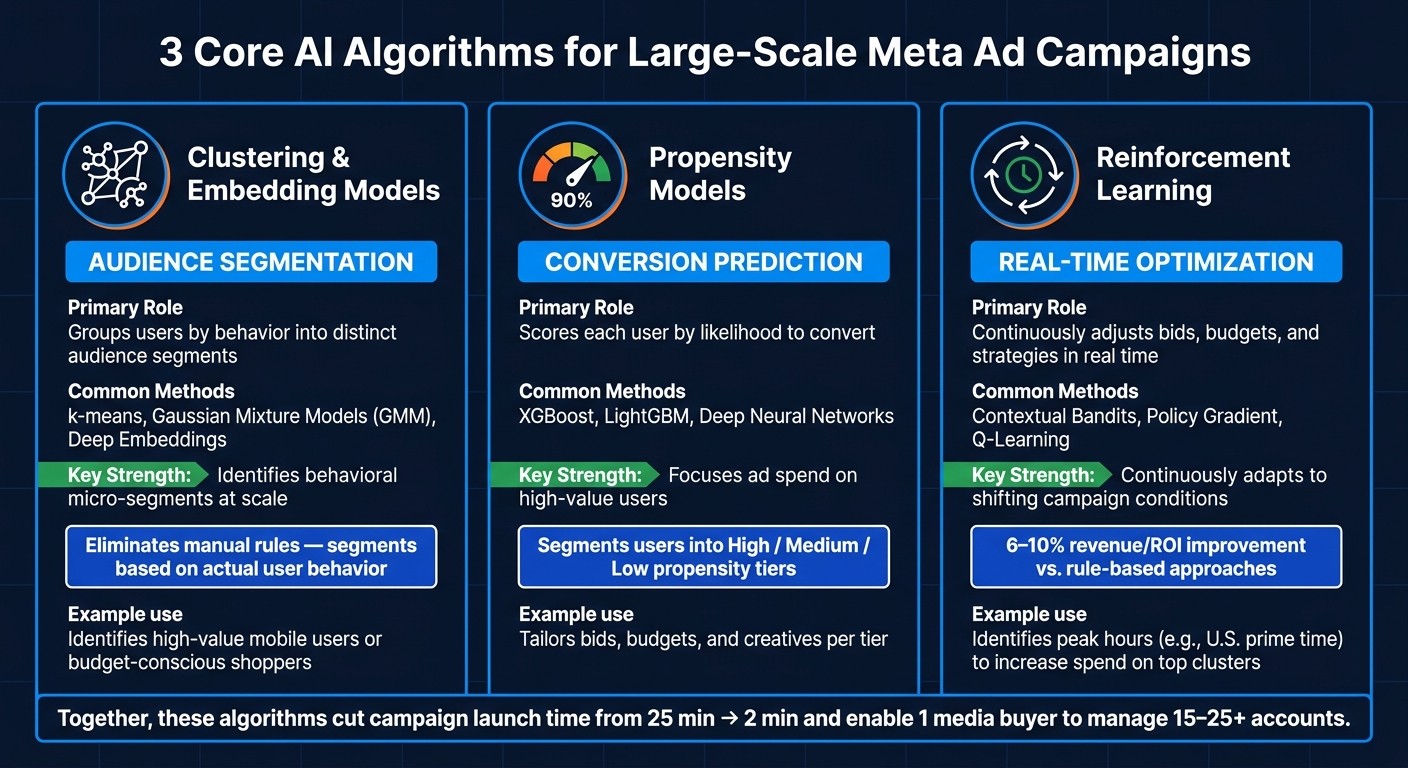
3 Core AI Algorithms Powering Large-Scale Meta Ad Campaigns
Running scalable Meta ad strategies relies on three key AI models: clustering and embedding for audience segmentation, propensity models for predicting conversions, and reinforcement learning for real-time optimization. These algorithms automate complex tasks like grouping users, forecasting outcomes, and adjusting campaigns on the fly.
Clustering and Embedding Models for Audience Segmentation
Embedding models transform user data - like clicks, engagement patterns, and purchase history - into numerical formats that machines can process. Clustering algorithms, such as k-means or Gaussian Mixture Models (GMMs), then group these numerical representations into distinct audience segments. This approach eliminates the need for manual rules versus AI-driven segmentation and allows for smarter, data-driven results.
For example, clustering can identify high-value mobile users or budget-conscious shoppers. By basing segments on actual user behavior, advertisers can achieve steadier conversion rates compared to traditional segmentation methods.
Once these audience groups are defined, propensity models step in to assess and rank them by their likelihood to convert.
Propensity Models for Conversion Prediction
Propensity models assign a score to each user or segment, predicting how likely they are to make a purchase. These models use supervised learning techniques, often relying on tools like gradient-boosted decision trees (e.g., XGBoost, LightGBM) or deep neural networks, trained on historical data about impressions and conversions.
For instance, a purchase within 7 days might be labeled as a positive outcome, while non-conversions are marked as negatives. The models analyze a variety of inputs, such as user behavior (session depth, scrolling activity, past ad interactions), geographic location, device type, and even time-of-day trends.
Advertisers can then categorize users into high-, medium-, and low-propensity tiers. Each tier can receive tailored bids, budgets, and creatives, ensuring resources are allocated efficiently rather than treating all users the same.
While propensity models focus on predicting conversions, reinforcement learning takes it a step further by dynamically fine-tuning campaigns in real time.
Reinforcement Learning for Real-Time Optimization
Reinforcement learning (RL) systems continuously monitor campaign metrics - like CPM, CPA, ROAS, budget pacing, and audience composition - and make real-time adjustments. These adjustments might include tweaking daily budgets, changing bidding strategies, rotating creatives, or even broadening audience targets. The RL system evaluates rewards, such as revenue minus ad spend or incremental conversions, and refines its strategy accordingly.
Unlike static rules like “increase budget by 20% if CPA stays under $30 for three days,” RL adapts to shifting market conditions. For instance, it might identify optimal times, such as peak U.S. hours, to increase spending on certain audience clusters when conversion rates are naturally higher.
Real-world applications of RL in ad bidding have shown revenue or ROI improvements of 6–10% compared to rule-based approaches. This is largely because RL accounts for complex factors like auction dynamics and budget limits that static rules often overlook.
Algorithm Type | Primary Role | Common Methods | Key Strength |
|---|---|---|---|
Clustering & Embeddings | Audience segmentation | k-means, GMM, deep embeddings | Identifies behavioral micro-segments at scale |
Propensity Models | Conversion likelihood scoring | XGBoost, LightGBM, deep neural networks | Focuses resources on high-value users |
Reinforcement Learning | Real-time budget & bid optimization | Contextual bandits, policy gradient, Q-learning | Continuously adapts to campaign conditions |
Real-Time Adaptation and Refinement of Audience Sets
Keeping data fresh is a must for accurate propensity scores and reinforcement learning (RL) policies. Real-time adaptation ensures that performance remains scalable across large audience sets, perfectly complementing the clustering, propensity, and RL algorithms discussed earlier.
Continuous Data Ingestion and Feature Updates
Modern ad systems are built to capture events - like page views, add-to-carts, purchases, or ad impressions - the moment they happen. These events are processed through streaming pipelines, often powered by tools like Apache Kafka or Apache Flink, and fed into a feature store. This enables near-instant updates to audience membership and propensity scores.
For example, when a Meta Pixel or Conversions API logs an event, it updates user features and refreshes segment assignments and bid logic within minutes. Here’s why this matters: feature freshness is just as important as feature volume. Outdated data can lead to wasted spend by targeting audiences that have already converted or lost interest, inflating costs like CPMs unnecessarily.
Important features - such as event recency, cart abandonment signals, product view depth, ad exposure frequency, and recent first-party purchase data - are constantly changing. These factors directly influence conversion intent and need to be updated in real time to maintain campaign effectiveness.
This naturally brings us to the comparison between online learning and batch updates for model optimization.
Online Learning vs. Batch Model Updates
When it comes to updating models, there’s always a balance between speed and stability. Online learning adjusts model parameters incrementally as new events come in. This makes it highly responsive to changes like shifts in click-through rates, creative fatigue, or auction competition. Research shows that static models can lose 20–50% of their effectiveness due to concept drift, which is why scalable ad systems often combine stable batch-trained models with online fine-tuning for quick adaptability.
Most advanced ad systems adopt a hybrid approach. They rely on a batch-trained base model, refreshed periodically, while layering online fine-tuning on top to respond to fast-changing signals. This ensures that the core audience model benefits from reliable historical data while staying nimble enough to react to real-time user behavior.
Factor | Online Learning | Batch Updates |
|---|---|---|
Update frequency | Near real time | Hours, daily, or weekly |
Responsiveness | High | Lower |
Stability | Can be noisy | More stable |
Best for | CTR drift, creative shifts, auction changes | Core model refreshes, long-term patterns |
This hybrid strategy creates a strong foundation for dynamic adjustments to bids and budgets, ensuring campaigns stay optimized in real time.
Dynamic Budget and Bid Adjustments
Algorithms play a key role in reallocating spend based on the predicted value of audience segments. Sometimes, a smaller, high-intent audience segment can outperform a broader prospecting pool if its predicted conversion rate justifies the higher CPM.
Bid logic adapts to auction signals on the fly. For instance, if CPMs rise in a particular segment but conversions remain efficient, the algorithm might hold or even increase bids. On the other hand, if costs start to outweigh value, bids are reduced, or the budget is shifted to more effective segments. Studies on adaptive budget pacing have shown that moving from static to RL-based pacing can boost campaign ROI by 10–15% while still meeting daily spend targets. This is achieved by dynamically adjusting bids based on the marginal value of each impression.
For U.S. advertisers working with dollar-based KPIs like target CPA or target ROAS, this kind of intra-day budget reallocation is especially useful during high-competition periods like Black Friday or Cyber Monday. Auction dynamics can shift dramatically in just a few hours, and these adjustments ensure every dollar is spent efficiently.
Using AI Tools to Run Meta Campaigns at Scale
Autonomous AI tools are changing the game for managing Meta campaigns, offering speed and scalability that traditional methods can't match. By using techniques like clustering, propensity scoring, and reinforcement learning, these tools transform theoretical strategies into real-time campaign execution, making large-scale Meta advertising more efficient.
The Role of Autonomous AI Media Buyers
Handling large audience sets in Ads Manager can be overwhelming due to the sheer volume, speed, and need for consistent performance. When campaigns grow to hundreds of ad sets, AI tools step in to process performance metrics like CPM, CTR, CPA, and ROAS in real time. Unlike traditional workflows, these systems act instantly, without waiting for manual input or scheduled check-ins.
With these tools, teams can manage three to five times more campaigns without increasing headcount. This is especially valuable for U.S. advertisers managing campaigns during peak shopping events like Black Friday or Cyber Monday, where quick adjustments can directly impact profitability.
Customizable Automation Aligned to Business Goals
A common concern with automation is losing control, but rule-based guardrails ensure the AI operates within set boundaries. For example, an eCommerce brand in the U.S. might implement a rule like: pause any ad that spends over $200 with a ROAS below 1.5 over the last three days. This approach allows the AI to work faster and more precisely than a human team, but always within the advertiser's limits. This is critical for avoiding costly mistakes, such as misconfigured bids that could impact millions of impressions in just a few hours.
Key Features of AdAmigo.ai for Meta Ad Campaigns
AdAmigo.ai is a platform designed specifically for managing large-scale Meta campaigns. Here’s how its features help advertisers handle complex campaigns effectively:
AI Autopilot
This feature is the core of the platform, continuously monitoring the account to identify high-impact opportunities. It handles tasks like reallocating budgets, optimizing audiences, scaling successful ads, and pausing underperforming ones. These changes can be made automatically or with a single click, depending on user preference.
AI Chat Agent
With this tool, campaign management becomes as simple as having a conversation. Ask questions like "Why did our ROAS drop yesterday?" or give commands like "Launch a retargeting campaign for 30-day add-to-cart visitors." The AI handles the setup, cutting down hours of analysis and configuration into just minutes.
Ad Factory
Creative fatigue can quickly derail large-scale campaigns. Ad Factory uses clustering and behavioral data to analyze top-performing ads and competitor creatives, then generates fresh variations to keep audiences engaged. A helpful tip: rotate creative every 2–4 weeks, or sooner if ad frequency exceeds benchmarks of 3 impressions in 7 days.
Bulk Ad Launcher
Launching hundreds of ad variations manually is a bottleneck for large campaigns. This feature automates the process - just upload assets to Google Drive, provide a brief, and AdAmigo takes care of generating copy, structuring campaigns, and publishing ads. This is especially handy for multi-region campaigns or product catalogs with numerous SKUs.
AdAmigo Protect
This safety feature monitors account health around the clock, flagging issues like sudden CPC spikes, delivery problems, or broken tracking pixels. For campaigns with large budgets and fast-moving metrics, catching these problems early can save significant ad spend.
Feature | What It Does at Scale |
|---|---|
AI Autopilot | Continuous account auditing, budget reallocation, scaling winners |
AI Chat Agent | Natural language campaign management and performance analysis |
Ad Factory | Automated creative generation and iteration to prevent fatigue |
Bulk Ad Launcher | Deploy hundreds of ads in minutes using Google Drive assets |
AdAmigo Protect | 24/7 anomaly detection for spend, delivery, and account health |
Conclusion: Scaling Meta Ad Campaigns with AI
Keeping up with the demands of managing large-scale audience sets on Meta has outgrown the capabilities of manual processes. The sheer complexity - thousands of ad sets, ever-changing auction dynamics, and audiences that shift in behavior throughout the day - makes it nearly impossible to rely on traditional workflows.
This is where AI steps in. By breaking down audiences, predicting conversions, and fine-tuning bids and budgets in real time, AI ensures campaigns can scale without compromising performance. These tools provide the operational efficiency needed to handle the challenges of modern campaign management.
Key Takeaways for Advertisers
AI-driven optimization isn’t about sidelining human expertise - it’s about letting marketers focus on what truly matters. With AI handling repetitive tasks, media buyers can dedicate their energy to strategy, creative ideas, and refining offers, instead of endlessly adjusting bids and budgets.
Here are a few important principles to guide you as you scale:
Data quality is critical: AI models rely on clean, accurate event signals. Ensure your Meta Pixel and Conversions API are properly tracking key events like
PurchaseandAddToCartbefore leaning on AI for optimization.Start with guardrails and build trust over time: Use AI in recommendation mode to understand its decision-making process. Gradually shift to full automation as confidence grows.
Audience optimization is an ongoing process: Audience behavior and auction conditions are constantly evolving. AI systems that continuously process fresh data will always outperform static setups.
Platforms such as AdAmigo.ai bring these strategies to life. They handle tasks like account audits, reallocating budgets, and optimizing performance with ease. With AI-powered tools, a single media buyer can manage 3–5× more accounts compared to manual workflows, delivering operational efficiency whether you’re running an agency or working in-house.
The takeaway? AI doesn’t replace advertisers - it enhances their capabilities. Set clear goals, establish boundaries, and let AI handle the heavy lifting at a scale and speed that manual efforts simply can’t keep up with.
FAQs
What data is needed for AI to optimize Meta ads?
To get the most out of Meta ads, start by making sure the Meta Pixel is installed on all the pages that matter. This allows you to track user interactions effectively. Also, enable advanced matching and double-check that your event tracking is working correctly to gather accurate data.
Next, link your Business Manager account and provide essential details, such as audience KPIs, performance targets, budget limits, and your optimization preferences. These inputs help guide the system toward better results.
For an extra edge, consider integrating offline conversion data from your CRM. This step allows Meta’s AI to fine-tune its models using actual revenue data, making your campaigns even more precise.
How can I prevent AI automation from overspending or exceeding my KPIs?
To ensure AI automation stays within your financial limits, it's crucial to establish clear guardrails, budget caps, and performance targets right from the start. Tools like a Policy and Constraint Engine can help enforce key metrics such as CPA (Cost Per Acquisition) and ROAS (Return on Ad Spend).
You can maintain control by choosing to manually approve actions or by using an autopilot mode with preset configurations. For added security, AdAmigo Protect keeps an eye on your account 24/7, identifying potential issues like unexpected spending spikes to safeguard your budget.
When should I use clustering, propensity scoring, or reinforcement learning?
When it comes to data analysis and improving campaign results, different methods tackle specific challenges:
Clustering: This groups users based on behavior or engagement patterns, making it easier to fine-tune targeting strategies.
Propensity scoring: By predicting how likely users are to take specific actions - like making a purchase - it helps focus efforts on high-value prospects.
Reinforcement learning: This adjusts bidding, budgeting, and ad creatives in real time to boost long-term outcomes.
Platforms like AdAmigo.ai streamline these processes, making optimization more efficient and effortless.