
AdAmigo Product Update: Your AI Media Buyer Now Learns Your Goals, Rules, and Preferences
Set KPIs, targeting rules, and preferences so your AI media buyer optimizes Meta ads and learns from your inputs over time.
AdAmigo.ai just made managing Meta ad campaigns easier. With its latest update, the platform allows you to set specific goals, KPIs, and targeting rules that the AI memorizes and applies automatically. Whether your focus is on scaling budgets with a target ROAS of 2.5 or prioritizing qualified leads over cost, the AI adjusts campaigns based on your inputs. Over time, it learns your preferences and optimizes accordingly, saving you time and improving performance.
Key Features:
Customizable Goals: Define KPIs and performance targets based on your specific budget priorities.
Targeting Rules: Specify locations, demographics, and languages for precise audience targeting.
Learning Over Time: The AI remembers and applies your instructions to future campaigns.
Easy Updates: Use a settings panel for detailed adjustments or a chat agent for quick changes.
This update transforms AdAmigo into a personalized media buyer that aligns with your business needs and handles execution while you focus on strategy.
How to Configure AdAmigo AI Media Buyer: Goals, KPIs and Targeting Setup
5 NEW AI That Just Changed Facebook Ads Forever
How to Set Goals, KPIs, and Business Context
For AdAmigo to manage your campaigns effectively, it needs a clear picture of what success means for your business. This involves defining your KPIs, setting performance benchmarks, and explaining where your traffic should go. These steps help the AI understand what "good performance" looks like for your goals.
Let’s break down how to establish these essential parameters.
Setting Your KPIs and Performance Targets
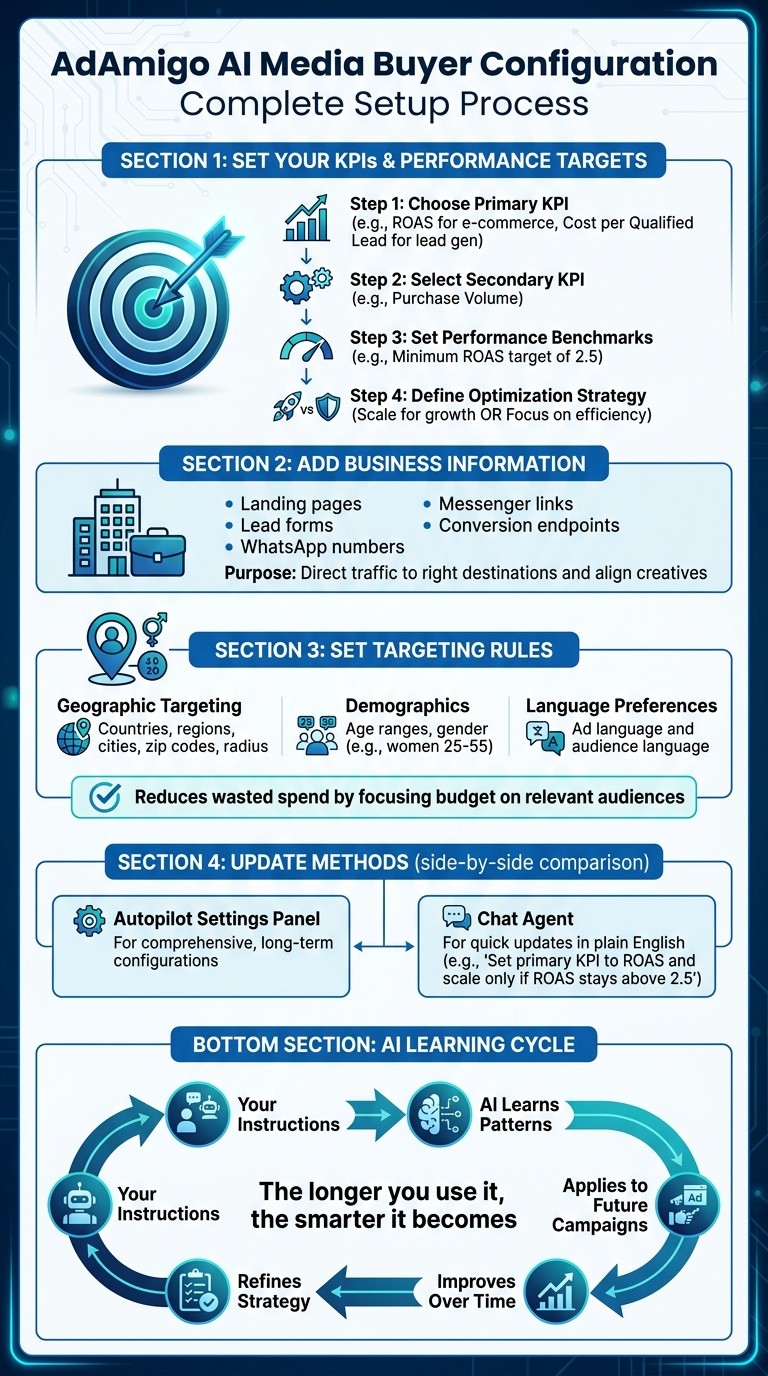
Start by identifying your primary KPI - the key metric that drives your business. For e-commerce brands, this might be ROAS (Return on Ad Spend). For lead generation, it could be the cost per qualified lead. You’ll also want to pick a secondary KPI to add more context. For example, an e-commerce store might focus on ROAS as the main metric but also track purchase volume to ensure growth is on track.
Once your KPIs are set, determine the performance benchmarks by industry you aim to hit. For instance, you might set a minimum ROAS target of 2.5 and allow the AI to scale budgets aggressively if that target is met. Alternatively, you might prioritize maximizing ROAS even if it means spending less. For lead generation, you could emphasize the cost per qualified lead rather than just the overall cost per lead. These benchmarks guide the AI in making decisions about budgets, testing, and whether to scale or pause specific campaigns.
Next, decide on your optimization strategy. Do you want to scale budgets as long as targets are met, or would you rather focus on efficiency, even if it means reducing spend? The first approach prioritizes growth, while the second ensures tighter control over performance.
Adding Business Information
Beyond KPIs, AdAmigo needs details about your business operations and traffic destinations. This includes information like landing pages, lead forms, WhatsApp numbers, Messenger links, or any other conversion endpoints. These details help the AI ensure traffic is directed to the right places.
Providing this business context allows the AI to align creatives with appropriate destinations and make smarter decisions about campaign structure and traffic flow. By tailoring its approach to your setup, AdAmigo becomes more than just an automation tool - it becomes a system designed to work seamlessly with your business.
Setting Targeting Rules and Restrictions
Once you've established your KPIs and business objectives, the next step is to decide where and how your ads should run. AdAmigo makes this easy by allowing you to set detailed targeting rules and guardrails. These act as clear guidelines, ensuring the AI aligns campaigns with your business's actual capabilities. Essentially, they help prevent wasting money on audiences that don’t make sense for your goals.
Available Targeting Parameters
AdAmigo offers a range of targeting options to refine your audience. For geographic targeting, you can specify locations down to countries, regions, cities, zip codes, or even a radius around a specific point. This is especially handy for local businesses or brands with limited shipping areas. For instance, if your business only ships within the United States, you can restrict campaigns to specific regions within the country.
When it comes to demographics, you can define age ranges and gender. If your product is aimed at women between 25 and 55, you can lock in that audience, ensuring the AI doesn’t recommend campaigns outside that group. Additionally, you can set language preferences for both your ads and your audience. For example, if you're running campaigns in Germany, Austria, and Switzerland, you can instruct the AI to create German-language ads and target German-speaking users.
These parameters do more than just pinpoint your audience - they help you allocate your budget more effectively.
Why Targeting Restrictions Reduce Wasted Spend
By applying these restrictions, you’re not just narrowing your audience - you’re boosting performance. Clear boundaries allow the system to focus your budget on audiences that matter. Instead of wasting resources testing irrelevant groups, the AI can zero in on optimizing campaigns for your chosen parameters.
"Our budgets are controlled, our spend is being smartly allocated and our ROAS is up massively"
This approach highlights how an AI media buyer can adapt to your specific business rules, ensuring campaigns feel increasingly tailored to your needs.
2 Ways to Update Your AI Preferences
AdAmigo offers two simple methods to fine-tune how your AI media buyer operates. You can either use the structured Autopilot Settings Panel for detailed configurations or update preferences effortlessly through natural conversation with the Chat Agent.
Using the Autopilot Settings Panel
To make comprehensive adjustments, head to the Autopilot panel located in the dashboard's top-right corner. This tool lets you set key parameters like targets, budget limits, targeting restrictions, language preferences, and custom rules. It’s ideal for establishing long-term guidelines or making account-wide changes to how the AI functions.
Giving Instructions Through Chat Agent
For quick updates, the Chat Agent allows you to communicate your preferences in plain English. For example, you can type commands like, "Set my primary KPI to ROAS and scale only if ROAS stays above 2.5" or "Limit targeting to women aged 25 to 55, or adapt to new targeting restrictions." The AI instantly processes these instructions, updates your settings, and applies them to future decisions.
"The fact that you can launch campaigns through text or voice commands feels like magic! It handles everything from creating lookalike audiences to adjusting budgets with just a few prompts"
This conversational approach is perfect for on-the-go adjustments. Want to focus campaigns on specific states? Just say so. Need to prioritize qualified leads over cheaper ones? Type it out. The AI translates your natural language into actionable settings without requiring you to navigate complex menus. Plus, every command refines the AI’s learning, ensuring it adapts and aligns with your evolving preferences.
How the AI Learns Your Preferences Over Time
AdAmigo.ai doesn’t just follow a automated bid rules - it adapts and improves its understanding of how you want your ad account managed. Every interaction you have with the platform fine-tunes its approach, making sure it evolves alongside your needs.
What the AI Learns From Your Instructions
Every time you interact with the AI, it picks up on patterns in your preferences. Whether you’re specifying campaign structures or emphasizing which KPIs matter most, the AI takes note and applies these insights to future recommendations.
For instance, if you consistently prioritize qualified leads over cheaper ones, the AI adjusts its suggestions to align with that priority. Similarly, if you prefer gradual budget increases of 5–10% instead of larger jumps, the AI adopts that cautious strategy in its optimizations.
"These AI actions go beyond simply suggesting actions; they provide valuable insights and justifications. This not only improves my results but also deepens my understanding of campaign optimization."
Verified User, G2 Reviewer
How Learning Improves Performance Over Time
As the AI learns more about your preferences, its strategies become sharper and more personalized. The longer you use AdAmigo.ai, the less you need to repeat your instructions. Over time, it fine-tunes its approach to align perfectly with your specific goals - whether that’s hitting a particular ROAS target, following proven ROAS optimization tips, staying within a CPA limit, or managing budgets with precision.
The AI works around the clock, analyzing both real-time campaign data and historical performance to refine its targeting and budgeting strategies. With every insight it gathers, its recommendations get closer to your objectives, cutting out guesswork and minimizing wasted spend.
This continuous learning turns the AI into more than just a tool - it becomes a true extension of your strategic vision.
Conclusion
With its advanced goal-setting and targeting capabilities, AdAmigo.ai has evolved from being just another Meta ads automation tool into a tailored AI media buyer that truly understands your business needs. It empowers you to take control of your campaigns by setting KPIs, defining performance targets, and establishing targeting guidelines - all while ensuring the AI follows your exact instructions. As you engage with the Chat Agent, the system learns and adapts to your unique approach.
"What others promised, AdAmigo.ai delivered. True AI, automation, and results." - Nadia Toffar
This track record of success highlights the platform's dedication to exceeding advertiser expectations. Recognized as a High Performer on G2, users are impressed by its ability to launch intricate campaigns with simple text commands, while also delivering noticeable improvements in ROAS and budget management. As an official Meta Business Technology Partner, AdAmigo.ai ensures secure and seamless integration with your ad account.
The more you use it, the smarter it becomes - allowing the AI to act as an extension of your strategic vision.
FAQs
How do I know the AI will follow my rules?
The AI works within your guidelines because you can define specific goals, restrictions, and preferences using Autopilot settings or direct instructions to the Chat Agent. Over time, it learns your preferences and applies them consistently to tasks like campaign management, budget planning, targeting, and adjustments. Plus, you have the option to review its actions to make sure they align with the rules you've established.
What happens if my KPI targets aren’t met?
If your KPI targets fall short, the AI agent will adjust and refine its approach based on your preferences. It might propose tweaks or adjustments aimed at boosting performance. By setting clear objectives, you ensure the AI focuses its efforts on achieving your goals and consistently strives to meet your expectations.
How long does it take to “learn” my preferences?
It typically takes around 7 days or 50 optimization events for the AI to fine-tune itself to your preferences and start optimizing campaigns effectively. This learning phase helps the AI better understand your goals, paving the way for improved results as it gathers more data.