
Meta Ads: Secure Audience Data Across Platforms
Compare consent mode, PETs, first-party strategies, and automation to secure audience data, ensure compliance, and improve Meta ad performance.
Managing audience data securely on Meta platforms is more important than ever. With stricter privacy laws like GDPR and CCPA, advertisers must adopt tools and strategies that protect user data while ensuring compliance. Here's what you need to know:
Meta Consent Mode: Adjusts data collection based on user preferences, automating compliance with privacy laws. It's easy to set up and works with tools like Meta Pixel and Conversions API.
Privacy-Enhancing Technologies (PETs): Uses advanced encryption and real-time data checks for stronger security but requires significant technical resources.
First-Party Data Strategies: Allows businesses to control data directly, improving data quality and compliance. However, it demands technical expertise and ongoing maintenance.
AdAmigo.ai: A simple, automated tool for managing Meta ads and ensuring compliance. It’s affordable ($99/month for smaller ad budgets) and easy to implement, even without technical skills.
Each option has its strengths and trade-offs. For small teams, AdAmigo.ai offers a straightforward solution. Larger enterprises may prefer PETs for robust security. Combining these tools can help you protect user data, meet legal requirements, and maintain effective ad campaigns.
How to Make Facebook Ads HIPAA-Compliant (Avoid These Costly Mistakes!)
1. Meta Consent Mode
Meta Consent Mode works with Meta Business Tools - like Meta Pixel and Conversions API - to respect users' data-sharing preferences. If someone opts out, the system adjusts how campaigns gather and process their information automatically. This setup forms the basis for the privacy-focused measures discussed further below.
Data Security
Meta's Privacy Aware Infrastructure (PAI) ensures data security by performing real-time checks on information flow. It verifies trillions of consent checks each hour and monitors millions of data flows daily. Instead of relying on audits after the fact, this system prevents unauthorized access by inspecting data flows as they occur.
Meta also employs over 3,000 privacy specialists who review approximately 1,400 products, features, and data practices every month before they are released. To further protect user information, billions of unauthorized scraping attempts are blocked daily across Facebook and Instagram.
Compliance with Privacy Regulations
Meta Consent Mode aligns with GDPR and CCPA requirements by offering detailed consent controls. For example, European users can differentiate between consent for essential services and personalized ads. In California, the Limited Data Use (LDU) flag restricts data processing for users who opt out in compliance with local regulations.
"Investing in this work now will make it easier for you to address future regulatory requirements and industry changes, including enhanced transparency and control responsibilities." – Meta Business Help Center
The system also keeps detailed consent records and integrates with Meta's Data Processing Terms, providing a clear legal framework for managing shared data. Advertisers are required to secure a lawful basis and the necessary permissions before sharing data through Meta's Business Tools, with the infrastructure automating much of the compliance process.
Implementation Complexity
Unlike systems that require physical data silos, Meta Consent Mode uses logical separation to secure simultaneous data flows through runtime restrictions. A "logging mode" feature lets teams simulate enforcement effects before full deployment, minimizing potential disruptions during implementation.
Meta also reduces the technical workload by automating key processes. For instance, privacy annotations are applied to millions of data assets using automated classifiers, eliminating the need for manual labeling. Generative AI tools like "Dr. Policy Zone" further streamline operations by diagnosing and addressing errors quickly. This integrated system simplifies compliance efforts, saving teams from building custom solutions from the ground up.
2. Privacy-Enhancing Technologies (PETs)
Privacy-Enhancing Technologies (PETs) take privacy measures to the next level by embedding controls directly into Meta's infrastructure. These tools rely on advanced techniques like Information Flow Control (IFC) to enforce data rules automatically, eliminating the need for manual audits. Building upon Meta Consent Mode, which is part of how Meta handles consent in ad accounts, PETs introduce real-time mechanisms to ensure data integrity and how Meta syncs audience data across platforms.
Data Security
PETs enhance data security by implementing Policy Zones, which use IFC to ensure data is only used for its intended purpose. This technology enforces rules in real time, preventing violations during code execution instead of identifying them later through audits. Recent upgrades to Policy Zones and the Privacy Aware Infrastructure have increased computational efficiency for data flow checks by 10x. Logical separation at both the request and function levels ensures problematic data flows are blocked instantly.
Compliance with Privacy Regulations
To meet privacy regulations, PETs employ advanced cryptographic methods and precise data annotations. Meta enforces encryption standards like TLS 1.2 or greater for data transmitted over public networks and uses robust storage encryption methods such as AES-256 and BitLocker for server-side protection. Developers are required to complete an annual Data Protection Assessment (DPA), which involves creating detailed data flow diagrams, conducting penetration tests, and documenting security controls. Additionally, Governable Data Annotations (GDAs) - human-readable labels that indicate purpose-use limitations - help streamline compliance tracking across Meta's complex systems.
Implementation Complexity
Technology | Implementation Complexity | Primary Security Mechanism |
|---|---|---|
Meta Pixel | Low | Browser-based cookies |
Conversions API | Medium–High | Server-to-server encryption |
Privacy-Enhanced Match | Medium | Cryptographic hashing |
LDU Flag | Low | Regulatory data restriction |
DPA Compliance | High | Annual audits & vulnerability testing |
Meta’s Policy Zone Manager (PZM) adds another layer of automation by offering tools to identify data assets and address violations at scale. While automation reduces manual work, server-side tools like the Conversions API require more technical expertise compared to comparing Meta Pixel vs. Conversions API for event mapping.
"Treating security as a final step - something to be bolted on after the system is built - is what we call the Final Layer Fallacy. In reality, data security has to run through every stage of the AI pipeline." – Jessica Hammond, Protegrity
3. First-Party Data Strategies
Meta's advanced privacy controls make first-party data strategies an essential tool for advertisers looking to maintain direct control and ensure secure data handling. First-party data - gathered directly from customers through your website, CRM, or email—often unified via CDP integration - allows businesses to create custom audiences and manage shared signals with Meta on their own terms. The Signals Gateway centralizes this data and only transmits it through pipelines you establish. This setup prioritizes customer privacy and transparency while adhering to legal requirements.
Data Security
Meta employs rigorous encryption protocols to safeguard all first-party data. Features like Policy Zones and Governable Data Annotations (GDAs) add another layer of security by restricting data flows. This robust system manages trillions of user consent checks every hour and processes multiple petabytes of data within the same timeframe. Additionally, businesses are required to perform yearly vulnerability scans or penetration tests on systems that handle Meta platform data. To further protect sensitive information, details like personally identifiable information (PII) and encryption keys must be excluded from audit reports.
Compliance with Privacy Regulations
First-party data ownership makes navigating privacy regulations more straightforward. Meta's Policy Zone Manager (PZM) includes a specialized AI tool, "Dr. Policy Zone", which helps engineers identify and resolve blocked data flows before they escalate into compliance issues. The system enforces a strict rule: downstream data restrictions must always match or exceed the restrictions of upstream sources. By automating compliance checks in real-time, this approach minimizes the risk of accidental breaches and eliminates the need for time-consuming manual audits. This seamless integration ensures businesses can meet diverse implementation needs with confidence.
Implementation Complexity
Business Size | Primary Tools | Implementation Effort | Technical Requirements |
|---|---|---|---|
Small Businesses | Signals Gateway, Pixel | Low ("one-click" setups) | Minimal; no specialized hires needed |
Large Enterprises | Privacy Aware Infrastructure, Policy Zones | High (custom libraries, tool suites) | Collaboration across engineering teams |
For small businesses, tools like the Signals Gateway Pixel or simple CRM integrations are easy to set up and require little technical know-how. On the other hand, larger enterprises managing extensive data assets need advanced tools like the Policy Zone Manager to monitor and address compliance issues across complex data flows.
Cost Efficiency
Adopting first-party data strategies can lead to measurable financial benefits. Businesses using these strategies see a 27% increase in conversion rates and an 18% reduction in customer acquisition costs. The Signals Gateway offers a cost-effective, all-in-one solution, removing the need for multiple third-party tools. While enterprises may face higher initial expenses when implementing tools like Privacy Aware Infrastructure, the long-term savings from automated and real-time data management significantly outweigh the upfront investment. Additionally, first-party strategies improve customer satisfaction by 21% and raise spend per customer by 20%.
4. AdAmigo.ai
AdAmigo.ai is an autonomous tool designed to optimize Meta ads by automating campaign management and securely handling audience data. As a Meta Business Technology Partner, it integrates directly with Meta ad accounts, ensuring data security and compliance without requiring advertisers to deal with technical hurdles. This direct connection allows for a streamlined and secure ad management experience.
Data Security
AdAmigo.ai employs advanced security measures like automated API management, token encryption, and credential protection to safeguard user data. Through server-side synchronization with Meta's Conversions API (CAPI), the platform implements event deduplication using unique event IDs. This ensures accurate data tracking across both Pixel and CAPI, preventing inflated audience metrics and maintaining data reliability. These features form the backbone of its secure and compliant operations.
Compliance with Privacy Regulations
AdAmigo.ai is built with privacy compliance at its core. Its AI Actions feature provides daily recommendations for budgets, audiences, and creative adjustments, all aligned with Meta's privacy standards. The platform enforces automated data retention policies, deleting personal data when it’s no longer needed. To further bolster security, it uses IP whitelisting to limit API access to trusted systems and monitors team accounts in real-time. Accounts without two-factor authentication are flagged automatically, ensuring stringent access control. These safeguards work in tandem with Meta’s privacy framework to protect sensitive data in an era of heightened privacy concerns.
Implementation Complexity
Setting up AdAmigo.ai is refreshingly simple compared to traditional tools that often require weeks of customization. You can connect your Meta ad account, define KPIs, and set campaign goals in about five minutes - no coding or specialized skills needed. This ease of use enables advertisers to focus on strategy while automating routine tasks, allowing a single media buyer to handle 4–8× more accounts efficiently.
Cost Efficiency
AdAmigo.ai offers a flat-rate subscription of $99 per month for accounts spending less than $5,000 on ads. This fee covers everything from strategy and creative generation to campaign management and optimization, eliminating the need for extra tools or freelancers. The platform’s autonomous features have delivered measurable results, including a 30% performance boost within the first month and documented cases of 83% ROAS increases. By cutting down on manual tasks and third-party tool expenses, AdAmigo.ai provides a cost-effective solution that doesn’t compromise on security or performance.
Advantages and Disadvantages
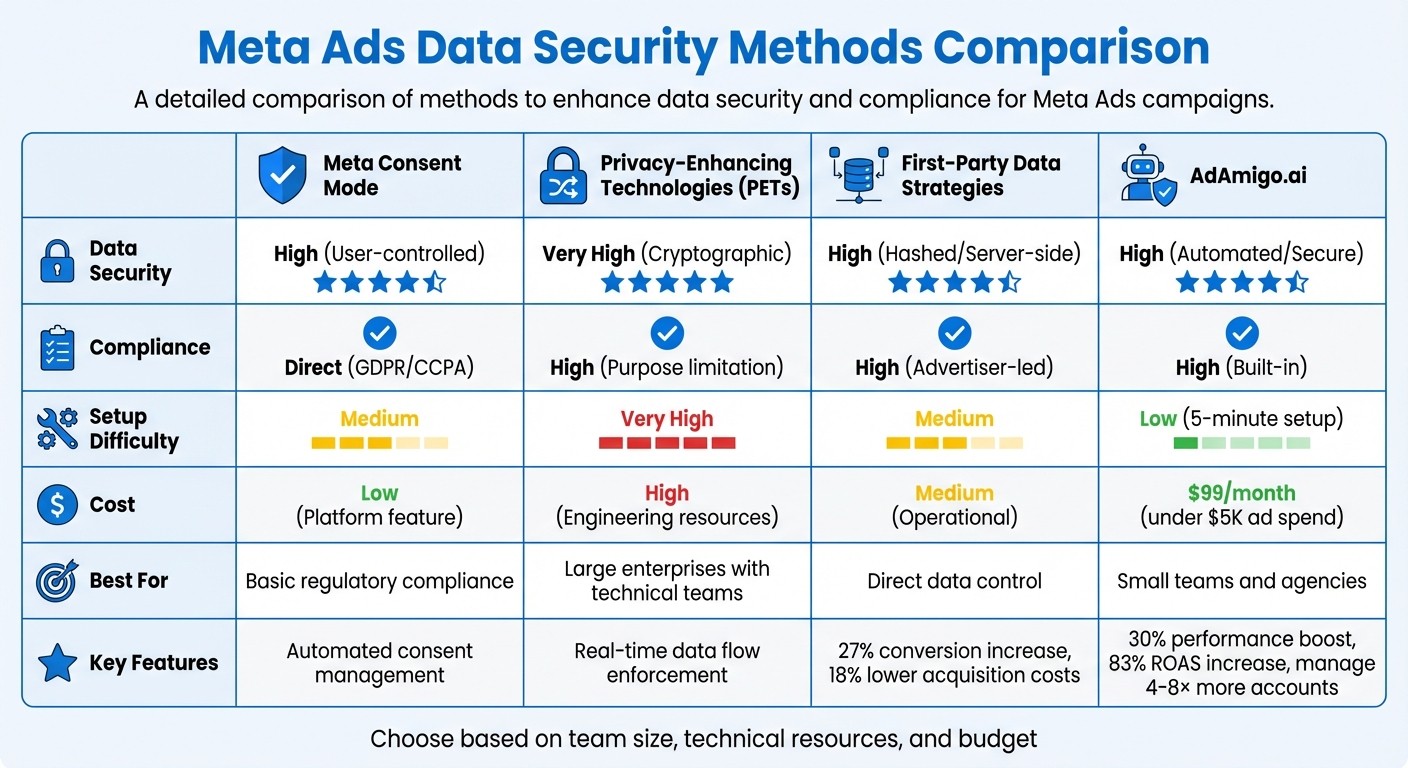
Comparison of Meta Ads Data Security Methods: Features, Costs, and Implementation
Every method for managing data privacy in advertising comes with its own set of pros and cons. Meta Consent Mode stands out for its ability to meet regulatory requirements at a low cost. However, it falls short in providing advanced cryptographic security. On the other hand, Privacy-Enhancing Technologies (PETs) offer robust cryptographic protection, making them a strong choice for technical security. The downside? They demand extensive engineering resources, which can be a hurdle for smaller advertisers.
First-Party Data Strategies, powered by the Conversions API, provide a middle ground. These strategies bypass browser cookie restrictions and allow advertisers to standardize and manage server-side data. While this approach offers more control, it comes with its own challenges, such as requiring technical know-how and ongoing server maintenance. For brands without dedicated developers, the operational costs can add up quickly.
Then there’s AdAmigo.ai, which simplifies the process significantly. For $99 per month (for accounts spending under $5,000), it automates Meta API integrations and ensures event deduplication to stay privacy compliant. With just a five-minute setup, it allows advertisers to focus on strategy rather than the technical grind. AdAmigo.ai provides an efficient, automated solution that eliminates the need to replicate Meta’s extensive infrastructure.
Here’s a quick comparison of the methods based on key factors like data security, compliance, ease of setup, and cost:
Method | Data Security | Compliance | Setup Difficulty | Cost |
|---|---|---|---|---|
Meta Consent Mode | High (User-controlled) | Direct (GDPR/CCPA) | Medium | Low (Platform feature) |
Privacy-Enhancing Technologies | Very High (Cryptographic) | High (Purpose limitation) | Very High | High (Engineering resources) |
First-Party Data Strategies | High (Hashed/Server-side) | High (Advertiser-led) | Medium | Medium (Operational) |
AdAmigo.ai | High (Automated/Secure) | High (Built-in) | Low | Flat-rate subscription ($99/mo) |
Ultimately, the choice depends on your team’s technical abilities and operational needs. Large organizations with dedicated engineering resources might lean toward PETs for the highest level of security. Meanwhile, smaller advertisers or agencies can benefit from tools like AdAmigo.ai, which streamline operations and help a single media buyer manage 4–8× more accounts with ease.
Conclusion
Protecting audience data across Meta platforms isn't a one-size-fits-all challenge. The best approach depends on your technical capabilities, budget, and compliance requirements. Thankfully, advertisers can meet these needs without building complex infrastructure from scratch.
Different organizations require tailored solutions. Large enterprises with dedicated engineering teams can leverage Privacy-Enhancing Technologies for top-tier cryptographic security. On the other hand, smaller advertisers and agencies often benefit more from combining Meta Consent Mode for regulatory compliance with First-Party Data Strategies powered by the Conversions API. This approach ensures reliable server-side tracking with encryption standards like AES256 for data at rest and TLS 1.2 (or higher) for data in transit.
For teams without significant technical resources, tools like AdAmigo.ai offer a practical solution. For $99 per month (for accounts spending under $5,000), it simplifies Meta API integrations, handles event deduplication, and ensures privacy compliance. This automation allows a single media buyer to manage 4–8× more accounts without needing extra hires.
To achieve the best results, consider combining these strategies: use Meta Consent Mode to meet global privacy rules, implement server-side tracking via the Conversions API for stronger signal quality, and rely on automation tools like AdAmigo.ai to save time and resources. Together, these methods provide robust data security, regulatory compliance, and operational efficiency - no engineering team required.
FAQs
How does Meta Consent Mode help businesses comply with privacy laws?
Meta Consent Mode is designed to help businesses navigate privacy laws by adjusting how Meta's tracking tools, like the Meta Pixel and Conversions API, handle data collection based on user consent. When users opt out or don't give consent, these tools automatically limit data collection to what’s legally permissible, ensuring compliance with privacy regulations.
This feature aligns with laws such as GDPR and CCPA, giving users greater control over their data while still enabling businesses to run effective ad campaigns. To achieve this balance, Meta incorporates privacy-first technologies like Aggregated Event Measurement, which allows businesses to measure ad performance without compromising individual privacy. By dynamically responding to user preferences, Meta Consent Mode ensures businesses can stay legally compliant while maintaining advertising effectiveness.
How can AdAmigo.ai benefit small advertisers managing Meta ad campaigns?
AdAmigo.ai is designed to help small advertisers simplify their Meta ad campaigns by automating essential tasks like creating ad content, selecting target audiences, managing bids, and setting budgets. Its AI learns from actual campaign results, fine-tuning strategies and boosting performance much faster than traditional, manual approaches.
With tools like bulk ad launching and daily AI-powered suggestions, advertisers can save valuable time, make the most of their ad budgets, and respond quickly to changing market trends - all while keeping their focus on growing their business. On top of that, AdAmigo.ai eliminates the need for costly hires by serving as a round-the-clock AI media buyer, customized to meet your specific goals.
Why should businesses consider using Privacy-Enhancing Technologies (PETs)?
Businesses should look into Privacy-Enhancing Technologies (PETs) as a way to safeguard user data while staying compliant with privacy regulations like GDPR, the EU AI Act, and various U.S. state privacy laws. PETs work by limiting data sharing, encrypting or anonymizing sensitive information, and managing access. These measures help build user trust and reduce the risk of legal issues.
Using PETs also aligns with Meta’s privacy standards, which include strict data security practices and purpose limitation policies to ensure responsible data use. Beyond preventing data breaches, PETs allow businesses to extract meaningful insights for privacy-focused advertising. They provide a practical solution for balancing user privacy with advertising effectiveness in today’s digital world.