
Top 5 Risks in Cross-Border Data Transfers
Top five legal and technical risks of moving ad data across borders — missing safeguards, government access, compliance gaps, transparency issues, and localization.
Running ads on platforms like Meta in regions such as the EU, UK, or Brazil involves transferring personal data to U.S. servers. This process, called cross-border data transfer, comes with legal and operational risks due to conflicting privacy laws. The €1.2 billion fine against Meta in 2023 highlights the stakes. If your data transfers aren’t compliant, your business could face fines, halted campaigns, or frozen budgets. Here are the five main risks:
Missing Legal Mechanisms: Transfers without valid safeguards like SCCs or the EU-US Data Privacy Framework can lead to non-compliance.
Government Access Risks: U.S. surveillance laws (e.g., FISA 702) clash with GDPR, exposing data to potential government access.
Compliance Failures: Skipping mandatory assessments like Transfer Risk Assessments (TRAs) increases enforcement risks.
Transparency Issues: Failing to inform users about where their data goes or relying solely on consent can lead to legal challenges.
Data Localization Laws: Rules requiring data to stay within borders disrupt operations for platforms with centralized infrastructure.
Quick Comparison of Legal Mechanisms
Mechanism | Ease of Use | Protection Level | Best For |
|---|---|---|---|
Adequacy Decision | Easy | High | Seamless transfers to certified countries |
Standard Contractual Clauses (SCCs) | Moderate | Medium | Flexible for vendor relationships |
Binding Corporate Rules (BCRs) | Difficult | High | Internal transfers within large companies |
To stay compliant, map your data flows, conduct TRAs, and implement encryption or pseudonymization. Regularly update practices to align with evolving laws and avoid penalties.
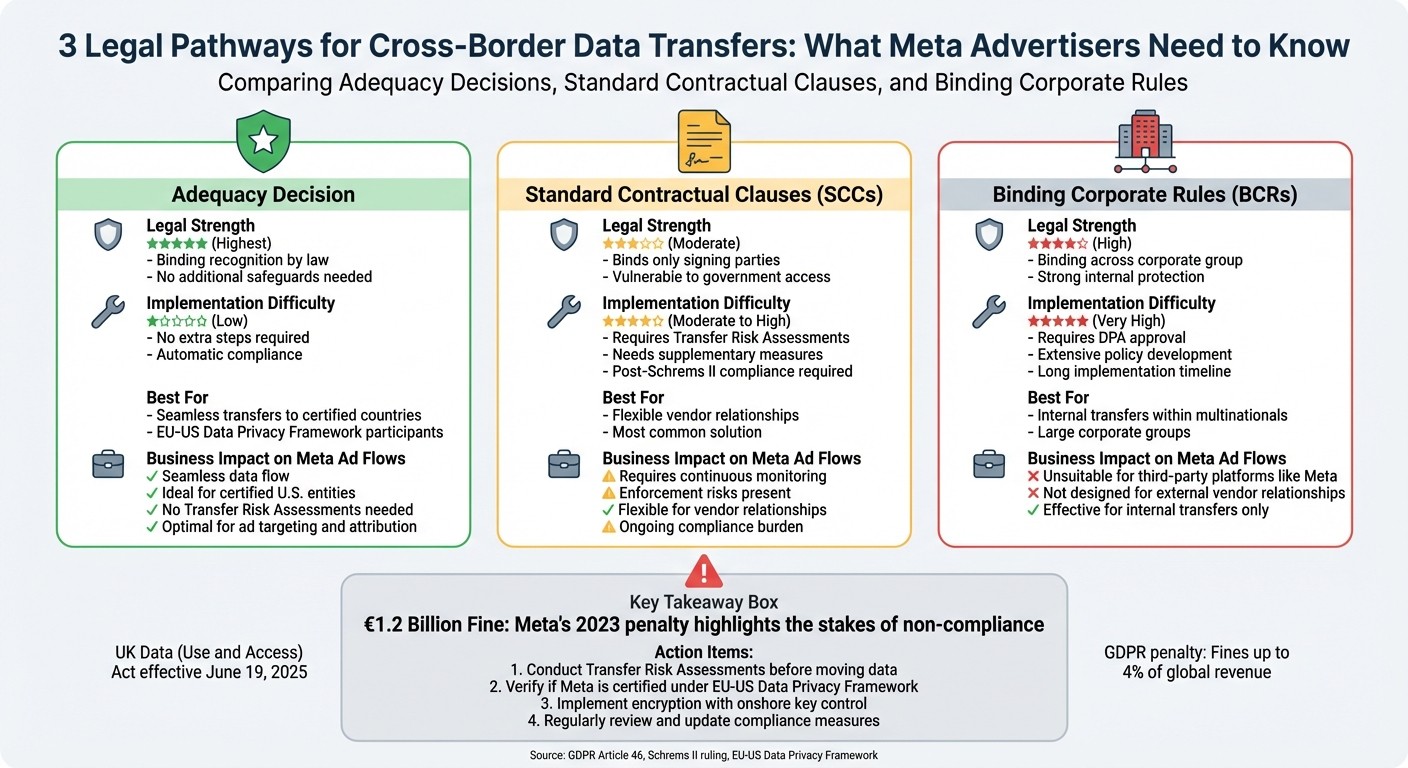
Cross-Border Data Transfer Legal Mechanisms Comparison for Meta Advertisers
1. Missing Legal Transfer Mechanisms
Risk to Meta ad operations

If you're running Meta ads targeting audiences in the EU, UK, or Brazil, there's a critical issue you need to address: every pixel fire, conversion, and audience sync transfers personal data to Meta's servers in the U.S. Without a proper legal mechanism in place, you could be at risk of non-compliance. This concern has grown since the Schrems II ruling in 2020, which invalidated the EU–US Privacy Shield. Businesses have since leaned on Standard Contractual Clauses (SCCs) or the newer EU–US Data Privacy Framework. But here's the catch - SCCs alone might not be enough if U.S. surveillance laws can still access the transferred data.
Impact of regulatory frameworks (e.g., GDPR, Schrems II)
Under GDPR Article 46, businesses are required to implement safeguards such as SCCs, the UK's International Data Transfer Agreement (IDTA), or Binding Corporate Rules (BCRs). Additionally, a Transfer Risk Assessment (TRA) is essential to evaluate whether U.S. laws could compromise these safeguards. If your TRA identifies gaps in protection and technical measures can't resolve the risks, the transfer must stop.
"Contractual and organizational measures alone will generally not overcome access to personal data by public authorities of the third country." - European Data Protection Board
This regulatory landscape doesn’t just pose legal risks - it also has the potential to disrupt your business operations significantly.
Business disruption potential
Meta's €1.2 billion fine in May 2023 serves as a stark warning about the consequences of non-compliance. For advertisers, failing to establish a valid legal transfer mechanism could lead to campaign halts, frozen budgets, and lost revenue. The process of restructuring data flows or shifting to compliant systems can be both time-consuming and costly.
Mitigation strategies
To navigate these challenges, customize your privacy policies and take proactive steps to meet global privacy rules and secure your data transfers. Start by mapping out every data flow - track where Meta pixels, SDKs, and the Conversions API send data, including any sub-processor transfers. For transfers to the U.S., check if Meta is certified under the UK Extension to the EU–US Data Privacy Framework (also known as the "Data Bridge"). This certification can simplify compliance without requiring additional Article 46 mechanisms.
If Meta isn’t certified, consider implementing advanced encryption with onshore key control and pseudonymization to limit unauthorized access by government entities. Update contracts to use the 2021 EU SCCs or the UK IDTA before older versions expire. Lastly, regularly revisit your TRA as U.S. privacy laws continue to evolve. By staying ahead of these regulations, you can reduce risks and maintain smooth ad operations.
2. Government Access and Weak Technical Protections
Risk to Meta Ad Operations
When you use Meta's advertising platform to transfer user data, you risk exposure to U.S. surveillance laws that clash with GDPR requirements. Section 702 of the U.S. Foreign Intelligence Surveillance Act (FISA) and Executive Order 12,333 allow U.S. government agencies to access personal data without the protections required under European law. This means that advertisers relying on Meta could face risks, as U.S. authorities can access unencrypted data that Meta processes for campaign operations.
Impact of Regulatory Frameworks (e.g., GDPR, Schrems II)
These technical vulnerabilities become even more problematic under strict regulations. The Schrems II decision specifically targeted Facebook Ireland (now Meta), invalidating the EU–US Privacy Shield due to insufficient safeguards against U.S. government data access and the lack of legal remedies for non-U.S. individuals. GDPR rules are clear: if the laws of a destination country weaken your Standard Contractual Clauses, you must either implement "supplementary measures" or completely stop data transfers. The European Data Protection Board emphasized this point:
"Contractual and organizational measures alone will generally not overcome access to personal data by public authorities of the third country." - European Data Protection Board
Non-compliance risks extend beyond Europe. For example, under China's PIPL, companies can face fines as high as 5% of their annual revenue.
Business Disruption Potential
For advertisers using Meta's platform, regulatory orders to halt data transfers can cause immediate disruptions. Campaigns may be paused, budgets frozen, and access to conversion data cut off. Violations of GDPR in the EU or UK can result in fines of up to 4% of global annual revenue.
Mitigation Strategies
To address these risks, implement strong technical safeguards. Start by using encryption where only you control the keys, ensuring they remain within the EEA or an "adequate" jurisdiction. This prevents Meta or U.S. authorities from accessing unencrypted data. Pseudonymization is another effective approach - retain exclusive control of mapping keys in a secure jurisdiction.
You might also consider "warrant canaries." These involve requiring your data processors to publish cryptographically signed updates confirming they haven't received government disclosure orders. If updates stop, you can immediately suspend data transfers. Additionally, conduct mandatory Transfer Impact Assessments (TIAs) for all data flows. These assessments should document the legal environment of the destination country and outline the technical safeguards you’ve put in place.
3. Compliance Failures and Enforcement Risk
Risk to Meta Ad Operations
A significant number of Meta advertisers overlook the critical task of thoroughly mapping their data flows. This includes hidden transfers that occur through sub-processors and remote teams. Many also skip the required Transfer Impact Assessments (TIAs), leaving their operations exposed to compliance gaps . These lapses - along with missing legal frameworks and inadequate technical safeguards - heighten the risks involved in cross-border data transfers. Such oversights not only weaken compliance efforts and scaling personalization without privacy risks becomes harder, drawing the attention of regulators, increasing the likelihood of enforcement actions.
Impact of Regulatory Frameworks (e.g., GDPR and Schrems II)
In May 2023, Meta faced a staggering €1.2 billion fine from the Irish Data Protection Commission. The penalty stemmed from transferring EU user data to the U.S. using Standard Contractual Clauses (SCCs) that failed to adequately protect against government surveillance. Similarly, under China's Personal Information Protection Law, violations can lead to fines as high as RMB 50 million or 5% of annual revenue.
Business Disruption Potential
The consequences of non-compliance extend beyond financial penalties. Under GDPR, fines can reach up to 4% of global annual turnover. Enforcement actions can also disrupt operations by freezing ad campaigns, halting tracking mechanisms, complicating Meta ads structuring, and severely impacting ad performance trends.
"Failure to comply with data protection laws can attract corrective measures, including orders to cease transfers of personal data and significant financial penalties." - Nicola McCrudden, Of Counsel, Ogletree Deakins
Mitigation Strategies
To address these compliance challenges, start by documenting every data transfer, including onward flows and any third-party remote access . Conduct a Transfer Impact Assessment for each data transfer to countries that lack adequate data protection standards. For organizations in the UK, tools provided by the ICO can simplify this process. Additionally, the Department for Science, Innovation and Technology offers analyses that help streamline assessments for U.S. data transfers .
Don't rely solely on contractual measures to safeguard data. Strengthen your defenses with technical solutions, such as encryption where only you control the keys within the EEA or another jurisdiction deemed adequate. Pseudonymization techniques can also be effective, provided re-identification keys remain secure . Lastly, make it a priority to regularly review and reassess your data transfer practices. Compliance is an ongoing responsibility, and what works today may not meet future requirements.
4. Poor Transparency and Consent Practices
Risk to Meta Ad Operations
Under GDPR, advertisers are required to clearly inform users about where their data is being sent and who has access to it. Without this transparency, data transfers become legally vulnerable. According to GDPR Article 49, user consent should only be relied upon as a last resort. A lack of clarity in this area significantly increases the legal risks, which are further explored in later sections.
Impact of Regulatory Frameworks (e.g., GDPR, LGPD, Schrems II)
Regulatory bodies have raised concerns about insufficient transparency in laws like FISA 702 in the U.S., which fail to adequately disclose government access to data. Even with user consent, you must ensure that the destination country’s laws do not undermine data protection standards. This often requires conducting a thorough Transfer Risk Assessment. For example, in 2022, a Singapore-based online marketplace faced a breach that affected 324,000 users in Hong Kong. Despite centralizing its data in Singapore, the Hong Kong Privacy Commissioner held the local entity accountable for failing to meet transparency requirements under the Personal Data (Privacy) Ordinance. The company was issued an enforcement notice to implement corrective actions.
"The question is not so much whether the law of the recipient's country is 'essentially equivalent' to the standard in the GDPR, but whether that law prevents the relevant transfer tool selected... from being effective." - Orrick
Business Disruption Potential
Failing to address transparency issues can result in risks of non-compliant data collection. For instance, Meta faced a €1.2 billion fine for unlawful data transfers. Similarly, in 2023, Singapore’s Personal Data Protection Commission fined a company S$58,000 for failing to safeguard user data in a cross-border breach. Beyond fines, regulators can impose severe corrective measures, such as immediate orders to halt data transfers to specific jurisdictions. These actions can abruptly disrupt ad campaigns and undermine tracking systems tied to those data flows.
Mitigation Strategies
To address these challenges, ensure that users are properly informed about data transfers. Use contractual clauses to require data importers to disclose structured details - such as via questionnaires - about local laws that allow government access. Maintain clear documentation, publish transparency reports, and secure fresh consent if data usage changes. Keep in mind, relying solely on consent is not enough if the destination country’s laws weaken data protection. You’ll need strong technical safeguards and consistent risk assessments to minimize exposure.
5. Data Localization Requirements and Operational Disruption
Risk to Meta Ad Operations
Data localization laws dictate that personal data must remain within the borders of the country where it was collected. This creates a direct conflict with Meta's centralized infrastructure, which often involves transferring user data to U.S.-based servers for processing. Many countries now ban the transfer of personal data abroad, making compliance a challenge for cloud-based ad operations, especially when data is unencrypted. Without robust technical measures to prevent unauthorized access, adhering to these regulations becomes even more complex. This is where AI detects privacy threats in real time to maintain compliance. This tension between centralized processing and local data requirements poses serious operational hurdles.
Impact of Regulatory Frameworks (e.g., GDPR, LGPD, Schrems II)
The European Data Protection Board has made it clear: for companies subject to U.S. surveillance laws like FISA 702, data transfers can only comply with GDPR if technical safeguards effectively block government access. In May 2023, Meta faced a €1.2 billion fine from the Irish Data Protection Commission for breaching GDPR Article 46, with a six-month deadline to cease unlawful data transfers.
"Contractual and organizational measures alone will generally not overcome access to personal data by public authorities of the third country." - European Data Protection Board
Business Disruption Potential
Localization laws often leave businesses with two stark choices: overhaul their entire data infrastructure or pull out of certain markets. Even remote access to data, such as for IT support or centralized campaign management, can qualify as a transfer under GDPR, triggering compliance obligations. These requirements can lead to enforcement actions, interrupted ad campaigns, and steep operational costs.
Mitigation Strategies
Tackling localization challenges requires a mix of technical and legal solutions. Start with data mapping to pinpoint where your Meta ad data is stored and processed. Conduct Transfer Risk Assessments to evaluate whether the destination country's laws compromise data protections. Use privacy-enhancing technologies like end-to-end encryption and "Bring Your Own Key" (BYOK) systems, which ensure encryption keys remain within the country of origin. Minimize data transfers by only moving what’s absolutely necessary, and when possible, keep sensitive data within its country of origin. For UK-to-US data transfers, certified organizations can take advantage of the UK Extension to the EU–US Data Privacy Framework to simplify compliance.
Privacy Made Easy Series : Cross Border Transfer
This video explores how businesses can navigate these complexities, similar to how Meta ads consent mechanisms help manage regional compliance.
Comparison Table
When transferring Meta ad data across borders, there are three primary legal pathways: adequacy decisions, Standard Contractual Clauses (SCCs), and Binding Corporate Rules (BCRs). Each option comes with its own level of legal protection, complexity, and impact on operations.
Adequacy decisions are the most straightforward option. When a regulatory authority - like the European Commission or the UK government - deems a country "adequate", data can move as easily as it would domestically. No additional documentation or Transfer Risk Assessments are needed. For Meta advertisers, the EU‑US Data Privacy Framework simplifies transfers to U.S. entities that have obtained certification.
Standard Contractual Clauses (SCCs) are the go-to solution for most organizations. These agreements require the parties involved to adhere to specific data protection obligations but don't shield against third-party government access. Since the Schrems II ruling, businesses must conduct a Transfer Risk Assessment to evaluate whether the destination country's laws compromise the safeguards outlined in the contract.
Binding Corporate Rules (BCRs), on the other hand, are not ideal for platforms like Meta that operate with third-party relationships. While they provide strong legal protection, they demand approval from Data Protection Authorities (DPAs) and require extensive policy work. BCRs are more suited for internal transfers within large multinational corporations.
Choosing the right legal mechanism is crucial to avoid compliance issues and operational challenges. Here's a summary of the key differences:
Mechanism | Legal Strength | Implementation Difficulty | Business Impact on Meta Ad Flows |
|---|---|---|---|
Adequacy Decision | Highest; binding recognition by law | Low; no extra steps required | Seamless data flow for ad targeting and attribution; ideal for certified U.S. entities |
Standard Contractual Clauses (SCCs) | Moderate; binds only the signing parties | Moderate to high; requires Transfer Risk Assessments and supplementary measures | Flexible for vendor relationships; enforcement risks and requires continuous monitoring |
Binding Corporate Rules (BCRs) | High; binding across the corporate group | Very high; requires DPA approval and extensive policy development | Effective for internal transfers within multinationals; unsuitable for third-party platforms like Meta |
Conclusion
Meta advertisers are navigating increasingly complex challenges when it comes to cross-border data transfers. With the UK’s Data (Use and Access) Act set to take effect on June 19, 2025, and regulators already imposing record-breaking penalties - like the €1.2 billion fine issued in 2023 - businesses must prioritize conducting Transfer Risk Assessments before moving data beyond approved jurisdictions. And these assessments aren’t a one-and-done deal; they need to be revisited regularly to keep pace with evolving laws and technological changes. Now is the time to reevaluate your transfer mechanisms.
The stakes are high. Under EU and UK GDPR, fines can hit up to 4% of global revenue, while China’s PIPL allows penalties of RMB 50 million or 5% of the prior year’s revenue. Beyond the financial blow, regulators can even halt data transfers altogether, potentially derailing campaigns and damaging customer trust across markets.
To reduce these risks, automation provides a practical lifeline. Privacy automation, in particular, offers a way forward. AdAmigo.ai, a certified Meta Business Technology Partner, equips advertisers with secure, private integrations that analyze campaign performance without exposing sensitive data. Its AI Actions feature delivers daily, tailored optimizations - whether it’s adjusting budgets or refining creatives - all while maintaining full traceability and auditability.
Another critical layer of protection comes from addressing internal risks. Research shows that 80% of organizations have faced risky behaviors from AI agents, including improper data handling. By centralizing ad operations on a Meta-certified platform that enforces geo, budget, and placement rules, businesses can significantly reduce manual data handling and the likelihood of accidental breaches.
Take the time to review your data flows, implement strong encryption protocols, and follow a GDPR and CCPA checklist to adopt compliant transfer mechanisms. By integrating automation into your processes, you can stay ahead of compliance demands and avoid the steep penalties looming as 2025 approaches.
FAQs
What legal measures ensure compliance when transferring data across borders?
To follow data protection laws like the EU GDPR or UK GDPR, businesses need to use officially recognized measures to ensure data protection standards are upheld in the destination country. Here are the main options:
Adequacy decisions: These confirm that a country’s legal framework offers protections comparable to the GDPR, allowing data transfers without extra contracts.
Standard Contractual Clauses (SCCs): These are pre-approved legal agreements that establish GDPR-level protections between data exporters and importers.
Binding Corporate Rules (BCRs): Internal policies, approved by regulators, that allow secure data sharing within multinational companies.
International Data Transfer Agreements (IDTAs): Contracts specific to the UK for transferring data to countries without an adequacy decision.
On top of these measures, businesses are required to perform Transfer Risk Assessments (TRAs). This process evaluates whether the selected safeguard sufficiently protects data, particularly in countries with different laws on government access or surveillance. These steps help ensure compliance and safeguard individuals’ rights during international data transfers.
How do U.S. surveillance laws impact GDPR compliance for cross-border data transfers?
U.S. surveillance laws, such as the Foreign Intelligence Surveillance Act (FISA) and the CLOUD Act, grant government agencies the authority to access personal data stored or processed within the United States for national security or law enforcement purposes. This creates a direct conflict with the General Data Protection Regulation (GDPR), which mandates that any transferred data must uphold protection standards equivalent to those in the European Union. The European Court of Justice’s Schrems II decision brought this issue to the forefront by invalidating the EU-U.S. Privacy Shield, forcing businesses to evaluate whether U.S. laws could jeopardize data protection rights.
To navigate this complex landscape, businesses are required to perform a Transfer Risk Assessment (TRA). This involves identifying how U.S. surveillance laws might impact data privacy and implementing measures to mitigate risks. Common steps include:
Documenting potential risks.
Applying encryption or pseudonymization techniques.
Limiting the scope of data transfers.
Keeping track of legal and regulatory updates.
For advertisers managing sensitive data, such as Meta ads information, tools like AdAmigo.ai can be a game-changer. These platforms streamline compliance by automating risk assessments, flagging potential vulnerabilities, and ensuring necessary safeguards are in place. This means you can prioritize your advertising strategies while staying aligned with GDPR requirements.
How can businesses minimize risks from data localization laws when transferring data across borders?
To navigate the challenges posed by data localization laws, businesses should implement a combination of legal, technical, and operational measures. Start by leveraging established transfer mechanisms such as Standard Contractual Clauses, Binding Corporate Rules, or Transfer Impact Assessments to align with the legal requirements of the destination country. On the technical side, encrypt sensitive data both during storage and transit, enforce strict access controls, and track activity logs to guard against unauthorized access.
From an operational perspective, map out your data flows and keep an inventory of third-party vendors to maintain a clear understanding of where your data is stored and how it's being transferred. In regions that mandate local storage, you might explore options like regional data centers or hybrid-cloud setups. These solutions allow raw data to remain onshore while enabling analytics through anonymized datasets. Staying up-to-date with changing regulations, such as the EU-US Data Privacy Framework, and seeking advice from legal professionals can help ensure compliance while maintaining the smooth operation of global Meta ad campaigns.