
Manus AI vs AdAmigo for Ecommerce: Creative Testing, Budget Scaling, and Iteration Speed
Compare analytics-focused Manus AI with AdAmigo’s end-to-end ad creation, automated testing, and budget scaling to find the best fit for ecommerce growth.
Looking to grow your ecommerce business through Meta ads? Deciding between Manus AI and AdAmigo can make or break your strategy. Here’s the deal:
Manus AI specializes in analyzing performance data and delivering insights, but it doesn’t handle campaign execution.
AdAmigo manages everything from ad creation to scaling, automating tasks like launching ads, reallocating budgets with a planner, and testing variations.
If you want a tool for data analysis and reporting, Manus AI is a solid choice. But if your priority is speeding up ad testing and scaling budgets effectively, and reducing manual work, AdAmigo offers a complete solution.
Quick Comparison
Feature | Manus AI | AdAmigo |
|---|---|---|
Primary Function | Analytics and insights | Full ad management and scaling |
Ad Creation | No | Yes (AI-generated designs) |
No | Yes (100+ ads at once) | |
Budget Scaling | Insights only | Automated with safeguards |
Testing Speed | Limited by manual effort | |
Optimization Metrics | CRM, LTV, MER, contribution margin |
AdAmigo is ideal for teams looking to run more tests, scale faster, and simplify ad management, while Manus AI is better suited for in-depth analysis and reporting. Choose based on your business needs and growth goals.
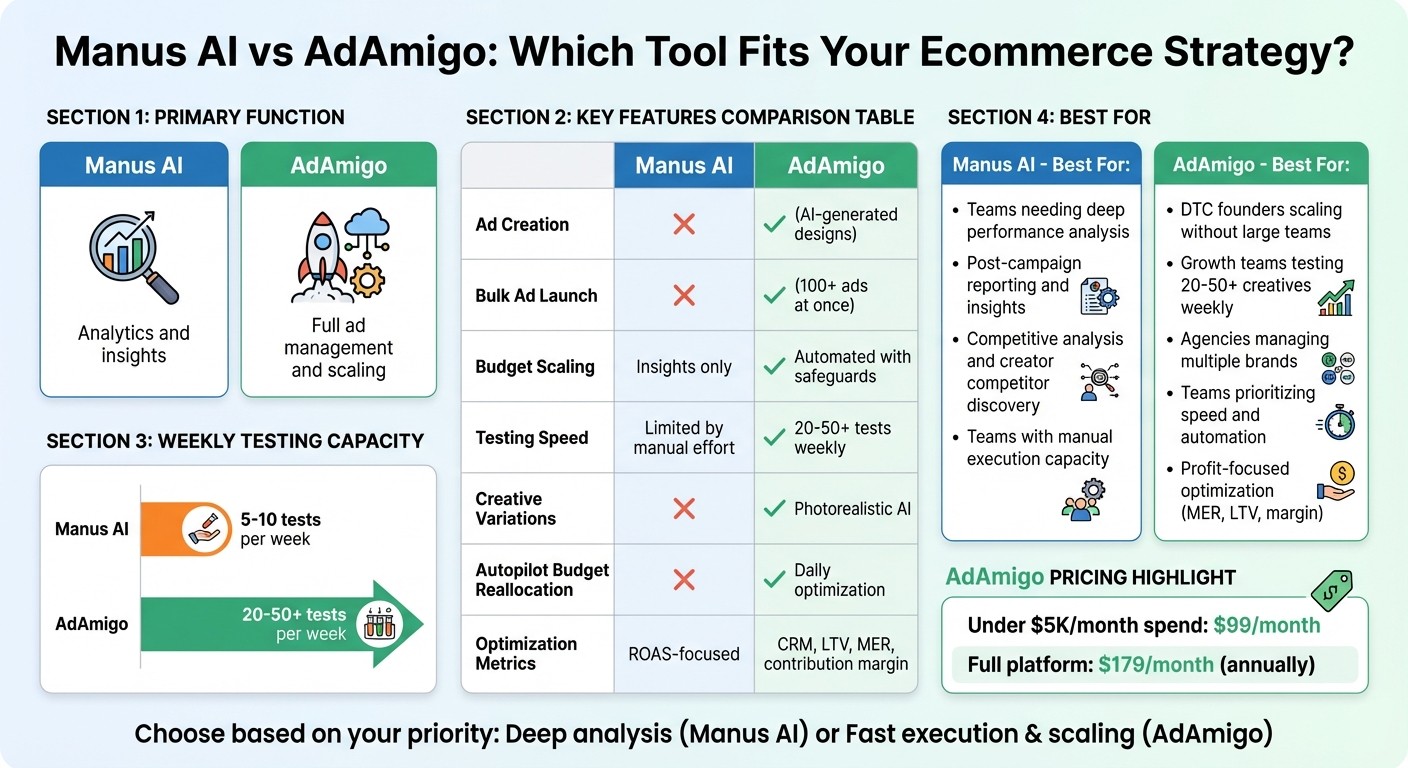
Manus AI vs AdAmigo Feature Comparison for Ecommerce Meta Ads
How Ecommerce Brands Scale on Meta

The 6-Step Ecommerce Growth Loop
Scaling on Meta requires a system that consistently produces winning ad creatives. This process operates as a six-step growth loop:
Create: Develop ad variations like UGC clips, product demos, and lifestyle videos.
Launch: Test these ads with structured budgets.
Learn: Identify which creative angles perform best.
Optimize: Shift budgets toward the top-performing ads.
Scale: Increase spending on ads that consistently deliver results by scaling Meta ads horizontally.
Protect: Monitor performance closely to catch and address any declines early.
This loop runs on a weekly cycle, and the brands that execute it most efficiently tend to come out ahead. The tools you use - such as Manus AI or AdAmigo - play a big role in how smoothly you can run this process.
Why Creative Volume Limits Growth
Many ecommerce teams think their growth is held back by targeting issues, but the real challenge lies in producing enough creative content. Since the iOS 14.5 update, 96% of iPhone users opted out of sharing their IDFA, which made precise targeting far less effective. The real bottleneck is how many new ad creatives you can test each week.
Here’s why: even the best-performing ads lose effectiveness quickly, often within five to seven days, as audiences experience creative fatigue. After just four exposures, the likelihood of converting drops by 45%. Brands that scale successfully are the ones testing 3–5 new ad variations every week, not those stuck fine-tuning interest-based targeting.
A great example of this is a men's supplement brand that, in 2026, implemented a "3-2-2" funnel structure - 3 cold ad sets, 2 retargeting sets, and 2 post-purchase engagement sets. By focusing on creative testing instead of tweaking their targeting, they slashed their customer acquisition cost from $38 to $21. Their success came from speeding up the testing of new hooks and angles, making creative iteration speed a game-changer for brands looking to scale.
Measuring Iteration Speed
Iteration speed measures how many new ad creatives you test weekly. This includes experimenting with new hooks, angles, formats, or offers that could improve performance. Top-performing DTC brands call this "creative velocity", which is tracked as the number of new creatives launched per $10,000 in weekly ad spend.
Here’s what the numbers look like: maintaining a velocity of at least 1.0 is essential - dropping below 0.8 often leads to higher customer acquisition costs (CAC) within two to three weeks. The best-performing brands hit a velocity above 3.0, allowing them to scale their ad spend without seeing a spike in CAC.
For video ads, delivering a value-driven message within the first three seconds can boost click-through rates by 32%. But these results only come when you’re testing enough variations to find the winning combinations. Tracking these metrics is crucial when selecting tools that can speed up your creative testing and help you scale effectively.
What Manus AI Does Well
Analytics and Reporting Features
Manus AI shines when it comes to providing post-campaign insights for ecommerce teams. Its competitive analysis tools allow you to dig into competitor content to understand what drives performance, while its creator discovery feature helps identify influencers who align with your brand and audience.
One standout tool is the AI Slides feature, which transforms campaign data into presentation-ready decks automatically, saving teams a ton of time on reporting. The platform also integrates seamlessly with Slack and email through its Mail Manus feature. Plus, as part of the Meta ecosystem, it benefits from direct access to Meta's platform tools.
For pre-campaign efforts, Manus AI offers AI-powered research tools that gather market insights and identify performance trends before you launch. The browser operator tool further simplifies pulling data from web-based advertising platforms. In addition to analytics, the platform provides tools like an AI tools that generate ad creatives like an Instagram Ads generator and product image refinement features to ensure your creatives are polished and ready to perform.
However, while these analytics and reporting features are robust, the platform doesn’t extend its capabilities into campaign execution, which reveals its limitations. Many ecommerce teams look for AI tools for Meta Ads that bridge the gap between analysis and execution.
What Manus AI Doesn't Handle
Despite its strengths in analytics and reporting, Manus AI stops short of managing live campaign execution. It focuses solely on analysis and reporting, leaving out key execution features such as bulk creative testing, automated budget scaling, or profit-based optimization.
Another limitation is its "closed-box" approach. Without a public SDK, the platform doesn’t integrate well with more complex ecommerce tech stacks. This setup also makes it unsuitable for high-frequency auctions that require instant micro-adjustments - something critical for maintaining a competitive edge.
Ecommerce teams relying on Manus AI will still need a separate platform to handle tasks like scaling and optimizing Meta ad spend. This gap in execution capabilities can be a significant drawback in fast-paced advertising environments.
"Manus AI is built to support developers and tech-savvy folks who want to get more done with less manual work... but the tool limits design control, versioning, and workflow customization." - Future AGI
What AdAmigo Does for Ecommerce
6 Core Features and Their Ecommerce Benefits
AdAmigo is an all-in-one platform designed to fuel ecommerce growth, handling everything from ad creation to budget scaling based on actual business results. Its AI Ads Agent crafts photorealistic ad designs, while the Bulk Launcher deploys them at scale, compressing weeks of work into just hours.
Once campaigns are live, Autopilot takes over, reallocating budgets from underperforming ads to top performers. This ensures a steady testing rhythm while scaling budgets in 10-20% increments every few days - keeping Meta's learning phase intact. Automated kill switches are in place to pause creatives that exceed 3x your target CPA without delivering conversions. The Chat Agent streamlines operations by enabling bulk changes, performance reporting, and new campaign launches through conversational commands, cutting down on manual effort.
Unlike tools that focus solely on ROAS, AdAmigo uses CRM and attribution data to optimize for broader metrics like MER (blended ROAS), contribution margin, and customer lifetime value (LTV). Its anomaly detection system provides around-the-clock monitoring, quickly identifying performance drops - even during off-hours - so revenue remains protected. Together, these features enable faster testing, safer scaling, and consistent revenue growth for ecommerce brands.
Feature | Ecommerce Benefit |
|---|---|
AI Ads Agent | Creates photorealistic designs → more ad variants → higher chances of success |
Bulk Launcher | Scales testing quickly → accelerates learning |
Autopilot | Automatically reallocates budgets → minimizes waste while maintaining consistency |
Chat Agent | Speeds up execution → increases operational efficiency |
CRM Optimization | Aligns with profitability metrics, not just ROAS |
Anomaly Detection | Provides early warnings → protects revenue during off-hours |
Each feature works together to speed up creative testing and optimize budget management, making it easier for ecommerce brands to achieve real growth.
Why Ecommerce Teams Choose AdAmigo
Ecommerce teams are turning to AdAmigo for its ability to streamline execution and scale operations effectively. The platform allows businesses to increase their workload capacity without hiring additional staff. One media buyer can handle 4-8× more accounts, as the AI takes care of tasks like ad creation, campaign setup, and budget adjustments, leaving the team free to focus on strategy and decision-making.
For smaller teams managing multiple brands, AdAmigo's semi-autonomous mode simplifies daily operations with one-click AI Actions. This approach balances automation with user control, reducing manual labor while maintaining oversight. Pricing is designed to be accessible: brands spending less than $5,000/month can start at $99/month, while the full platform - offering unlimited AI Actions, bulk launching, and Slack integration - costs $179/month annually. This price point is far lower than the cost of hiring a dedicated media buyer or working with an agency.
Creative Testing: Manus AI vs AdAmigo
Feature Comparison Table
When it comes to execution, Manus AI and AdAmigo take very different approaches. Manus focuses solely on analysis, leaving tasks like ad creation, bulk launching, and budget management off the table. AdAmigo, on the other hand, offers a complete testing system - from generating photorealistic UGC ads to automating campaign launches and reallocating budgets based on performance.
Feature | Manus AI | AdAmigo |
|---|---|---|
Generate creative variations | No (analysis only) | Yes (photorealistic AI designs) |
No | Yes (hundreds of ads in one shot) | |
Enforce testing budgets | No | Yes (automated guardrails) |
Rotate spend to winners | No | Yes (Autopilot reallocates daily) |
Weekly testing capacity | Limited by manual work | 20-50+ tests per week |
The ability to test more creative concepts faster is a game-changer. As highlighted earlier, the speed of creative iteration directly affects how quickly you can identify winning ads. This is where AdAmigo shines - it allows you to run significantly more tests in a structured, efficient way compared to Manus.
How Many Tests Can You Run Per Week?
Testing capacity plays a huge role in determining how quickly you can refine and scale your ad campaigns. With Manus, you're limited to 5–10 tests per week, largely due to the manual effort required. For smaller accounts spending under $10,000 per month, this slower pace might suffice, as testing one concept at a time is often manageable at that scale, though manual vs AI budget testing can still impact your efficiency.
However, for growth-focused teams using AdAmigo, the story is entirely different. AdAmigo enables you to run 20–50+ tests weekly. Its AI Ads Agent can generate multiple variations for each concept, the Bulk Launcher deploys them in minutes, and its Autopilot feature ensures a smooth testing process by pausing underperforming ads and scaling winners automatically. For accounts spending between $10,000 and $25,000 per month, this streamlined system allows you to test 3-4 concepts simultaneously, speeding up the learning process and helping you find profitable strategies more quickly.
But it’s not just about running more tests - it’s about running them smartly. AdAmigo’s built-in guardrails keep spending under control by capping daily budget adjustments to 10-20% and pausing ads that exceed 3x your target CPA without conversions. This structured approach prevents chaos and ensures that your testing aligns with a growth-focused strategy. With AdAmigo, you’re not just testing more - you’re testing better, keeping your efforts aligned with the ecommerce growth loop: create, launch, learn, optimize, scale, and protect.
Budget Scaling: Manus AI vs AdAmigo
Scaling Rules and Guardrails
When increasing ad budgets on Meta, abrupt changes can disrupt the learning phase and hurt performance. Here’s where Manus and AdAmigo differ: Manus focuses on analyzing your campaign data and providing insights after the fact, while AdAmigo automates the scaling process with built-in safeguards designed to maintain stability.
AdAmigo's Autopilot enforces rules like daily budget change limits (typically capped at 10–20% increases), minimum data thresholds before scaling, and stop-loss protocols that automatically pause campaigns if performance dips below set benchmarks. One team, for example, managed to scale ad spend by 40% without adding staff, slashing manual audits from over 20 hours to nearly zero.
AdAmigo also employs anomaly detection, acting like a vigilant expert to catch early signs of trouble - whether it’s algorithm shifts, creative fatigue, or audience saturation. These triggers can send alerts or pause campaigns automatically, protecting revenue during scaling. Manus, on the other hand, focuses on post-campaign analysis and doesn’t handle real-time budget adjustments or enforce these types of guardrails.
These automated safeguards are essential for maintaining ad performance, but they also need to align with your business metrics to ensure scaling efforts remain profitable.
Tying Budget Scaling to Business Metrics
While guardrails protect ad performance, profitability depends on tracking metrics for ad set prioritization that reflect your overall business health. Relying solely on ROAS during scaling can be misleading. Instead, metrics like MER (blended ROAS across all channels), contribution margin (factoring in COGS and shipping), and customer LTV provide a clearer picture of sustainable growth.
AdAmigo leverages CRM and attribution data to ensure scaling decisions are grounded in the broader context of your business, not just the numbers reported by Meta's Ads Manager. This distinction is critical because Meta’s algorithm optimizes for visible conversions, often ignoring key factors like returning customers, high-margin items, or refund rates.
While Manus delivers useful post-campaign insights, it doesn’t offer the real-time adjustments that directly connect scaling actions to business outcomes. For ecommerce teams working within tight margins, this difference can make or break profitability.
Optimizing for Profit, Not Just ROAS
Why ROAS Alone Misleads Ecommerce Teams
ROAS (Return on Ad Spend) measures revenue generated for every dollar spent on advertising, but it overlooks critical costs that directly impact profitability. For example, a campaign boasting a 5x ROAS in Meta's Ads Manager might seem like a win, especially when compared against Meta Ads scaling ROAS benchmarks. But when you factor in costs like COGS (which often eat up 40–60% of revenue), shipping fees (10–20%), and refund rates (5–15%), that "win" could easily turn into a loss or just break even.
Focusing solely on ROAS can also lead to poor decision-making. Brands often inflate ROAS by offering steep discounts, which might drive sales but slash profit margins. And ROAS treats all conversions the same - whether it's a first-time buyer or a loyal customer —who can be reached through AI-powered retargeting— - ignoring the vastly different lifetime values (LTV) of these groups, which can be improved using AI tools for behavioral targeting. Tools like Manus AI, which don’t integrate profit metrics, fail to address these blind spots. This narrow focus on ROAS highlights the need for a broader, more profit-centered approach.
How AdAmigo Optimizes for Real Business Outcomes
AdAmigo takes a different path, prioritizing real-time profit optimization over vanity metrics like ROAS. Unlike Manus AI, which focuses on post-campaign analysis, AdAmigo integrates CRM and attribution data to optimize campaigns in real time. It uses meaningful metrics like MER (blended ROAS across all channels), contribution margin (revenue minus COGS and shipping), and customer LTV to guide decisions.
This shift ensures that campaigns are built for sustainable growth. Instead of chasing short-term wins, AdAmigo helps protect margins and drive actual profitability, making scaling decisions smarter and more effective.
How To Scale Meta Ads from $30k-$100K/Month with AI!
Which Tool Should You Choose?
Here's a quick guide to help you decide which tool aligns best with your team's needs based on their strengths and priorities.
Decision Guide by Team Type
Go with Manus AI if your team thrives in creative production and media buying but needs a tool for analysis of Meta ad performance. Manus is ideal for workflows that require support with reporting, analysis, and brainstorming next steps - especially if you have the capacity to manually handle campaign launches and optimizations.
Opt for AdAmigo if speed and efficiency are your primary challenges:
scaling budgets efficiently without constant manual intervention
Managing multiple ad accounts with a smaller team
AdAmigo is designed for DTC founders who need to act quickly without building a full media buying team, growth leads aiming to test 20-50+ new creatives weekly, and agencies managing multiple brands where one media buyer handles significantly more clients. If you're still manually launching ads from tools like Google Drive or spreadsheets, AdAmigo streamlines this process entirely.
Key Differences Summary
Here are the standout differences between the two tools:
Creative Testing Speed: Manus focuses on interpreting results, while AdAmigo automates creative generation, bulk-launch testing, and budget rotation.
Budget Scaling: Manus offers insights, whereas AdAmigo continuously scales winning campaigns with safeguards, avoiding resets in the learning phase.
Outcome Optimization: Manus tracks ROAS, while AdAmigo leverages real-time CRM data to optimize metrics like MER, margin, and LTV.
The distinction is clear: Manus acts as an analysis assistant, while AdAmigo serves as an execution platform with manual and autopilot modes. If your priority is speeding up creative tests and scaling profits seamlessly, AdAmigo provides a complete solution for ecommerce growth.
FAQs
What is creative testing velocity?
Creative testing velocity is all about how fast you can create, test, and launch new ad creatives within a set time frame. On Meta platforms, this speed plays a key role in staying ahead of the competition. Faster iterations mean you can learn what works more quickly and scale your campaigns more effectively.
How do you scale Meta budgets without resetting learning?
To increase Meta ad budgets without disrupting the learning phase, a gradual and methodical approach is key. Slowly raise budgets while implementing safeguards to maintain stability. AdAmigo recommends a few strategies: limit daily budget adjustments, ensure you meet minimum data thresholds, and apply stop-loss rules alongside anomaly detection to track performance. These steps help avoid sudden changes that might reset the learning phase, allowing campaigns to scale effectively while maintaining consistent results.
Should I optimize for ROAS or MER/margin?
To truly drive profitability, it's better to focus on MER (blended marketing efficiency ratio) or margin rather than putting all your attention on ROAS. While ROAS evaluates the immediate performance of your ads, MER and margin give a clearer picture of overall profitability by factoring in things like cost of goods sold (COGS), shipping expenses, and customer lifetime value.
AdAmigo takes this approach by prioritizing downstream signals, such as CRM and attribution data. This ensures that decisions around scaling and creative strategy are guided by profitability. The result? Ad efforts that align with real business goals, paving the way for sustainable growth.