
CTR vs. ROAS: Which Metric Matters More?
Use CTR to screen creative early and ROAS to judge profitability when scaling; tracking and margins determine accuracy.
If I have to pick one rule, it’s this: I use CTR to judge the ad first, and ROAS to judge the business result after.
A high CTR can look good and still burn money. A lower CTR can still win if it brings in sales at the right margin. That’s the whole point of this comparison.
Here’s the short version:
CTR shows whether people click.
ROAS shows whether those clicks turn into revenue.
CTR matters more early in testing, traffic campaigns, and top-of-funnel ads.
ROAS matters more later when I’m deciding where to put budget.
Tracking changes everything. If Pixel and CAPI data are weak, ROAS can be off.
Benchmarks help, but context matters more:
Meta average CTR in 2026: 1.49%
Lead gen average CTR: 2.59%
Awareness average CTR: 0.94%
Weak tracking can waste 35%–40% of ad spend
A few patterns make the decision easier:
High CTR + low ROAS = people click, but sales fall apart after the click
Low CTR + high ROAS = fewer clicks, but better buyers
Low CTR + low ROAS = the ad or audience likely misses
2025 Meta Ads Benchmarks by Industry (CTR, CPC, CPM, CPL & ROAS)
Quick Comparison
Metric | What it tells me | Best time to use it | Main risk |
|---|---|---|---|
CTR | If the ad gets attention and clicks | Early tests, traffic, top-of-funnel | I can mistake clicks for business results |
ROAS | If ad spend turns into revenue | Scaling, budget shifts, sales campaigns | I can trust bad tracking or ignore margin |
So if I’m testing hooks, copy, or audience fit, I analyze CTR to gauge initial interest. If I’m deciding whether to scale or cut spend, I focus on scaling ROAS.
The simple answer: CTR wins attention, but ROAS decides whether the campaign is worth the money.
What CTR Tells You in Meta Ads
CTR measures how often an impression turns into a click. It matters when you want to see if an ad is getting attention before you judge revenue.
Think of CTR as an upper-funnel signal. It shows whether your creative, copy, and offer are landing with the audience. In 2026, the average CTR across Meta ads is about 1.49%. But that number only tells part of the story. Lead generation campaigns average 2.59%, while awareness campaigns sit closer to 0.94%.
Where CTR Is Useful and Where It Falls Short
CTR is most helpful in creative testing, audience testing, and traffic campaigns. It gives you a fast sense of what’s working and what’s not. It can also act like an early warning light. If CTR starts to drop while frequency goes up, ad fatigue is likely setting in, and it’s time to refresh the ads.
Where people get into trouble is using CTR like a business scorecard. It doesn’t tell you anything about purchase intent, conversion rate, average order value (AOV), or profitability. You can have a campaign with a 3% CTR and still lose money. That gap showed up clearly in 2026 data: CTRs went up 7.5% year over year, while conversion rates dropped 9.3%. More clicks, less revenue.
How to Read CTR Without Misreading It
The biggest mistake is comparing CTR across campaigns that aren’t apples to apples. A retargeting campaign will almost always beat cold prospecting on CTR. That’s structural. It doesn’t automatically mean the ad itself is better. The smarter move is to benchmark CTR within the same objective, placement, and audience type.
Also, give campaigns 3–7 days of data before making calls, especially during Meta’s learning phase. If CTR is high but conversions are low, the problem usually isn’t the ad click. It’s the next step in the chain, like the landing page or the offer.
One more thing: use Link CTR, not CTR (All). Link CTR filters out non-destination clicks, so it gives you a cleaner read on actual click intent.
That makes CTR a useful input metric, while ROAS is the better test of business impact.
What ROAS Tells You About Profitability
If CTR measures attention, ROAS measures whether that attention turned into money. It tracks revenue against spend: ROAS = tracked revenue ÷ ad spend.
Why ROAS Is Often the Stronger Business Metric
ROAS connects budget choices to revenue, not just clicks. That makes it a stronger business metric in many cases.
But ROAS on its own doesn't tell you whether you're making money. That part depends on your margins. The way to check it is against your break-even ROAS: 1 ÷ gross margin. So if your gross margin is 40%, you need a 2.5x ROAS just to break even.
That only works if your tracking is clean.
Tracking Requirements and Blind Spots in ROAS
ROAS is only as good as the data behind it. For Meta, that means your Meta Pixel and Conversions API (CAPI) need to be set up the right way. In 2026, CAPI is a must because it helps work around browser-based tracking limits and can improve data quality by 15% to 25%.
Attribution windows matter too, and this is where a lot of advertisers get tripped up. A 7-day click window will usually show higher ROAS than a 1-day click window for the exact same campaign. Neither one is wrong. The problem starts when you compare campaigns that use different windows. That's when the numbers can point you in the wrong direction.
ROAS tells you what happened, not why it happened. If ROAS is low, the issue might be a weak landing page, an offer that doesn't land, or ad fatigue. The metric spots the problem. It doesn't diagnose it.
That's why ROAS makes more sense when you read it next to:
CTR, to see whether people are engaging
Margin, to see whether the revenue is enough
Attribution settings, to make sure you're comparing like with like
Those blind spots are exactly why ROAS shouldn't be read on its own. It works best when you look at it alongside CTR, not instead of it.
CTR vs. ROAS: A Direct Comparison
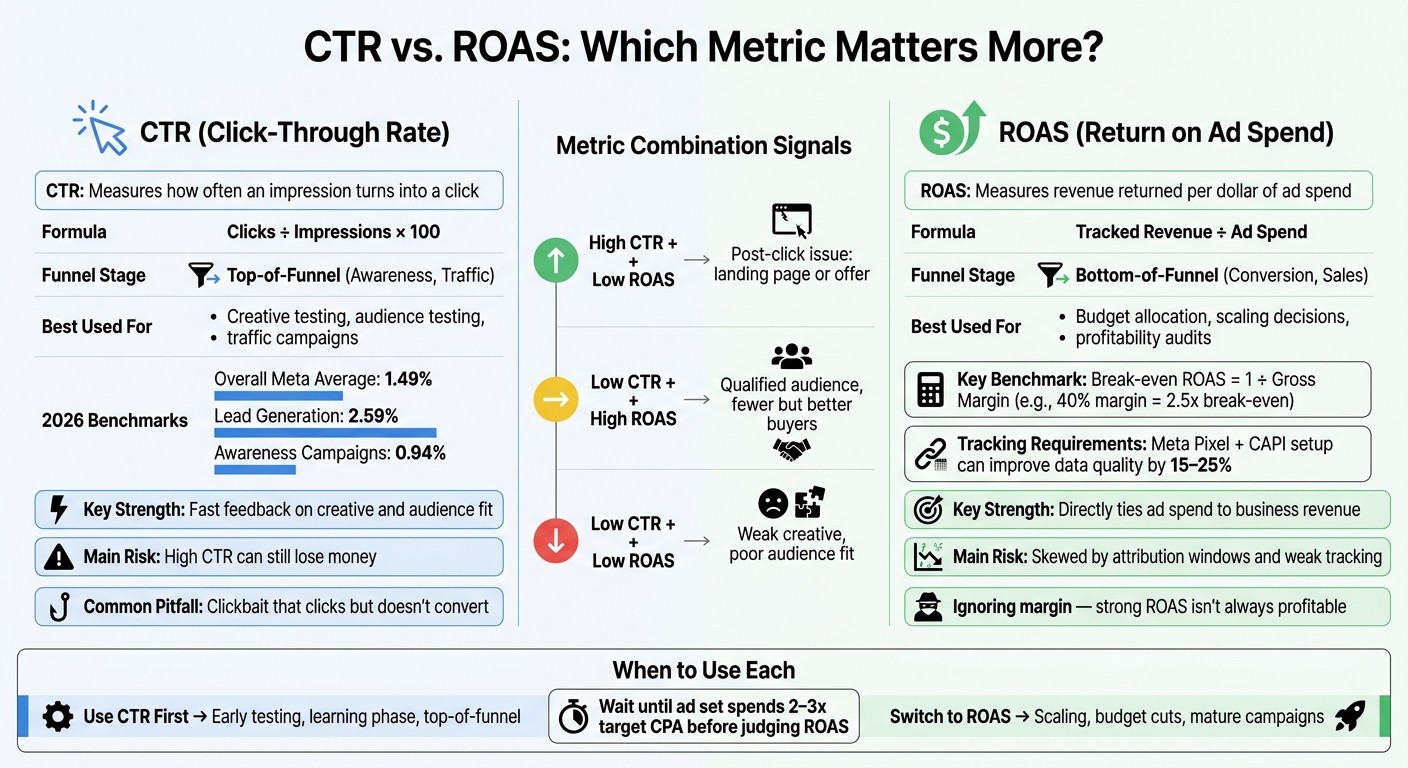
CTR vs. ROAS: Key Differences, Benchmarks & When to Use Each
CTR tells you whether your ad gets people to stop and click. ROAS tells you if those clicks turned into revenue. Put them side by side, and the split is simple: CTR shows response to the ad, while ROAS shows what happened to the money after the click.
Metric | What it measures | Funnel stage | Best use cases | Strengths | Limitations | Common pitfalls |
|---|---|---|---|---|---|---|
CTR | Creative resonance and audience fit | Top-of-funnel (awareness, traffic) | Testing new creatives; evaluating hooks and ad copy | Immediate feedback on ability to stop the scroll | Doesn't account for traffic quality or purchase intent | Chasing high CTR with clickbait that doesn't convert |
ROAS | Revenue returned per dollar spent | Bottom (Conversion, Sales) | Budget allocation, scaling, profitability audits | Directly ties spend to business outcomes | Can be skewed by attribution windows and modeling | Ignoring margin context - a strong ROAS isn't always profitable |
The table lays out the difference. What matters next is how the two metrics move together.
How to Read Common Metric Combinations
The useful signal comes from the pairing, not from looking at either number on its own.
High CTR with low ROAS usually points to a post-click issue. People are interested enough to click, but something breaks after that - the landing page, the offer, or the quality of the traffic.
Low CTR with high ROAS often means the ad is getting in front of a very qualified audience. Fewer people click, but the ones who do are more likely to buy.
Low CTR with low ROAS is the clearest warning sign. In most cases, that means weak positioning, poor audience fit, or a creative that just isn't landing.
Which Metric to Use for Different Decisions
CTR is the metric to use when you're judging creative early in a test. If you're trying new hooks, images, or ad copy, CTR gives fast feedback. On Meta, the 2026 average CTR benchmark is about 1.49%.
ROAS matters more when it's time to decide where the budget should go. Scaling a campaign, cutting spend, or comparing ad sets are all ROAS calls. It also helps to look at CPC and CPM next to it, since those numbers can show why ROAS is missing the mark.
Use CTR to judge response. Use ROAS to judge whether that response is worth putting more money behind.
When to Prioritize CTR, When to Prioritize ROAS, and How to Use Both
Use CTR First in Early Testing and Top-of-Funnel Campaigns
The rule is pretty simple: use CTR to judge early response, then switch to ROAS once conversion data is stable enough to trust.
In the Learning Phase, ROAS often jumps around. CTR gives you a faster read on whether the ad is getting attention. If you lean on ROAS too soon, you can kill campaigns before they’ve had enough data to prove themselves.
Think of CTR as a creative screening tool. In prospecting campaigns, a CTR below 1% usually points to weak creative or a weak offer. That gives you a clean way to cut obvious losers within 48–72 hours, then move the stronger ideas into deeper testing.
Use ROAS First in Mature Conversion Campaigns
Once tracking is stable and conversion volume is there, ROAS should drive the big calls. That means budget moves, scaling, and cuts should come from ROAS first.
A simple workflow works well here:
Allocate budget based on ROAS
Use CTR, CPC, and CPM to diagnose why performance looks the way it does
For example, if ROAS drops but CTR stays steady, the ad is probably not the issue. The landing page or the offer is the more likely problem. If ROAS and CTR both fall at the same time, creative fatigue is the stronger bet.
ROAS also has to be judged against your break-even margin. The formula is 1 ÷ gross margin. So a 3.0x ROAS might be profitable for one business and unprofitable for another, depending on margin.
Before you make a call on ROAS, wait until an ad set has spent at least 2–3x your target CPA. Moving too early on ROAS is one of the fastest ways to waste budget.
Using AI to Monitor Both Metrics Without Manual Guesswork
Looking at CTR, ROAS, CPC, and CPM together gives you a much clearer view than staring at one number alone.
AdAmigo.ai can track CTR, ROAS, CPC, and CPM all the time, then run tests, shift budgets, and pause weak performers based on your rules. That way, you can watch attention and revenue side by side instead of reacting to each metric on its own.
Conclusion: CTR Measures Attention, ROAS Measures Business Impact
CTR and ROAS solve different jobs. CTR measures attention. ROAS measures business impact.
That’s why one metric alone never gives you the full picture. CTR helps you spot whether the creative is doing its job. You can use an ad performance analyzer to audit these metrics. ROAS tells you if the campaign is making money. The best way to use them is together, not as separate signals.
Use CTR first to screen creative in the early stage. Then use ROAS to decide whether to scale a campaign or pause it.
Treat platform ROAS as directional, then compare it with break-even ROAS benchmarks before scaling. Start with CTR, validate with ROAS, and scale only when both the click and the economics make sense.
FAQs
Can CTR be too high?
Yes. A high CTR can fool you if it doesn’t lead to business results.
It tells you the ad is getting attention. That sounds good on the surface. But if those clicks don’t turn into sales, you’re still paying for traffic that brings in no revenue.
If CTR is high but CVR or ROAS is low, the problem usually isn’t the ad itself. It’s more likely the landing page, the offer, or the audience targeting.
What is a good ROAS for my business?
A “good” ROAS comes down to your profit margins. There’s no one-size-fits-all benchmark.
To find your break-even ROAS, divide 1 by your profit margin. So if your margin is 50%, you need a 2.0 ROAS just to break even.
Benchmarks can still help as a gut check. For example, 3.5x is often cited as an e-commerce average. But that number is only context. The smarter way to judge ROAS is against your campaign goals, funnel stage, and gross margins.
Why do CTR and ROAS sometimes conflict?
CTR and ROAS can pull in different directions because they track different parts of the customer journey.
A high CTR tells you the ad is getting attention and driving clicks. But if ROAS is low, the problem usually shows up after the click. In most cases, that points to the landing page, the offer, or the pricing.
A low CTR signals something else. It usually means the creative isn't connecting with people, so fewer users click through in the first place. And if they never reach the site, they can't move to the conversion stage that drives ROAS.