
Behavioral Pattern Recognition with AI Algorithms
How AI leverages behavioral signals, clustering, predictive models and NLP to optimize Meta ad campaigns and improve ROAS.
AI is transforming how advertisers analyze and optimize campaigns on Meta. By identifying behavioral patterns, AI can predict user actions, segment audiences, and automate decisions to improve ad performance.
Key insights:
Behavioral data, like clicks, saves, and purchases, is essential for understanding user intent.
AI models - supervised, unsupervised, and reinforcement learning - analyze patterns to forecast outcomes and optimize campaigns. This includes monitoring ad frequency benchmarks to prevent performance drops.
Dynamic patterns (e.g., time-based user behavior) outperform static metrics for predicting conversions and managing budgets.
NLP (Natural Language Processing) adds value by analyzing ad copy and user comments to refine messaging and detect issues.
Practical steps:
Clean and organize data using tools like BigQuery or Snowflake.
Use clustering (e.g., K-means, DBSCAN) to segment users by behavior.
Apply predictive models (e.g., XGBoost) to forecast conversions and lifetime value.
Leverage NLP to improve ad copy and address user feedback.
Automate optimizations with tools like AdAmigo.ai for scaling budgets, pausing underperforming ads, and refreshing creatives to solve fatigue.
Results: Companies using AI-driven targeting see up to a 15% revenue boost and 30% marketing efficiency gains. Start by centralizing your data, then let AI handle execution while you focus on high-level strategy.
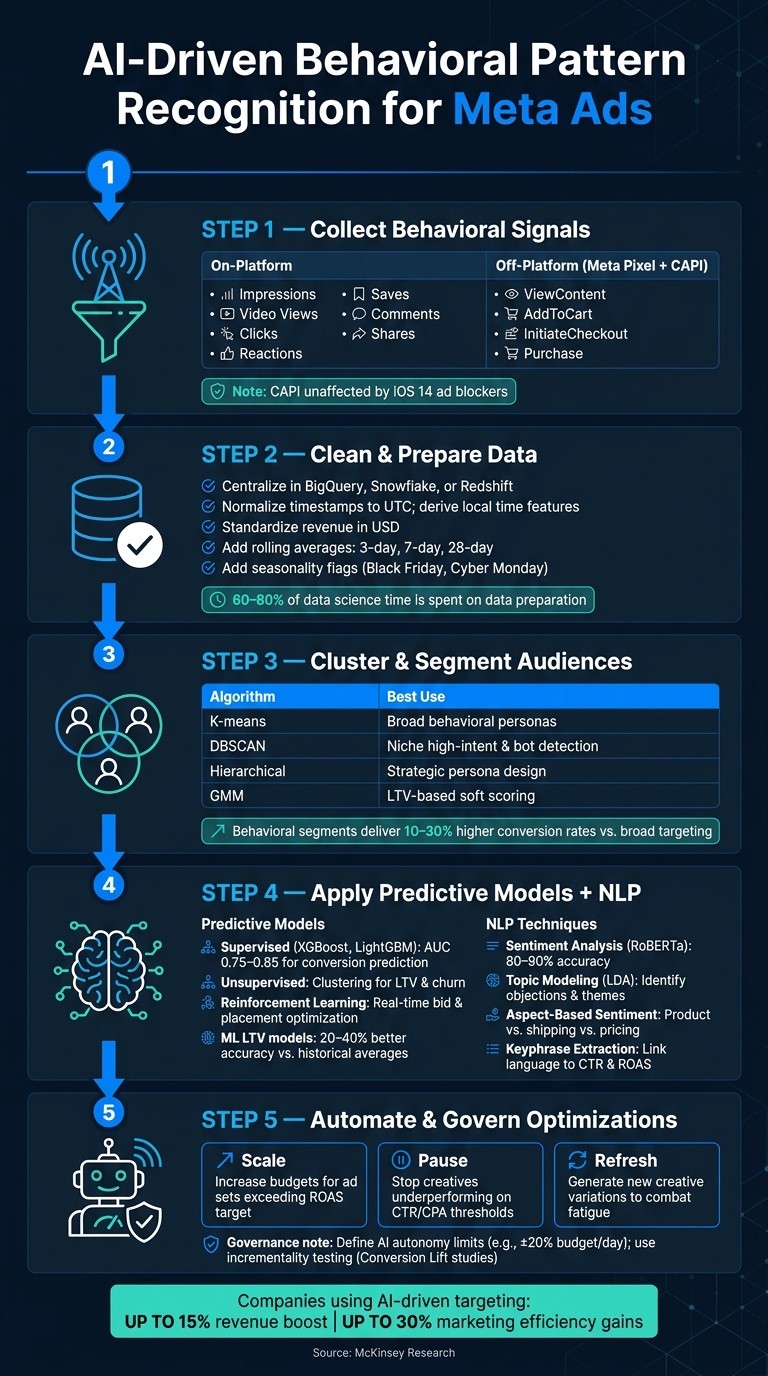
AI-Driven Behavioral Pattern Recognition: 5-Step Optimization Framework for Meta Ads
Pattern Recognition in AI: A Comprehensive Guide
Basics of Behavioral Pattern Recognition in Meta Ads
Grasping these basics is key to leveraging AI for improving Meta ad campaigns.
Behavioral Signals in the Meta Ecosystem
Meta's signal data breaks down into two main categories: on-platform and off-platform signals.
On-platform signals include metrics like impressions, video views (e.g., 3-second views, ThruPlays), link clicks, reactions, comments, shares, and saves. These metrics reveal how users engage with content. For instance, a high number of saves on a product ad often suggests stronger purchase intent than a simple click.
Off-platform signals come from tools like the Meta Pixel and Conversions API (CAPI). These track key events such as
ViewContent,AddToCart,InitiateCheckout, andPurchase, which highlight buying intent. Since browser-based tracking has become less reliable after iOS 14 updates, server-side CAPI data has become increasingly important. Unlike browser tracking, CAPI data isn’t affected by ad blockers or privacy settings.
By combining these signal types, AI systems can better understand where users are in their journey - whether they’re just discovering a product or are repeat buyers.
Core AI Concepts for Pattern Recognition
Three main AI approaches help recognize behavioral patterns in Meta campaigns, each with a specific role:
Supervised learning: This method uses labeled data, such as impressions marked as "purchased" or "churned", to predict future behavior. It’s commonly used for creating lookalike audiences, scoring conversion probabilities, and forecasting creative performance. Research shows supervised models can achieve AUCs (Area Under the Curve) between 0.75 and 0.85 for conversion predictions when detailed behavioral and contextual data are included.
Unsupervised learning: This approach identifies patterns without predefined labels, grouping users into segments like "serial browsers" or "high-LTV repeat buyers." Campaigns that target these behavioral segments often deliver 10–30% higher conversion rates compared to broad targeting.
Reinforcement learning: Focused on long-term outcomes like ROAS (Return on Ad Spend), this method uses trial and error to optimize decisions. Meta’s delivery system incorporates reinforcement learning to adjust bids and placements in real time. Tools like AdAmigo.ai build on these mechanisms, allowing campaign management with minimal manual oversight.
These AI frameworks are crucial for analyzing both static and dynamic user behaviors, which we’ll dig into next.
Static vs. Dynamic Behavioral Patterns
Static and dynamic patterns offer different insights into user behavior.
Static patterns provide a snapshot of past performance. Think metrics like last week’s CTR, average CPA by audience, or ROAS by ad set. These are easy to interpret and great for quick checks but don’t account for how behavior evolves over time.
Dynamic patterns go deeper, tracking how behavior changes across time. For example, they analyze sequences like how many ads a user saw, how quickly they moved from
ViewContenttoInitiateCheckout, or whether engagement is speeding up or slowing down. Two users with similar static profiles might behave entirely differently - one converting on the first click, the other requiring multiple touchpoints. Time-based models can reduce prediction error by 10–20% compared to static models, leading to better retargeting, smarter frequency capping, and more accurate budget pacing.
Static Patterns | Dynamic Patterns | |
|---|---|---|
Data structure | Aggregated snapshots | Sequential events with timestamps |
What they capture | Point-in-time performance | How and when behavior changes over time |
Best for | Reporting | Conversion prediction, detecting ad fatigue |
Typical models | Logistic regression, gradient boosting | LSTMs, transformers, Markov chains |
Understanding the difference between static and dynamic patterns is essential for tailoring campaigns to user behavior and improving overall performance.
AI Algorithms for Behavioral Pattern Recognition
Data Preparation and Feature Engineering
Before diving into algorithms, your data needs to be clean and well-organized. Studies show that data scientists spend a significant chunk of their time - around 60–80% - just preparing and cleaning data. Without this groundwork, even the most advanced algorithms can produce unreliable results.
For Meta campaigns, structuring your data into a comprehensive feature table is crucial. Each row should represent a clear unit, like a user-day or ad-set-day, and include metrics such as impressions, clicks, video view percentages, add-to-cart events, checkouts, purchases, and revenue. Rate-based features like CTR (click-through rate), cost per click, conversion rate, and ROAS (return on ad spend) help standardize the dataset for better analysis.
Two common challenges for U.S.-based accounts are time zones and revenue normalization. To address time zones, store raw timestamps in UTC and then derive local time features based on the account’s primary time zone (e.g., America/New_York). This ensures models can accurately capture behavioral patterns - like increased conversions in the evening - without being skewed by time-zone inconsistencies. For revenue, record all transactions in U.S. dollars at the time of purchase. For international campaigns, convert foreign currencies using the exchange rate at the time of the transaction, keeping both the original and USD values to maintain consistency for budget decisions.
Seasonality adds another layer of complexity. Incorporate calendar features for major U.S. shopping dates like Black Friday and Cyber Monday. Additionally, use rolling averages (e.g., 3-day, 7-day, 28-day) for metrics like spend, revenue, and conversion rates. These averages smooth out daily fluctuations, making it easier to spot meaningful trends instead of reacting to isolated spikes.
Once your dataset is clean and feature-rich, the next step is uncovering natural audience segments through clustering techniques.
Clustering and Segmenting Audiences
Clustering algorithms are powerful tools for identifying behavioral patterns in Meta campaigns. By grouping users into segments, you can uncover insights like frequent browsers who rarely purchase or low-frequency users with high order values. These segments allow you to tailor ad strategies and adjust bids effectively.
A popular starting point is K-means clustering. It’s fast, scales to large datasets, and produces easily interpretable segments using features like recency, frequency, and revenue. However, it does have limitations: you need to decide the number of clusters in advance, and it assumes clusters are roughly spherical. To optimize results, run K-means with different cluster counts (e.g., 3 to 10) and evaluate stability using the silhouette score.
For more complex needs, consider DBSCAN. It doesn’t require a predefined number of clusters and can identify irregularly shaped groups, making it ideal for spotting niche high-intent users or filtering out bot-like activity. Another option is Gaussian Mixture Models (GMMs), which assign probabilistic membership scores instead of hard labels. For example, a user could be 70% likely to belong to a high-LTV segment and 30% at risk of churn. These probabilities can then feed into predictive models as continuous features.
Algorithm | Best for in Meta Campaigns | Key Limitation |
|---|---|---|
K-means | Broad behavioral personas (engagement, value, frequency) | Requires choosing cluster count; assumes spherical clusters |
DBSCAN | Niche high-intent clusters; bot/fraud detection | Sensitive to epsilon and min_samples parameters |
Hierarchical clustering | Strategic persona design on smaller samples | Doesn’t scale well to large datasets |
Gaussian Mixture Models | LTV-based segmentation; soft scores for predictive models | Computationally intensive; assumes Gaussian-like distributions |
One critical tip: always standardize your features (e.g., using z-score normalization) before clustering. Without standardization, metrics with larger numerical ranges - like revenue - can overpower others and skew the results.
Predictive Modeling for Campaign Optimization
After clustering your audience, predictive models can refine your Meta campaigns by forecasting user behavior. By analyzing events like ViewContent, AddToCart, and purchases, these models predict key outcomes such as conversion likelihood, churn risk, and lifetime value (LTV).
Logistic regression is a simple yet effective baseline. However, gradient-boosted trees - like XGBoost, LightGBM, or CatBoost - often outperform it by capturing non-linear relationships and feature interactions. For LTV predictions, combining financial metrics with early behavioral signals (e.g., first-week engagement, device type, acquisition source) can lead to much more accurate results. Research shows that machine learning-based LTV models can improve prediction accuracy by 20–40% compared to using basic historical averages.
Calibration is essential to ensure that predicted probabilities align with real-world outcomes. Techniques like Platt scaling or isotonic regression can fine-tune model outputs. For instance, if your model predicts a 30% conversion probability, it should reflect an actual 30% conversion rate. Without calibration, budget decisions risk being inaccurate. Once calibrated, these probabilities become actionable: high scores can justify increased bidding, while low scores might indicate the need for tighter frequency caps.
Tools like AdAmigo.ai simplify this process by integrating behavioral scores to automate budget scaling for high-ROAS segments, test emerging clusters, and pause underperforming ad sets before they consume too much spend.
According to McKinsey research, companies that use advanced analytics for targeting and personalization see a 5–15% increase in revenue and a 10–30% boost in marketing efficiency.
The key to success lies in continuous validation. Regularly A/B test model-driven decisions against existing strategies to ensure they deliver measurable improvements in metrics like ROAS, CPA, and LTV.
NLP for Behavioral Data Interpretation
Once you've used AI to predict user behavior, the next step is understanding why users act the way they do. That’s where NLP (Natural Language Processing) comes in. While predictive models can tell you who is likely to convert, NLP digs deeper by analyzing the language in ads and user interactions. This combination of text analysis and behavioral data helps pinpoint the motivations behind performance, paving the way for smarter campaign tweaks.
Key Text Signals in Meta Campaigns
In Meta campaigns, text data typically comes from three main sources:
Ad copy: This includes primary text, headlines, and descriptions. These elements reveal which messages, emotional cues, or offers resonate most with your audience. Phrases like "free returns", "limited time", or "risk-free trial" carry psychological weight. By linking these phrases to metrics like CTR (click-through rate), CPA (cost per acquisition), and ROAS (return on ad spend), you can identify what drives performance.
User comments: Comments provide raw, unfiltered feedback. Complaints like "too expensive" or "never received my order" highlight friction points in the funnel. On the flip side, positive remarks such as "love mine" or "worth every dollar" show what customers appreciate, offering clues for creative improvements.
Private messages and lead form responses: These often contain high-intent questions like "Does this ship to Texas?" or "Is there a warranty?" Such inquiries reveal gaps in your ad copy or landing page. Addressing these details upfront can boost conversions.
Core NLP Techniques
Several NLP techniques are particularly useful for analyzing text data in Meta campaigns:
Sentiment analysis: This categorizes comments and messages as positive, neutral, or negative, while also identifying emotions like frustration or excitement. Transformer-based models like RoBERTa achieve high accuracy (80–90%) and are reliable for analyzing ad performance.
Topic modeling: Using methods like LDA (Latent Dirichlet Allocation) or embedding-based clustering, topic modeling groups comments into themes without manual tagging. For example, one ad might generate comments about "sizing confusion", while another sparks discussions about "fast delivery." These insights reveal audience concerns specific to each ad.
Aspect-based sentiment analysis: This technique goes beyond general sentiment to assess how users feel about specific aspects of an experience. For instance, a customer might praise a product but criticize shipping delays - an important nuance that overall sentiment scores might miss.
Effective NLP analysis hinges on proper data preparation. This includes normalizing text case, removing tracking URLs, converting emojis into sentiment tokens, and lemmatizing words so variations like "buying", "bought", and "buys" are treated the same. Skipping these steps can lead to inaccurate results and poor decisions.
Combining NLP with Behavioral Metrics
When NLP insights are paired with campaign performance metrics, you can uncover actionable strategies. For instance, creating a language-performance matrix links key phrases and sentiment scores from ad copy and comments to metrics like CTR, CVR (conversion rate), and ROAS. This approach helps identify language patterns that consistently drive results. Ads that use risk-reversal language, such as "30-day money-back guarantee", often perform better with cold audiences compared to ads that focus solely on product features.
NLP also helps detect creative fatigue early. A spike in negative sentiment, for example, can signal the need to refresh your ads before performance declines. Tools like AdAmigo.ai can integrate these insights into automated workflows, allowing you to monitor account health and avoid wasted ad spend.
NLP Technique | What It Analyzes | Key Campaign Insight |
|---|---|---|
Sentiment analysis | Comments, messages, reviews | Understand how audiences feel about specific creatives or offers |
Aspect-based sentiment | Comments broken down by topic | Distinguish product perception from issues like shipping or pricing |
Topic modeling | Large volumes of comments | Identify dominant objections, questions, and themes |
Keyphrase extraction | Ad copy and top comments | Find language patterns tied to strong CTR and ROAS |
Putting AI-Driven Behavioral Pattern Recognition into Practice
Building Data Pipelines and Tools
Transforming behavioral insights into actionable campaign improvements starts with setting up a robust data pipeline. This involves regularly pulling data from Meta's Marketing API and Ads Insights API and centralizing it in a cloud data warehouse like BigQuery, Snowflake, or Redshift. Once centralized, you can combine ad performance data with web events from tools like the Meta Pixel and Conversions API (CAPI), along with additional sources like your CRM or Shopify store. This setup supports full automation across the campaign lifecycle.
To keep a pulse on performance, integrate rolling 7- and 30-day metrics into your pipeline. These metrics help track trends like time-to-purchase, funnel progression rates (e.g., impression → click → add-to-cart → purchase), and creative engagement signals like thumb-stop rate and video watch time. Tools such as dbt or Apache Airflow are essential for ensuring these data processes remain reproducible and version-controlled.
For advertisers in the U.S., it's critical to handle user data responsibly. Pseudonymize user identifiers before storage, separate personally identifiable information (PII) from behavioral data, enforce role-based access controls, and maintain a data processing inventory to comply with CCPA/CPRA regulations. Retain raw logs for 12–24 months and aggregate older data instead of keeping it indefinitely.
Once your dataset is centralized and enriched with features, the next step is turning insights into automated decisions.
Using AI Media Buying Systems
Behavioral signals only matter if they lead to action. Tools like AdAmigo.ai connect directly to your Meta ad account via the official API, continuously analyzing behavioral data across campaigns, ad sets, and creatives. This enables near real-time optimization, translating patterns into actionable campaign improvements.
The platform's AI Autopilot takes care of execution. It scales budgets for ad sets that exceed your ROAS target, pauses creatives underperforming on CTR or CPA thresholds, and initiates new tests when optimization opportunities arise. The AI Chat Agent simplifies campaign management by answering questions like, "Why did ROAS drop on my remarketing campaigns yesterday?" and providing both insights and actionable fixes. Meanwhile, the Ad Factory tool studies your top-performing creatives and generates fresh variations to combat creative fatigue, iterating on hooks, formats, and messaging that resonate with your audience.
This approach shifts the media buyer's role from repetitive manual tasks to strategic oversight. Instead of micromanaging campaigns, you can focus on refining KPI thresholds, reviewing AI-driven adjustments, and shaping creative strategies, while the system handles the thousands of small decisions that would otherwise be unmanageable at scale.
While automation boosts efficiency, maintaining proper oversight ensures risks are minimized and campaigns stay on track.
Governance and Performance Measurement
Automation without clear boundaries can lead to problems. Before fully enabling autopilot, establish clear decision guidelines. For example, define which actions the AI can take independently - such as adjusting budgets within ±20% per day - and which require human approval, like launching new campaigns or increasing overall daily spend beyond a certain threshold. AdAmigo.ai offers an "approve changes first" mode to help during this transition, ensuring you maintain control as the system optimizes performance.
On the performance side, monitor both business KPIs and model-level metrics to ensure your AI-driven system is delivering results.
Metric | Type | Role in Campaign Decisions |
|---|---|---|
ROAS (in USD) | Business KPI | Guides scaling or pausing ad sets |
CPA (in USD) | Business KPI | Influences bid strategies and budget distribution |
CVR (conversion rate) | Business KPI | Identifies funnel issues; triggers creative or landing page tests |
AUC-ROC | Model metric | Measures model accuracy; aim for >0.70 |
Incremental ROAS | Measurement | Confirms true lift from AI optimizations |
Frequency | Delivery metric | Detects creative fatigue; prompts Ad Factory to generate new variations |
To verify that AI-driven optimizations are genuinely improving outcomes, rely on incrementality testing. Use Meta's Conversion Lift studies or geo holdout experiments to separate actual business impact from conversions that might have occurred regardless of the campaign.
According to McKinsey, AI-driven marketing personalization can lead to 5–15% revenue growth and 10–30% efficiency gains in marketing spend. However, achieving these results depends on rigorous measurement to distinguish real gains from attribution noise.
Conclusion: Key Takeaways for Optimizing Meta Ads with AI
Recognizing behavioral patterns is the key to scaling Meta campaigns effectively while minimizing wasted ad spend. The main takeaway? Behavioral data is your most dependable signal, and AI is the only way to process and act on it quickly enough to meet the demands of Meta advertising.
To succeed, focus on a few critical principles: ensure accurate tracking, use clustering to group audiences effectively, and rely on predictive modeling to shift from reacting to anticipating trends. Natural Language Processing (NLP) enhances this process by combining behavioral insights with user feedback, fine-tuning your creative messaging and overall strategy.
AI's strength lies in its ability to detect subtle patterns and make real-time adjustments - whether it’s rotating creatives at the first sign of fatigue or reallocating budgets as audience behaviors evolve. Your role? Set clear strategic parameters and routinely review AI-driven decisions. This partnership between human oversight and automated execution creates a powerful framework for success.
For those ready to put these strategies into action, AdAmigo.ai offers tools to streamline the process. Their AI Autopilot audits Meta accounts, scales high-performing audiences, and pauses low-performing ones while staying within your defined guidelines. The Ad Factory creates new creatives based on performance data, and AdAmigo Protect identifies potential issues before they escalate. Agencies using this platform report managing 3–5× more client accounts per media buyer, with some accounts experiencing up to an 83% improvement in ROAS within the first month.
Start by ensuring your data is clean and your KPIs are well-defined. Once your pipeline is integrated, let AI handle the execution so you can focus on strategy. By continuously optimizing based on behavioral data, you’ll see performance gains that not only meet but exceed expectations - turning insights into tangible results.
FAQs
What data is needed to start AI optimization on Meta ads?
To get started with AI optimization using a platform like AdAmigo.ai, the first step is connecting your Meta ad account through the official API - a process that takes just about 5 minutes. Once connected, you’ll need to define your Ideal Customer Profile (ICP) and Customer Value Proposition (CVP). After that, record your baseline metrics, such as CTR (Click-Through Rate), CPC (Cost Per Click), CPA (Cost Per Acquisition), and ROAS (Return on Ad Spend).
Finally, set up key parameters like brand guardrails, budget limits, and KPIs. With these details in place, the AI can either optimize your campaigns autonomously or work with your approval for adjustments.
How do I choose between clustering and prediction models?
You don’t have to pick one over the other because they work hand in hand. Clustering models help break down your audience into groups based on factors like behavior, transactions, or engagement. This can pinpoint high-value customers or those at risk of leaving. On the other hand, prediction models take historical data and forecast outcomes, such as ROAS or how well creative assets might perform. When used together, clustering helps you understand your audience, while prediction fine-tunes budgets, bids, and creative strategies to boost results.
How can I prove AI changes actually increased ROAS?
To see if AI-driven changes have boosted your ROAS, begin by documenting your baseline metrics - like ROAS, CPA, CTR, and CPC - before activating the AI. Tools such as AdAmigo.ai offer clear reporting on every adjustment made. By tracking these metrics over time, you can pinpoint how the AI's 24/7 monitoring and adjustments are impacting your campaign performance.