
Checklist for AI Seasonal Ad Campaigns
Step-by-step checklist for planning, creating, targeting, optimizing, and reviewing seasonal Meta ad campaigns using AI to speed launches and boost ROAS.
Seasonal ad campaigns can be overwhelming, with rising costs, intense competition, and quick creative fatigue. Here's how AI tools can simplify the process and improve results:
Plan Ahead: Use past campaign data to set clear goals, organize product groups, and align promotions with seasonal demand, such as testing Meta ads for Black Friday. AI insights can fine-tune these steps.
Launch Quickly: AI platforms like AdAmigo.ai streamline ad creation, from generating on-brand visuals to writing seasonal copy. Test 10–20 ad variations to find what works best.
Smart Targeting: Leverage AI for lookalike audiences, A/B testing, and budget allocation. Focus 70% on new customers and 30% on AI retargeting.
Real-Time Adjustments: AI tools monitor campaigns 24/7, making instant tweaks to bids, budgets, and creatives for optimal performance.
Post-Campaign Analysis: Use AI to analyze key metrics like ROAS and conversion rates, remove outdated promotions, and document insights for future campaigns.
AI tools save time, reduce manual effort, and improve campaign efficiency, allowing teams to focus on strategy while scaling results.
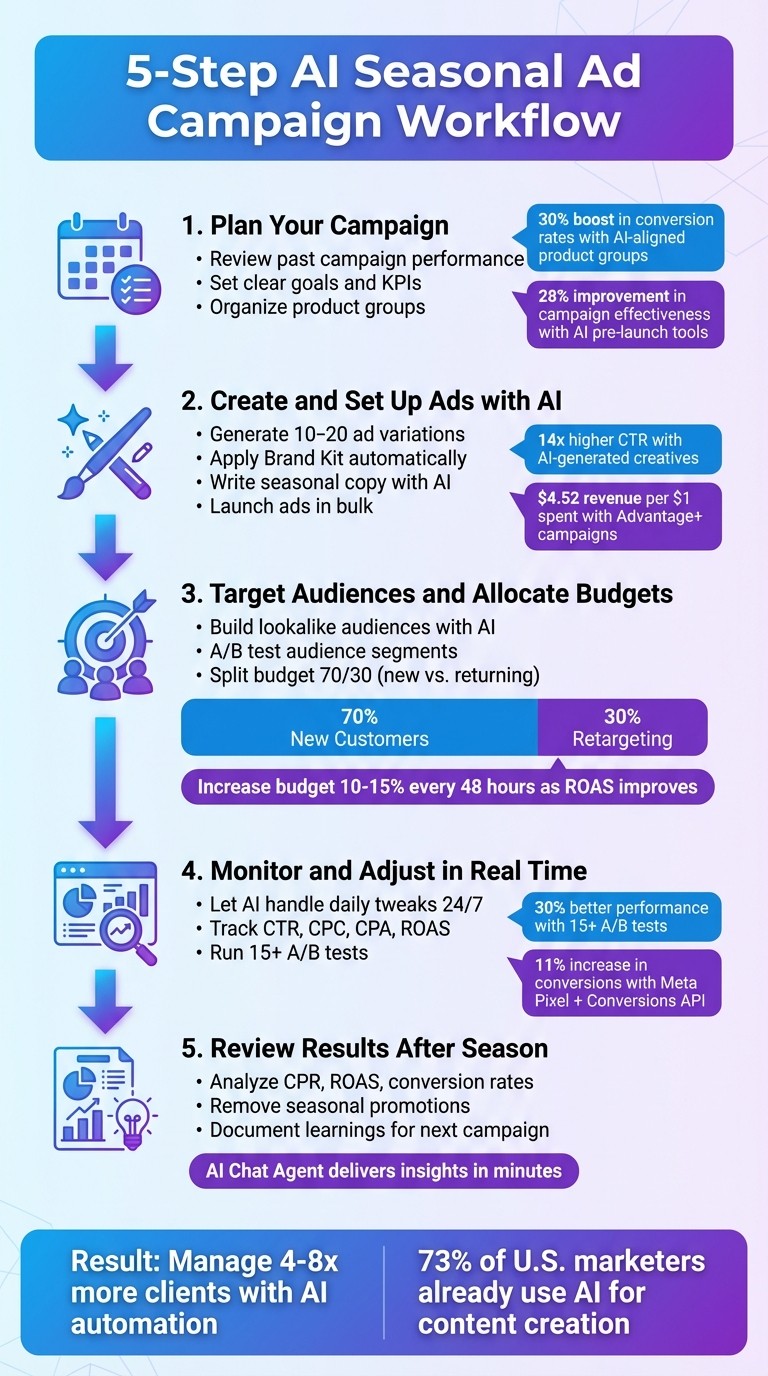
5-Step AI Seasonal Ad Campaign Workflow for Meta Ads
Step 1: Plan Your Campaign Before the Season Starts
Your campaign’s success starts with solid preparation. The groundwork you lay before launch will determine how well your ads perform when competition heats up and costs rise. Using AI insights during this phase can help fine-tune your strategy, ensuring you’re ready to tackle the season ahead. This step sets the foundation for later performance reviews and goal-setting.
Review Past Campaign Performance
Start by analyzing data from previous campaigns through tools like Meta Audience Insights and Ads Manager. Look for patterns in high-performing creatives, cost-efficient audiences, and placements that worked best. Take note of when creative fatigue set in and which formats held attention the longest. Identify top-performing categories, order values, and peak performance times. This historical data will serve as a guide to set realistic goals and avoid repeating past mistakes.
Set Clear Goals and KPIs
Specific goals lead to better outcomes. Define measurable targets that align with your business model and campaign objectives. Use the table below to identify primary and secondary KPIs based on your campaign goals:
Business Goal | Primary KPIs | Secondary KPIs |
|---|---|---|
E-commerce | ROAS, Cost per Purchase | AOV, Purchase Volume |
Lead Generation | Cost per Lead, Lead Quality | Form Completion Rate |
Brand Awareness | CPM, Reach | Frequency, Brand Lift |
App Downloads | Cost per Install | App Event Rate |
Structure your goals by funnel stage. For example, top-of-funnel (TOFU) efforts should focus on reach and awareness, middle-of-funnel (MOFU) campaigns should drive engagement and consideration, and bottom-of-funnel (BOFU) campaigns should aim for conversions. Assign separate budgets and success metrics to each stage to measure and optimize performance independently.
Organize Promotions and Product Groups
Once your goals are clear, tailor your product offerings to match seasonal demand. A well-organized product feed is key for AI-powered Advantage+ Shopping Campaigns. Ensure product titles, descriptions, prices, and availability are up to date. Group similar high-demand items - like winter clothing, holiday gift sets, or seasonal décor - into separate campaigns. Align these product groups with anticipated customer preferences.
AI-driven predictive analytics can make a big difference here. Research shows that aligning product groups with customer personas can boost conversion rates by 30%. Additionally, marketers who used AI tools during pre-launch reported a 28% improvement in campaign effectiveness and a 22% reduction in wasted ad spend. Use this time to create product bundles and promotions that resonate with your audience segments, maximizing your chances of success during the seasonal rush.
Step 2: Create and Set Up Ads with AI
Now that your planning is done, it’s time to launch your ads. AI tools can speed up the creative process while ensuring your brand stays consistent across countless variations. Instead of spending days manually designing assets, you can use AI to generate, test, and launch seasonal campaigns in just a few hours.
Create Seasonal Creatives That Align with Your Brand
AI-powered tools can apply your Brand Kit to every asset they generate, keeping your logos, colors, fonts, and style guidelines consistent. By uploading your seasonal style guides at the start, the AI will automatically integrate them into all the creatives it produces. Platforms like AdAmigo.ai's AI Ads Agent take it a step further by analyzing your brand identity and your top-performing ads. This allows them to create new image and video creatives that match your seasonal themes.
The results can be impressive. For example, Casetify used Meta's GenAI Background Generation and saw a 13% increase in return on ad spend (ROAS), freeing up their team to focus on more strategic tasks. Similarly, AI-generated creatives from platforms like AdCreative.ai have delivered up to 14 times higher click-through rates and conversions. Some advanced AI models can even predict how well a creative will perform and its brand recall with over 90% accuracy before the ad is launched.
"Meta's investments in AI for advertisers have resulted in consistent performance for our business and allowed Casetify to focus on more creative and strategic work." - Wesley Ng, Founder and CEO, Casetify
To maximize results, aim to create 10-20 variations for each product to test different seasonal messaging angles. For instance, compare "limited holiday offer" with "winter bundle deal" to see which resonates more with your audience. AI can take a single product photo and generate dozens of video and static variations, each testing a unique hook - all without the need for manual design work.
Write Ad Copy and Refresh Product Feeds
Seasonal campaigns call for updated headlines, descriptions, and product feed labels that align with your promotions. AI copywriting tools can quickly produce multiple headline options tailored to seasonal themes, saving you hours of effort. Use copy that creates urgency (like “Ends Monday”), emphasizes exclusivity (“Members Only”), or highlights value (“Save 30%”).
Don’t forget to update your product feed with seasonal labels such as holiday_bundle, limited_offer, or winter_collection. This helps Meta’s algorithm match your products to the right audiences. A well-maintained product feed is crucial for AI-driven Advantage+ Shopping Campaigns, which have delivered $4.52 in revenue for every dollar spent, according to Meta. Make sure your product titles, descriptions, prices, and availability are accurate before launching. Since 2022, AI-driven campaigns have boosted the average ROAS by 12%. With optimized creatives and copy, you can make your campaign launches smoother and more effective.
Launch Multiple Ads Simultaneously
AdAmigo.ai's Bulk Ad Launch feature allows you to upload hundreds of Meta ads directly from Google Drive in one go, complete with the right copy, creatives, and targeting. This method ensures consistency across campaigns while drastically cutting setup time.
AI tools make it possible to deploy hundreds of ads with just one click, offering predictive analytics, real-time adjustments, and on-brand creative generation - all from a single platform. This level of efficiency is especially critical during busy seasonal periods, where speed can make or break your campaign. With 73% of U.S. marketers already using AI tools for content creation, teams that can test and scale quickly will have the upper hand in a competitive market.
Step 3: Target Audiences and Allocate Budgets
Once your campaign plans and creative assets are in place, the next step is zeroing in on the right audience and managing your budget effectively. These two elements are the backbone of any seasonal campaign, especially when AI tools come into play. Meta's Advantage+ system can handle much of the heavy lifting, but setting up a strong foundation with proper structure and clean conversion signals is still essential.
Use AI for Lookalike Audiences
After launching your ads, take audience targeting to the next level with AI. Meta's Lookalike Audiences use data from your best customers to identify new, high-potential prospects. This is especially valuable during busy seasonal periods when efficiency is key. By integrating clean conversion data through Meta's Conversions API, you ensure the system can match your ads to the right audiences - even in a world where cookies are becoming less reliable.
To make the most of this feature, exclude your existing customers from lookalike audiences so your budget focuses on finding new buyers. Use high-value seasonal customers - like those from last year’s holiday campaign - as your seed audience to find similar shoppers. AI vs manual audience creation often shows that Advantage+ campaigns outperform manual setups, delivering quicker learning phases, lower CPMs, and more cost-effective conversions during peak times.
Experiment with Audience Segments
Testing is key to refining your audience strategy. A/B testing different audience segments can speed up Meta AI’s learning process. Experiment with combinations of demographics, interests, and ad formats to pinpoint what works best for your campaign. Let the data guide your decisions and continuously refine your approach.
Meta’s automated budget tools take it a step further by identifying top-performing segments and reallocating your spend accordingly. This real-time approach is far more efficient than manual adjustments, as it processes performance signals instantly. Additionally, lead ads with instant forms can help you capture customer information quickly, making it easier to gather high-quality leads without requiring users to leave the platform.
Balance Budgets for New and Returning Customers
With your target audiences in place, it’s time to allocate your budget wisely. A good rule of thumb is to split your budget 70/30: dedicate 70% to acquiring new customers and 30% to retargeting existing ones. This ensures you’re investing in growth while also nurturing customer loyalty.
As your campaign progresses, adjust your budget incrementally. Increasing it by 10-15% every 48 hours as your return on ad spend (ROAS) improves can help you scale effectively. AI tools can play a crucial role here, allowing for real-time budget adjustments based on audience behavior and market trends. This flexibility is especially valuable during high-stakes seasonal campaigns when competition is fierce and budgets are higher than usual.
Step 4: Monitor and Adjust Campaigns in Real Time
Once your seasonal campaign is up and running, the key to keeping it successful lies in real-time monitoring and quick adjustments. Seasonal campaigns often require swift changes to maintain their edge. The ability to act on performance signals quickly can make all the difference between a standout campaign and one that falls flat. AI tools excel here, processing data and making changes instantly, while manual adjustments are limited by human schedules and capacity.
Let AI Handle Daily Tweaks
Instead of spending hours manually adjusting bids, budgets, and other campaign elements, AI-powered tools can tackle these tasks in mere minutes. For example, AdAmigo.ai's AI Actions provides a daily to-do list of prioritized recommendations for your campaigns. It highlights actionable changes to creatives, audiences, budgets, and bids. You can either approve these suggestions with a single tap or let the system handle them automatically. With AI working 24/7, your campaigns remain optimized around the clock.
AI systems also have the advantage of learning from real-time performance data, adapting strategies as they go, rather than relying on static rules that can quickly become outdated.
Keep an Eye on Key Metrics
Pay close attention to metrics like click-through rate (CTR), cost per click (CPC), cost per acquisition (CPA), and return on ad spend (ROAS). These indicators reveal how well your ads are connecting with your audience and whether they’re delivering profitable results. If you notice a drop in CTR or a rise in CPC, it could signal that your ad creatives are losing their appeal. In such cases, refreshing your ads promptly can help sustain audience engagement. This is especially important when you need to fix ad fatigue to prevent performance dips.
Meta's research found that advertisers who conducted 15 or more A/B tests achieved a 30% improvement in ad performance compared to those who didn’t test at all. Use A/B testing for conversion rules to pinpoint which combinations of messages, visuals, and offers perform best. Focus your budget on the top performers and pause the ones that aren’t delivering.
Consistency Is Key Across Platforms
While optimizing metrics is vital, don’t overlook the importance of keeping your messaging consistent across all ad placements. Whether someone sees your ad on Facebook, Instagram, or the Audience Network, your messaging should feel unified and aligned. Syncing inventory data and promotions through product catalogs can help maintain this consistency.
Using tools like the Meta Pixel and the Conversions API together can also enhance your campaign’s effectiveness. Meta reports an 11% increase in purchase conversions when both tools are implemented compared to using the pixel alone. This setup ensures that your AI systems receive accurate data for optimization, even as third-party cookies become less reliable. By centralizing your campaign management and leveraging these tools, you can ensure your messaging stays sharp and effective across all channels.
Step 5: Review Results After the Season Ends
When the season wraps up, it’s time to dig into your campaign data. This analysis is your roadmap for smarter strategies moving forward. The insights you collect now will help refine targeting and improve creative for your next seasonal campaigns. Meta highlights that your results are only as reliable as your setup, so having clean, accurate tracking data is crucial for meaningful analysis.
These insights also lay the groundwork for tidying up and prepping for what’s next.
Examine Campaign Results
Start by pulling detailed performance data to see what worked and what didn’t. Pay close attention to metrics like cost per result (CPR), return on ad spend (ROAS) benchmarks, conversion rates, and engagement levels across all platforms and placements. Calculate your overall ROI by comparing your ad spend to the revenue generated during the campaign. Then, break this data down further - look at audience types (new vs. returning customers), creative format benchmarks (video, carousel, static images), and placements (Facebook, Instagram, Reels).
To speed up this process, use AI tools for quick and clear performance summaries. For example, AdAmigo.ai's AI Chat Agent can deliver actionable insights in minutes. Ask it specific questions like "Which audience segments had the highest ROAS?" or "What creative formats performed best during Black Friday?" to uncover patterns. Additionally, review Advantage+ campaign data to identify which ad variations, headlines, and calls-to-action resonated most with your audience. These insights can directly shape your next steps.
Once you’ve reviewed the data, make necessary updates to your active campaigns.
Remove Seasonal Promotions
It’s important to remove seasonal labels, promotions, and limited-time offers from your active ads. Pause or archive seasonal creative assets, and update your ad copy to reflect non-promotional messaging. To avoid running outdated ads that waste your budget, set campaign close dates in advance.
Document Learnings for Next Season
Capture what you’ve learned while it’s still fresh. Document key takeaways, including creative performance, audience behavior, budget efficiency, and timing. Note which creative assets delivered the lowest CPR, which audience segments converted best, and which shopping days (like Black Friday or Cyber Monday) generated the highest ROI. Save Meta’s AI suggestions and Advantage+ insights - such as which placements the algorithm prioritized and why - in a shared, easily accessible location for your team. Over time, this knowledge builds a playbook that helps you avoid past mistakes and double down on what works.
Conclusion
Running successful seasonal Meta ad campaigns doesn’t have to be a time-consuming, manual grind. With the right approach, you can streamline your entire process - from planning and creative development to targeting, live optimization, and post-campaign analysis - into an efficient, automated workflow.
AI tools like AdAmigo.ai make this process seamless. Start by connecting your Meta account and setting clear, measurable goals. The platform’s AI Ads Agent creates seasonal ad creatives that align with your brand and launches them with just one click. For targeting and budgets, the system optimizes lookalike audiences and allocates spending across customer segments, all while adhering to your specific geographic, pacing, and placement requirements.
Once your campaigns are live, the automation doesn’t stop. AI Actions provide a daily to-do list of impactful adjustments, covering everything from creatives to AI audience profiling and budget tweaks - all running around the clock. Need quick answers or insights? The AI Chat Agent is there to help. After the season wraps up, the same tools assist in analyzing performance, clearing outdated promotions, and documenting insights to refine future campaigns.
The benefits go beyond just saving time. Agencies using AI-powered platforms can manage significantly more clients - up to 4–8× more - because the technology handles execution, freeing strategists to focus on high-level planning. In-house teams can reduce reliance on additional hires, relying instead on an AI media buyer that continuously improves with each campaign. Routine optimizations that once took hours can now be handled in just 15–30 minutes each day, while the AI scales your best-performing ads for maximum impact.
The results speak for themselves. Automated platforms consistently outperform manual setups, delivering faster learning cycles, reduced CPMs, and stronger conversion rates during competitive seasons like the holidays. By automating repetitive tasks, your team can dedicate its energy to strategic decisions that drive real growth. Let AI handle the heavy lifting, so you can focus on what truly matters - achieving measurable success.
FAQs
How can AI help prevent creative fatigue in seasonal ad campaigns?
AI tools play a key role in combating creative fatigue during seasonal ad campaigns by automating the creation, testing, and updating of ad creatives. These tools keep an eye on performance metrics like engagement and click-through rates to spot early signs of fatigue - think declining results or increasing costs. Once fatigue is identified, AI steps in to generate fresh variations of images, videos, or copy. It then tests these new versions to uncover the most effective combinations, ensuring your audience stays engaged and your campaigns remain dynamic.
On top of that, AI can handle tasks like managing ad frequency caps and scheduling regular creative updates, often refreshing content every 10–14 days. This prevents overexposure to the same ads, keeping your audience interested and your message relevant. By automating these processes, AI not only reduces the manual workload for marketers but also frees up their time to focus on strategy, ultimately boosting campaign performance during the hectic seasonal rush.
What are the main advantages of using AI for adjusting ad campaigns in real time?
Leveraging AI for real-time campaign tweaks comes with some game-changing advantages. For starters, it allows you to react quickly to performance trends. By automatically fine-tuning budgets, adjusting targeting, and updating creatives based on live data, your campaigns stay sharp and relevant - all without needing constant hands-on management.
Another major perk? AI takes over the repetitive, time-consuming tasks. This frees you up to concentrate on the bigger picture - like refining your strategy and making impactful, high-level decisions. Plus, with its ability to learn and adapt over time, AI works to get the most out of your campaigns, helping you boost ROI while cutting down on the daily grind of campaign management.
How can AI-driven lookalike audiences improve targeting for seasonal ad campaigns?
AI-powered lookalike audiences take targeting for seasonal ad campaigns to a whole new level. By tapping into advanced data analysis, these tools identify individuals who closely resemble your most loyal customers. Unlike older methods, AI dives into historical performance, user behavior, and demographic trends to build incredibly precise audience segments. The result? Your ads are shown to people who are far more likely to engage or make a purchase, boosting both efficiency and campaign outcomes.
What’s even better is that AI doesn’t stop there. These tools continuously fine-tune audience segments in real time, using performance data to make adjustments on the fly. This dynamic approach is a game-changer for seasonal campaigns, where timing and precision are critical for maximizing return on ad spend (ROAS). By automating this process, platforms like AdAmigo.ai enable advertisers to scale their efforts effectively while staying relevant during key shopping periods.