Can AI Replace Your Ads Agency? What an AI Ad Agent Covers and What It Does Not
Short answer: an AI ad agent replaces the media buying, campaign building, daily optimization, reporting and most of the ad creative your agency does, which is usually 60% to 80% of a paid media retainer. It does not cover the work outside the ad account, and it does not orchestrate itself: someone has to configure it, supervise it, fill the gaps and decide what to sell to whom. Under $20,000 a month in ad spend, the switch almost always makes sense, because a $2,500 to $4,000 retainer on that budget is a 15% to 40% tax that has to be earned back on top of ad spend and product cost. Above $20,000 the agent still does the work, but you want a named person supervising it. Agency retainers run $2,000 to $5,000 a month, AI ad agents like AdAmigo.ai run $99 to $349 a month, or $899 fully managed with a dedicated account manager.
That is the summary. The rest of this guide is how to work out the answer for your specific setup. If you are earlier in the decision and have not settled on replacing your agency at all, start with who should run your ads, which compares agencies, freelancers, in-house hires and AI ad agents side by side.
First, break down what your retainer actually buys
Most arguments about this question fail because they treat "agency" as one thing. A Meta outsourcer and a full-service shop both call themselves agencies. An agent replaces one of them almost entirely and the other only in part.
One clarification before the table. Agents exist for almost every marketing discipline now. There are agents that run email and SMS campaigns, agents that write and place press releases, agents that test landing pages. So the question is not whether AI can do a thing. It is whether the agent you are hiring for paid ads does that thing, and who connects the pieces if you end up running several.
The table below is scoped to an AI ad agent, which is what AdAmigo.ai is and what most people mean when they ask this question.
What the retainer covers | In scope for an AI ad agent | Notes |
|---|---|---|
Media buying and daily optimization | Yes, fully | The part agents do best. Every day, no gaps. |
Campaign build and launch | Yes, fully | Including bulk launches and account structure. |
Taking your existing assets and getting them live | Yes, fully | Mostly mechanical work. |
Reporting | Yes, fully | Weekly and monthly, without you asking. |
New image and video creative | Yes | Generated from scratch, and iterated from your winners. |
Creative iteration on what already works | Yes | Finding the winner and building better versions of it. |
Account strategy | Mostly | The agent builds and runs it. You set the direction. |
Filmed content with real people, creators, influencers | No | Someone has to shoot it. |
Landing pages and conversion rate optimization | No | Separate agents exist for this. Not part of an AI ad agent. |
Email and SMS | No | Separate agents exist for this. Not part of an AI ad agent. |
PR, affiliate, offline media | No | Separate agents exist for PR too. Not part of an AI ad agent. |
Positioning, offers, what to sell and to whom | Partly | An agent contributes ideas. The judgement call stays with a person. |
Running and connecting all of the above | No | This is the orchestration job. See the next section. |
Add up your own rows. If most of your retainer sits in the top group, replacing it is straightforward. If a lot of it sits below the line, you are not buying media buying, you are buying a marketing department, and you need to decide who assembles the replacement.
On creative specifically, since this is where people expect the switch to fail: in the accounts AdAmigo.ai manages, roughly 70% of creative is AI-generated or AI-assisted and 30% is human-made or human-edited. Our customer base skews toward early adopters of AI, so treat that split as a signal rather than a law. The practical read is that an agent covers far more of the creative load than people expect, and that a healthy account still mixes in real footage with real people.
What an agency is worth once agents exist
An agency that does not use agents is competing with agents on price and diligence, and it will lose that fight. An agency that does use them is doing something different, and it is worth being precise about what.
Ownership of the agent itself. Somebody has to select the agent, configure it, provision access, set the guardrails and priorities, and watch what it does. That work does not disappear because the execution is automated. An agency that takes it on is selling accountability, which is a real product.
Filling the gaps. Agents have edges. When something falls outside what the agent handles, or the agent gets something wrong, a person steps in. That coverage is worth paying for, particularly at higher spend where a bad week is expensive.
Staying current on which agent to use for which job. The tooling changes every few months. Knowing which agent is best for paid ads, which for email, which for PR, and how they connect is becoming a discipline of its own. Most companies do not want to track that.
Judgement on positioning, offers and creative direction. Agents generate options here, and good ones generate strong options. Deciding which angle is right for your market, what your offer should be, and where your brand sits is still where experienced people earn their fee. This is the part that is hardest to automate and the part most worth buying.
So the real question is not "agency or AI." It is whether you want to own the orchestration yourself or pay someone to own it. Under $20,000 a month in spend, owning it yourself is realistic: about an hour a week. Above that, or if nobody internally has the time, paying for that layer makes sense, whether it comes from an agency or from a managed service.
When the answer is no
Keep your agency, or keep part of it, if:
You do not want to own the orchestration. Somebody has to configure the agent, hold the guardrails and answer for the numbers. If nobody internally can, do not switch to self-serve.
You need disciplines outside paid ads and do not want to assemble them yourself. You could run separate agents for email, landing pages and PR, and someone would then have to connect and manage them.
Paid is still an experiment at your company. An agency is fast to start and fast to stop, and that flexibility has value while you are still deciding whether the channel matters.
Your creative depends on production. If your winners are shot content with people, actors or locations, you need a source for that footage no matter who runs the account.
You are buying strategic judgement rather than execution. If your agency is shaping your positioning and offers, and doing it well, that is the part worth keeping.
The cost problem is structural, not a comment on agency quality
A $4,000 retainer on $40,000 of monthly ad spend is 10%. Fine.
A $4,000 retainer on $10,000 of monthly ad spend is 40%.
Look at what your ads have to earn in the second case. They cover the ad spend. They cover what your product or service costs to deliver. And now they also cover the retainer. The return you need just to break even climbs to a level most businesses never reach.
The number of companies that pause their ads because the whole effort came out unprofitable, when the retainer was the reason it came out unprofitable, is very large. That is not a statement about how good the agency's work was. The work can be excellent and the math still does not clear.
What it means in practice is that the current pricing model favours well-capitalized companies. A business that can spend $5,000 to $10,000 a month on ads, but cannot also absorb $2,500 to $4,000 in fees on top, never gets to switch on the best growth channel available to it. That is the actual problem an AI ad agent solves at this size, and it is a pricing problem before it is a technology one.
What to check before you trust any AI ad agent
An agent is not an agent. Most tools marketed this way are recommendation engines with a chat box. Before you connect an ad account, get answers to these. For a longer version of this list, see how to evaluate an AI ad platform before you buy.
Does it have a context layer
This is the first question and the most important one. Does it learn your business, your ad account history, your brand assets and your competitors, or does it run on general knowledge?
Generic intelligence produces generic ideas, and it produces them convincingly. AI is very good at making a suggestion sound smart enough that you approve it. Without context it will not know that you make no sales at weekends, so it launches a creative test on a Friday and the test fails for reasons that have nothing to do with the creative. It will not know which KPIs move together in your account. It will not know that a competitor's messaging angle has been working extremely well and should be in your rotation.
An agent without a context layer can still take instructions. Ask it to build an audience and it will build the audience. What you cannot do is trust it to tell you what to do, which means you are back to needing an expert.
Ask each vendor: what does the agent know about my business, where does that knowledge come from, and does it keep growing as I use the product?
Does it hold your guardrails and priorities
Which countries and regions to stay out of. Which audiences not to target. What it must not spend past. What you are pushing this month. What performance targets it is working toward.
If the agent does not hold these, it will overspend and it will target places you did not want. Ask each vendor to show you exactly where these are stored and how the agent uses them.
Is it an official platform partner
Check that the vendor is listed in the Meta Business Partner directory and the Google Partners directory, and that it works through the official APIs. Google explains what listing in its directory requires in the Google Ads Help documentation. Tools that drive your account through browser automation instead of the API can get your traffic flagged, and in the worst case get your ad account disabled.
Grant access through Business Manager partner access rather than sharing your login. Ask how your Meta and Google tokens are stored and protected.
Is there quality assurance and an alert system
Two separate things.
Quality assurance means the agent's own proposals get checked before they land. A second pass that sanity-checks the strategy and catches obvious errors.
Alerts mean you get pulled back in when something goes wrong. Spend collapses because the auction shifted. A live ad has a typo. Delivery stops. The agent may well handle it, and you should still know it happened.
Does it cover creative, strategy and optimization together
An agent that only optimizes leaves you sourcing creative. An agent that only makes creative leaves you running the account. Ask what happens across all three.
Does the automation scale from none to full
You want to start with everything requiring approval, then hand over more as you build trust, until parts of the account run on autopilot. A tool that only recommends, and never implements, means you keep doing the work. A tool that only runs autonomously, with no approval mode, is not something you should connect to a live budget on day one.
The failures that take weeks to show up
The first week with almost any tool looks impressive. The problems arrive slowly, which is why a trial does not always catch them.
Ad copy that is subtly off-brand every time. Naming conventions it never gets right. Missing UTM tags, which quietly breaks your reporting. The wrong logo in a design. And the one that tells you the most: contradicting itself, raising a budget one day and cutting it the next on the same asset, with no thread running between the two decisions.
Each of these is small. Together, over six weeks, they are the difference between a tool you tolerate and one you rely on. All of them trace back to the same root cause, which is missing context and missing memory of its own actions.
What you actually need to run ads yourself
Less than people expect. The full list:
Admin access to your Meta Business Manager, your ad account, your pixel or dataset, and your Facebook page. Instagram page optional but recommended.
Admin access to your Google Ads account and your conversion tracking.
A payment method attached to both ad accounts.
If people convert on your website, your pixel or dataset and conversion events installed and firing correctly. Server-side tracking through Meta's Conversions API is worth having in place before you switch, since every option you are considering optimizes against whatever you can measure. Our guide to setting up the Conversions API walks through it, and Meta's own getting started documentation covers the prerequisites.
That is it. With those in place you connect the accounts to an agent and it can read everything and start working.
Setup itself is short. With AdAmigo.ai the onboarding walks you through your goals, your priorities and your guardrails, then connects your channels, and takes about five minutes. Give yourself another hour to click around and understand where recommendations appear and how to brief the agent. One afternoon and you are running.
Get your assets out before you give notice
Agencies often create these assets for you, which means they may sit under their Business Manager rather than yours. Sort this out before anything else.
Ask for admin access to, or transfer of:
The ad account, under your Business Manager rather than theirs.
The pixel or dataset, with its history. This one matters most. Starting over on tracking data means starting over on performance.
The Facebook and Instagram pages.
The Google Ads account.
Creative source files, not only the exported images and videos.
Historical performance data in a usable format.
Most contracts state that assets created for you belong to you. Check yours. If it is not written down you are relying on goodwill, which usually holds, because most people do not want to burn a relationship on the way out. Ask early and ask in writing.
Do not give notice until the transfer is confirmed.
The migration timeline
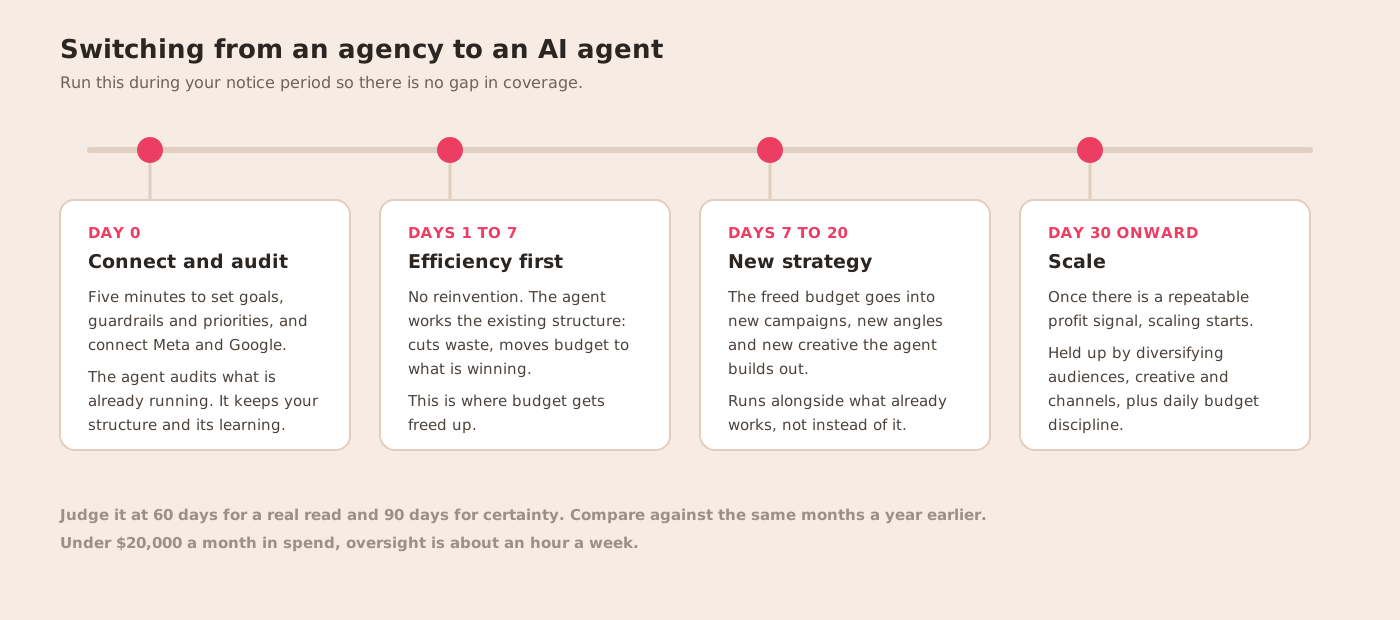
Two things to sort out before day one.
Check your notice period. Most retainers run 30, 60 or 90 days, and some renew automatically. Check the renewal date and any off-boarding fee.
Then use that notice period rather than waiting it out. Deploy the agent while the agency is still working and still being paid. You get a parallel run with no gap in coverage, and by the time the contract ends the agent already holds your account context. If your notice is short or already served, deploying takes an afternoon, so a day or two of light supervision is enough of a gap.
Day 0: connect and audit
Connect Meta and Google, set your goals, guardrails and priorities. The agent runs an audit of the account as it stands.
Important: a good agent iterates, it does not rebuild. Your existing campaigns and ad sets carry historical learning, and that learning has value. Anything that comes in, deletes the account structure and starts from scratch will cost you a month of performance, and sometimes the account never gets back to where it was. Take what is there, keep what works, cut what does not, then improve.
Days 1 to 7: efficiency on what exists
No reinvention. The agent works the existing structure: cutting waste, reallocating between what is winning and what is not, tightening delivery. This is where budget gets freed up.
Days 7 to 20: build the new strategy with the freed budget
The budget saved in the first phase gets deployed into new campaigns, new angles and new creative that the agent builds out. This runs alongside the existing structure rather than replacing it.
Day 30 onward: scale once there is a profit signal
When the account shows a repeatable profitable position, scaling starts. Scaling holds only if it is supported, so this phase runs together with audience diversification, creative and content diversification, and channel diversification, which usually means adding Google Ads alongside Meta or the other way around.
Past that point the work is discipline: budget management, keeping inefficiency from building up as spend grows, and continuing to feed the account new angles.
Middle paths that are not "retain them or keep them"
Ask your agency to use an agent. If the relationship works and the results are decent, this gets you the daily discipline and the time savings without changing vendor, and it puts the orchestration work with the people already doing it. Many agencies already run agents on client accounts, and it lifts their capacity as much as your results. Since pricing is per ad account, an agency can add it to your account alone rather than restructuring how they work. This is often the best first move.
Run a comparison instead of switching outright. The clean way to do this is a geo split, or handing the agent a defined subset of campaigns inside your existing account. The messier way is a second ad account. Be aware of what that costs you: a new account has no learning history, its early numbers will look worse for reasons unrelated to the agent, and at higher spend two accounts under the same business end up bidding against each other. It also tends to become visible to your agency, which is its own conversation.
Handing the agent your existing assets, so it inherits the learning and improves on it, gives you a better read than any parallel test.
Move paid to the agent and keep the agency for the rest. Media buying goes to the agent, and the agency keeps landing pages, email, production, PR or strategic direction at a reduced scope. This is a common outcome, and most agencies will negotiate rather than lose the account entirely.
One agent across Google and Meta beats two vendors
Plenty of companies run one agency or freelancer for Google and another for Meta. That setup has a specific failure.
Both platforms claim the same sale. Google reports the conversion, Meta reports the conversion, and each vendor reports it as theirs. You end up moving budget toward whichever channel claims attribution most aggressively, not toward whichever one is actually generating incremental sales.
The second problem is that neither party can move money between the channels. When Meta hits creative fatigue and Google is running strong, nobody is positioned to shift budget, because each vendor is measured only on their own channel.
One agent sitting on top of both has no loyalty to a channel. It moves budget toward performance. It also carries learning across: a headline that wins on Google Search feeds your Meta copy, a video that performs on YouTube gets cut for Reels, an audience insight from one platform informs targeting on the other.
If your setup is currently split between two vendors, consolidating Meta and Google under one agent is often worth more than the switch itself.
How to tell whether it worked
Do this before you switch, not after.
Pull your last 90 days: cost per acquisition, ROAS or cost per lead, spend by campaign, and your blended number across all channels. Screenshot it. Note anything unusual in that period.
Then judge it on a fair schedule. Two weeks tells you nothing except whether something is broken. Sixty days gives you a real read. Ninety days gives you certainty.
If you are starting more or less from scratch, expect the shape to be: month one poor, because learning has to be built and budget goes into experimentation and feeding the pixel. Month two, first signs of momentum. Month three, break-even or profitable, and that is when scaling starts.
Two adjustments people forget.
Seasonality. Comparing a Black Friday period against January will tell you something about the calendar, not about the agent. The cleanest comparison is the same months against the same months a year earlier. A rolling comparison also works.
Spend changes. Efficiency gets harder as spend grows. If you switch to an agent and double your budget at the same time, some of the pressure on your return comes from the extra spend, not from the agent. Hold spend roughly flat for the first read, or account for the increase when you compare.
What if it does not work
If you own your ad account, your pixel, your pages and your creative files, going back to an agency takes about a week and costs you nothing but the retainer you were paying before.
That is the real argument for getting your assets in order before you do anything else. Owning them makes every future decision reversible, whoever ends up running your account.
Who supervises the agent
Somebody still owns the numbers. What changes is that this person no longer has to be a trained media buyer, because the button-pressing and the daily diligence are the parts the agent takes over.
Under $20,000 a month in spend, founder-led oversight is enough. About an hour a week, mostly uploading creative you want launched, reading the updates and approving recommendations. On autopilot, closer to 30 minutes.
Above $20,000, name someone. Not a media buyer hire. Someone who reviews what changed, keeps the guardrails current as the business shifts, and owns the result. Your SEO lead, your Google specialist, a marketer already wearing other hats, or your CMO directly.
If nobody internally can take it, AdAmigo.ai's managed service provides the account manager. They own the agent, run Meta and Google, design the creative, report weekly and monthly, and get your approval before strategy or creative changes go live. That is $899 a month per ad account with no minimum term.
How this works with AdAmigo.ai
Measured against the checklist above:
Scope. AdAmigo.ai is an AI ad agent. Meta and Google today, more channels coming. It does not do email, landing pages or PR, and it does not pretend to.
Context layer. It builds a knowledge base of your brand, offers, customers, competitors and account history at signup, and keeps adding to it with every campaign and result. Decisions reference that context rather than general knowledge.
Guardrails and priorities. Geographies, audiences, budget ceilings, current product priorities and performance targets are set during onboarding and held by the agent, not re-explained each session.
Both channels under one agent. Budget moves toward performance instead of toward whichever vendor claims the conversion.
Creative included. Image and video creative is generated from scratch and iterated from your existing winners, which is where the 70/30 split mentioned earlier comes from.
Automation that scales. Start with every change requiring your approval, then move parts of the account to autopilot as you build trust.
Pricing. $99 or $349 a month per ad account self-serve, or $899 a month fully managed with a dedicated account manager and no minimum term.
Frequently asked questions
Can an AI ad agent fully replace an ads agency?
For media buying, campaign building, daily optimization, reporting and most creative, yes. An AI ad agent does not cover email, landing pages, PR or filmed production, though separate agents exist for several of those. What no agent covers is the orchestration: configuring the tools, holding the guardrails, filling the gaps and deciding what to sell to whom. Whether you switch depends on whether you want to own that layer or pay someone to own it.
Does an agency still add value if AI ad agents can do the work?
Yes, in four places. Owning the agent, meaning selecting, configuring, provisioning and monitoring it. Filling gaps when the agent falls short. Staying current on which agent is best for which job as the tooling changes. And judgement on positioning, offers and creative direction, where experienced people still outperform. An agency that does not use agents is competing on price and diligence and will struggle.
How much cheaper is an AI ad agent than an agency?
Agency retainers typically run $2,000 to $5,000 a month. AdAmigo.ai runs $99 to $349 a month per ad account self-serve, or $899 a month fully managed with a dedicated account manager. The larger effect is on your margin, since a retainer has to be earned back by your ads on top of ad spend and product cost.
At what ad spend does replacing an agency make sense?
Below roughly $20,000 a month, the retainer takes 15% to 40% of your budget and profitability becomes structurally hard, so the switch usually makes sense. Above $20,000, the agent still does the work but you want a named person supervising it. The full breakdown by spend level is in who should run your ads.
How long does it take to switch from an agency to an AI ad agent?
Connecting accounts and setting goals and guardrails takes about five minutes, plus an hour to get familiar with the product. The account then goes through roughly a week of efficiency work, one to two weeks of building out new strategy with the freed budget, and reaches a scaling position from around day 30. Run this during your notice period so there is no gap in coverage.
Will switching hurt my ad account performance?
Not if the agent iterates instead of rebuilding. Your existing campaigns carry historical learning that has real value. Anything that deletes your structure and starts fresh will cost you a month or more of performance. Ask any vendor directly how they handle your existing setup.
What do I need before I can run ads without an agency?
Admin access to your Meta Business Manager, ad account, pixel or dataset and Facebook page, admin access to your Google Ads account and conversion tracking, a payment method on both, and working conversion tracking on your website. Meta's Conversions API documentation covers the server-side part.
Can I keep my agency and use an AI ad agent too?
Yes, and it is often the best first move. Ask your agency to run the agent on your account, which puts the orchestration work with the people already doing it. Or move media buying to the agent and keep the agency for the disciplines and judgement it brings. Most agencies will renegotiate rather than lose the account.
How do I know if the switch worked?
Take a 90-day baseline before you switch. Judge at 60 days for a real read and 90 days for certainty. Compare against the same months a year earlier to control for seasonality, and account for any increase in spend, since efficiency naturally gets harder as budgets grow.