Who Should Run Your Ads? Agency, Freelancer, In-House, or AI
Short answer: if your offer is already proven and you can track conversions, an AI agent is the right choice under $20,000 a month in ad spend, because an agency retainer at that level takes 20% to 40% of your budget and makes profit very hard. Between $20,000 and $50,000, use an AI agent with a named person supervising it, or an agency if paid is still an experiment for you. Above $50,000, bring the channel in-house and pair that owner with an agent. Hire a freelancer when you need one channel run exceptionally well and nothing else. On cost, agency retainers run $2,000 to $5,000 a month, a media buyer is a salary, and AI agents like AdAmigo.ai run $99 to $349 a month, or $899 fully managed with a dedicated account manager.
You have four ways to run Meta and Google ads: hire an agency, hire a freelancer, hire in-house, or use an AI agent. Under $20,000 a month in ad spend, an agency retainer eats too much of your budget to work, and an AI agent can run the account on its own. Above $20,000, you want a person overseeing that agent. Above $50,000, you want the whole channel in-house.
That is the short answer. The table below is the long one, and there is a decision tree at the end to land you on the right choice.
The four options at a glance
Agency | Freelancer | In-house hire | AI agent | |
|---|---|---|---|---|
Typical monthly cost | $2,000 to $5,000+ | $1,500 to $4,000 | Salary plus payroll costs, tools and ramp time | $99 to $349 |
Works best at ad spend of | $40,000+ | $20,000+ | $50,000+ | Any budget. On its own up to $20,000, with someone overseeing it above that |
Your time commitment per week | 1 to 2 hours of calls and approvals | 1 to 2 hours | Managing the person | 30 to 60 minutes |
Time until real work starts | 2 to 4 weeks | 1 to 2 weeks | 2 to 4 months including ramp | Same day |
Who is in your account daily | Usually nobody | Often | Yes | Every day, without exception |
Do you talk to the person doing the work | No, an account manager sits in between | Yes | Yes | Yes |
One channel or many | Many, if you pay for more scope | Usually one channel only | Whatever the one hire knows | Meta and Google, plus creative and strategy |
Can it cover email, SMS, landing pages, PR | Yes, that is their strength | Rarely | Only if you hire for it | No, ads only |
How fast it reacts when your business changes | Days, messages pass through layers | Same day | Same day | Minutes |
What you get if the talent is weak | An average result, their process holds it up | A bad result, nothing catches it | A bad result baked into your company | Same result every time, it follows the rules you set |
What happens when they leave | They swap in someone new, you barely notice | You start over | You start over, plus a hiring cycle | Does not apply |
Where the learning ends up | With them | With them | With that person, until they quit | In your knowledge base, and it grows |
Who is accountable for results | Them, in theory | Them, in theory | Them | You, or an account manager you hire |
Two things the table cannot show. An agency and an AI agent are not rivals in every case, and plenty of companies run both. And the real question at higher budgets is not whether to use an agent, it is who supervises it.
Check this before you choose anything
Can you measure a sale?
If people buy on your website, a working pixel and Conversions API setup is enough. If your sales happen off the website, on a phone call, in a showroom, or weeks later in a CRM, you need to send those conversions back to Meta and Google.
This is not a preference, it is a prerequisite. Every option in this guide, human or AI, optimizes toward whatever you can measure. If you can only measure form fills, you will get form fills, not customers. Fix this first, then pick your model.
Why this question exists at all
Five years ago almost nobody asked it. If you wanted to run Facebook or TikTok ads, you hired an agency. There were two good reasons for that.
First, these channels were experiments. Budgets were small, most marketing leaders were not sure they worked, and "my buyer is not on Facebook" was a normal thing to hear. When you test something, you want a partner you can plug in fast and rip out fast. Building a team for a channel that might not survive the year made no sense.
Second, the method was new. Performance marketing, buying against a sale instead of against reach, needed skills most in-house teams did not have. Companies bought that knowledge instead of building it.
Then things changed. Meta and Google ads stopped being experiments. For a lot of companies they became the main growth engine, the line in the plan everything else depends on. The moment a channel becomes that important, depending on an outside party to run it turns into a risk. That is why so many companies have been pulling paid media back in-house.
The blocker was always the same. In-housing needs expertise, proven processes, and someone with time to be in the account every day. Most companies have none of the three. AI agents remove that blocker, which is why the answer to "who should run your ads" looks different today than it did in 2021.
Agency
You pay a monthly retainer. A team manages your account alongside a number of other clients.
What works:
They have seen a lot of accounts in your space, and that has real value. They know what account structure holds up, what creative angles land, what landing pages convert, and they can apply it to you quickly instead of learning it on your budget.
They are wide. A good agency does not only buy media. They bring email, SMS, creative production, affiliate, sometimes PR, and they can grow with you as your needs change.
They do not break when someone leaves. If a media buyer quits, the agency swaps in a new one who follows the same playbook. You barely feel it.
They are fast to start and fast to stop. No hiring, no notice period, no severance.
Where it breaks:
The business model is one team serving many clients, so the incentive is to serve as many accounts as possible with as few people as possible. That is not malice, that is how the model makes money. What you feel is thin attention. Your account does not get looked at every day, optimizations happen in batches, and performance gets left on the table.
Communication runs through layers. The person you talk to is usually not the person clicking in your account, so things get lost in the handoff. When something changes in your business, a stock issue, a new offer, a bad week, it takes days to reach the account.
Playbooks cap your upside. Agencies standardize to stay efficient, which gives you a reliable floor and a low ceiling. Your ads end up looking like everyone else's ads.
And the price does not scale down. Agency minimums exist because a client costs a certain amount to serve, no matter how small their budget is. Which brings us to the math that decides this for most companies.
The retainer math nobody puts on their pricing page
A $4,000 retainer on $40,000 of monthly ad spend is a 10% cost. Annoying, defensible, fine.
The same $4,000 retainer on $10,000 of monthly ad spend is 40%.
Now look at what your ads have to earn. They cover the ad spend. They cover what your product or service costs you to deliver. And now they also cover the retainer. At 40%, the return you need just to break even is so high that most businesses never reach it.
The second effect costs more than the arithmetic. That pressure makes you quit early. You give it two or three months, the numbers do not clear the bar, and you shut it down. In a lot of those cases another two or three months of testing would have gotten you there. The retainer did not only cost you money, it cost you the runway to make the channel work at all.
That is how the agency model, priced the way it is priced, fails small and mid-size advertisers. The people are usually fine. The math starts against you.
Freelancer
You hire one person directly, usually for a monthly fee or a day rate. They work with a handful of clients.
What works:
No dilution. They carry a few accounts, not thirty, so you get real attention.
You talk to the person doing the work. No account manager in the middle, no translation loss. You say something on Monday, it goes live on Monday.
No playbook ceiling. Good freelancers build concepts specifically for you, because they are not trying to standardize across fifty clients.
Where it breaks:
They are narrow. A strong Meta freelancer is often weak on Google, and knows little about email, landing pages, or conversion rate optimization. You are paying a specialist rate to cover one slice of your marketing.
Then there is the talent problem, which is the bigger one. Excellent operators are rare in every field and paid media is no exception. The best freelancers know what they are worth and charge for it. Most of the market is not the best.
With an agency, weak talent gets absorbed by process. Their playbook holds the outcome up at "okay." With a freelancer there is no process layer between you and the person. If they are excellent you get an excellent result. If they are not, you get their result raw, with nothing to catch it.
That is why so many people say they got burned by a freelancer or a very small agency. Bad luck is not the explanation. The model has no floor.
In-house hire
You hire someone onto your team to own paid media.
What works:
Total control and total alignment. They sit in your meetings, know your margins, know what is out of stock, know what the sales team is hearing. No outside party owns your growth channel.
The knowledge stays with you. Every test, every learning, every account decision lives inside your company instead of leaving with a vendor.
Where it breaks:
Same talent problem as freelancers, only harder. Great operators can earn more freelancing, with more freedom, so the pool of people looking for a salaried media buyer job skews toward the middle.
That leads to the trap: average people build average processes. You hire someone hoping they will bring structure and best practices. If they are average, you have now baked average into your company permanently.
The alternative is hiring junior and training them into what you want. That only works if you already have strong processes and a track record of ramping people fast. Be realistic about whether you do.
Then there is churn. If you do train someone into a strong media buyer, they now have a very good reason to go freelance and earn more with more freedom. When they leave you start from zero, and unlike an agency you have no bench and no playbook to plug the next person into.
Worth adding: salary plus payroll costs plus tools is not a small commitment, and it takes months before that person produces at full strength.
AI agent
You connect your ad accounts. The agent runs the day-to-day work, either on your command or on its own, and reports what it did.
The framing that matters: this is not really a fourth option sitting next to the other three. Every company running ads should have an agent in the account, the same way every company already uses software to write, design and analyze. The real question is who supervises it, and that answer changes with your budget.
What works:
Discipline. It is in the account every single day. No holidays, no sick days, no slow week because three other clients are on fire. Consistency wins most of paid media, and consistency is the thing humans are worst at.
Scale of analysis. Modern models read and reason over far more data than a person can hold in their head. Every campaign, every ad set, every creative, every trend across months. Things a human would never spot, because a human cannot look at all of it at once.
Speed. Ask for new ads, a report, a budget change, a new market, and it happens now instead of next week.
No drift. Set a rule and it follows the rule. Humans drift from process, which makes outcomes unpredictable. Machines do not.
Cost. AdAmigo.ai starts at $99 a month, with the unlimited plan at $349 a month. Set that next to a $4,000 retainer or a salaried hire and the comparison is not close.
It compounds. This part gets underrated. Every test and every result gets stored in the knowledge base instead of in one person's head. Six months in, the agent knows your brand, your customers, your winning angles, and what has already failed. That knowledge does not quit, does not get poached, and does not walk out the door. It turns into an asset your competitors do not have.
What it costs you in time
Under $20,000 a month in spend, an agent can run the account on its own and your weekly commitment is about an hour.
Most of that hour is uploading new creative you want launched. The rest is reading the updates, checking the numbers, and approving the optimizations it suggests. Put it on autopilot so it implements changes without asking, and you are closer to 30 minutes a week.
That is the whole job. No account structure to learn, no bid strategies to research, no daily check-ins.
Above $20,000, put someone in charge of it
At higher budgets every decision carries more weight. A wrong turn costs more, and a right turn compounds faster. That is where you want a person responsible for the agent on a regular basis: reviewing what it changed, keeping the guardrails current as the business shifts, and owning the numbers.
This does not mean hiring a media buyer. It means naming someone who supervises. More on who that person can be below.
Not all AI agents are the same
This matters more than which model you pick. Most tools marketed as AI ad agents are not agents. Connecting a chat model to an ad platform does not make one, and neither does a dashboard with a chat box bolted onto the side.
A real one needs all of the following.
It takes commands. You tell it what you want, through chat or voice, and it does it. Build new ads. Pull a report that answers a specific question. Shift budget. Open a new market. If it can only answer questions, it is a chatbot.
It acts on its own. It looks at the account without being asked, finds what needs changing, and either implements it or comes to you for approval first. This is where the time saving lives. On-demand only means you still have to remember to ask.
It knows your limits. Where you can and cannot sell, who you can and cannot target, what you will not spend past. It has to hold these, not ask you to repeat them.
It knows your priorities right now. Which products or services matter this month, and what numbers you need to hit.
It knows your business. Brand guidelines, tone, naming conventions, how you track things, who your best customers are, why people buy from you, your messaging angles, who you compete against.
That context keeps building. Some of it you give at signup, the rest it should learn from every campaign and every result. If the context stops at onboarding, you have a tool. If it compounds, you have an asset.
It covers more than one channel. Meta and Google at minimum, because your customers do not live on one platform.
It does the whole job. Creative and content, strategy, daily optimization, and optimizing against real business results rather than surface metrics.
It shows its reasoning. Not only what it changed, but why, what it saw in your trends over time, and what works in accounts like yours. You cannot supervise something that will not explain itself.
It keeps records and can undo. A log of every action and the reason behind it, plus a way to roll something back.
The one question that separates the field: does it write to your ad account, or does it only recommend? Most tools in this space recommend, which leaves you doing all the work. Ask that first and half the market answers itself.
Where AI agents fall short
Any guide that skips this part is selling you something.
It does not replace a CMO. It executes and optimizes very well. It does not decide what business you are in, what you stand for, or which market to go after next. Strategy stays yours.
It is only as good as your data. Broken tracking, no Conversions API, no offline conversions flowing back, and it will optimize toward the wrong thing faster and more consistently than a human would. Speed in the wrong direction makes things worse, not better.
It is leverage, not zero headcount. Someone still owns targets, limits, and the big approvals. More on that next.
Give it approval mode at the start. Anything that can build a campaign can also change one you did not want changed. Start with approvals, move to autonomy once you trust it.
It does not do the work outside the ad account. Influencer deals, PR, offline media, brand building, retail. If you need those, you need people.
Someone still has to own it
This comes up in every conversation with a mid-size or larger company, and it is the right question. If the AI makes decisions, who is accountable?
Autonomy does not remove accountability. Somebody still owns the numbers and owns whether this channel is run well.
What changes is who that somebody can be.
It used to have to be a trained media buyer, because the job was knowing which buttons to press and being in the account every day. That is exactly the part the agent takes over. What remains is strategic oversight: setting targets, setting limits, approving direction, reading results.
So your SEO lead can own paid. Your Google specialist can own Meta too. Your CMO can own it directly and stay strategic instead of hiring someone to do the clicking. The skill requirement drops away, the ownership does not.
You have two ways to cover it.
Someone on your team owns it. A founder, a marketer already wearing other hats, or the CMO. They do not need media buying experience. AdAmigo.ai includes a guided program that turns that person into a capable AI-assisted media buyer, and the learning curve runs in days rather than months.
Nobody on your team can own it. Then we supply the person. With the managed service, an AdAmigo.ai account manager owns the agent, sets it up, watches it, reports to you, and comes to you for approval on strategy and creative changes. You get the outcome without the headcount.
Combinations that beat picking one
For a lot of companies the right answer is not a single model.
Agency plus AI agent. The agency keeps strategy and creative volume. The agent handles daily execution and optimization. Companies often renegotiate the retainer down after this, because they have taken work off the agency's plate.
Junior in-house hire plus AI agent. This fixes the biggest problem with hiring junior. The agent supplies the process and the expertise the junior does not have yet, and the junior grows into the strategic side much faster.
Freelancer plus AI agent. Your specialist covers the channel they are excellent at. The agent covers everything they do not touch.
Before you leave an agency, ask who owns what
This gets skipped and it costs people badly. Ask now, not on your way out.
Who owns the ad account? Your Business Manager or theirs? If it is theirs, your account history, your audiences, and your learning phase progress belong to them.
Who owns the pixel and its data? Same problem, bigger consequence. Starting over on tracking data means starting over on performance.
Do you get the creative source files, or only the exported videos and images?
Do you get the historical performance data, in a form you can use?
If the answers are uncomfortable, that is worth knowing about your current setup no matter what you do next. Owning your own accounts is the first step of in-housing, whoever ends up running them.
The decision tree
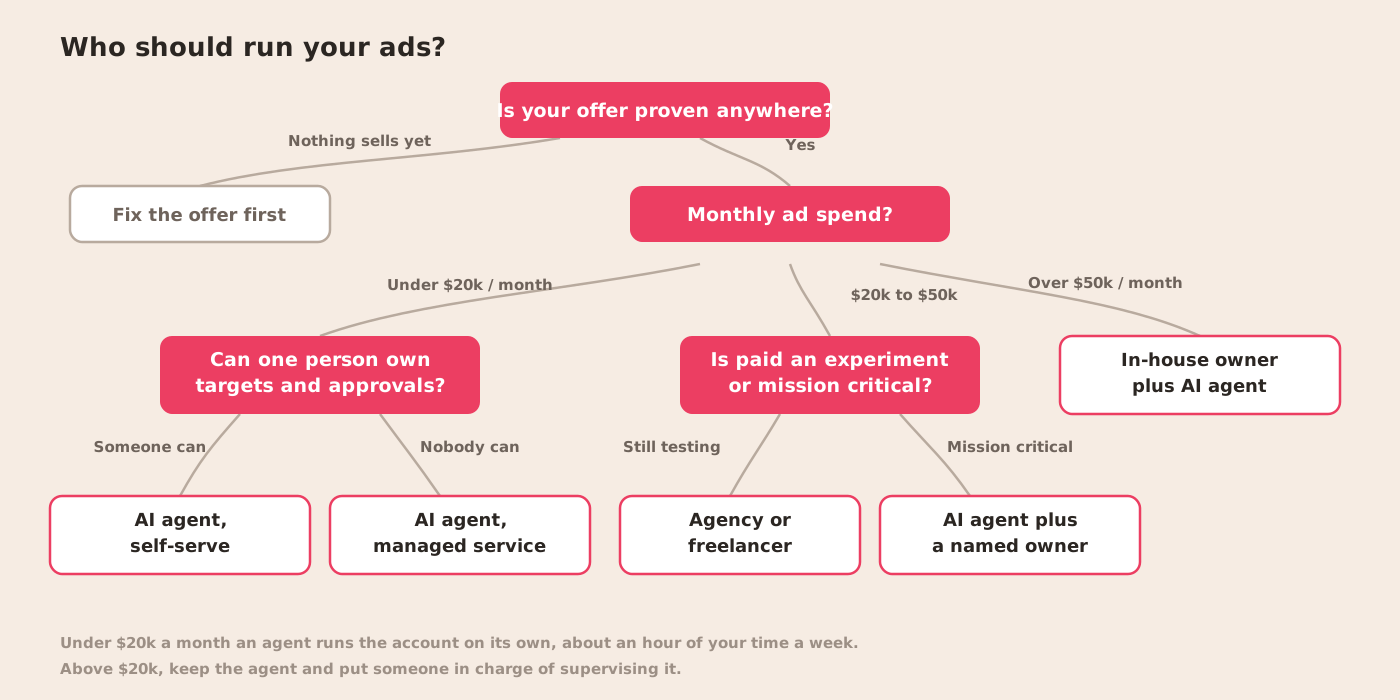
Five steps, in order.
Step 1: Is your offer proven anywhere?
Proof from any channel counts. Organic social, word of mouth, referrals, retail, inbound, repeat customers. Paid ads history is not required.
Your answer | Where you go |
|---|---|
Nothing is selling anywhere yet | Fix the offer first. Paid ads amplify what already works, and there is nothing to amplify yet. |
It sells, but only through organic or word of mouth | Go to step 2, and read the note below. This is the strongest case on this page. |
It sells, and paid ads have run before | Go to step 2. |
A proven offer that has never had paid budget behind it is the fastest growth most companies ever see. The demand is already confirmed. All that is missing is reach.
Step 2: How much do you spend on ads per month?
Your answer | Where you go |
|---|---|
Under $20,000 | An AI agent can run this on its own. Go to step 4. |
$20,000 to $50,000 | It depends. Go to step 3. |
Over $50,000 | In-house owner plus an AI agent, with an agency or freelancer for gaps. Go to step 5. |
Why the line sits at $20,000: below that, a retainer takes 20% to 40% of your budget, profit becomes structurally hard, and the pressure pushes you to quit before the channel has had a fair run. Above it, decisions carry enough weight that you want a person supervising the account regularly.
Step 3: Is paid an experiment or is it mission critical?
Your answer | Where you go |
|---|---|
An experiment, we are still testing whether this channel works for us | Agency or freelancer. Fast in, fast out, no permanent cost. This is the case the agency model was built for. |
Mission critical, our growth targets depend on it | Bring it in-house, which today means an AI agent with someone supervising it. Go to step 4. |
Step 4: Who owns it?
Your answer | Where you go |
|---|---|
One person can own targets, limits and approvals, even part-time, even with no ads background | AI agent, self-serve, with guided onboarding. Go to step 5. |
Nobody internally can own it | Managed service, where an account manager owns the agent and reports to you. Or a traditional agency, if you also need the breadth in step 5. |
Step 5: Do you need more than media buying?
Your answer | Where you go |
|---|---|
Media buying, creative and daily optimization only | An AI agent covers the whole job. |
We also need email, SMS, landing pages, affiliate, PR or offline media, and have nobody for it | AI agent for paid, plus an agency or specialist freelancers for the rest. |
Shortcut: find yourself in this list
Your situation | Best setup |
|---|---|
Ecommerce brand, $10,000 a month in spend, no marketing hire | AI agent, self-serve, about an hour of your time a week |
Proven offer selling organically, first time putting paid behind it | AI agent, self-serve, start small and scale as it works |
Local service business, no one internally to run ads | Managed service |
$30,000 a month, testing paid for the first time as a company | Agency or freelancer, then reassess in six months |
$30,000 a month, paid already carries the growth plan | AI agent with a named owner supervising it |
$80,000 a month, full marketing team, agency doing everything | In-house owner plus AI agent for paid, agency retained for the disciplines you do not cover |
Agency in place and performing, but slow and expensive | Agency plus AI agent, then renegotiate the retainer |
Strong Meta freelancer, nothing running on Google | Freelancer plus AI agent |
Frequently asked questions
Is an AI agent cheaper than an ads agency?
Yes, by a wide margin. A typical agency retainer runs $2,000 to $5,000 a month. AdAmigo.ai is $99 or $349 a month per ad account, and the fully managed option with a dedicated account manager is $899 a month. The bigger difference is what that cost does to your margin. A retainer has to be earned back by your ads on top of ad spend and product cost, and at smaller budgets that is very hard.
How much time does it take to run ads with an AI agent?
About an hour a week under $20,000 in monthly spend. Most of that is uploading new creative you want launched, then reading the updates and approving the optimizations it suggests. On autopilot, where it implements changes without asking, closer to 30 minutes. Above $20,000 you want someone checking in more regularly, because the decisions carry more weight.
Can AI replace a media buyer?
It replaces the execution work: building campaigns, writing and designing ads, daily optimization, reporting, spotting trends. It does not replace strategy or accountability. Someone still owns the targets and the direction. What changes is that this person no longer needs to be a trained media buyer.
At what ad spend does an agency stop making sense?
As a rule of thumb, below roughly $20,000 a month the retainer takes 20% to 40% of your budget and profitability becomes very difficult. Between $20,000 and $50,000 it depends on whether you need their breadth. Above $50,000 the question is usually in-house versus agency rather than agency versus nothing.
Is a freelancer better than an agency?
Different trade-off. A freelancer gives you direct communication, real attention and fast iteration, but a narrow skill set and no process to catch it if they are not excellent. An agency gives you breadth and a reliable floor, but thin attention and layered communication. Neither is better in general.
Do I need to know anything about ads to use an AI agent?
No. You need to be able to say what you sell, who you want to reach, what you want to spend, and what a good result looks like. The agent handles the rest and explains what it is doing so you can supervise it.
Can I use an AI agent alongside my agency?
Yes, and it is a common setup. The agency keeps strategy and creative production while the agent runs daily execution. Many companies use this to renegotiate their retainer down.
What if I have nobody to own it internally?
Use a managed service. With AdAmigo.ai, a dedicated account manager owns the agent, runs your Meta and Google ads, designs your creative, reports weekly and monthly, and gets your approval before strategic or creative changes go live.