
Neural Networks in Meta Ads: Key Benefits
Unified models (GEM, Meta Lattice) boost Meta ads with sequence learning and smarter targeting—3–5% more conversions, 10% revenue gain and 20% less compute.
Meta has transformed its ad systems by using advanced neural networks, delivering better results for advertisers and users alike. Here’s the quick takeaway:
Meta now uses deep neural networks with trillions of parameters to analyze user behavior with AI tools and improve ad performance.
Unified models like Meta Lattice and GEM (Generative Ads Recommendation Model) optimize ads across all platforms using AI tools for interest-based targeting (Facebook, Instagram, etc.).
Key results include:
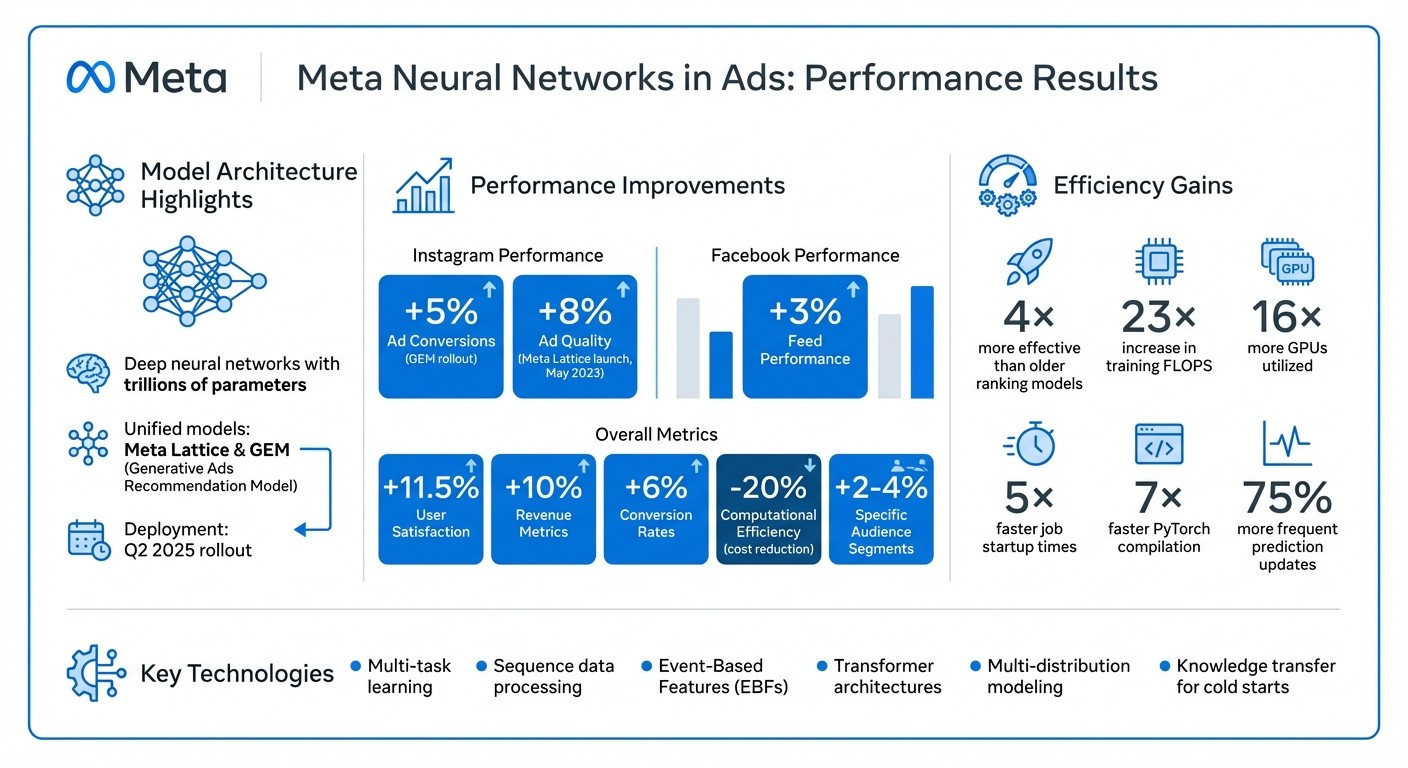
5% increase in Instagram ad conversions (Q2 2025, GEM rollout).
3% boost in Facebook Feed performance.
11.5% improvement in user satisfaction.
10% growth in revenue-driving metrics.
Advanced techniques like multi-task learning allow models to optimize for multiple goals (clicks, conversions, etc.) simultaneously.
Neural networks now process sequence data (e.g., browsing history) and non-sequence features (e.g., age, location) for precise targeting.
Challenges like delayed feedback and cold starts are addressed with knowledge transfer and temporal modeling.
Meta’s neural networks have also improved efficiency, cutting computational demands by 20% while delivering better results. These advancements make ad personalization smarter, timing more accurate, and campaigns more effective overall. This includes optimizing ad frequency to prevent audience fatigue while scaling.
Meta Neural Networks Performance Results: Key Metrics and Improvements
Meta’s AI Ads Engine Explained (Andromeda + ASC) | The Unofficial Shopify Podcast
How Neural Networks Improve Ad Performance
Meta has transitioned from using separate models for different formats like Feed, Stories, and Reels to implementing unified neural networks that work across all platforms. Using architectures such as Meta Lattice and GEM, the system now shares insights and knowledge across various objectives and surfaces without requiring manual adjustments. Advertisers can further evaluate these results using an ad performance analyzer to track specific ROI gains. For example, what the system learns about user engagement on one platform can be applied to enhance performance on another. This shift allows for more reinforcement learning for ad optimization and seamless integration across platforms.
Multi-Task Learning for Better Results
With this unified framework in place, Meta has introduced advanced strategies like multi-task learning. This approach allows a single model to optimize for multiple goals, such as clicks, video views, and conversions, all at the same time. A notable example is the launch of Meta Lattice on Instagram in May 2023, which led to an 8% improvement in ad quality by optimizing outcomes for both users and advertisers. The system uses a method called MetaBalance, which effectively manages thousands of objectives and domains. By achieving "Pareto optimality", the system ensures that no single metric improves at the expense of another.
"Meta Lattice is capable of improving the performance of our ads system holistically... through joint optimization of a large number of goals." - Meta AI
The results speak for themselves: 10% gains in revenue-driving metrics, an 11.5% boost in user satisfaction, and a 6% increase in conversion rates, all while cutting computational demands by 20%.
Balancing Multiple Campaign Goals
One of the key strengths of neural networks is their ability to balance conflicting objectives like awareness, engagement, and conversions. Using multi-distribution modeling, the system captures both immediate actions, like clicks, and delayed outcomes, like purchases, enabling advertisers to target short-term and long-term goals simultaneously. This temporal flexibility ensures campaigns remain effective across different time horizons.
The GEM architecture further enhances efficiency, proving to be 4× more effective than older ranking models. During its rollout in Q2 2025, GEM delivered a 5% increase in ad conversions on Instagram and a 3% boost in Facebook Feed performance. It continuously learns which features improve ad outcomes across various platforms, objectives, and ad formats.
Better Audience Insights Through Behavioral Pattern Recognition
Advancements in unified models have paved the way for deeper audience understanding, leading to more precise ad strategies.
Meta's neural networks have transformed how advertisers analyze their audiences through behavioral clustering. Instead of relying on manually designed features that often overlooked subtle patterns, the system now learns directly from raw user behavior using Event-Based Features (EBFs). These features standardize diverse data - like recent ad clicks, liked pages, and browsing history - into meaningful behavioral streams that reflect real user activity.
Analyzing User Behavior Patterns
Sequence modeling has revolutionized how user events are analyzed by maintaining their chronological order. Older systems reduced user actions into basic counts - like the number of clicks in a week - removing the context provided by event order. With architectures such as Transformers and Meta's Generative Ads Recommendation Model (GEM), sequences of thousands of events can now be processed, preserving the "purchase journey" to reveal shifts in user intent.
"Sequence information, i.e., the order of a person's events, can provide valuable insights for better ads recommendations relevant to a person's behavior." - Sri Reddy et al., Meta
Meta's Wukong model takes this even further by using cross-layer attention to identify which combinations of user traits and ad attributes drive engagement, often by testing emotional triggers within the creative. By analyzing factors like age, location, and previous purchases, the system uncovers patterns that traditional methods would likely miss. This capability allows for more accurate predictions of user actions, laying the groundwork for smarter targeting strategies. These predictions are most effective when paired with multi-format creatives that cater to different user preferences.
Predictive Targeting for More Conversions
Neural networks are particularly effective at forecasting future actions. Using multi-distribution modeling with temporal awareness, these systems can recognize, for instance, that a user adding an item to their cart today might complete the purchase a few days later. This temporal understanding ensures that ads reach users at the ideal moment in their decision-making process.
These advanced sequence learning systems have already shown results, driving a 2% to 4% increase in conversions within specific audience segments by improving prediction accuracy. By perfectly timing ad delivery to align with user behavior, these models further strengthen Meta's commitment to performance-driven, data-centric advertising and privacy strategies.
Better Ad Personalization and Targeting
Building on the performance improvements achieved through behavior analysis, personalization and targeting have taken a significant leap forward, making ads more effective than ever. Neural networks have transformed how Meta delivers personalized ads, moving away from static targeting rules. Instead of requiring advertisers to predict which demographics might convert, Meta's systems now analyze how AI learns from performance data and analyze dynamic creative ad results - everything from ad clicks to page likes and browsing habits. This approach, powered by Event-Based Features (EBFs), allows the platform to pick up on subtle preferences and intent signals that traditional methods often miss. The result? Ads that feel more relevant and engaging. This is often achieved by using AI agents to test creatives and optimize performance. This precision is also central to AI-powered retargeting, which re-engages users based on these deep behavioral signals. This shift is part of a broader trend in how AI predicts Meta ad performance to optimize ROI.
One standout example of this shift is the Generative Ads Recommendation Model (GEM), which was rolled out across Facebook and Instagram in Q2 2025. GEM leverages a wealth of user data to fine-tune every step of the purchase journey.
Dynamic Ad Customization
Dynamic customization takes these insights to the next level by tailoring ads in real time. Meta's InterFormer architecture, a key component of GEM, retains full sequence information while enabling cross-feature learning. This means it can uncover important connections between user traits and ad attributes. Even better, it allows these insights to flow seamlessly across platforms. For instance, engagement data from Instagram Reels can enhance ad targeting when the same user switches to browsing Facebook Feed.
The impact has been impressive: after GEM's launch in Q2 2025, ad conversions rose by 5% on Instagram and by 3% on Facebook Feed. Additionally, Meta Lattice brought an 8% improvement in overall ad quality by optimizing both user experience and advertiser goals simultaneously.
Solving Delayed Feedback and Cold Start Problems
Delayed feedback and cold start issues are common hurdles in digital advertising. Delayed feedback happens when a user clicks on an ad but doesn’t take action - like making a purchase - until days later. On the other hand, the cold start problem arises when launching a new campaign, product, or audience segment with little to no historical data available, often mirroring the challenges of the Meta Ads Learning Phase. Traditional systems often fall short in handling these situations, as they struggle with delayed or sparse conversions.
Meta has tackled these challenges using neural networks that incorporate multi-distribution modeling with a focus on temporal awareness. This method accounts for both immediate actions, such as a click happening within seconds, and longer-term behaviors, like a purchase made days after seeing an ad. By doing so, Meta's system stays effective even when conversions happen outside the attribution windows.
To address cold starts, Meta's GEM (Generalized Embedding Model) uses knowledge transfer to draw insights from patterns across platforms. For example, engagement data from Instagram video ads can help predict outcomes for a new Facebook Feed campaign, even if the new campaign has little interaction history. This strategy works hand-in-hand with the unified models mentioned earlier, ensuring strong performance right from the start. Meta AI explains:
"This mechanism is particularly useful for the 'cold start' problem - people can receive more relevant ad recommendations on emerging products and surfaces, even though there is little data to learn from, through better generalization".
The GEM model also tackles stale supervision, which refers to the lag between training a model and seeing real-world results. To solve this, Meta employs Student Adapters that continuously update predictions with the latest ground-truth data, keeping the system aligned with shifting user behaviors. These combined methods have already shown measurable improvements, building on prior successes.
Meta continues to enhance its ability to make accurate predictions, even when data is sparse or delayed.
Multi-Distribution Modeling for Limited Data
When dealing with sparse data - like during a new product launch or when targeting niche audiences - Meta's neural networks rely on multi-task and multi-domain learning. This approach identifies hidden engagement patterns across diverse data sources, enabling the system to predict user responses based on similar behaviors observed elsewhere. This capability is especially valuable for advertisers entering unfamiliar markets or launching new product categories, where waiting weeks for sufficient data could lead to wasted budget and inefficiencies, making ROI optimization difficult.
For example, Meta Lattice demonstrated an ~8% improvement in overall ad quality , which is a key factor in reducing ad costs by optimizing multiple objectives simultaneously. This ensures that even campaigns with minimal data can benefit from the collective insights of the platform.
Efficiency and Scalability Benefits
Unified neural networks are doing more than just improving predictive accuracy - they're streamlining operations in a big way. In the past, Meta managed separate systems for Feed, Stories, and Reels. This fragmented approach not only consumed extra computing power but also slowed down the pace of innovation.
Now, with unified architectures like Meta Lattice and GEM (Generative Ads Recommendation Model), those siloed systems have been replaced by single, high-capacity models. These models can handle multiple objectives across platforms simultaneously. This shift has significantly reduced computational demands and made the entire ad system more adaptable to new advancements. As Meta AI Research puts it:
"Maintaining a large model space often leads to slower proliferation of AI innovations and compute inefficiency".
GEM is 4× more efficient at improving ad performance using the same amount of data and computational resources compared to older ranking models. Meta has also revamped its infrastructure, achieving a 23× increase in training FLOPS, utilizing 16× more GPUs, cutting job startup times by 5×, and slashing PyTorch compilation times by 7×. This optimization doesn’t just save resources - it speeds up the innovation process.
Faster Innovation with Unified Models
These efficiency gains have a direct impact on how quickly Meta can experiment with and roll out new ad strategies. With unified models, engineers can focus on updating a few shared foundation models. A breakthrough on one platform, like Instagram Reels, can instantly benefit others, such as Facebook Feed, thanks to this "horizontal sharing" approach. This eliminates the need to create separate models from scratch.
Lightweight model variants make it easier to test new ideas quickly. Promising concepts are scaled up into full-fledged models without delay. GEM also employs a "Student Adapter" technique, which uses fresh ground-truth data to refine predictions. This method is twice as effective as traditional knowledge distillation approaches. Smaller models can therefore leverage insights from large foundational networks without increasing computational costs.
Performance Results and Use Cases
Meta's Meta Lattice deployment has delivered some impressive results. By using advanced neural network architectures, the company reported a 10% increase in revenue-driving top-line metrics, a 6% boost in conversion rates, and an 11.5% improvement in user satisfaction. On top of that, Meta achieved 20% capacity savings in its infrastructure. These gains have paved the way for more focused improvements in critical areas like ad click-through rates (CTR) and return on ad spend (ROAS) benchmarks.
CTR and ROAS Improvements
When Meta introduced the Lattice architecture to Instagram, the platform saw an ~8% improvement in ad quality. This was largely thanks to next-generation sequence learning systems, which rely on user engagement data instead of manually crafted features. These systems drove 2–4% more conversions in specific audience segments.
The key to these improvements lies in how the neural networks process behavioral signals. They can analyze far more data with greater precision and refresh predictions 75% more often than traditional models. This allows advertisers to adapt quickly to shifts in user behavior, maximizing the impact of their campaigns. This is often achieved through full-funnel AI optimization that automates targeting and monitoring.
Industry Case Studies: Travel and Other Sectors
These performance boosts aren't limited to Meta's platforms - they're driving results across industries. Advertisers in sectors like e-commerce, travel, and app installs are seeing measurable benefits. By using creative-first optimization, where neural networks test multiple ad variations simultaneously, advertisers have reduced their cost-per-acquisition while boosting returns.
As Rochelle D., a G2 Reviewer for AdAmigo.ai, shared:
"We are getting INSANE RESULTS ;) our budgets are controlled, our spend is being smartly allocated and our ROAS is up massively."
This efficiency is particularly impactful in industries like travel, where conversion cycles are longer and user intent can change quickly. By lowering cost-per-lead and increasing profitability, these innovations are helping businesses thrive in competitive markets.
Using Neural Networks with AdAmigo.ai
Meta's neural networks power the insights that AdAmigo.ai uses to simplify and enhance campaign management. These insights lay the foundation for a range of efficient tools and features, which are outlined below.
Key Features of AdAmigo.ai
AdAmigo.ai's AI Ads Agent takes the guesswork out of advertising. It analyzes your brand, tracks top-performing ads, and instantly delivers tailored creatives directly into your ad account. The AI Actions feature provides a daily, auto-prioritized list of impactful tweaks across creatives, AI vs manual audience creation, budgets, and bids. This is all driven by the same advanced behavioral pattern recognition that powers Meta's audience targeting.
One feature that really stands out is its natural language interface. As Jakob K., a G2 reviewer, described:
"The fact that you can launch campaigns through text or voice commands feels like magic! It handles everything from creating lookalike audiences to scaling budgets with just a few prompts".
Additionally, the AI Chat Agent provides real-time diagnostics, actionable insights, and the ability to launch multiple campaigns through conversational commands.
Benefits of Using AdAmigo.ai for Meta Ads
AdAmigo.ai offers tangible improvements in ad performance. Inspired by Meta's unified model approach, it combines creative, targeting, bid, and budget adjustments into one cohesive system. This integration ensures faster results by aligning both user and advertiser goals.
Another big win? Cost savings. AdAmigo.ai costs about one-seventh the price of traditional agencies while delivering better ROAS. For agencies, a single media buyer can handle 4–8× more clients by letting the AI take care of execution. In-house teams can scale back on expensive hires or use AdAmigo.ai to complement their efforts. The system works 24/7, refining strategies while respecting every rule you set - whether it’s budget limits, pacing, geo-targeting, or placement preferences.
Conclusion
Unified neural network models have reshaped how Meta ads perform. Instead of relying on hundreds of separate models making individual decisions, systems like Meta Lattice and GEM now work as one interconnected system, optimizing creatives, targeting, bids, and budgets seamlessly. For example, Meta's GEM model achieved a 5% increase in Instagram ad conversions and a 3% boost on Facebook Feed in Q2 2025 - all while being four times more efficient.
By moving away from manual feature engineering to event-based sequence learning, these networks can better track shifting purchase intent and tackle challenges like delayed feedback and attribution and cold starts. This shift not only improves prediction accuracy but also makes it easier to integrate these advancements into campaign management tools.
Platforms such as AdAmigo.ai bring these neural network advancements to life by offering actionable, user-friendly solutions. They provide daily prioritized recommendations, AI tools for creative generation, and even conversational tools for launching campaigns, making cutting-edge technology accessible for advertisers.
FAQs
How do neural networks enhance ad personalization on Meta platforms?
Meta platforms use neural networks to refine ad personalization by analyzing extensive user behavior data, such as browsing habits and interactions. These deep-learning models predict user preferences, enabling the delivery of ads that align closely with individual interests.
By continuously fine-tuning ad creatives and optimizing relevance scores, these networks enhance ad quality and improve conversion rates. This approach ensures users encounter ads that match their needs, benefiting both advertisers and audiences with a more engaging and effective experience.
What challenges does Meta face with delayed feedback and new campaigns, and how are they solved?
Meta’s ad delivery system grapples with two major machine learning hurdles: delayed feedback and cold starts. Delayed feedback happens because actions like purchases or sign-ups often take hours - or even days - after someone views an ad to register. This delay makes it tricky for the system to quickly evaluate how well an ad is performing. On the other hand, cold starts occur when new campaigns, creatives, or target audiences have no historical data for the algorithm to work with, leaving it flying blind in the early stages. Both challenges can result in inefficient bidding, wasted budgets, and slower optimization.
To tackle these problems, Meta employs cutting-edge neural network technologies. The Andromeda retrieval engine processes billions of real-time signals, helping bridge the gap between ad impressions and conversion data. This allows for quicker adjustments and more responsive performance. For cold starts, the Generative Ads Model (GEM) steps in, drawing insights from existing campaigns to estimate how new ads might perform - even when no prior data exists. Meanwhile, the Lattice framework combines data from multiple sources, streamlining the learning process and reducing inefficiencies. These tools work together to keep Meta’s ad delivery system precise, efficient, and ready to adapt.
How does the GEM architecture improve ad efficiency compared to older models?
The Generative Ads Model (GEM) is transforming ad performance by replacing Meta's older setup of multiple specialized models with a single, scalable foundation model. In the past, Meta relied on dozens - or even hundreds - of independent neural networks, each trained separately for specific tasks. This approach not only duplicated efforts but also consumed more GPU resources.
GEM simplifies this by centralizing the process. Instead of running numerous models, one large-scale model is trained across thousands of GPUs, sharing its insights across all ad prediction tasks. This unified system cuts down infrastructure costs, accelerates predictions, and delivers more accurate results.
Thanks to its ability to scale efficiently with added parameters, GEM enables faster processing and higher conversion rates, making it a far more efficient solution compared to the fragmented systems it replaces.