
Top 7 Strategies for Scaling Small Meta Ad Budgets
Scale Meta ads on a $20–$30 daily budget by spending smarter: gradual budget increases, cost-cap bidding, creative testing, ABO→CBO shifts, and AI automation.
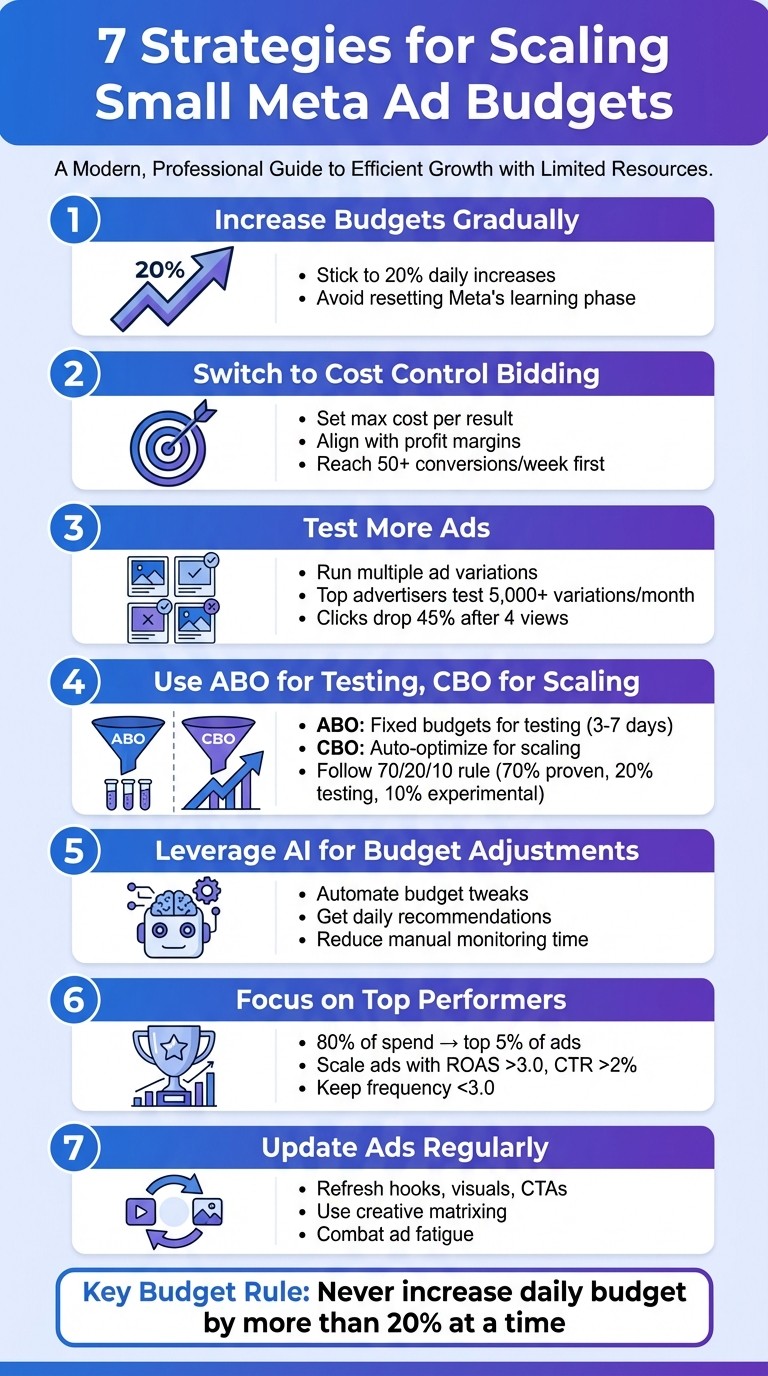
Scaling Meta ads with a small budget? The key is spending smarter, not just spending more. With limited funds (e.g., $20–$30 daily), it's essential to avoid common pitfalls like scaling too fast or spreading spend across too many ad sets. Here are the 7 best strategies to grow your campaigns effectively while keeping costs under control:
Increase Budgets Gradually: Stick to a 20% daily increase to avoid resetting Meta’s learning phase.
Switch to Cost Control Bidding: Set a max cost per result to align with your profit margins.
Test More Ads: Run multiple ad variations to gather performance data and avoid audience fatigue.
Use ABO for Testing, CBO for Scaling: Allocate fixed budgets for testing, then let Meta optimize for scaling. 5. Leverage AI for Budget Adjustments: Automate tweaks with tools like AdAmigo.ai to save time and improve results.
Focus on Top Performers: Redirect budgets to ads that meet key metrics like ROAS and CTR.
Update Ads Regularly: Refresh ad elements (e.g., hooks, visuals) to maintain engagement and prevent ad fatigue.
Scaling requires patience, data-driven decisions, and consistent updates to your campaigns. AI tools can simplify the process by automating repetitive tasks like budget adjustments, ad creation, and performance tracking. By following these steps, you can grow your campaigns without wasting your budget.
7 Strategies for Scaling Small Meta Ad Budgets Effectively
1. Increase Your Budget Gradually Each Week
Budget Efficiency
When it comes to adjusting your ad budget on Meta, patience is key. Avoid increasing your daily budget by more than 20% at a time. Why? Meta treats larger jumps as major edits, which can reset the ad set's learning phase. Once reset, the algorithm has to relearn delivery patterns, often leading to higher costs and reduced performance. This disruption affects key machine learning metrics that govern ad delivery. For instance, a sudden 150% budget increase can instantly disrupt optimization.
To keep things running smoothly, stick to the 20% rule. Some experts even suggest smaller adjustments - around 5% to 7% - to maintain maximum stability. Gradual increases ensure your campaign remains efficient and avoids unnecessary turbulence.
Ad Performance Optimization
Making small, steady budget adjustments helps you maintain consistent acquisition costs and a stable return on ad spend (ROAS). Respecting the learning phase is crucial for keeping your cost per acquisition predictable. Rushing the process can undermine your campaign’s foundation. As AdStellar AI wisely points out:
"scaling a weak campaign is like building a skyscraper on sand - it collapses under its own weight."
Before scaling further, confirm that your campaign is delivering solid, sustainable results. Trying to scale an unproven campaign often leads to wasted budget and poor outcomes.
2. Switch to Cost Control Bidding
Budget Efficiency
Once you've fine-tuned your budget pacing, switching to cost control bidding is a smart next step for keeping expenses under control. This method allows you to set a maximum cost per result, ensuring Meta doesn't overspend while still aligning with your profit margins. For businesses with tighter budgets, this strategy is a lifesaver - it curbs overspending while still leveraging Meta's system to optimize ad delivery.
If you're working with smaller budgets, hitting the 50-conversion threshold can feel like an uphill battle. Consolidating ad sets can make a big difference here. By pooling your budget, you can hit that 50-conversion mark faster, giving Meta’s AI the data it needs to identify cost-efficient opportunities more effectively. This is a clear example of how consolidating ad sets can improve your campaign's efficiency.
Ad Performance Optimization
Before setting cost controls, make sure your campaign is generating at least 50 optimization events per week. If you base decisions on fewer conversions, you might end up chasing patterns that are just noise rather than real trends.
When it comes to setting your cost cap, aim for balance. Meta's system may flag your campaign as "high cost per result" if the estimated cost is double that of similar past campaigns. If you're too aggressive with your cost cap, ad delivery could grind to a halt. A better approach? Start with a cost cap slightly below your current average and tighten it gradually as your campaign performance improves.
Automation and AI Integration
Manually managing cost controls across multiple ad sets can be a time drain. This is where AI tools step in to save the day. They monitor performance and adjust bids automatically to keep you within your target costs. For instance, Meta's Advantage+ campaign budget feature reallocates spending to ad sets that show the best opportunities.
Automation not only simplifies scaling your campaigns but also frees you from juggling spreadsheets. Tools like AdAmigo.ai (https://adamigo.ai) continuously refine bids and budgets, allowing you to focus on the bigger picture - your overall strategy and creative direction.
3. Run More Creatives to Generate Better Data
Ad Performance Optimization
By 2026, creative content has become the backbone of ad targeting. Meta's algorithm now evaluates your ad’s text, visuals, and audio to decide who should see it. Testing a variety of creatives provides the system with the data it needs to fine-tune audience targeting.
When you test multiple creatives, you gather critical performance insights. Early indicators like click-through rate (CTR) and engagement rates help identify which ads grab attention. Mid-funnel metrics, such as cost per signup, reveal whether that attention translates into meaningful actions. Interestingly, after a user sees the same creative four times, their likelihood of clicking drops by about 45% due to ad fatigue. That’s why top-performing mobile app advertisers test over 5,000 ad variations every month to keep their campaigns effective. This constant flow of data lays the groundwork for scalable creative strategies.
Creative Scalability
Once you identify high-performing creatives, scaling becomes a matter of strategy. The 80/20 rule applies here: approximately 80% of ad spend tends to be driven by the top 5% of creatives. To uncover those top performers, high-volume creative testing is essential. The formula for success in 2026 is straightforward: combine quantity with diversity. Regularly introducing fresh ad variations allows the system to learn and optimize.
You don’t need a massive design team to make this work. A creative matrix approach can streamline the process. Break a successful ad into modular components - such as hooks, body copy, and calls to action (CTAs). By mixing and matching these elements, you can create nine or more variations from a single ad. If an ad performs well in mid-funnel metrics but struggles with engagement, tweak the hook (like the first few seconds of a video or the headline) to boost its ability to grab attention.
Automation and AI Integration
Keeping up with the demand for creative testing can be overwhelming without automation. Manually producing dozens of ad variations isn’t realistic for teams on tight budgets. Fortunately, AI tools can now generate high-quality static and video ads, eliminating the need for a dedicated design team. Platforms like AdAmigo.ai (https://adamigo.ai) streamline the process by automatically creating on-brand, conversion-focused ads and launching them directly into your ad account. This ensures you maintain the creative momentum necessary for scaling without overstretching your team or budget.
4. Use ABO for Testing and CBO for Scaling
Budget Efficiency
Once you've nailed down budget pacing and creative testing, the next move is structuring your campaigns with ABO (Ad Set Budget Optimization) and CBO (Campaign Budget Optimization). Here's how it works: ABO allows you to assign fixed budgets to individual ad sets, making it a great tool for testing. Meanwhile, CBO automatically allocates your budget to the best-performing ad sets, ensuring efficient scaling.
Start with ABO to test new audiences and creatives. This approach ensures each ad set gets enough budget to gather meaningful data, preventing Meta's algorithm from prematurely favoring one ad set over others. After 3–7 days of testing, identify ad sets that hit your target cost per acquisition (CPA) or return on ad spend (ROAS). These proven ad sets can then be moved into a CBO campaign for scaling. In CBO, the algorithm dynamically reallocates your budget throughout the day to focus on ad sets that deliver the best results.
"The difference between a 1.5x ROAS and a 4x ROAS often comes down to how intelligently your budget flows through your account structure." – AdStellar
This strategy ensures every ad set gets the data it needs during testing, setting you up for better performance when scaling.
Ad Performance Optimization
The 70/20/10 framework is a handy guide for balancing testing and scaling. It suggests splitting your budget as follows: 70% for proven winners, 20% for ABO testing, and 10% for experimental creatives. To optimize effectively, each ad set should aim for around 50 conversions per week to exit the learning phase.
When shifting to CBO for scaling, it's smart to set minimum spend limits on new ad sets. This ensures they gather enough data before the algorithm deprioritizes them. By carefully dividing your budget between testing and scaling, you can get the most out of every dollar while boosting your overall ROAS.
Automation and AI Integration
Managing the constant back-and-forth between ABO testing and CBO scaling can get overwhelming, especially when you're handling multiple campaigns. That’s where automation tools come in. Platforms like AdAmigo.ai (https://adamigo.ai) can track performance across your account and automatically adjust budgets based on results. Its AI Actions feature even provides a daily list of high-impact budget tweaks. You can approve these changes with a single click or let the system handle them automatically, all while keeping your pacing and budget rules intact.
5. Let AI Handle Budget Adjustments
Budget Efficiency
Once you've set up your creative and allocation strategies, let AI take over the fine-tuning of your budget adjustments. Managing budgets manually can eat up a lot of time and often leads to reactive decisions that aren't always the best use of funds. AI tools change the game by offering continuous, data-driven adjustments, even for smaller budgets. Instead of constantly checking dashboards, you’ll receive a daily prioritized list of impactful budget tweaks. Approve them with a single click or let the system handle everything automatically.
Machine learning algorithms analyze key metrics like ROAS (Return on Ad Spend), CTR (Click-Through Rate), CPA (Cost Per Acquisition), and frequency before making any budget changes. This ensures adjustments are based on solid performance data, with AI adapting thresholds as trends shift in real time. Whether it’s a seasonal fluctuation or an unexpected market change, your campaigns stay optimized.
Ad Performance Optimization
A standout benefit of AI-driven budget management is predictive analytics. These systems identify early signs of trouble - like rising CPMs (Cost Per Thousand Impressions) or declining CTRs - and make adjustments before your ROAS takes a hit. This proactive approach ensures your campaigns stay on track, so you’re not scrambling to fix issues after they’ve already hurt performance.
To avoid wasting money on underperforming ads, you can set up automation rules for scaling. For example, automatically pause any ad set that spends over $25 without generating a single conversion. This simple safeguard prevents unnecessary overspending. When scaling up, AI can also incrementally increase budgets - by 10–25% every 2–3 days - helping you avoid disrupting Meta's learning phase while still growing your campaign.
Automation and AI Integration
Platforms like AdAmigo.ai (https://adamigo.ai) take budget optimization to the next level by integrating it with creatives, targeting, and bidding strategies. Their AI Actions feature provides daily budget recommendations that you can either approve manually or set to auto-publish. The platform respects all your budget, pacing, geo, and placement rules, giving you full control while handling the heavy lifting.
Aspect | Manual Scaling | AI Automation |
|---|---|---|
Time Investment | Requires daily hands-on monitoring | Simplifies decisions with daily recommendations |
Scaling Speed | Limited by human capacity to analyze data | Simultaneously manages multiple campaigns and metrics |
Budget Optimization | Reactive, based on periodic reviews | Proactive, leveraging real-time insights |
Error Risk | High - prone to emotional or rushed decisions | Low - follows logical, multi-condition processes |
Allow AI tools to run for 7–14 days to establish a performance baseline. During this learning phase, the system will fine-tune its optimization logic based on your account’s unique patterns. This process works hand-in-hand with the gradual scaling and creative testing strategies mentioned earlier, creating a well-rounded system for steady growth.
6. Focus Spending on Top-Performing Ads
Budget Efficiency
Once you've nailed down which ads are delivering the best results, it’s time to double down. Shift your budget toward these proven winners to maximize returns. In most high-performing accounts, about 80% of the total spend tends to go toward the top 5% of ads. This isn’t by chance - it’s about deliberately channeling funds into ads that consistently perform well. Strike a balance by prioritizing these top performers while still leaving room for testing new ideas. That way, you can scale what works while staying open to fresh opportunities.
When reallocating budgets, keep changes gradual - no more than 20% per day - to avoid disrupting the learning phase. Tools like Campaign Budget Optimization (CBO) can handle this dynamically, allowing Meta’s algorithm to allocate funds in real time to your best-performing ad sets.
Ad Performance Optimization
Scaling isn’t just about throwing money at a good ad. Before increasing spend, make sure the ad hits these key benchmarks: a ROAS above 3.0 (averaged over three days), a CTR above 2%, CPA at least 20% below your target, 50+ conversions per week, and a frequency score under 3.0. If an ad consistently meets these metrics over 30 days, with ROAS staying within a 15% range, you’ve got a scalable winner.
Don’t just stop at the basics - watch for early and mid-funnel signals too. High CTRs, strong thumbstop rates, and low CPC suggest the ad is grabbing attention effectively. If click-to-conversion rates are solid and cost per add-to-cart remains low, it’s a good sign your traffic is qualified. To avoid bidding against yourself, use Meta’s Auction Overlap tool when consolidating spend. And once your metrics are strong, keep the momentum going with fresh creative ideas and automated testing.
Creative Scalability
Here’s the catch with scaling: over time, even the best ads can hit a wall due to creative fatigue. To keep things fresh, take your top-performing ads and break them into modular components - like hooks, body text, and calls-to-action - to create new ad variations. This "creative matrix" approach lets you refresh your campaigns without starting from scratch. Plus, Meta’s algorithm now uses your ad’s visuals and text to determine audience reach, so updating creative elements can extend an ad’s lifespan.
Automation and AI Integration
Managing budgets across multiple ads can quickly become overwhelming. That’s where automation tools come in. Platforms like AdAmigo.ai (https://adamigo.ai) simplify the process by monitoring campaigns and offering manual vs. autopilot recommendations for reallocating spend. Its AI Actions feature identifies ads that meet your scaling criteria and suggests budget increases, all while sticking to the 20% rule. You can either approve these changes with a single click or let the system handle everything autonomously. By aligning creatives, targeting, bids, and budgets, this integrated approach can amplify your results.
7. Update Creatives and Add Partnership Ads
Creative Scalability
Creative fatigue is often a bigger challenge than budget when scaling ad campaigns. For example, a high-performing ad running at $500 daily might last 14 days, but if you ramp it up to $2,000 daily, it could burn out in just 5 days.
"Creative is the new targeting. Meta analyzes your ad content - text, visuals, audio - and uses it to figure out who should see it." – Sasha, Co-founder, Spiral.ad
To counter this, use multi-format creative matrixing. This technique involves mixing and matching elements like hooks, body copy, and calls-to-action (CTAs) to produce multiple ad variations. For instance, combining 3 hooks with 3 body messages and 3 CTAs gives you 9 fresh options. Additionally, you can breathe new life into successful ads by localizing them or incorporating partnership ads. Translating a top-performing ad into Spanish for U.S. Hispanic audiences, for example, has been shown to boost monthly recurring revenue by 25%. Including user-generated content (like reviews or testimonials) adds social proof, which can build trust and reduce acquisition costs, particularly for small businesses.
Once you have a pool of refreshed creatives, the next step is testing and optimizing their performance to maximize results.
Ad Performance Optimization
When launching new campaigns, expect a win rate of about 10% for new accounts and closer to 5% for mature ones. Leading mobile app advertisers set the bar high, creating over 5,000 ad variations every month.
"The formula for scaling in 2025 = quantity × diversity of ads. Growth comes from consistently feeding the system fresh inputs." – Spiral.ad
For best results, focus on the basics when creating ads. In videos, grab attention with a strong hook within the first 3 seconds. Use optimized aspect ratios - like 1:1 or 4:5 for feed ads and 9:16 for Stories or Reels - and ensure key visuals stay within the "safe zone" to avoid cropping issues. Authentic visuals, such as behind-the-scenes clips, product photos, or customer selfies, often perform better than polished, studio-quality ads.
Automation and AI Integration
Managing constant creative updates can feel overwhelming, but AI-driven tools can simplify the process. Platforms like AdAmigo.ai (https://adamigo.ai) can break down your winning ads into modular components and generate new variations automatically. Their AI Ads Agent analyzes your brand identity, identifies top-performing ads, and delivers ready-to-launch creatives directly to your ad account. Features like Bulk Ad Launch allow you to quickly create and launch dozens - or even hundreds - of Meta ads using pre-set copy, visuals, and targeting directly from your Google Drive.
This automation is a game-changer, enabling you to maintain a steady flow of on-brand, conversion-focused ads while saving time. And with AI-driven static ad design already in play, full video editing capabilities are just around the corner.
How To Crush Meta Ads with a Small Budget (2026)

Conclusion
Scaling a small Meta ad budget doesn’t mean spending more - it’s about spending smarter. The strategies outlined - like gradual budget increases, cost control bidding, creative testing, ABO/CBO testing, AI-driven bid adjustments, focusing on top performers, and regular creative updates - work together seamlessly. Gradual increases protect the algorithm, diverse creatives keep your audience engaged, and automation handles tedious optimization tasks.
Before scaling, make sure your foundation is solid. Double-check that your Meta Pixel and Conversions API are tracking accurately (aim for a match quality score above 7.0), and ensure your campaigns generate at least 50 conversions per week. Weak foundations are often the culprit behind failed scaling attempts - 73% of them falter within the first week.
When you’re ready, apply the 70/20/10 budget allocation rule: allocate 70% of your budget to proven performers, 20% to testing new audiences, and 10% to experimental ideas. Pair this with a strict 20% daily budget adjustment cap. This disciplined method helps you scale spending without disrupting the algorithm.
Creative variety is another cornerstone of success. By using a mix of formats like videos, static images, and carousels, you enable Meta’s algorithm to find the right audience across different placements. This approach also minimizes the "monotony tax", which can lead to higher CPMs. To keep things fresh, establish a weekly cycle for updating visuals and messaging - creative fatigue sets in faster as spending increases.
For an even smoother experience, consider AI tools like AdAmigo.ai (https://adamigo.ai). This platform automates creative production and handles daily adjustments for budgets, audiences, and bids. Setup is quick - just connect your Meta ad account, set your KPIs, and let the tool optimize your campaigns. Starting at $99/month, it’s an affordable way to scale without adding to your team.
FAQs
How can I use AI tools to optimize my Meta ad budget effectively?
To make the most of your Meta ad budget, consider using AI tools that bring automation and smart analysis into the mix. These tools, like AdAmigo.ai, can handle tasks such as crafting customized ad creatives, fine-tuning audience targeting, and adjusting bids and budgets in real-time. This allows you to focus more on big-picture strategies rather than getting bogged down in day-to-day optimizations.
For instance, you can automate budget adjustments by gradually increasing spend (say, 10-25%) when your return on ad spend (ROAS) surpasses your goals. On the flip side, ads with high cost-per-acquisition (CPA) can be paused automatically. AI tools also shine when it comes to discovering fresh audience segments, experimenting with creative variations, and shifting budgets toward campaigns that are delivering the best results. These capabilities are especially useful when you're working with tight budgets or scaling campaigns step by step.
By embracing AI tools that continuously adapt and refine their approach, you can boost your ROI, cut down on time spent micromanaging, and ensure your ad dollars are going toward strategies that truly make an impact.
What are the advantages of using ABO for testing and CBO for scaling Meta ads?
ABO (Ad Set Budget Optimization) is perfect for testing because it gives you full control over how much budget each ad set gets. This means you can test specific audiences and creatives without interference, making it easier to see what works best.
On the flip side, CBO (Campaign Budget Optimization) is ideal for scaling. It automatically allocates your budget across ad sets, focusing on the ones performing the best. This saves you time and ensures your budget is used efficiently.
A smart approach is to start with ABO to pinpoint your top-performing audiences and creatives. Once you've identified the winners, switch to CBO to scale those successes effortlessly. It’s a practical way to maximize your results, even when working with a tight budget.
Why is it essential to refresh ad creatives regularly when scaling Meta ad campaigns?
Refreshing your ad creatives often is key to keeping your campaigns performing well. Meta's algorithm thrives on variety, and sticking with the same assets for too long can lead to problems like higher CPMs, lower engagement, and reduced reach. All of this can drag down your campaign's success.
When you introduce new creatives, you not only keep your audience interested but also improve ad relevance. Plus, it gives Meta's algorithm more chances to discover combinations that work. This approach helps control costs and ensures your campaigns remain effective as they grow.