
Common Budget Allocation Mistakes AI Fixes
AI fixes common Meta ad budget mistakes by consolidating ad sets, automating reallocation, pacing scale, and optimizing learning-phase spend for better ROAS.
Struggling with Meta ad budgets? AI can help. Missteps like spreading budgets too thin, scaling too fast, or underfunding ad sets can hurt performance and waste money. AI tools like AdAmigo.ai solve these problems by reallocating budgets in real time, scaling gradually, and focusing spend on top-performing ad sets. Here’s how AI tackles five common budget mistakes:
Thin Budget Splits: AI consolidates funds into 2–4 high-performing ad sets to ensure optimal conversions.
Manual Budgeting: AI automates reallocation, avoiding wasted spend and missed opportunities.
Low Budgets in Learning Phase: AI adjusts budgets dynamically to hit 50 conversions/week.
Frequent Budget Changes: AI scales gradually (10–20%) to maintain stability and prevent cost spikes.
Equal Budget Distribution: AI prioritizes high-performing ad sets, reallocating funds from underperformers.
AI tools reduce inefficiencies, improve ROAS, and eliminate the need for constant manual monitoring. Want better results? Let AI handle the heavy lifting.
How To Scale Meta Ads from $30k-$100K/Month with AI!

Mistake 1: Splitting Budgets Across Too Many Ad Sets
When you spread your budget across too many ad sets, you risk starving them of the conversions they need to perform well. Meta's algorithm requires about 50 conversions per week per ad set to move out of the learning phase. If this doesn’t happen, the ad set gets stuck in a "learning limited" status. For instance, one ad set might dominate by consuming 70–80% of your budget, while others sit idle for over 48 hours. Ads Manager may also flag audience fragmentation, a common issue when comparing AI vs manual audience creation, signaling that your budget is too small for the audience size. This fragmentation can lead to ad sets competing against each other, which drives up costs unnecessarily, often a symptom of ad fatigue, though there are several ways to reduce Facebook ad costs.
AI Fix: Automatic Budget Consolidation
AI tools like AdAmigo.ai offer a solution by continuously analyzing ad set performance. Their AI Actions feature identifies underperforming ad sets using an ad performance analyzer and reallocates budgets to focus on the 2–4 ad sets that are actually converting. This ensures that the top-performing ad sets get the necessary 50 conversions to exit the learning phase, while also cutting down on wasted ad spend.
Mistake 2: Not Using Advantage+ Campaign Budget Optimization
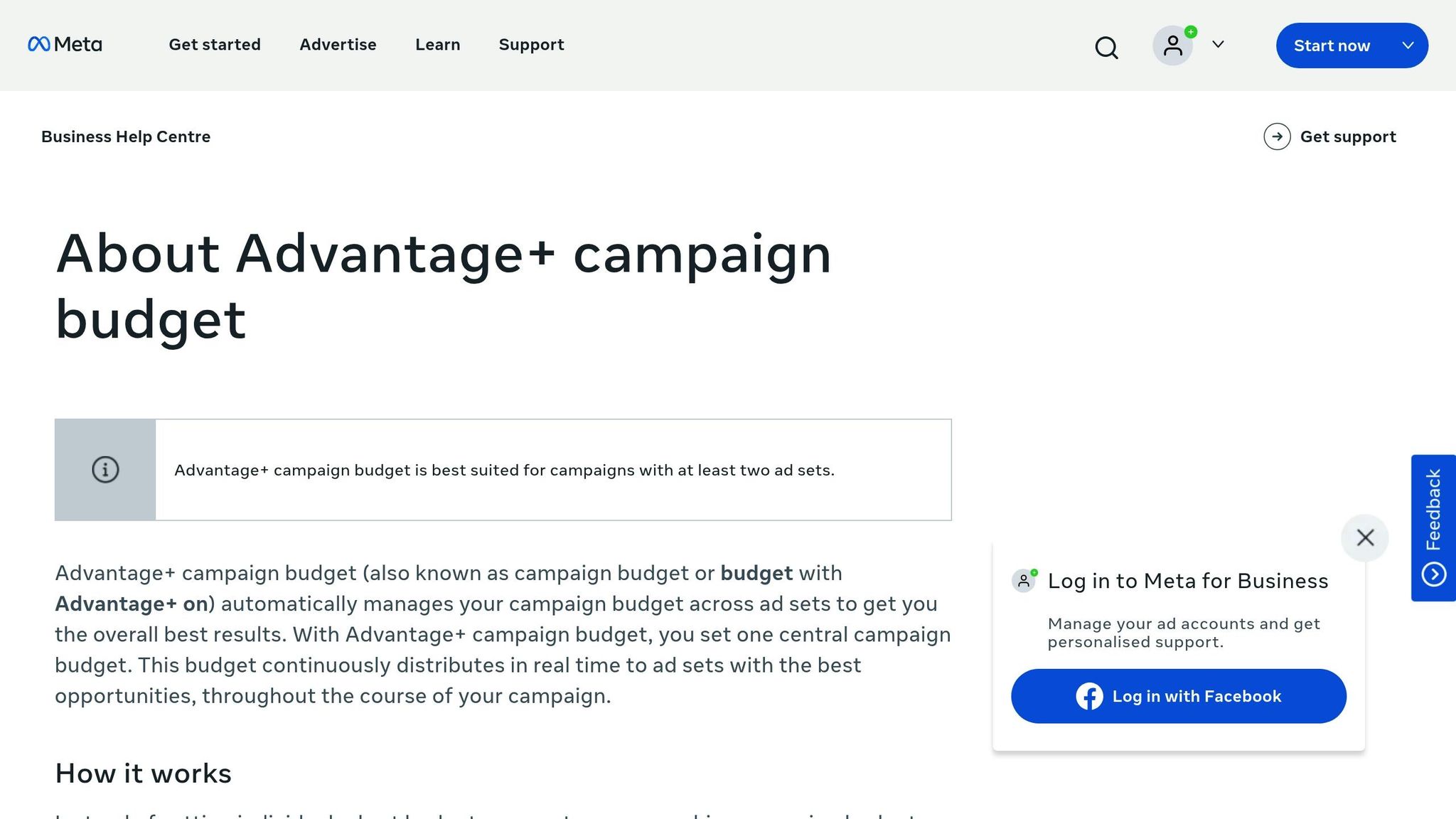
Manually setting budgets for each ad set can feel like you're in control, but it often works against you. When budgets are fixed and don’t adapt to real-time performance, underperforming ad sets drain funds while your top-performing ones hit daily caps during peak conversion times. The result? You’re losing money on ineffective ads while missing out on high-value opportunities. For campaigns to grow effectively, a flexible budget strategy is a must.
With manual budgeting, you’re tied to constant monitoring, risking missed conversions when you’re offline. According to Meta, using Advantage+ Campaign Budget Optimization (CBO) best practices can lead to 27% lower costs per result compared to manual budgeting. Why? Because it dynamically reallocates spending to focus on what’s working at any given moment.
While manual vs AI budget testing shows that manual control creates inefficiencies, it also risks performance. You’re left juggling multiple budgets and trying to keep pace with algorithm updates. Advantage+ CBO simplifies this process by letting Meta’s AI handle budget distribution at the campaign level. It shifts funds automatically to the ad sets delivering the best results, ensuring your money is spent where it counts most.
AI Fix: Automatic Budget Reallocation
An AI Media Buyer removes the hassle of manual budget adjustments by reallocating funds in real-time. Platforms like AdAmigo.ai take Advantage+ CBO a step further by automating this process entirely. Their system ensures your top-performing ad sets keep running, even during peak conversion times when you’re not actively monitoring your campaigns.
To make the most of this, set Cost Caps at 20–30% above your target CPA. This gives the AI enough flexibility to secure conversions without letting costs spiral. AdAmigo’s AI Actions feature tracks performance daily and offers recommendations to improve results - whether that’s scaling up successful ad sets faster or preventing overspending. The system works within the rules you set, ensuring your budgets, pacing, and placements stay aligned with your strategy. This way, you keep control while avoiding the constant grind of manual reallocation.
Mistake 3: Setting Budgets Too Low During Learning Phase
When starting new ad sets, it’s important to know that they require about 50 optimization events (like purchases or leads) within a 7-day period to move out of the learning phase. If your budget is too low compared to your cost per acquisition (CPA), it limits impressions and reduces the chances to test different audiences, placements, and creatives effectively. This often results in campaigns becoming "Learning Limited", where ad sets remain stuck in the learning phase and can lead to 10% higher customer acquisition costs.
To sidestep this problem, apply the 5x Rule: set your daily budget at five times your expected CPA. For instance, if your target CPA is $10, start with a $50 daily budget. This approach helps you meet the 50-event weekly threshold. If hitting 50 purchases per week isn’t realistic, consider optimizing for higher-funnel actions like "Add to Cart" or "Landing Page Views" to collect more data.
AI Fix: Smart Budget Scaling
A more flexible way to handle this challenge is through automated scaling rules. AI tools can simplify this process by analyzing past performance and automatically scaling budgets to help campaigns exit the learning phase faster. For example, AdAmigo.ai uses your conversion data to recommend budget levels that meet the 50-event requirement without overspending. Its AI Actions feature suggests small, incremental budget increases - typically 5–10% at a time - ensuring that budget adjustments don’t disrupt the learning process.
Mistake 4: Changing Budgets Too Often or Scaling Too Fast
Frequent budget changes can wreak havoc on Meta's algorithm. Each adjustment forces the system to recalibrate, essentially restarting the learning phase. Sudden, large budget increases - like jumping from $20 per day to $50 overnight - can throw the algorithm into chaos. This often results in your audience being burned through too quickly, which drives up costs significantly. This is often a sign of audience saturation being accelerated by inefficient spending. Even campaigns that were performing well at lower budgets may see their cost per acquisition (CPA) spike under these conditions.
The key is to scale gradually. Increase budgets by 10–20% every 48–72 hours, giving the algorithm enough time to adapt. If your CPA stays consistent after an increase, wait at least three days before scaling further. On the other hand, if costs begin to climb, revert to the previous budget and slow down the pace of adjustments. A common mistake advertisers make is keeping successful campaigns stuck at low daily budgets, potentially leaving profits untapped—a key reason to compare budget vs. audience scaling strategies..
AI Fix: Steady Pacing and Gradual Increases
AdAmigo.ai simplifies scaling with automated 10–20% budget increases whenever your campaign metrics remain stable. The platform’s AI Actions feature monitors your campaign performance and suggests budget adjustments. You can choose to review and approve these recommendations or let the system handle them on autopilot - all while keeping your performance goals in check.
The system keeps an eye on CPA stability, conversion volume, and other quality indicators with every adjustment. If performance starts to slide after a budget increase, it halts further scaling and notifies you. This prevents costly mistakes that often come with manual, aggressive adjustments. By automating the process, AdAmigo.ai helps you scale campaigns effectively while maintaining the stability Meta’s algorithm needs for optimal results.
Mistake 5: Giving Every Ad Set the Same Budget
Splitting your budget equally across all ad sets might seem fair, but it’s far from effective. This approach ignores performance data - metrics like click-through rates and conversions that Meta’s algorithm relies on to identify high-performing segments. The result? Underperforming ad sets continue to drain funds, while the top performers are left underfunded. Even worse, your best ad sets might exhaust their audience quickly, causing ad frequency to spike above 3–4 impressions per user, which can lead to higher costs.
Things can get even trickier with Campaign Budget Optimization (CBO). If you don’t set clear minimum and maximum spend limits for individual ad sets, Meta might channel most of your budget into a single segment. And that segment might not even be the best performer, stifling your ability to test smaller ad groups and uncover their potential value.
This kind of budget mismanagement doesn’t just waste money - it also prevents your campaigns from scaling effectively with optimal ROAS. That’s where AI automation platforms can step in to make a difference.
AI Fix: Performance-Based Budget Distribution
AI can solve this problem by dynamically adjusting your budget based on real-time performance data. For example, AdAmigo.ai takes a holistic approach, treating budgets, bids, targeting, and creatives as interconnected elements. Its AI Actions feature continuously monitors live metrics like ROAS, CPA, and conversion volume. Then, it reallocates funds from ad sets that are oversaturated (e.g., those with frequencies above 3–4) to segments that still have room to grow. You can either approve these adjustments manually or let the AI handle them automatically, ensuring your budget is always working where it matters most.
Why AI Beats Manual Budget Management
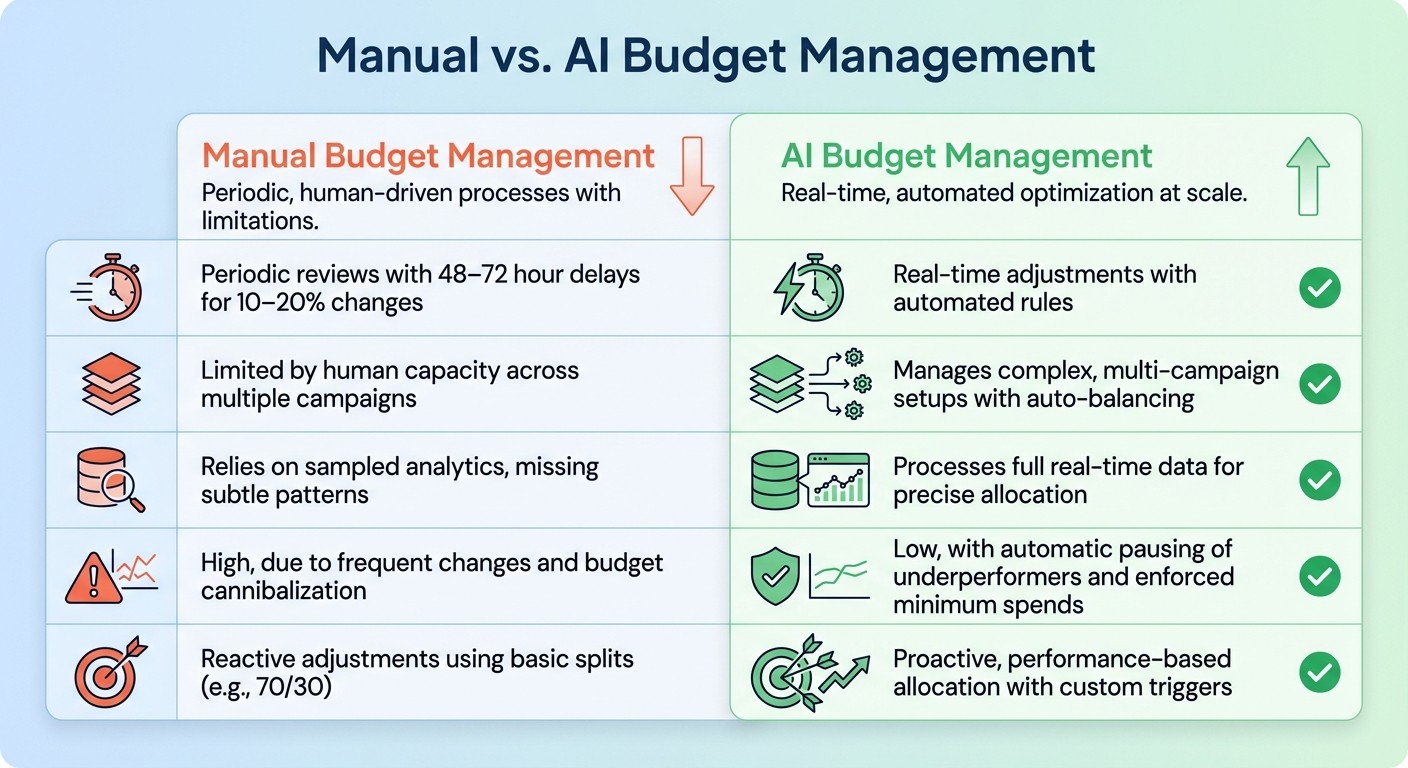
Manual vs AI Budget Management: Speed, Scale, and Efficiency Comparison
Managing budgets manually requires constant, time-intensive monitoring. This approach often leads to delayed responses, budget inefficiencies, and missed opportunities for top-performing ad sets. By the time you spot and fix an issue, underperforming campaigns might have already drained a large chunk of your budget, while high-performing ones remain underfunded.
AI handles this challenge head-on. It processes performance data in real time, adjusting budgets within seconds or minutes. When performance metrics shift, AI reallocates funds instantly, ensuring opportunities are maximized and overspending is minimized. This ability to act in real time highlights the stark difference in efficiency between AI and manual approaches.
The gap becomes even more apparent as your campaigns grow. Managing multiple campaigns with numerous ad sets requires tracking performance across countless segments - a task that overwhelms human teams. AI, however, can process thousands of data points simultaneously, identifying subtle trends that manual methods might overlook. For instance, AI can detect when one geographic area delivers three times the return on ad spend (ROAS) compared to another and automatically redistribute budgets accordingly.
Manual methods also suffer from common errors like confirmation bias (favoring segments that "should" perform well despite data suggesting otherwise), delayed scaling (missing opportunities due to slow decision-making), over-aggressive scaling (causing instability by drastically increasing budgets), and inconsistent decisions when different team members apply varying strategies. AI avoids these pitfalls by following consistent, data-driven rules. It scales budgets gradually - by 30–40% - to maintain stability without resetting the learning phase.
Here’s a quick comparison of manual and AI-driven budget management:
Manual vs. AI Budget Management
Factor | Manual Budget Management | AI Budget Management |
|---|---|---|
Speed | Periodic reviews with 48–72 hour delays for 10–20% changes | Real-time adjustments with automated rules |
Scale | Limited by human capacity across multiple campaigns | Manages complex, multi-campaign setups with auto-balancing |
Data Processing | Relies on sampled analytics, missing subtle patterns | Processes full real-time data for precise allocation |
Error Rates | High, due to frequent changes and budget cannibalization | Low, with automatic pausing of underperformers and enforced minimum spends |
Efficiency | Reactive adjustments using basic splits (e.g., 70/30) | Proactive, performance-based allocation with custom triggers |
AI-driven optimization builds on these advantages, addressing common budget allocation mistakes. Manual methods often lead to underfunding high-performing segments while wasting resources on underperforming ones. This reduces overall campaign ROAS and increases wasted spend. Tools like AdAmigo.ai take this a step further by integrating budgets, bids, targeting, and creatives into one system. This allows media buyers to manage 4–8× more client accounts while maintaining - or even improving - optimization quality.
Conclusion
Budget allocation can be tricky, but AdAmigo.ai simplifies the process by tackling common challenges head-on. It consolidates scattered budgets, reallocates budgets in real time, scales intelligently during the learning phase, adjusts pacing, and shifts funds based on performance. By comparing campaign metrics automatically, the tool ensures every dollar is used effectively. This approach not only minimizes wasted spend but also fuels consistent campaign growth.
AdAmigo.ai manages these tasks automatically. Its learning agent tracks conversion events and increases budgets in 20% increments as ad sets approach 50 weekly conversions. By setting clear goals like “Scale spend 30% at ≥3× ROAS,” the platform provides daily updates with optimized campaigns, refined audience targeting, and budget adjustments for your approval.
Getting started is quick and easy. Just connect your Meta ad account, set your KPIs, and let AdAmigo.ai take the reins. This efficient setup allows agencies to handle 4–8× more client accounts without hiring additional staff. Meanwhile, in-house teams can replace expensive hires with an AI-driven media buyer that continuously learns and adapts with every campaign.
Say goodbye to manual errors and slow responses. Ready to fix your budget mistakes? Try AdAmigo.ai for 24/7 automated optimization that keeps your campaigns on track.
FAQs
How do I know if my ad set budget is too low to exit learning?
Your ad set budget might be holding you back if it’s too low to gather enough data or conversions within 24–72 hours. Pay attention to indicators like a low Cost Per Result (CPR), limited ad frequency, or poor ROAS. Without sufficient spending, your campaign may struggle to reach the statistical significance required for effective optimization.
When should I use Advantage+ Campaign Budget Optimization vs manual budgets?
Advantage+ Campaign Budget Optimization (CBO) simplifies scaling by automatically distributing your budget across multiple ad sets. This automation not only saves time but can also help improve your return on ad spend (ROAS). It's especially effective for larger campaigns that involve multiple audiences or creative variations.
On the other hand, manual budgets are better suited for situations where you need precise control. For example, if you're testing specific audiences or creative approaches, manual budgets let you allocate fixed amounts to ensure consistent comparisons. This approach works well for A/B testing or targeting niche groups.
A common strategy many advertisers follow is to begin with manual budgets for testing and fine-tuning, then transition to CBO when it's time to scale up.
What guardrails should I set before letting AI change my Meta budgets?
Before letting AI take the reins on your Meta ad budgets, it's crucial to establish boundaries that keep your campaigns aligned with your goals and avoid unnecessary spending. Here’s how you can set things up for success:
Set Budget Limits: Define both daily and lifetime budget caps to ensure spending stays within a manageable range.
Establish Performance Goals: Identify key metrics like Return on Ad Spend (ROAS) or Cost Per Lead (CPL) that reflect your campaign objectives.
Use Bid Caps: Implement bid caps to control how much you're willing to pay for ad placements, keeping costs predictable.
Beyond these initial steps, keep a close eye on your campaign metrics. Use automated rules to make adjustments when needed, but don’t rely entirely on automation. Human oversight is essential to strike the right balance between efficiency and strategic decision-making.