
Vibe Marketing Tools: The Complete 2026 Category Map
A complete 2026 map of vibe marketing tools across 7 categories — research to vibe coding. Compare pricing, find the right tools, and pick your stack.
Vibe marketing is all about using AI and automation to save time, boost productivity, and focus on connecting with your audience. But here's the thing: "vibe marketing" isn't one tool or one tactic. It's a workflow — spanning research, creative production, video generation, distribution, measurement, automation, and even no-code building — where each category solves a different piece of the puzzle. Understanding how the tools map across this workflow is the difference between a chaotic stack and a system that actually saves you 12.5 hours per week.
This page is your complete category map. Below you'll find every major category of vibe marketing tools, what each one actually does, how to pick the right one, and which tools lead each category — plus a comparison table to scan at a glance and role-based stacks that put it all together.
Here's a breakdown of the seven key tool categories to help you execute vibe marketing efficiently:
Research Tools: Track online conversations, test emotional triggers in ads, and spot trends before they peak. Examples: Talkwalker, SparkToro.
Creative Production Tools: Quickly scale ad creative production across formats and generate hundreds of variations. Examples: Pencil, AdCreative.ai.
AI Video Generation Tools: Turn text prompts and static assets into short-form video ads and social content — no production crew needed. Examples: Runway, Synthesia.
Distribution Tools: Automate ad campaigns and optimize performance across Meta, Google, and TikTok. Examples: AdAmigo.ai, Revealbot.
Measurement Tools: Analyze which creative elements actually drive results — beyond just CTR and impressions. Examples: Motion, GetCrux AI.
Automation Tools: Simplify repetitive tasks like campaign setup, reporting, and cross-platform workflows. Examples: Zapier, Funnel.io.
Vibe Coding Tools: Build landing pages, microsites, and prototypes without writing code — the execution layer that turns a marketing vibe into a live experience. Examples: Bolt, Lovable.
Whether you're a solo marketer, an agency managing dozens of accounts, or an e-commerce brand running hundreds of creative tests, combining the right tools across these categories helps you scale your efforts, reduce wasted time, and achieve better results. Start by identifying your biggest bottleneck and choose tools that address it directly.
Vibe Marketing Tools: Comparison Table at a Glance
Before diving into each category, here's a quick-reference grid of the standout tools across all seven categories. Use it to scan for what fits your role and budget.
Tool | Category | Best For | Starting Price | Free Tier? |
|---|---|---|---|---|
Distribution | AI media buyer — Meta ads on autopilot | $99/month | Free trial | |
SparkToro | Research | Solo founders, lean teams | $38/month | Limited free |
Brand24 | Research | Brand monitoring, crisis management | $149/month | 14-day trial |
Talkwalker | Research | Enterprise social listening | Custom quote | Demo only |
AdCreative.ai | Creative Production | Conversion-focused static ads | $29/month | 7-day trial |
Pencil | Creative Production | E-commerce video ads | $119/month | Trial available |
Creatify | Creative Production | URL-to-video, AI avatars | $39/month | Free plan |
Runway | AI Video Gen | Short-form video from prompts | $15/month | Free plan |
Synthesia | AI Video Gen | AI-avatar explainer videos | $22/month | Free demo |
HeyGen | AI Video Gen | Personalized video at scale | $24/month | Free plan |
Revealbot | Distribution | Rule-based ad automation | $49/month | 14-day trial |
Motion | Measurement | Creative-level attribution | ~$250/month | Demo only |
GetCrux AI | Measurement | Hook/intro performance analysis | Custom quote | Trial available |
Zapier | Automation | Cross-platform workflow automation | $19.99/month | Free plan |
Make | Automation | Visual workflow builder | $9/month | Free plan |
n8n | Automation | Self-hosted, technical teams | Free (self-hosted) | Free |
Bolt | Vibe Coding | Rapid landing pages, prototypes | $20/month | Free plan |
Lovable | Vibe Coding | Full-stack apps from prompts | $20/month | Free plan |
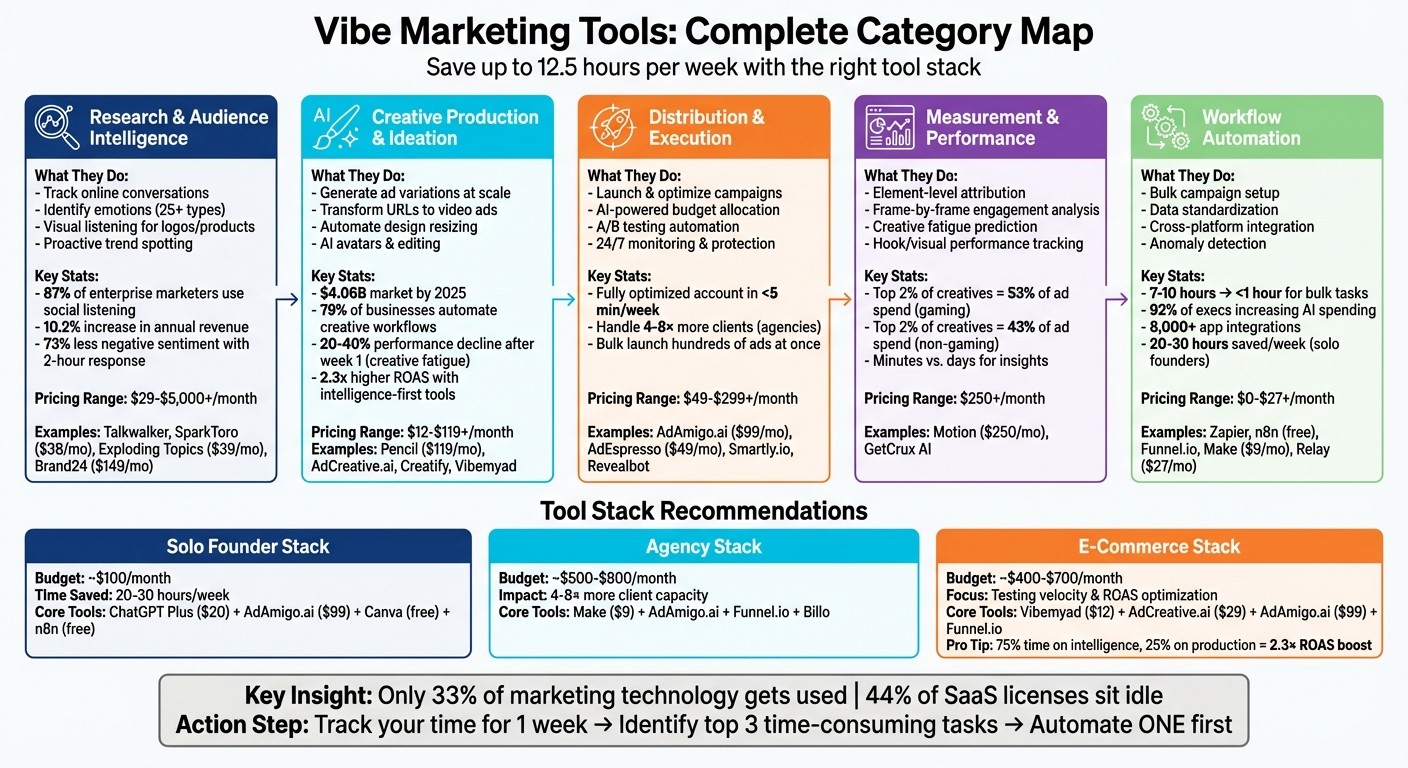
Research & Audience Intelligence Tools
What They Do
Research and audience intelligence tools go beyond simply monitoring social media. They actively track online conversations, identify emotions like joy, frustration, or even sarcasm using Emotion AI, and employ visual listening to detect your brand's logo or products in images and videos — even when there's no text involved.
"Social media monitoring is reactive... Social listening is proactive. It's the process of uncovering insights and changes in your industry by keeping a pulse on online conversations."
– Rochi Zalani, Freelance SaaS Writer
This proactive approach is becoming a must-have for marketers. Social listening has become a cornerstone of modern marketing strategy — industry surveys consistently show that the vast majority of enterprise marketers now include it in their toolkit. And it's paying off — social-first brands, according to Deloitte research, have reported significantly higher revenue growth compared to peers who lag on social engagement. For example, Talkwalker claims its platform can identify over 25 distinct emotions, Exploding Topics (starting at $39/month) spots trends before they become mainstream, and SparkToro (at $38/month for the Starter plan, 50 searches/month) reveals what your audience actually consumes — beyond just what they post about.
What to Look For
Once you understand how these tools work, focus on choosing platforms that provide actionable insights rather than overwhelming you with raw data. The best tools leverage AI for summaries and recommendations. Take Mentionlytics, for instance — it's rated 4.9/5 on G2 and includes a "Social Intelligence Advisor" that creates automated summaries of key findings.
Before diving in, make sure to establish at least three weeks of baseline data. This helps you spot trends more reliably. Also, use Boolean logic (e.g., "Apple -fruit") to filter out irrelevant chatter and focus on meaningful conversations.
Pricing varies widely. Basic real-time sentiment tracking starts at $149/month (Brand24), while enterprise-level solutions like Brandwatch range from $800–$1,200/month for small businesses and can exceed $5,000/month for global teams. Avoid tools with overly complex navigation — if it takes more than 15 clicks to extract insights, it's likely to slow you down. Keep in mind that rapid response matters: in one widely cited case study, a brand that responded to social signals within two hours saw significantly less negative sentiment escalation during a crisis. Delayed alerts, on the other hand, can make even the best tools ineffective when it counts.
Best For
The right tool depends on your team size and resources. These platforms work best for teams with strategists who can analyze data and turn insights into actionable plans. For solo founders, simplicity and cost-effectiveness are key. Options like Socialhose's Reddit-only monitoring tier ($29/month) or SparkToro ($38/month) can help avoid long-term enterprise contracts. (Note: Socialhose's main pricing page starts at $149/month — the $29 Reddit Starter may be a separate entry-level product, so confirm current availability before committing.)
If you're managing brand reputation, prioritize tools with near-real-time updates (every 5 minutes) for effective crisis management. On the other hand, solo marketers can often get by with tools that provide hourly or daily updates.
Creative Production & Ideation Tools
What They Do
Creative production tools are designed to help brands quickly turn research insights into captivating ad content. These platforms can transform static images or URLs into customized video ads for platforms like TikTok and Instagram Reels, using features like AI avatars and automated editing tools. They also streamline the process of adapting designs for various social media formats, saving marketers from hours of manual adjustments. With these tools, brands can produce hundreds of ad variations in just minutes.
The demand for such tools is skyrocketing. By 2025, the generative AI market for creative applications was projected to hit $4.06 billion. Already, 78% of organizations now use AI in at least one business function (McKinsey, 2025), and creative workflows are among the fastest-growing adoption areas. Tools like Pencil (starting at $119/month) specialize in creating video ads for e-commerce, while Creatify (from $39/month, free plan available) excels at converting URLs into videos with AI avatars — perfect for sellers on platforms like Amazon or those without access to filming resources. Other examples include AdCreative.ai (from $29/month), which focuses on static, conversion-driven ads, and Creatopy, which automates design resizing for teams managing campaigns across multiple platforms. These tools make it easier to scale campaigns efficiently, aligning creative production with broader distribution strategies.
What to Look For
The best creative tools deliver polished, ready-to-use content, much like research tools that provide actionable insights rather than raw data. Platforms with brand kits — preloaded colors, fonts, and logos — help ensure that every AI-generated ad aligns with your brand's identity. Some tools even allow you to set "brand constraints" to maintain consistent visuals and messaging. Advanced platforms go a step further by learning your brand's tone and vocabulary, making their text outputs feel natural and on-brand.
"Your creative assets are the raw ingredients. The platform is the chef's kitchen. No matter how advanced the kitchen is, giving it bland ingredients will only result in a huge batch of bland food."
– AdStellar
Look for tools that offer API integrations with platforms like Meta, Google, and TikTok to simplify the publishing process. Some platforms combine creative production with competitive analytics, delivering better results. Some platforms report that teams combining competitive analytics with creative production see meaningfully higher ROAS compared to those relying on standalone creation tools. Another feature to prioritize is predictive performance scoring, which helps you test bold ideas while focusing on the versions most likely to succeed.
Pricing varies based on features and scale, so finding the right fit for your budget is key. Keep in mind that ad performance tends to decline measurably within the first week or two as audiences tire of seeing the same creative — a pattern well-documented across Meta ad accounts. Opt for tools that allow for quick testing and the creation of fresh variations to maintain engagement.
Best For
Solo marketers benefit from tools that are easy to use, affordable, and efficient. For example, Vibemyad (around $12/month) combines competitor analysis with asset creation, making it a great choice for individual users looking to make an impact.
Agencies and marketing teams require tools that support scalability and client management. Pencil is ideal for e-commerce brands that need to test a high volume of video ads, while Creatopy is perfect for teams managing campaigns across multiple platforms. To maximize ROAS, follow the 3:1 rule: spend three hours on competitor research for every hour spent on creative production. These assets can then be fed into performance analysis tools for ongoing optimization based on real-world campaign data.
AI Video Generation Tools
What They Do
AI video generation tools let marketers create professional-quality video content from nothing more than a text prompt, a static image, or a rough script. Unlike the creative production tools covered above — which focus on templated ad variations — these platforms generate entirely new video footage: realistic scenes, AI avatars speaking your script, or stylized animations. For vibe marketers, this category is the bridge between "I need a video ad" and actually having one live, without a production crew, camera, or editing suite.
The space has exploded. Runway, used by major studios and indie creators alike, turns text prompts into cinematic video clips. Sora (OpenAI's text-to-video model) generates realistic scenes from natural-language descriptions. Kling, developed by Kuaishou, specializes in high-quality short-form video. On the avatar side, Synthesia and HeyGen let you create presenter-led videos with AI actors who speak your script in dozens of languages — perfect for product demos, onboarding, and localized ad creative.
What to Look For
The key differentiator here is output quality versus speed. Tools like Runway (from $15/month, free plan available) prioritize creative control and cinematic fidelity, making them ideal for brand-forward content where visual quality is non-negotiable. Synthesia (from $22/month) and HeyGen (from $24/month, free plan available) optimize for speed and scale: pick an avatar, paste a script, and render a talking-head video in minutes. Both offer free tiers or demos so you can test before committing.
For ad-specific use cases, pay attention to whether the tool supports aspect ratios for Meta, TikTok, and YouTube Shorts — vertical 9:16 is non-negotiable for Reels and Stories. Also check if the tool provides commercial-use rights for AI-generated footage; some free tiers restrict commercial usage.
"AI video isn't replacing filmmakers. It's replacing the 'we don't have time or budget to make a video' excuse."
– Industry consensus, 2026
Best For
E-commerce brands running Meta and TikTok ads benefit most from Runway and Kling for rapid creative testing of video concepts — iterate 10 hooks in an afternoon instead of waiting two weeks for a shoot. B2B marketers gravitate toward Synthesia and HeyGen for product explainers and personalized outreach at scale. Solo founders can start with Runway's free plan or Synthesia's demo to test video concepts before investing. The category pairs naturally with creative scaling workflows: generate video variants, test them through a distribution tool like AdAmigo.ai, and feed winners back into the production pipeline.
Distribution & Meta Ads Execution Tools
What They Do
Distribution tools handle everything from launching your ad creatives to setting up campaigns, tweaking targeting, managing budgets, and optimizing performance. Unlike traditional if-then rule systems, these tools use flexible AI agents — think of them as specialized team members like a Director, Copywriter, or Budget Allocator — working together to manage and refine campaigns.
For smaller teams, tools like AdEspresso (starting at $49/month) simplify A/B testing, while Smartly.io caters to enterprise brands juggling large-scale creative needs. Revealbot (from $49/month) appeals to more technical users with its advanced rule engine and Google Sheets integration, giving precise control over automated actions. Madgicx offers an all-in-one approach with audience targeting, creative insights, and budget optimization in a single platform.
A standout in this space is AdAmigo.ai, which takes automation further — acting as an autonomous AI media buyer rather than a rule engine.
AdAmigo.ai: Autonomous Meta Ads Management
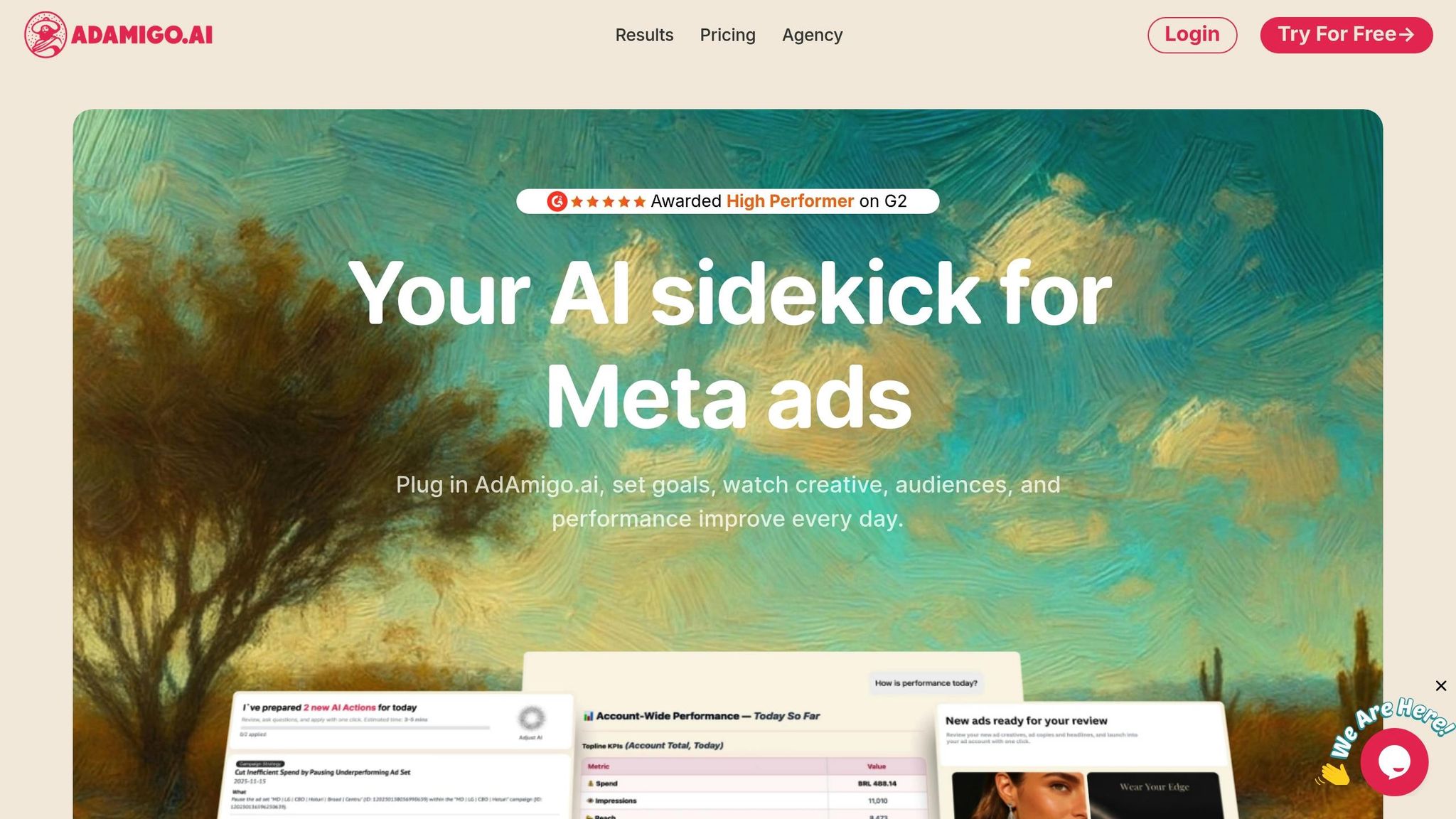
AdAmigo.ai continuously refines campaigns by analyzing performance and adjusting strategies. From generating on-brand creatives to optimizing budgets and targeting, it handles the execution layer. Its standout feature is a daily, auto-prioritized to-do list of AI-recommended actions across creatives, audiences, budgets, and bids — you approve changes with a single tap or let the system operate on autopilot. The built-in AI Chat Agent provides instant performance reports, detailed audits, and bulk campaign launches via spreadsheet integration.
AdAmigo.ai has earned G2's "High Performer" badge, with users highlighting its ability to hit KPIs effortlessly.
"A fully optimized ad account in under 5 minutes per week"
– Sherwin S., G2 Reviewer
The Protect feature monitors campaigns around the clock, catching issues like broken links, unusual spending patterns, or disabled ads before they drain your budget. Pricing starts at $99/month for accounts spending under $5,000/month, with unlimited AI Actions available at $299/month. For teams comparing manual vs AI-powered management, the time savings are significant — what used to take hours of daily monitoring becomes a weekly check-in. And for those exploring vibe marketing on autopilot, AdAmigo.ai functions as the distribution engine that executes while you focus on strategy.
Best For
Agencies: Media buyers can handle 4–8× more clients, freeing senior strategists to focus on big-picture planning. Tools like Revealbot and AdAmigo.ai complement each other — rule-based automation for known scenarios, AI-driven optimization for everything else.
Brands and in-house teams: An AI media buyer provides round-the-clock optimization, effectively replacing or supplementing expensive hires. Combine with a measurement tool like Motion to close the loop from execution to insight.
Solo marketers: Start with AdAmigo.ai at $99/month to handle execution, then add Revealbot ($49/month) if you need custom rule-based automations. The combination turns what would usually be a full-time job into a manageable weekly task.
Measurement & Performance Analysis Tools
What They Do
These tools dive deeper than standard ad reporting, showing which creative elements truly drive results. They can pinpoint why an ad succeeds by connecting specific features — like the hook style, color scheme, narrator type, or emotional appeal — to key metrics such as CAC (Customer Acquisition Cost), ROAS (Return on Ad Spend), and LTV (Lifetime Value).
Modern platforms use AI to automatically tag creative components (e.g., "humorous opening" or "product close-up") and link those tags to performance data. They also track signs of ad fatigue — like declining CTR, rising CPM, or high frequency — to predict when an ad's effectiveness will drop. Some tools even provide frame-by-frame engagement graphs to show precisely where viewers lose interest in a video. On top of that, advanced systems use predictive scoring to simulate audience reactions and estimate how well creative assets will perform.
These insights help teams refine their ad strategies, making data-driven adjustments that tie directly into broader campaign improvements.
What to Look For
The best tools don't just measure clicks or impressions — they connect creative elements to conversion outcomes. As Darkroom Agency explains:
"Creative analysis used to be 'CTR by ad.' That's not analysis. That's the scoreboard."
Seek platforms that offer element-level attribution, identifying which specific hooks, visuals, or emotional tones influence your most important KPIs. Tools with automated tagging are especially helpful — they scan your videos and images to label creative components without requiring manual input, ensuring consistency across all your assets or using a creative idea converter to generate fresh concepts.
Integration is another key factor. Choose tools that work seamlessly with your ad platforms and Mobile Measurement Partners (MMPs) like AppsFlyer or Adjust. This allows you to combine creative data with performance metrics for a complete picture. Avoid tools that only track surface-level metrics like clicks, as they won't reveal what makes certain creative elements resonate with your audience.
For example, Motion provides creative-level reporting and frame-by-frame analysis, starting at around $250/month. Another example: in April 2025, Cloaked used GetCrux AI to double its Meta ad win rate. By identifying which hooks and intros delivered the lowest CAC, they cut their time-to-insight from days to minutes.
Best For
These tools are ideal for performance-driven teams with larger ad budgets, allowing for in-depth creative testing while managing expenses. Using established creative testing benchmarks helps these teams determine if their performance justifies the spend. In mobile gaming, a small fraction of top-performing creatives often captures the majority of ad spend — a pattern that also holds in other verticals, where a handful of winning creatives drive disproportionate results. This shows how critical it is to quickly identify high-performing creative elements. Brands experimenting with different emotional approaches to attract quality users will see the most benefit. Smaller marketers with limited budgets can still gain value but should ensure the tool's pricing aligns with their spending capacity.
Workflow Automation & Governance Tools
What They Do
These tools are designed to handle repetitive tasks like bulk ad setup and launching, data standardization, and managing hundreds of campaign variations. The result? Processes that used to take 7–10 hours can now be completed in under an hour. For example, Funnel.io simplifies performance tracking by standardizing naming conventions and metrics across platforms. Similarly, tools like n8n (free, self-hosted) connect your marketing stack, automating workflows to save time and effort.
Modern platforms, such as Zapier (from $19.99/month) and Make (from $9/month), take it a step further by using AI agents to link thousands of apps. These agents manage tasks across your entire stack, eliminating the need for manual intervention.
"Gumloop has been critical in helping all teams at Instacart — including those without technical skills — adopt AI and automate their workflows, which has greatly improved our operational efficiency."
– Fidji Simo, CEO of Instacart
Some advanced platforms even feature anomaly detection, helping you catch costly mistakes — like overspending on ad budgets — before they spiral out of control.
When exploring these tools, focus on features that align with your specific automation needs.
What to Look For
Start by identifying your biggest bottleneck. Is it campaign setup, generating ad creatives, or reporting? Then, select a tool tailored to address that challenge.
Here are some key features to prioritize:
Tools with drag-and-drop builders for ease of use, even for non-technical users.
Native integrations with ad platforms, CRMs, and analytics tools.
Centralized asset libraries and brand kits to ensure consistency across campaigns.
Permission controls for managing team access, along with starting with cautious, high-confidence automation rules.
It's important to strike the right balance — don't automate everything without a clear strategy.
"The point of creative automation isn't to automate creativity itself. It's about removing the friction from repetitive production, which ironically creates more space for strategic thinking and breakthrough ideas."
– AdStellar
Remember, automation amplifies whatever you feed into it. Weak headlines or generic visuals will only lead to a higher volume of poor-quality ads.
Best For
These tools are ideal for agencies automating client ad accounts and in-house teams juggling multiple campaigns. They ensure smooth, scalable operations. Solo marketers can also benefit — AI spending continues to climb across industries, with marketing and sales consistently ranking as top investment priorities in executive surveys.
For smaller teams, these tools align perfectly with the vibe marketing methodology, enabling one person to achieve what typically requires a full team. If you're just starting out, try auditing your time for a week to pinpoint your three most time-consuming recurring tasks. Automate those first to see immediate results.
Vibe Coding & No-Code Building Tools
What They Do
Vibe coding tools let marketers build functional websites, landing pages, microsites, and even simple web apps by describing what they want in plain English — no code required. If vibe marketing is about defining a brand's energy and letting AI handle execution, vibe coding is the natural extension: you describe the experience, and the tool builds it.
These platforms have matured rapidly. Bolt (from $20/month, free plan available) lets you prompt your way to a full-stack app or landing page in minutes. Lovable (from $20/month, free plan available) specializes in turning natural-language descriptions into polished, production-ready web apps. Replit (free tier available) combines an AI coding assistant with instant deployment, making it a favorite among technical marketers who want more control without starting from scratch.
For vibe marketers, the use case is straightforward: instead of waiting on a developer to build a campaign landing page, a lead-gen microsite, or an interactive product demo, you prompt it into existence in an afternoon.
What to Look For
The biggest variable across vibe coding tools is the ceiling: how complex a project can you build before you hit a wall? Bolt and Lovable excel at rapid prototyping and marketing pages — they're ideal for campaign microsites, waitlist pages, and simple tools. Replit goes further, supporting full applications with databases and backends, but requires more technical comfort.
Key features to prioritize:
One-click deploy: The tool should publish your project to a live URL without configuring DNS or servers.
Responsive by default: Mobile optimization should be automatic — you can't afford a landing page that breaks on phones.
iteration speed: How fast can you tweak copy, swap images, and A/B test variants? The best tools make edits as fast as prompting.
Pricing is accessible across the board — most tools offer free tiers sufficient for a handful of projects, with paid plans unlocking more generation credits and custom domains.
"The value is in knowing WHAT to build, not HOW to build it."
– James Dickerson
Best For
Solo founders and lean startups get the most mileage here. Instead of paying a developer $5,000 for a campaign landing page, you use Bolt or Lovable to build and iterate it yourself — then redirect that budget into ad spend. Agencies can use vibe coding tools to spin up client campaign pages and rapid prototypes without tying up engineering resources. E-commerce brands benefit from building product-launch microsites, quiz funnels, and interactive lookbooks that sit between an ad click and a purchase.
The category also pairs powerfully with distribution tools: build a landing page in Bolt, generate video ads in Runway, and launch everything through AdAmigo.ai — a complete vibe-marketing pipeline with no creative bottleneck.
Tool Stacks by Role
Blending research, creativity, video generation, distribution, measurement, automation, and vibe coding tools into customized setups ensures that marketers — whether working solo or as part of a team — can streamline their processes and boost productivity.
Here's a breakdown of four tailored tool stacks designed for different business needs, showing how these tools can work together effectively.
Solo Founder Stack
Budget: $100–$130/month | Time Saved: 20–30 hours/week
For solo entrepreneurs, the focus is on affordability and speed without sacrificing quality. Start with ChatGPT Plus ($20/month) for generating ad copy at scale and Claude Pro ($17–$20/month) for creating more refined, brand-specific messaging. For visual content, Canva's free tier offers templates and basic design tools, while Glif or Midjourney can produce custom AI-generated images as needed.
For video, start with Runway's free plan to generate short-form ad concepts, and for landing pages, use Bolt's free tier to build campaign microsites without a developer.
At the execution stage, AdAmigo.ai ($99/month) shines by automating the creation, testing, and optimization of Meta campaigns in under a minute. To tie everything together, use n8n's free self-hosted option to automate repetitive workflows.
Here's how it all flows: Start with Perplexity for market research, use Claude for positioning, rely on ChatGPT for ad copy variations, design with Canva, generate video hooks with Runway, build landing pages with Bolt, and distribute with AdAmigo.ai. This setup can drastically reduce time spent on tasks, with small businesses consistently reporting measurable efficiency gains after adopting AI tools. In fact, workflows like these can condense eight weeks of traditional work into just two days.
Agency Stack
Budget: $500–$800/month | Impact: 4–8× more client capacity per media buyer
Agencies need tools that scale seamlessly across multiple clients while maintaining quality. Begin with workflow automation tools like Make (starting at $9/month) or Relay (from $27/month) to connect CRMs, ad platforms, and approval systems. These tools include human checkpoints to ensure brand consistency. For creative production, tools like Glif and Sora AI help generate scalable visual content, while Billo provides authentic, human-generated content, ideal for industries like skincare. For client landing pages and microsites, Lovable ($20/month) lets you build and iterate without engineering requests.
Use AdAmigo.ai to handle bid optimization and creative testing, enabling you to scale client accounts efficiently. Supplement this with competitive intelligence tools like Perplexity or Analyze AI, and centralize reporting with Funnel.io to manage data across all client accounts.
This approach aligns with what James Dickerson calls "Marketing Architecture," where AI takes care of tactical tasks while humans focus on strategic decisions. Instead of relying on a single AI tool, agencies can deploy specialized agents, such as a "Conversion Expert" or "Agency Growth Expert," to independently review ad copy and strategy. For many marketing teams, bureaucracy is a well-known bottleneck — and producing even 10 ad variations by hand can eat an entire workday. Automation collapses that to minutes.
E-Commerce Stack
Budget: $400–$700/month | Focus: Testing Velocity and ROAS Optimization
For e-commerce brands, this stack focuses on combating creative fatigue through rapid testing and data-driven decision-making.
Start with Vibemyad (about $12/month) for competitive intelligence, enabling you to analyze competitor ad libraries and product shifts. This shifts your strategy from guesswork to informed decisions. For creative production, AdCreative.ai ($29/month) generates multiple ad variations, while Billo delivers human-generated content, which can lead to 81% higher click-through rates. For video ad concepts, Runway ($15/month) lets you test new hooks and visual styles without a production shoot.
At the execution level, AdAmigo.ai acts as your autonomous campaign optimizer, identifying the top-performing 5% of creatives and reallocating budgets to maximize success. It also ensures campaigns follow your pacing, geographic, and placement rules. Pair this with tools like Funnel.io or Supermetrics to consolidate data from platforms like Meta, Google, and TikTok, providing a clear view of ROAS.
A strong strategy involves dedicating 75% of your time to competitive intelligence and strategy, with the remaining 25% focused on asset production. Platforms that integrate competitive analytics with creative production consistently help teams outperform those relying on standalone creation tools — with some reporting dramatic ROAS improvements. Additionally, creating a "Winners Hub" with AdAmigo.ai to store and reuse top-performing elements can help replicate past successes effortlessly.
Lean Startup Stack
Budget: $120–$180/month | Focus: Speed-to-market and validation
For early-stage startups that need to move fast and validate ideas before scaling, this stack prioritizes rapid experimentation over polished production.
Start with SparkToro ($38/month) to understand where your audience spends time online — skip the guesswork. Use ChatGPT Plus ($20/month) for copy and positioning drafts. For landing pages and MVPs, Bolt ($20/month) builds functional prototypes from prompts — test a value proposition with real traffic before investing in custom development. Canva's free tier handles basic visual assets.
For distribution, AdAmigo.ai ($99/month) launches and optimizes Meta campaigns so you can test messaging and audiences without hiring a media buyer. Add n8n's free self-hosted option to automate lead capture and notification workflows. The stack is intentionally lean: every tool earns its place by directly contributing to the validate-or-pivot cycle, and nothing sits idle.
Conclusion
The best marketing tools for your team depend on factors like your role, budget, and team size. But the biggest mistake you can make? Picking tools without first understanding your workflow. As the AdAI Editorial Team puts it:
"The issue isn't choosing wrong tools. It's choosing tools wrong."
A good starting point is to track your time over a week and identify your top three most time-consuming recurring tasks. Once you've pinpointed them, focus on automating just one key task.
A well-chosen toolset can completely change the game. For example, a single marketer armed with the right 3–5 tools can outperform a traditional 10-person team, simply by eliminating operational bottlenecks. Yet the numbers tell a cautionary tale: organizations use only 47% of their SaaS licenses — wasting an estimated $21 million annually in unused software. The takeaway? Match your tools to your current needs instead of trying to implement everything at once.
When it comes to Meta ads, targeted automation is a game-changer. AdAmigo.ai is designed to handle execution and scaling, freeing you up to focus on strategy. Acting as an autonomous media buyer, it tests, optimizes, and scales campaigns around the clock — saving performance marketers over 15 hours per week. Whether you're a solo founder starting at $99/month, an agency managing multiple clients, or an e-commerce brand, this platform integrates seamlessly into your workflow as the execution layer that amplifies your strategic decisions.
This ties back to an earlier point: align your tool choices with your workflow needs. Start small, measure the results, and build from there. Using an ad performance analyzer can help you identify which campaigns to scale first. Explore the best AI tools for optimizing paid ads performance when you're ready to expand your stack. Document what works before adding more tools or complexity. The goal isn't to chase every shiny new solution but to create a streamlined system that lets you execute faster while staying in control.
FAQs
What's the fastest "starter stack" of vibe marketing tools for my role?
If you're looking to hit the ground running with vibe marketing, you'll want tools that streamline content creation, automation, and social media management. Here's a quick setup to get you started:
Canva: Perfect for creating eye-catching visuals without needing a design background.
Vibe Marketing Ninja (free tier, 10 posts/month; $9/month Apprentice plan): AI-powered social media scheduling for X and LinkedIn — handles automation of your posting calendar.
Claude AI or ChatGPT: Both are excellent for crafting engaging copy that resonates with your audience.
AdAmigo.ai: Ideal for scaling Meta ads while keeping everything under control with guardrails and action logs.
This stack is perfect for solo marketers or small teams focused on efficiency and quick execution.
How do I choose tools without wasting money on unused SaaS?
To prevent wasting money on SaaS tools that go unused, it's important to choose software that fits seamlessly into your workflow and solves specific challenges. A structured approach, like using a scorecard, can help you evaluate how well a tool integrates with your existing processes and whether it offers real utility. Take advantage of free trials to test tools before committing, ensuring they truly meet your needs. Steer clear of tools with overly broad features you're unlikely to use, and focus on solutions that directly support your goals. This way, you can maximize your ROI and cut down on unnecessary spending.
When should I automate Meta ads with AdAmigo.ai vs manage them manually?
Automating Meta ads with AdAmigo.ai is a smart choice when you're looking to save time, cut down on manual tasks, and improve performance on a larger scale. It's particularly useful if you're juggling multiple campaigns, running A/B tests, or aiming to boost your return on ad spend (ROAS) using AI-powered tools.
On the flip side, manual management might be better suited for smaller budgets, fewer campaigns, or situations where you need precise, hands-on control over every detail.
In short, go for automation when efficiency and scaling are your priorities. Stick with manual management for smaller operations that require close attention.
What's the difference between creative production tools and AI video generation tools?
Creative production tools (like Pencil, AdCreative.ai, and Creatify) take existing assets — images, product shots, URLs — and turn them into templated ad variations, often with AI-powered editing and resizing. They're built for scale: one product image becomes 50 ad formats. AI video generation tools (like Runway, Synthesia, and HeyGen) create entirely new video footage from prompts or scripts — generating scenes, avatars, and motion that didn't exist before. Think of creative production tools as your ad factory and AI video tools as your virtual production studio. They complement each other: use Runway to generate a video concept, then feed it into Creatify to produce platform-specific ad variations.