
Meta Advantage+ vs AdAmigo: Do You Still Need a Tool on Top of Meta's AI?
Use Meta Advantage+ for delivery and a third‑party layer for cross-channel control, creative supply, and account-level oversight.
Yes - if you want Meta to handle delivery and you want another layer to guide the account. Meta Advantage+ can improve ROAS inside Meta, with Meta reporting an average 22% lift over manual campaign setup. But it stops at Meta’s own system. It won’t shift budget across channels, build net-new ad ideas, or show much detail behind account decisions.
Here’s my simple take:
Use Advantage+ for delivery inside Meta
Use AdAmigo to guide what happens around it
Pick the extra layer when account volume, speed, and account sprawl start to hurt results
Skip it if your setup is small and manual checks still do the job
What matters most is the split in jobs:
Advantage+ handles targeting, placements, bidding, and budget flow inside Meta
AdAmigo adds new ad inputs, account direction, decision visibility, rule-based actions, and cross-channel reach
If I were running more than one account, pushing hard on new-customer growth, or spending enough that a 15-minute vs. 60-minute reaction window changed profit, I’d treat Meta’s AI as the engine and AdAmigo as the layer that keeps it pointed at the business goal.
Quick Comparison
Criteria | Meta Advantage+ | AdAmigo |
|---|---|---|
Main role | Delivery inside Meta | Layer above the ad platforms |
What it handles | Targeting, bidding, placements, budget delivery | Account guidance, new ad supply, monitoring, automations |
Ad inputs | Works from assets already in Meta | Adds net-new image and video concepts |
Goal setting | One goal plus budget | Ranked priorities with more control over tradeoffs |
Reporting | Limited view into decisions | Cards showing the decision, data, and action |
Channel scope | Meta only | Meta and Google Ads coverage |
Bias | Tied to Meta inventory | Set up around business performance |
Best fit | Brands that want Meta to automate delivery | Teams that need more direction and account oversight |
So the short version is simple: Meta Advantage+ is not the full ad operating layer. It’s the delivery layer. If you need more control over direction, more visibility, and the same logic across accounts or channels, a tool on top can still make sense.
Meta Advantage+ Guide 2026 | What Changed & What Still Works
What Meta Advantage+ does well in 2026, and where its job ends
In 2026, Advantage+ Sales handles sales, app installs, and lead gen. You set the goal, budget, and assets. Meta takes over targeting, placement, bidding, and delivery. That distinction matters. If something sits outside Meta's inventory, it's outside what Advantage+ can do.
Where Advantage+ is genuinely strong
Advantage+'s main strength is simple: delivery inside Meta. Once the system has enough signal, it does a strong job of finding the right people across Meta's ecosystem. Broad targeting helps because it gives the model more room to spot patterns and act on them.
Setup is simpler too. Instead of splitting prospecting and retargeting into separate buckets, the system pulls them into one optimized pool. That can cut audience overlap and help campaigns settle in faster.
Meta also automates parts of the ad build during delivery. It can apply creative enhancements, remix assets, and turn static images into video, though performance varies by creative format. For busy teams, that's a pretty big deal.
What Advantage+ is not built to do
Advantage+ can't shift budget to Google, judge TikTok performance, or make calls based on data that lives outside Meta's walls. That's not a bug. It's just what platform-level automation looks like when it operates inside a single ad network.
The bigger problem is structural. Meta's AI optimizes for Meta's goal. It has no reason to tell you that your next $1,000 might perform better somewhere else. And to be fair, every native ad AI has the same built-in bias. Each one can only work inside its own inventory.
There are limits inside Meta too. Advantage+ still gives you less control over targeting and placements, less visibility into how decisions are made, and only rough tools for keeping spend away from people who already bought from you. In ASC, existing customer budget caps are one workaround when you need to hold more budget for net-new acquisition.
It also doesn't research competitors or track market shifts for you. And it doesn't natively spot creative fatigue from patterns like rising frequency paired with falling engagement.
That is where Advantage+ stops.
Meta Advantage+ vs AdAmigo: what each one actually does
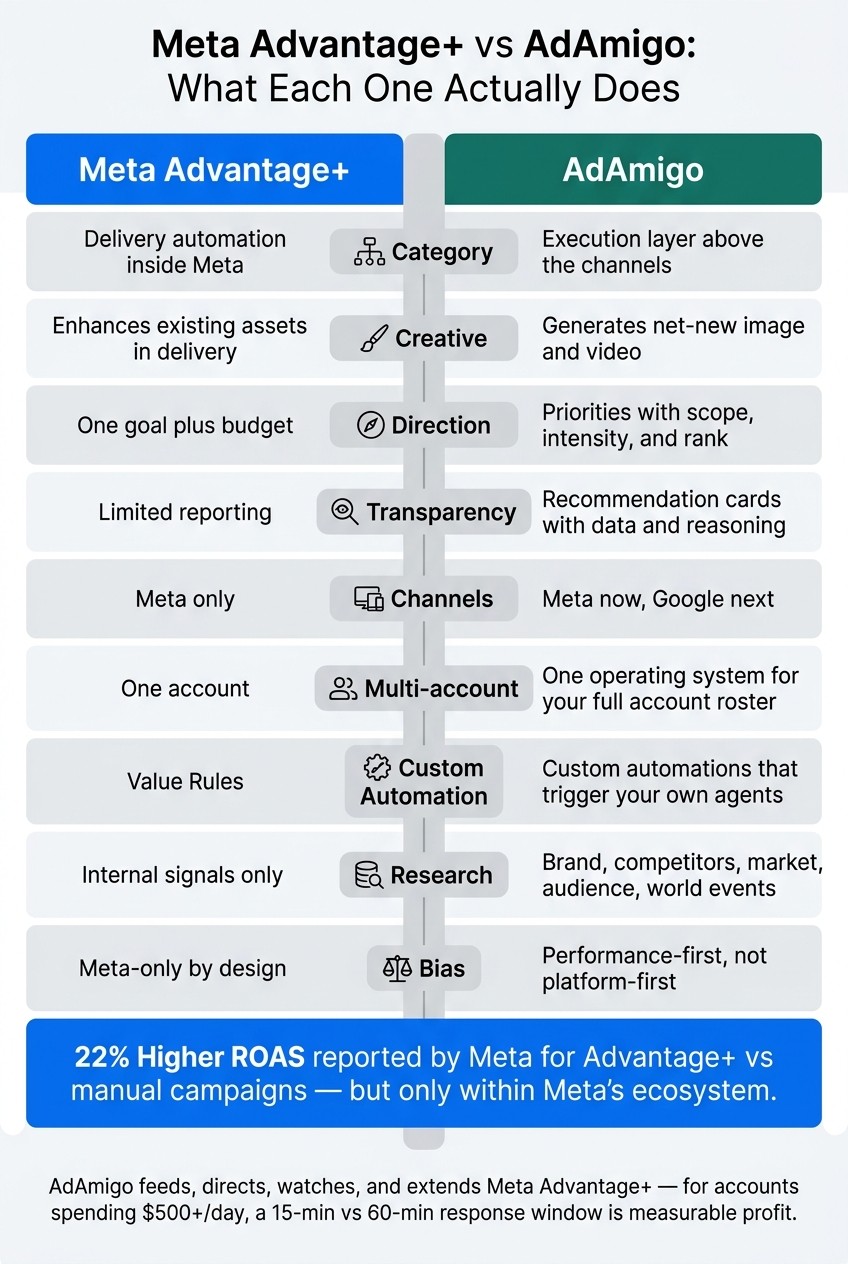
Meta Advantage+ vs AdAmigo: Feature-by-Feature Comparison
Meta Advantage+ and AdAmigo work on different layers of the ad account.
Advantage+ handles delivery inside Meta. AdAmigo sits above that layer. So they’re not doing the same job. The gap shows up in a few places: creative supply, direction, visibility, research, and automation.
Creative, strategy, transparency, and control
On the creative side, Advantage+ Creative can improve assets you already have and even turn static images into video. But it still starts with what’s already sitting inside Meta. AdFactory does something else: it generates net-new image and video concepts that you can use across channels.
The strategy gap is just as clear. Advantage+ works from a goal and a budget. AdAmigo’s Priorities give you more room to guide the account. You can set what matters most, define how hard the system should push each objective, and rank those goals. That means you can lean into new-customer acquisition for a given month, even if blended ROAS drops for a bit. Advantage+ doesn’t have a built-in way to express that kind of tradeoff.
Transparency is where this becomes easiest to see day to day. Advantage+ gives you limited reporting. AdAmigo’s recommendation cards show the exact decision, the data behind it, the reasoning, and the action taken. Put simply, Advantage+ shows results. AdAmigo shows the decision behind those results.
That matters because good account decisions often depend on more than what happens inside one ad platform.
Research, automation, and cross-channel logic
AdAmigo’s intelligence layer looks at brand, competitor, market, audience, operational, and external signals before it acts. Advantage+ optimizes delivery using signals from inside Meta only.
Automation is another clear split. Advantage+ includes Value Rules for basic conditional logic. AdAmigo supports custom automations that can trigger your own agents and actions beyond what native rules allow.
And then there’s channel scope. AdAmigo is live on Meta today, with Google coming next. That already matters. A third-party layer has no reason to keep spend on one platform if another channel is the better bet. Advantage+ can only optimize within Meta’s inventory.
Quick comparison table
Capability | Meta Advantage+ | AdAmigo |
|---|---|---|
Category | Delivery automation inside Meta | Execution layer above the channels |
Creative | Enhances existing assets in delivery | Generates net-new image and video |
Direction | One goal plus budget | Priorities with scope, intensity, and rank |
Transparency | Limited reporting | Recommendation cards with data and reasoning |
Channels | Meta only | Meta now, Google next |
Multi-account | One account | One operating system for your full account roster |
Custom automation | Value Rules | Custom automations that trigger your own agents and actions |
Research | Internal signals only | Intelligence across brand, competitors, market, audience, operations, world events, and custom workflows |
Bias | Meta-only by design | Performance-first, not platform-first |
The next question is how teams actually run AdAmigo on top of Advantage+.
How advertisers use AdAmigo alongside Advantage+
Advantage+ handles delivery inside Ads Manager. AdAmigo sits above that and runs the workflow around it. Day to day, that means there’s an extra operating layer making sure the machine doesn’t just run, but runs in the right direction.
Feed, direct, watch, and extend
In practice, AdAmigo does four jobs.
It feeds Advantage+ new creative
It directs it with Priorities
It watches decisions through recommendation cards that show the decision, data, and action
It extends the same operating system across accounts and, next, Google
For accounts spending over $500/day, the gap between a 15-minute response and a 60-minute response to a performance dip is money you can measure.
Who actually needs this layer
This setup tends to fit a few groups best: in-house ecommerce teams with broad product catalogs, agencies handling multiple client accounts, and brands leaning hard into new-customer acquisition. The upside comes from three places: solving creative fatigue, strategic direction, and consistency across accounts.
If you’re running a small account with one campaign, periodic manual review may be enough. This layer starts to pay off when the account gets messy enough that Advantage+ by itself can’t mirror your actual business priorities.
Automation removes execution work. It doesn’t remove operator judgment. That’s the line that matters when you’re deciding if this layer earns its keep.
Bottom line: use Meta's AI for delivery and a third-party layer for execution
Meta Advantage+ is strong where it matters inside Meta: targeting, bidding, placements, and budget allocation. Meta says it delivers an average 22% higher ROAS than manually optimized campaigns.
But that strength stops at Meta.
It doesn't create net-new ads. It doesn't run cross-channel workflows. And it doesn't give serious operators the account-level guardrails they often want. A platform AI will optimize for its own inventory. A third-party layer can optimize for the business.
That's the gap a tool like AdAmigo fills.
The setup is pretty simple: use Advantage+ for delivery, then use AdAmigo on top of it to supply new ads, set clear priorities, and keep an eye on performance without tying the account to a single platform's AI.
If that sounds like your setup, the pricing is straightforward:
Signals starts at $99/month per ad account
Full Access is $349/month
Both come with a 7-day trial
After the trial, the account drops back to read-only unless you subscribe
If Advantage+ is already running, the question isn't whether you should replace it. It's whether you should support it. Start your 7-day AdAmigo trial at AdAmigo.ai.
FAQs
When is Advantage+ no longer enough on its own?
Meta Advantage+ works well for delivery inside Meta, but it stays inside Meta and optimizes for Meta’s definition of success.
That starts to fall short when you need budget shifts across channels, tighter control over bidding or creative direction, or live use of outside data like CRM exclusions. That’s where an execution layer like AdAmigo comes in, adding strategy, research, and cross-channel intelligence.
Can I use AdAmigo with my existing Advantage+ campaigns?
Yes. You should use both because they work at different levels of your ad stack.
Meta Advantage+ handles delivery inside Meta, including bidding, targeting, and placement. AdAmigo sits above that layer and helps shape the plan with strategy, creative input, guardrails, and research so Advantage+ has better direction.
How do I know if a third-party layer will pay for itself?
A third-party layer tends to pay for itself when it closes operational gaps that Advantage+ can't. Meta’s native tools are built to drive platform efficiency first. Your business profitability doesn't always line up with that.
It often makes sense when you need advanced control, learning-phase protection, cross-channel visibility, net-new creative at scale, or account-level SOPs across many accounts.