
How In-Stream Video Ads Perform on Meta
A practical guide to Meta in-stream video ads: key metrics, creative hooks, cost benchmarks, targeting strategies and automation to improve completion and ROAS.
In-stream video ads on Meta platforms like Facebook and Instagram integrate directly into video content, appearing before, during, or after videos. These ads work well because they engage users already watching videos, often with sound on, leading to higher brand recall (+8.8 points) and improved campaign metrics and benchmarks.
Key highlights:
Ad Types: Skippable (after 5 seconds) and non-skippable (up to 15 seconds).
Performance Metrics: Focus on ThruPlays (15-second views), completion rates, and cost metrics like Cost per ThruPlay.
Creative Tips: Hook viewers in the first 5 seconds with clear branding, strong visuals, and sound.
Audience Insights: Use data to identify high-performing segments and refine targeting with AI tools.
Brands like Maybelline and Heineken have seen success by optimizing creative elements and leveraging data insights and account analysis. Tools like AdAmigo.ai further streamline ad management, enabling smarter targeting and faster scaling. This helps advertisers manage volatility during the learning phase as they increase budgets. This is particularly effective when looking to scale Meta ads horizontally across new segments.
🎥💰 Facebook “Instream Videos” Placement On Facebook ADs - Makes 3X The Returns - Try It! 🚀📲
Key Performance Metrics for In-Stream Video Ads
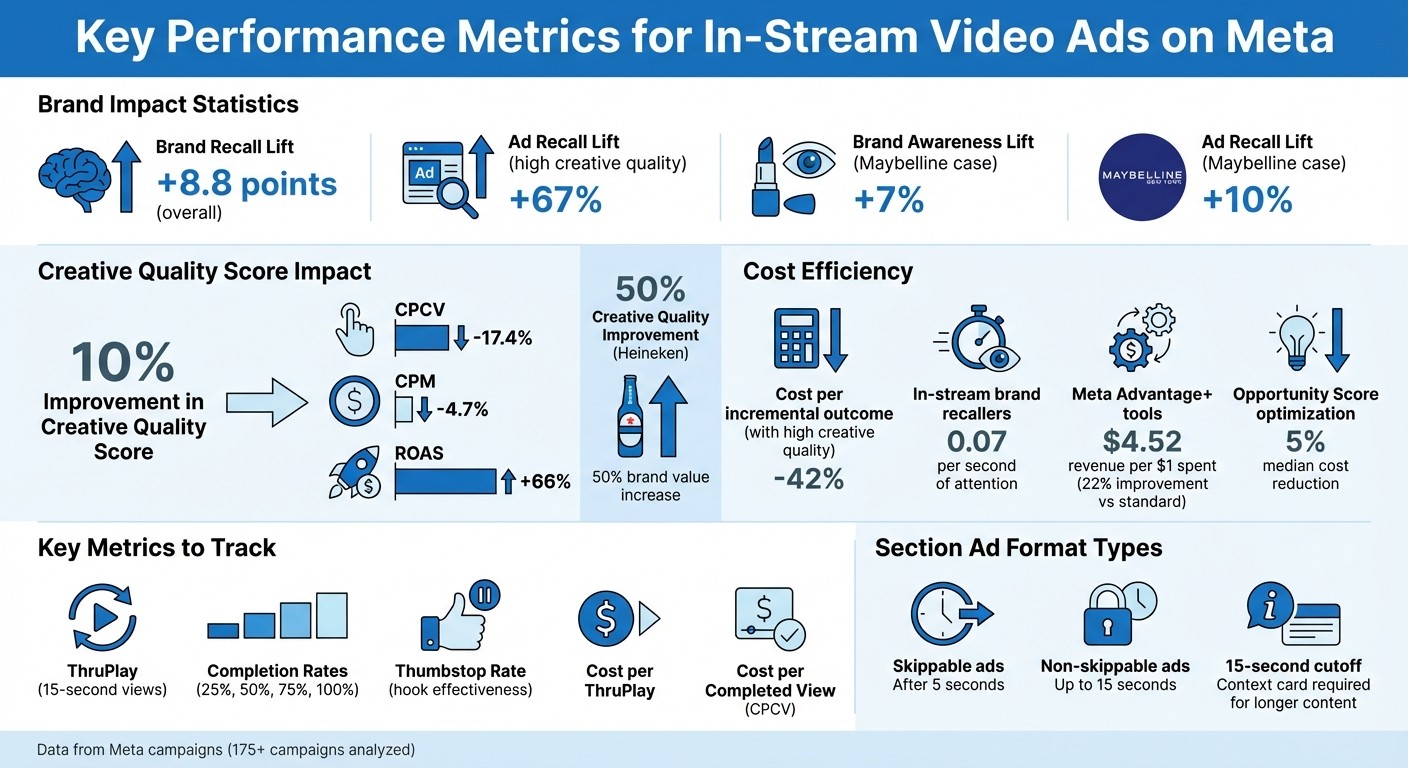
Meta In-Stream Video Ads Performance Metrics and Impact
To fine-tune your campaigns, it's crucial to focus on the right metrics. These metrics not only help identify successful strategies but also guide adjustments in creative execution and campaign setup and AI audience profiling using an Ad Performance Analyzer. Meta's in-stream video ads provide insights into viewer engagement through automated reporting, helping you gauge whether your ad spend is delivering results.
View Metrics: Views, ThruPlays, and Completion Rates
When it comes to in-stream ads, ThruPlay stands out as a key metric. It tracks how often a video is watched to the end (for videos under 15 seconds) or for at least 15 seconds (for longer videos). While 2- and 3-second views show brief exposure, ThruPlay reveals deeper engagement - indicating that viewers stayed long enough to absorb your main message.
Completion rates, on the other hand, highlight where viewers drop off - whether at 25%, 50%, 75%, or 100% of the video. High completion rates suggest your content resonates with the audience. A great example is Maybelline New York (France), which ran an in-stream campaign in November 2022 to promote its "Curl Bounce" mascara. Targeting women aged 15–34, the campaign achieved a 10% lift in ad recall and a 7% boost in brand awareness. According to Celine LY, Digital Brand Activation Manager, strong completion rates were a key factor in the campaign's success.
"The in-stream placement demonstrated outstanding completion rate and is therefore a very qualitative touchpoint we would consider in our future campaigns."
– Celine LY, Digital Brand Activation Manager, Maybelline New York
Metrics like ThruPlay and completion rates also help evaluate the strength of your video’s opening hook. A weak hook may lead to brief views, while a strong one keeps viewers engaged, ultimately influencing cost-related performance metrics across different industries.
Cost Metrics: Cost per Completed View and Cost per ThruPlay
Cost metrics like Cost per Completed View (CPCV) and Cost per ThruPlay focus on the quality of engagement rather than fleeting impressions. These metrics reveal how effectively your creative captures and holds attention.
Meta’s research highlights the impact of creative quality on costs. For instance, a 10% improvement in Creative Quality Score - measuring adherence to best practices like early branding and optimizing for sound - can lead to a 17.4% drop in CPCV, a 4.7% reduction in CPM, and a 66% higher Return on Ad Spend (ROAS). Aude Gandon, Global CMO at Nestlé, emphasized this connection:
"We just got data from Meta showing that ads with a higher Creative Quality Score received 66% higher ROAS."
– Aude Gandon, Global CMO, Nestlé
If your Cost per ThruPlay starts climbing, it could signal that viewers are skipping the ad early or losing interest. This often happens when creative fatigue sets in due to high frequency. To counter this, refine your creative by using strong visuals, clear text overlays, and compelling audio cues to lower creative testing costs. These adjustments can help reduce costs and improve overall engagement.
Analyzing Viewer Engagement and Drop-Off Points
Figuring out where viewers stay engaged - and where they drop off - is key to improving your in-stream video ads. Meta offers detailed data that highlights which moments grab attention and which ones cause viewers to skip or scroll away. By studying these patterns, you can fine-tune your ad creative and placements for better results.
Early Engagement: Hook Rate and Initial Views
The first few seconds of your video ad are everything. They determine whether viewers stick around or move on. One important metric to watch is the Thumbstop Rate (also called hook rate), which measures how many 3-second video plays you get compared to total impressions. If your thumbstop rate is low, it’s a sign your opening frames aren’t grabbing attention.
Since viewers can skip after 5 seconds, a drop-off at this point points to a weak hook. To fix this, make sure your brand identity and value proposition are clear and front-loaded in those critical first 5 seconds. Unlike feed ads, in-stream ads are often watched with sound on, so use audio to your advantage. Music, voiceovers, or sound effects can help pull viewers in during this short window of opportunity.
"For stream environments, leverage audio and video cues to hold attention during longer views."
– Adverteyes/Meta Study
Tracking Retention Through Completion Stages
Once you’ve captured attention, the next step is tracking how long viewers stay engaged. Retention metrics at key points - like 25%, 50%, 75%, and 100% - show where your narrative might be losing its grip. If there’s a sharp drop-off at any stage, it’s a signal to tweak your messaging or creative elements.
For ads longer than 15 seconds, Meta cuts the video at the 15-second mark, requiring viewers to click a context card to keep watching. This creates a natural point where engagement might dip. If retention drops significantly here, it could mean your message is too complex for the format, or your value proposition isn’t strong enough. To counter this, make sure your key message - whether it’s your brand story, product benefit, or call-to-action - lands before the 15-second cutoff.
In-stream ads generate approximately 0.07 brand recallers per second of attention. That means every second matters. By analyzing historical retention metrics in Meta Ads Manager, you can pinpoint weak areas in your creative and make adjustments to pacing, visuals, or messaging. These insights help you refine your campaigns for better engagement and stronger outcomes.
Improving Creative and Targeting Based on Performance Data
Using Performance Data to Improve Video Creative
Pinpoint where viewers drop off and tweak your video elements as needed. Start by linking your creative features - like branding placement, text overlays, and visual focus - to performance stats. For example, in 2024-2025, Heineken tracked four key creative elements against brand uplift. By monitoring their Creative Quality Score, they boosted creative quality by 50% and saw a 50% increase in brand value on Facebook.
To keep viewers engaged, use bold, concise text overlays and focus tightly on key characters. Make sure your branding is both visible and audible within the first few seconds. Tools like Meta's Image Animation and Video Expansion let you quickly create new variations without needing costly reshoots, helping you test and scale successful ideas faster. Performance data doesn’t just shape your creative - it also highlights which audience segments are worth targeting.
Refining Audience Targeting with Performance Insights
Performance data can also sharpen your audience targeting. By reviewing completion rates and costs across different segments, you can identify which audiences deliver the best results —often by integrating Meta Ads with external analytics tools for deeper visibility - those with high completion rates and lower costs per incremental outcome. Running incrementality testing can help confirm these findings. These are the groups where scaling your budget could pay off.
In May 2025, boohooMAN, a men’s clothing retailer, tested a strategy pairing creator-led partnership ads with their usual approach. By analyzing performance data, they discovered this method led to a 35% increase in new customers compared to brand-only ads. They also tapped into the fact that 40% of people rely on creator recommendations on Instagram when shopping, using this insight to refine their targeting.
Meta’s Opportunity Score in Ads Manager offers AI-driven suggestions to optimize campaigns. Advertisers who follow these tips often see a median 5% cut in cost per result. Additionally, Meta's Advantage+ suite automates audience targeting and diversifies creative assets, helping brands achieve better outcomes. Those using these tools report earning an average of $4.52 in revenue for every dollar spent - a 22% improvement over standard campaigns. As the system learns from your data, it hones in on the segments most likely to convert, allowing you to focus on broader full-funnel strategy.
Using AdAmigo.ai to Optimize In-Stream Video Ads
When it comes to improving performance metrics and CTR benchmarks and refining creative strategies, tools like AdAmigo.ai can elevate your Meta in-stream campaigns to a whole new level.
How AdAmigo.ai Enhances Creative and Targeting
AdAmigo.ai works as an autonomous AI agent, keeping a close eye on your Meta ad account. It tracks key elements like audiences, budgets, and creative setups. By analyzing your brand’s identity, the platform generates video creatives that align with your branding while adhering to Meta's "Brilliant Basics", which are designed to improve your Creative Quality Score.
The AI Chat Agent lets you audit your account simply by typing commands like, "Which audiences have the highest completion rates?" It quickly identifies configuration issues and highlights potential targeting opportunities. This is particularly useful for multi-campaign Meta ad optimization where manual oversight becomes difficult.
With the AI Ads Agent, you can review top-performing ads and competitor strategies. From there, it delivers fully configured ad creatives with just one click, simplifying the ad management process.
These features create a solid foundation for scalable and automated campaign management, which we'll explore further.
Automated Optimization and Campaign Scaling
The platform’s AI Actions feature provides a daily list of impactful automation rules for scaling creatives, audiences, budgets, and bids. You can review these suggestions and choose to activate autopilot mode for seamless management. Importantly, the system adheres to all the rules you set, including budgets, pacing, geographic preferences, and placement. This helps advertisers decide between dynamic and manual placements based on real-time data.
"AdAmigo.ai frames Meta ads optimization as an ongoing assistant role that watches accounts and suggests actions." – Extuitive
Acting as a learning agent, AdAmigo.ai continually fine-tunes its strategies by optimizing creatives, targeting, bids, and budgets. It tests and scales winning approaches much faster than any human team could. For agencies, this means a single media buyer can handle 4–8× more clients. For in-house teams, it serves as a cost-effective alternative to hiring additional team members, functioning as a tireless, ever-improving AI media buyer.
Conclusion
In-stream video ads on Meta can meaningfully boost brand performance when you prioritize metrics like completion rates, cost per ThruPlay, and Creative Quality Scores. Understanding global CPM and CPC benchmarks can further contextualize these results. Data from 175 campaigns highlights notable improvements in ad recall and funnel performance when these metrics are optimized. The lesson? Move beyond basic view counts and focus on what truly drives business outcomes.
Ads with high creative quality deliver impressive results, such as a 67% lift in ad recall and a 42% reduction in cost per incremental outcome. The most effective campaigns include key elements like early branding, clear on-screen text, purposeful sound design, and creative and visuals that match the immersive nature of in-stream environments.
Leverage performance data to refine your approach. For example, Maybelline New York achieved a 10% lift in ad recall and a 7% increase in brand awareness by using in-stream placements strategically. By monitoring drop-off points, testing different hooks (and avoiding common ad testing mistakes), and fine-tuning audience targeting, you can steadily improve campaign effectiveness.
Automation tools can also simplify and enhance your efforts. Platforms like AdAmigo.ai can take over tasks like generating on-brand creatives, automating daily optimizations for audiences and budgets, and scaling successful campaigns faster than manual processes. This efficiency is often driven by AI resource prioritization, which ensures budgets are allocated to the highest-performing assets automatically. Whether you prefer to approve changes yourself or let an AI copilot for Meta ads run autonomously, the goal is to free up time for strategic thinking while maximizing performance.
Focus on analyzing the metrics that matter, refine your campaigns based on data, and let tools like AdAmigo.ai help you scale efficiently. By aligning creative strategy, data-driven insights, and automation, you can take your campaigns to the next level.
FAQs
What’s a good Cost per ThruPlay benchmark?
A Cost per ThruPlay benchmark on Meta platforms usually falls between $0.10 and $0.30. That said, the actual cost can shift based on factors like your industry and the specific goals of your campaign. Always consider these variables when evaluating your performance to make meaningful comparisons.
How can I find the exact second viewers drop off?
Meta's Ads Manager offers milestone metrics that reveal how many viewers make it through 25%, 50%, 75%, 95%, and 100% of a video. These points are helpful for spotting where people lose interest, but they don’t provide second-by-second details. To dig deeper into exact moments of drop-off, you might need third-party tools. Additionally, examining viewer retention curves and average watch time can give you a clearer picture of where engagement starts to decline.
When should I use AdAmigo.ai for optimization?
AdAmigo.ai is your go-to solution when you're looking to save time and boost ad performance through automation. It’s especially handy for managing multiple campaigns with ease. The AI takes care of generating fresh creatives, fine-tuning targeting, adjusting bids and budgets, and scaling successful campaigns much faster than traditional manual methods.
This tool works perfectly for brands or teams that want to simplify ad management, cut down on repetitive tasks, and concentrate on strategic growth while leaving the day-to-day performance adjustments to the AI.