
Meta Ads MCP vs AdAmigo.ai: API Access Is Not the Same as an AI Media Buyer
API access alone won't replace strategic AI media buying—tools differ in automation, safeguards, and creative testing.
Meta Ads MCP and AdAmigo.ai serve different purposes in managing Meta ad campaigns. MCP, launched in April 2026, connects AI tools like ChatGPT to Meta’s Marketing API for data access and basic actions. However, it lacks decision-making abilities, safety measures, and account memory. AdAmigo.ai, on the other hand, acts as a full AI media buyer, offering advanced features like automated optimizations, approval workflows, and creative testing.
Key Takeaways:
MCP simplifies access to Meta Ads data but requires manual strategy and safeguards.
AdAmigo.ai automates campaign management with built-in logic, monitoring, and testing tools.
Choose MCP if you need custom solutions; choose AdAmigo.ai for an all-in-one media buying system.
Quick Comparison
Feature | Meta Ads MCP | AdAmigo.ai |
|---|---|---|
Data Access | Yes | Yes |
Action Execution | Limited | Yes |
Media Buying Logic | No | Yes |
Approval Workflows | Requires Setup | Yes |
Creative Testing | No | Yes |
Spend Controls | Requires Setup | Yes |
AdAmigo.ai is better suited for those seeking an automated, ready-to-use platform, while MCP is ideal for developers or marketers building custom workflows.
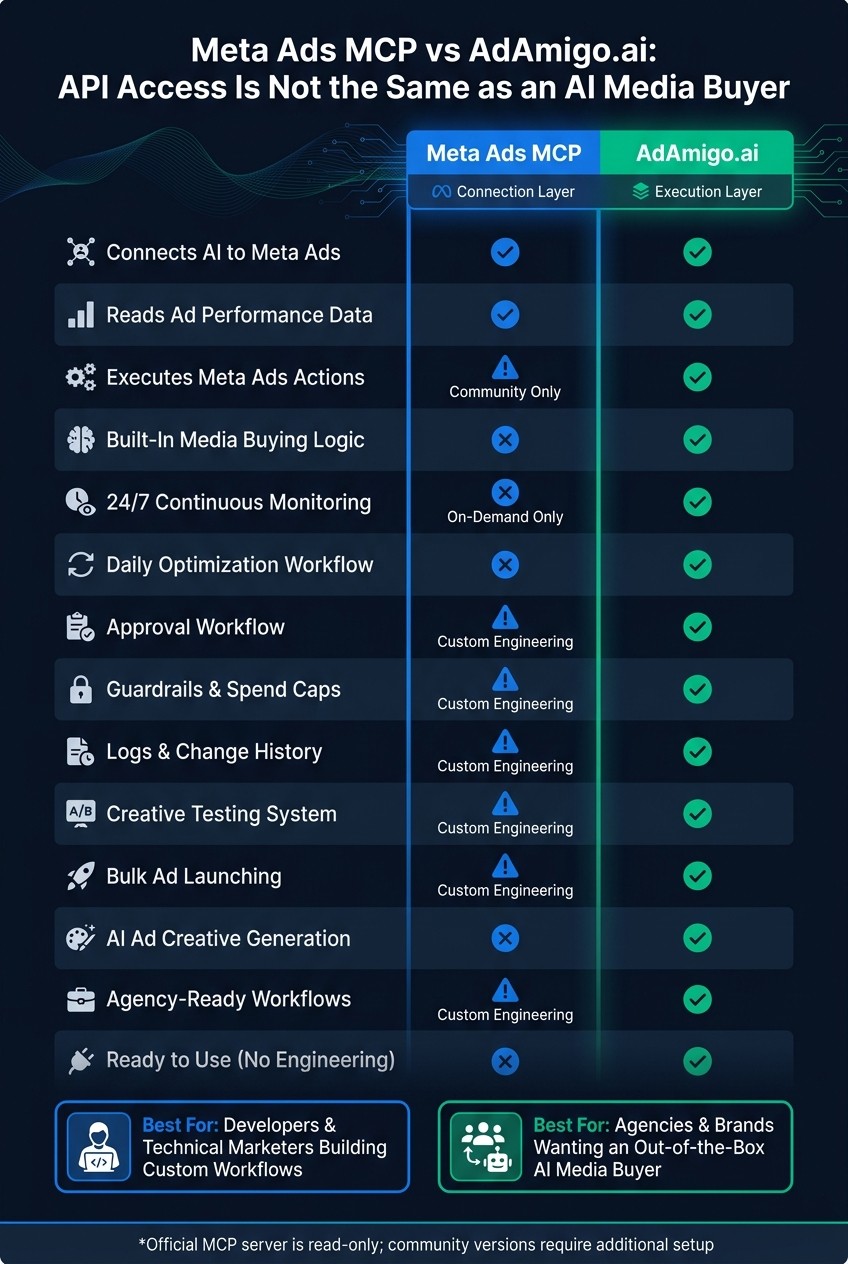
Meta Ads MCP vs AdAmigo.ai: Full Feature Comparison
What Meta Ads MCP Does and Where It Falls Short
How MCP Connects AI to Meta Ads
Meta's Marketing API Connection Protocol (MCP) serves as a bridge between AI tools like Claude or ChatGPT and Meta's Marketing API. Instead of relying on outdated methods like CSV exports or custom-built apps, MCP uses Facebook Business OAuth to establish a live connection in less than five minutes. Once connected, it provides real-time metrics such as spend, ROAS, CTR, and frequency. In some setups, it even allows for direct actions - like pausing underperforming ads or adjusting budgets - via chat commands. This streamlined process eliminates the need for the typical 3- to 7-day app review wait that traditional API setups often require.
What MCP Does Not Include
While MCP simplifies access to data and enables quick actions, it doesn’t handle strategic decision-making. It provides AI with access to Meta Ads data but doesn’t offer the nuanced judgment required for effective media buying. For example, it can’t assess target CPA goals, determine when ads have gathered enough data, or accurately interpret high frequency (a common indicator of ad fatigue). It also lacks features like account memory, creative testing tools, and scaling strategies. Moreover, MCP doesn't include approval workflows or safeguards to prevent overspending. As Adrio explains:
"The creative side, which is what actually decides whether an ad works, is still a manual job."
In short, MCP facilitates AI-driven actions but doesn’t replace human expertise.
The Risks of Using Generic AI Agents with MCP
Common Problems with Generic AI Agents
While generic AI agents like Claude or ChatGPT can technically access Meta Ads through MCP, access alone doesn’t equate to effective media buying. These agents rely on general knowledge rather than specific expertise in media buying, which can lead to costly mistakes.
The financial risks are clear. According to the MetaAdsMCP documentation:
"The worst-case impact if credentials are compromised includes creating campaigns/budgets that could spend money once activated and data exposure of account performance."
Operational risks are just as concerning. For instance, a generic AI agent might pause a high-performing ad set due to a temporary CPM spike, scale a campaign prematurely before it exits Meta's learning phase, or make frequent structural changes that reset the algorithm instead of letting it stabilize. Adding to the complexity, Meta’s Marketing API limits most endpoints to 200 requests per hour. Exceeding this limit during optimization can disrupt the entire process. These challenges highlight that API access through MCP isn’t enough - media buying requires precise controls and expertise.
Why Guardrails and Approval Workflows Matter
To mitigate these risks, robust guardrails and approval workflows are essential. Developer Andres Ochoa, after auditing existing MCP integrations, pointed out several vulnerabilities:
"Existing MCP integrations for Meta Ads have significant security gaps: no SSRF protection on pagination URLs, access tokens leaking into logs and error messages, no rate limiting, and no input validation."
Without these safeguards, an AI agent without media buying logic could pause live campaigns or cause unexpected spending. Features like approval workflows, budget caps, audit logs, and per-account permission controls are critical. They ensure that every AI-driven action is logged with a timestamp, reason, and clear documentation of changes, providing accountability and reducing the likelihood of errors.
Manus AI + Meta Ads: Turn This Setup Into a Paid Service (Step-by-Step)
How AdAmigo.ai Works as a Full AI Media Buyer
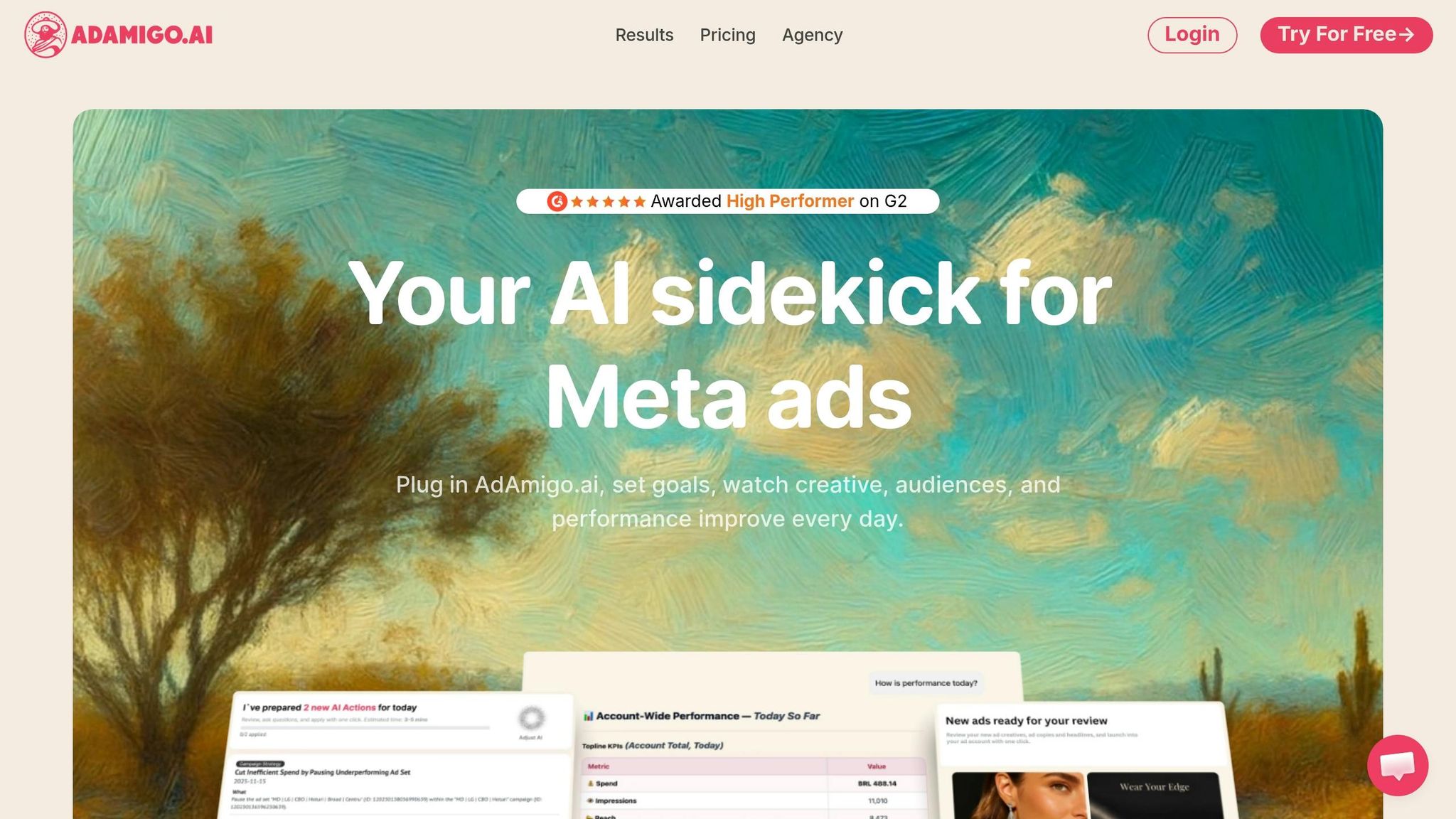
AdAmigo.ai fills the gap by combining advanced media buying strategies with built-in safety controls, addressing challenges that MCP alone cannot resolve.
Built-In Media Buying Logic
AdAmigo.ai takes media buying a step further by embedding strategic decision-making directly into its system. While MCP provides access and operational efficiency, AdAmigo.ai focuses on turning data into actionable strategies. As Nikhil Tiwari from MCP Playground explains:
"Claude is an extremely capable analyst and operator who works at AI speed, but you are still the strategist."
With AdAmigo.ai, the AI becomes the strategist. Its AI Autopilot evaluates your account using key metrics like ROAS, CPA, and CPL. It determines when an ad has collected enough data for a fair assessment, identifies signs of ad fatigue from high frequency, decides when to scale successful ads, and knows when to pause changes - all in real time.
Approvals, Logs, and Automation Controls
AdAmigo.ai offers flexibility in how you manage automation. You can choose approval mode, where every suggested change requires your confirmation, or switch to full autopilot with safeguards like budget caps, targeting restrictions, and custom account rules. Every action is logged with a detailed explanation, so you always understand what was adjusted and why. The AdAmigo Protect layer adds another layer of oversight by monitoring for unusual patterns, such as unexpected spikes in spending or performance drops, before they become significant issues. This system ensures controlled automation, paving the way for smooth creative testing, which is covered in the next section.
Creative Testing and Bulk Ad Launching
While MCP handles tasks like reporting and optimization, it leaves creative management as a manual process. AdAmigo.ai bridges this gap with its Ad Factory feature. Ad Factory analyzes your top-performing ads and generates fresh variations to combat creative fatigue. Its Bulk Ad Launcher streamlines the process by structuring campaigns, creating ad copy, and publishing ads, combining creative testing and execution into a single, efficient workflow.
Meta Ads MCP vs AdAmigo.ai: Feature Comparison
Here’s a breakdown of how Meta Ads MCP and AdAmigo.ai stack up against each other. The table below highlights the distinction between a simple connection tool and a fully developed AI-driven media buying platform. While MCP focuses on providing access, AdAmigo.ai delivers a more comprehensive solution tailored for strategic media buying.
Comparison Table
MCP acts as a connection layer, while AdAmigo.ai operates as an execution layer.
As described in the Adrio Blog:
"The Meta Ads MCP lets your AI assistant read and edit your ad account through a normal chat... It focuses only on account access."
The following table outlines the features and how they’re implemented in each tool:
Capability | Meta Ads MCP | AdAmigo.ai |
|---|---|---|
Connects AI to Meta Ads tools | Yes | Yes |
Reads ad performance data | Possible | Yes |
Executes Meta Ads actions | Possible (community versions) | Yes |
Built-in media buying logic | No | Yes |
24/7 continuous monitoring | No (on-demand only) | Yes |
Daily optimization workflow | No | Yes |
Approval workflow | Requires custom engineering | Yes |
Guardrails and spend caps | Requires custom engineering | Yes |
Logs and change history | Requires custom engineering | Yes |
Creative testing system | Requires custom engineering | Yes |
Bulk ad launching | Requires custom engineering | Yes |
For those looking to scale quickly, using bulk ad launch tools can significantly reduce manual setup time.
| AI ad creative generation | No | Yes |
| Agency-ready workflows | Requires custom engineering | Yes |
| Ready to use without engineering | No | Yes |
Note: The official MCP server is read-only, and community-based solutions require additional setup.
Conclusion: Which Tool Fits Your Situation
The table highlights a clear distinction: Meta Ads MCP connects AI to Meta Ads for custom solutions, while AdAmigo.ai takes charge of the entire media buying process. Both tools address unique challenges, and choosing the wrong one could lead to wasted time and resources.
Meta Ads MCP, launched in public beta on April 29, 2026, works best for technical marketers or developers who need to create custom reports, conduct ad-hoc analyses, or develop internal tools. The official server is free, and setup is quick - less than 5 minutes. That said, you’ll be responsible for every decision, workflow, and safeguard when it comes to media buying.
On the other hand, AdAmigo.ai is ideal for agencies and brands looking for a ready-made system. It offers daily optimization, creative testing, approval workflows, and spend controls without requiring custom development. With its AI handling tasks like launching tests, scaling successful campaigns, pausing underperformers, and monitoring issues via AdAmigo Protect, a single media buyer can manage three to five times more accounts with ease.
This comparison emphasizes how these tools serve different purposes in managing ad strategies. If you’re looking to build an AI-powered workflow, MCP gives you the tools to do so. But if you prefer an out-of-the-box solution to run your campaigns, AdAmigo.ai offers a quicker and more efficient option.
FAQs
Is Meta Ads MCP safe to use for making live changes?
The safety of making live changes with Meta Ads MCP largely hinges on how you've implemented it and the configuration of your servers. Since this tool is still in beta, it comes with potential financial and operational risks, so it's smart to approach it carefully. Here are some common precautions you can take:
Set new campaigns and ads to start in a paused state by default.
Require clear and explicit confirmation before any changes are applied.
Use dry run modes to test changes without affecting live campaigns.
Additionally, make sure to regularly review your server's security features and cross-check all data with Ads Manager to ensure accuracy.
What guardrails do I need before letting an AI adjust budgets?
Before letting AI take charge of budgets, it’s crucial to have safeguards in place to prevent overspending or missteps. Here’s how to stay in control:
Leverage dry-run features to simulate changes before they go live (e.g., using
dry_run=Truein tools like MCP).Configure all new campaigns, ad sets, and ads to start in a paused state, allowing for manual review before activation.
Enforce strict budget caps, require human approval for any budget adjustments, and keep detailed logs to track actions and performance for accountability.
Do I need to be a developer to use Meta Ads MCP?
No, you don’t need to be a developer to use Meta Ads MCP. Meta’s official MCP server makes it easy for marketers to connect AI tools like Claude or ChatGPT to their Meta Business Manager account. All it takes is a few minutes and a standard OAuth login.
However, if you choose to use third-party or self-hosted MCP servers, things can get a bit more technical. You might need skills like Python programming, terminal commands, or even setting up a Meta developer account. For those who want to avoid the technical side, managed services are available to handle the setup for you.