
Customer Lifetime Value (LTV) Calculator
Estimate gross-profit customer lifetime value from revenue, gross margin, customer churn, and acquisition cost. See the formula, worked examples, and important limitations.
Use this customer lifetime value calculator to estimate gross-profit LTV from average revenue per customer, gross margin, and churn, then compare it with customer acquisition cost (CAC). Use revenue and churn figures from the same period; the result is an estimate, not professional financial advice.
Made by AdAmigo.ai. The formula and all example outputs were last checked against the live calculator on October 31, 2026.
How to use the customer lifetime value calculator
Enter average revenue per customer for a period, such as a month or a year.
Enter gross margin as a percentage. This is the share of revenue left after direct costs included in your gross-margin calculation.
Enter customer churn for that same period. Use monthly revenue with monthly churn, or annual revenue with annual churn.
Enter CAC to compare the estimated gross-profit LTV with the cost to acquire a customer. Review the displayed results and the limitations below before using them in a budget decision.
How the LTV formula works
Gross-profit LTV per customer = (average revenue per customer per period × gross margin) ÷ customer churn rate for the same period. The calculator also shows gross profit per period (revenue × gross margin), LTV-to-CAC (LTV ÷ CAC), and estimated gross profit after CAC (LTV − CAC). Wall Street Prep publishes the same simple CLV structure using average revenue per account, gross margin, and churn; this calculator applies it to its customer-churn input.
Keep the time period aligned: monthly revenue needs a monthly churn rate, and annual revenue needs an annual rate. Wall Street Prep describes revenue churn in its formula, while this calculator asks for customer churn; those measures can differ, so use the measure the tool requests rather than switching between them. The calculation also does not discount future cash flows or include costs beyond the inputs you provide.
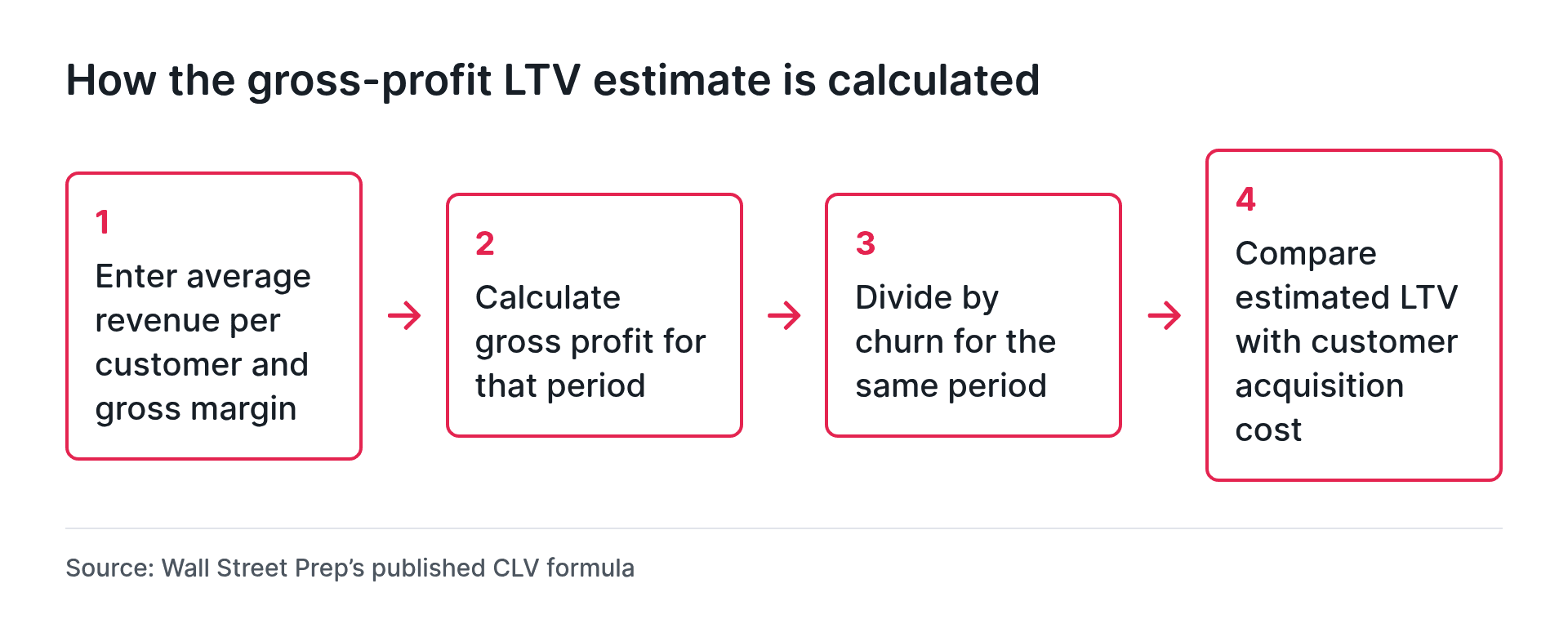
Source: Wall Street Prep’s published CLV formula.
Worked example: $100 monthly revenue and 5% churn
With average revenue of $100 per customer per month, a 60% gross margin, 5% monthly churn, and $100 CAC, gross profit is $100 × 60% = $60 per month. The calculator estimates gross-profit LTV at $60 ÷ 5% = $1,200, an LTV-to-CAC ratio of 12.0, and estimated gross profit after CAC of $1,100. The revenue and churn inputs are both monthly.
How to interpret the results
Gross-profit LTV estimates the gross profit associated with a customer under the inputs you supplied; it is not a full profit forecast. Check that your CAC definition and customer group match the revenue and churn data, and account separately for costs or cash-flow timing the formula leaves out.
If churn is 0%, the formula cannot produce a finite LTV estimate. In that case the calculator displays LTV $0, an LTV-to-CAC ratio of 0.0, and gross profit after CAC of $0, but none of those three values is a valid estimate. Gross profit per period is still calculated from revenue and margin. Use a positive churn estimate supported by data for the same customer group and period; do not enter an arbitrary rate just to force a result. If no supportable positive rate exists, this formula cannot give you an LTV estimate for that case.
If CAC is $0, the LTV-to-CAC ratio is undefined because division by zero is not possible. The calculator displays 0.0 for that ratio; treat it as an undefined output, not a meaningful ratio. Gross-profit LTV and gross profit after CAC may still be calculated from the other inputs.
Examples from the calculator
The table reproduces the calculator’s six example inputs and displayed results. The 0% churn row is marked explicitly: its displayed LTV, ratio, and after-CAC amount are not estimates because the formula cannot calculate LTV at zero churn.
Example | Inputs and calculator outputs |
|---|---|
Monthly revenue, CAC $100 | Inputs: Average revenue per customer per period $100; measurement period Month; gross margin 60%; customer churn per period 5%; CAC $100. |
Annual revenue, CAC $3,000 | Inputs: Average revenue per customer per period $12,000; measurement period Year; gross margin 75%; customer churn per period 25%; CAC $3,000. |
Zero churn | Inputs: Average revenue per customer per period $100; measurement period Month; gross margin 60%; customer churn per period 0%; CAC $100. |
Zero CAC | Inputs: Average revenue per customer per period $100; measurement period Month; gross margin 60%; customer churn per period 5%; CAC $0. |
100% margin and churn | Inputs: Average revenue per customer per period $1,000,000; measurement period Year; gross margin 100%; customer churn per period 100%; CAC $1,000,000. |
Zero revenue, margin, and CAC | Inputs: Average revenue per customer per period $0; measurement period Month; gross margin 0%; customer churn per period 100%; CAC $0. |
Customer lifetime value calculator questions
How do I calculate customer lifetime value?
Multiply average revenue per customer by gross margin to get gross profit for a period, then divide by the customer churn rate for that same period. To compare the result with acquisition cost, divide LTV by CAC. Keep monthly or annual inputs aligned; this is a simplified gross-profit estimate, not a discounted cash-flow valuation.
What is a good CLV-to-CAC ratio?
This calculator does not set a universal target. It divides estimated gross-profit LTV by CAC, so the result depends on the customer group, the costs included in CAC, and the model’s assumptions about margin and churn. Use the ratio alongside cash-flow timing and other costs rather than treating one number as a stand-alone budget rule.
What is the average lifetime value of a customer?
There is no single average this calculator can supply for every business. The estimate changes with revenue per customer, gross margin, churn, and the period measured, so use figures for the customer group you want to evaluate. The examples below show calculator outputs for specific inputs, not industry averages or benchmarks.
Can you provide an example of customer lifetime value?
For $100 in monthly revenue per customer, 60% gross margin, and 5% monthly churn, gross profit is $60 per month and the calculator estimates $1,200 in gross-profit LTV. With $100 CAC, it displays a 12.0 LTV-to-CAC ratio and $1,100 estimated gross profit after CAC. These are outputs for those inputs, not a general target.
What is customer lifetime value?
Customer lifetime value (CLV), also called LTV, estimates the value a customer contributes over the customer relationship. This calculator reports a simplified gross-profit estimate using average revenue per customer, gross margin, and churn, then compares it with CAC. It does not discount future cash flows or account for costs that are not entered.
Related tools and pages
For product-level economics that affect what paid acquisition can support, use AdAmigo.ai’s Profit Margin & Break-Even ROAS Calculator.
See how LTV fits alongside other campaign measures in AdAmigo.ai’s guide to prioritizing Meta ad sets.
If you’re using LTV to inform acquisition spending, AdAmigo.ai helps teams manage and optimize paid campaigns. Start a 7-day trial.