
Custom Audiences vs. Lookalike Audiences: GDPR Impact
Compare GDPR rules for custom and lookalike audiences on Meta: consent, controller roles, data minimization, risks, and practical compliance tips.
When advertising on Meta platforms, custom audiences and lookalike audiences are two popular targeting tools. However, under GDPR, these tools come with strict compliance requirements, especially for campaigns targeting EU or UK users. Here's what you need to know:
Custom Audiences: Built using your first-party data (e.g., emails, phone numbers, website activity). GDPR requires explicit user consent before uploading this data to Meta. Without proper consent, you risk hefty GDPR fines.
Lookalike Audiences: Modeled by Meta using a "seed" audience (e.g., top customers). While Meta handles the profiling, you must ensure the seed data complies with GDPR rules, including obtaining prior consent.
Key GDPR principles include:
Consent: Essential for data collection and sharing with Meta.
Transparency: Inform users about how their data is used.
Data Minimization: Only upload necessary data.
Regular Updates: Sync opt-outs and maintain accurate lists.
Quick Comparison
Aspect | Custom Audiences | Lookalike Audiences |
|---|---|---|
Data Source | Uploaded customer data | Meta-modeled from seed audiences |
Consent Requirements | Explicit opt-in consent required | Consent needed for seed audience |
Regulatory Risk | Higher due to direct data sharing | Lower if seed data is compliant |
Operational Effort | High - requires consent tracking, updates | Lower - Meta manages profiling |
To balance compliance and performance, focus on collecting first-party data with clear consent and use tools like AdAmigo.ai to automate compliance checks and audience management. Custom audiences are ideal for re-engaging existing customers, while scaling with lookalike audiences works best for finding new prospects at scale. Both require careful handling to stay GDPR-compliant.
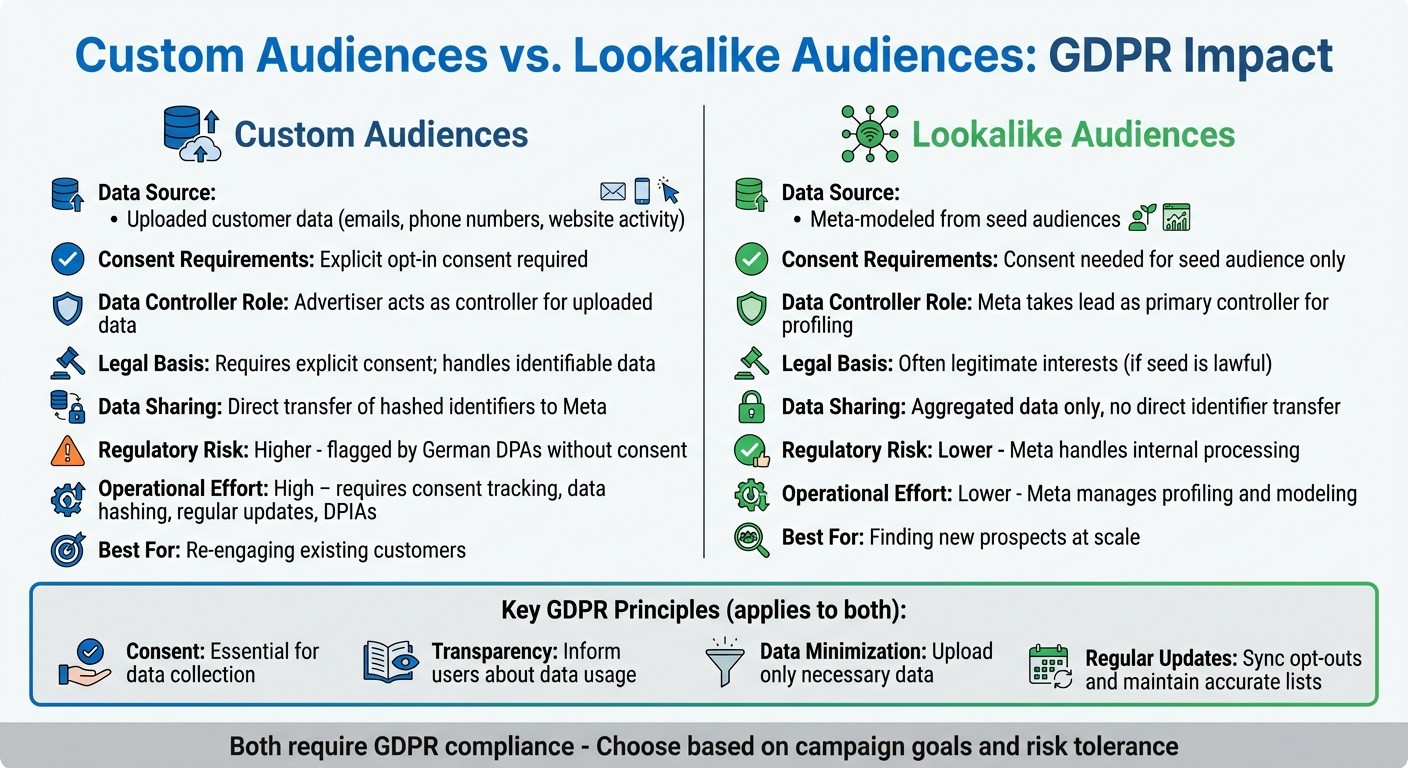
Custom vs Lookalike Audiences GDPR Compliance Comparison
GDPR Basics for Meta Advertising
Key GDPR Roles and Legal Bases
When running Meta ads with custom or lookalike audiences, GDPR outlines specific roles and responsibilities. As the advertiser, you are generally the data controller for any customer information you upload or collect through tools like tracking pixels. This is because you determine what personal data to collect, how it’s used, and how long it’s retained. On the other hand, Meta typically acts as a controller within its ad ecosystem, managing tasks like data matching, ad delivery, and optimization.
For audience targeting on Meta, many regulators in the EU now require explicit, opt-in consent when uploading customer lists or using tracking pixels for personalized ads. This is especially critical if the data was originally gathered for a different purpose, such as fulfilling orders. While some advertisers rely on legitimate interests for less invasive targeting, regulators caution that such methods often fail the balancing test due to their lack of transparency. For most cases involving Meta audience targeting, obtaining clear consent is the safest approach to mitigate legal risks.
Let’s now explore the core GDPR principles that influence how audience targeting is handled.
GDPR Principles for Audience Targeting
These GDPR principles are essential when working with Meta ads. Purpose limitation means you can’t use data for ad targeting without prior disclosure and a valid legal basis. Data minimization requires uploading only the essential identifiers - like hashed email addresses or phone numbers - while avoiding unnecessary or sensitive attributes.
To comply with storage limitation and accuracy, custom audiences should be updated regularly. For instance, if users unsubscribe, update their details, or exercise their rights, these changes must be reflected promptly. Additionally, accountability and transparency demand that you document your legal bases and provide clear privacy notices explaining how data is used with Meta.
Overlap with CCPA/CPRA
GDPR isn’t the only regulation impacting Meta advertising. U.S. laws such as California’s CCPA and CPRA share common themes with GDPR. Both require transparency and notice regarding the use of personal data for targeted ads, and both empower users with control - GDPR through consent and objection rights, and CCPA/CPRA through opt-out rights for the "sale" or "sharing" of personal information. Many regulators view Meta’s custom and lookalike audience targeting as data sharing, which triggers these opt-out requirements.
For advertisers running campaigns across both the EU and California, a unified approach is key. Implement granular consent mechanisms and centralized opt-out controls. Treat Meta audience targeting as data sharing under CCPA/CPRA, offering users an easy opt-out option, while adhering to GDPR consent requirements for EU audiences. Adopting this "highest standard" approach simplifies global privacy compliance and minimizes risks when running campaigns across different regions.
Custom Audiences: GDPR Compliance Challenges
How Custom Audiences Work
Custom Audiences allow you to target individuals who have previously engaged with your business. This can be done in several ways: uploading hashed customer lists (like email addresses or phone numbers), using website tracking tools such as the Meta Pixel or Conversions API (CAPI) to capture activities like page views or purchases, or leveraging data from mobile apps integrated with Meta's SDK. While the data is hashed for pseudonymization before being uploaded, Meta can still match and profile users. Importantly, even hashed data can often be linked back to individuals if matching is successful. For example, sharing hashed email addresses could inadvertently expose details about user affiliations, such as their shopping preferences or support for specific causes.
Legal Basis and Consent Requirements
When you upload customer lists, you take on the role of the data controller, which means you are legally responsible for ensuring a valid legal basis for processing the data - usually explicit consent. A German data protection authority ruled in one case that uploading customer lists without consent was unlawful, highlighting that hashing does not sufficiently anonymize data when matching is possible.
For audiences created using Pixel or CAPI, GDPR mandates that advertisers secure prior user consent before deploying non-essential cookies or trackers. This rule applies even to individuals who are not Facebook users, as cross-site tracking is neither transparent nor reasonably expected. These stringent consent requirements directly impact how you handle and process user data without privacy risks.
Compliance Risks and Practical Tips
Several compliance risks come with using Custom Audiences. These include uploading customer lists without proper consent (e.g., using emails collected from business cards or scraping), profiling individuals without a valid legal basis that could expose sensitive insights, and failing to update audiences when users opt out. A case involving a Bavarian data protection authority revealed the risks of undisclosed profiling through Custom Audiences, where users were not informed, leading to regulatory action. Such violations can result in hefty fines - up to 4% of global revenue.
To reduce these risks, follow these compliance best practices:
Obtain explicit and documented consent from users before processing their data.
Use only first-party data collected with clear permission.
Implement dynamic syncing to immediately remove users who opt out. This often requires a technical API setup for Meta audience sync to ensure real-time compliance.
Ensure data is properly hashed and inform users that their information will be shared with Meta in your privacy policy.
For high-risk profiling activities, conduct thorough Data Protection Impact Assessments (DPIAs).
Avoid sharing audiences between ad accounts.
Delete any non-compliant audiences promptly.
These steps are essential for maintaining GDPR compliance while scaling your advertising campaigns effectively. By staying proactive and transparent, you can navigate these challenges more confidently.
Lookalike Audiences: GDPR Considerations
How Lookalike Audiences Work
Meta's lookalike audiences rely on aggregated analytics rather than individual data, often outperforming manual audience creation in terms of scale. Here's how it works: you provide a seed audience, which could be a customer list, a pixel-based audience, or even your page fans. Meta then analyzes traits like demographics, interests, and behaviors within this seed audience. Using its vast internal data, the platform models and creates a new audience of users who share similar characteristics but aren't part of your original list.
You can adjust the size of the lookalike audience by selecting a percentage, typically between 1% and 10% of a country's population. Smaller percentages result in closer matches, while larger ones expand reach but reduce precision. Importantly, Meta handles all the profiling internally, acting as the controller. You, as the advertiser, only see aggregated data such as audience size and campaign performance. This setup defines the distinct GDPR responsibilities for both parties.
Legal Basis and Advertiser Responsibilities
Under GDPR, processing data lawfully is key, and this starts with creating a compliant seed audience. When building your seed, you need explicit consent from users to share their data with Meta. Meta then uses this consent-backed data to model and deliver ads.
Your main obligation is ensuring that the seed data complies with GDPR standards. For pixel-based audiences, this means obtaining consent before placing non-essential tracking cookies. You should document everything - this includes the lawful basis for data use, the consent language, timestamps, and the specific purpose (e.g., "sharing with Meta for lookalike advertising").
Lower Risk Profile Compared to Custom Audiences
Compared to custom audiences, which require you to manage detailed user data, lookalike audiences shift the profiling responsibility to Meta. Since you only receive aggregated data, the direct data management risks are lower. However, if your seed data isn't compliant, the entire process could be invalid. A compliant seed allows Meta to scale your reach without requiring you to manage extensive contact lists repeatedly.
Non-compliant practices - like using scraped lists, purchased data, or cookies placed without proper consent - make the lookalike process unlawful. Regulators have also flagged risks with seeds containing sensitive data, such as health information from pharmacy records or political views from mailing lists. These types of data require explicit consent, which is rarely obtained in practice. While the modeled audience may seem abstract, GDPR rules apply just as strictly to lookalike targeting as they do to custom audiences.
To reduce these risks, always use compliant seed data and maintain a suppression list to exclude users who have opted out, similar to how AI-powered retargeting manages audience exclusions. For pixel-based seeds, ensure accurate pixel configuration and block Meta pixels until valid consent is secured.
Tools like AdAmigo.ai can simplify seed audience management by centralizing and automating compliance checks. They ensure that only lawful data sources feed your lookalike audiences, respect region-specific rules like GDPR for EU users, and enforce audience exclusions for those who opt out. By regularly testing seed quality and focusing on compliant lookalike segments and interest-based targeting, these tools can help you maintain a strong return on ad spend (ROAS) while reducing manual data handling. This streamlined approach makes lookalike audiences a safer and more efficient alternative to custom audiences, addressing many of the challenges advertisers face.
Direct Comparison: Custom vs. Lookalike Audiences Under GDPR
Feature and Risk Comparison Table
Understanding the differences between custom and lookalike audiences is crucial for aligning your campaign goals with GDPR compliance. Here’s a side-by-side comparison to help clarify key aspects:
Aspect | Custom Audiences | Lookalike Audiences |
|---|---|---|
Data Source | Uploaded lists (e.g., emails, phone numbers), pixel IDs, app events | Meta-modeled similarity groups based on seed audiences |
Data Controller Role | Advertiser acts as the controller or joint controller for the uploaded data | Meta takes the lead as the primary controller for profiling, while the advertiser defines the purpose |
Legal Basis Typically Used | Requires explicit consent; involves handling identifiable data | Often relies on legitimate interests, provided the seed data is lawfully obtained |
Consent Requirements | Demands clear, per-user opt-in consent (e.g., via a checkbox) | Lower consent requirements, as it builds on already-obtained consent for the seed audience |
Data Sharing with Meta | Direct transfer of identifiers (e.g., hashed emails, phone numbers) | Relies on aggregated data, avoiding direct transfer of identifiers |
Regulatory Risk | Higher scrutiny - regulators (e.g., German DPAs) have flagged customer-list targeting without explicit consent | Lower risk - Meta’s internal processing reduces direct data-sharing concerns |
Operational Complexity | High - requires consent management, data hashing, regular updates, and sometimes DPIAs | Lower - Meta handles modeling; advertisers focus on seed quality |
This breakdown highlights the key factors that can shape your privacy-first advertising strategy.
Privacy-First Strategies for Advertisers
When deciding between custom and lookalike audiences, your choice should align with your campaign objectives, geographic priorities, and tolerance for regulatory risk and privacy concerns. For instance, custom audiences are highly effective for re-engagement campaigns targeting existing customers. However, securing explicit opt-in consent, maintaining detailed consent logs, and following best practices for Meta ad data privacy are essential. A practical example could involve targeting loyalty members who’ve opted in, with automated CRM updates to manage opt-outs.
On the other hand, for large-scale prospecting - especially in campaigns spanning the US and EU - lookalike audiences built from high-quality seeds are a simpler and broader-reaching option. For example, a B2B SaaS company might create 1–2% lookalike segments in key EU markets, using data from high-intent website visitors or top lifetime value customers who’ve already consented to personalized ads.
When dealing with sensitive topics like health, political views, or sexuality, it’s critical to avoid transactional data from high-risk sources. In such cases, advertisers should lean on contextual targeting or conservatively defined lookalikes. For campaigns under close scrutiny in the EU, stricter consent protocols, limited data transfers, and regular data protection impact assessments are advisable.
How Tools Like AdAmigo.ai Can Help
Managing GDPR-compliant audiences manually can be a heavy lift - tracking consent, syncing opt-outs, and updating audience lists takes time and resources. Automation tools like AdAmigo.ai simplify these tasks while optimizing ad performance. This platform automates audience workflows based on your compliance rules, ensuring that only properly sourced data is used for targeting. This is especially important as AI detects privacy threats in real-time to prevent compliance breaches. Whether you’re working with consent-verified custom audiences or privacy-conscious lookalike segments, AdAmigo.ai streamlines the process.
The platform’s AI Chat Agent allows you to bulk-create and launch campaigns efficiently, while the AI Actions feature provides a daily to-do list for fine-tuning audiences, budgets, and bids. For agencies juggling multiple clients in diverse regulatory environments, AdAmigo.ai can be a game-changer. It enables media buyers to manage more accounts effectively without compromising strategic oversight. As Jakob K., a G2 reviewer, shared:
It handles everything from creating lookalike audiences to adjusting budgets with just a few prompts.
Conclusion
Key Takeaways for Advertisers
The GDPR requirements for custom and lookalike audiences present critical considerations for advertisers. Custom audiences require stricter oversight because uploading personal identifiers - like hashed emails, phone numbers, or CRM data - directly to Meta makes you the data controller. This means you must obtain explicit opt-in consent before using customer data for ad targeting. The Bavarian DPA has made it clear: uploading customer lists without clear consent is illegal, even if the data is hashed, as matching can reveal sensitive information. To stay compliant, you need to maintain detailed consent records, regularly sync opt-outs, and only upload essential data. Without these measures, you could face regulatory scrutiny and hefty fines.
On the other hand, lookalike audiences offer scale with less compliance risk, provided your seed data is lawful. In this case, Meta handles the modeling and expansion, so you're not directly processing the personal data of new prospects. Your main responsibility is ensuring that the seed audience is built from properly consented sources and that users are transparently informed about data use. These practices highlight the importance of robust consent mechanisms as you navigate the balance between user privacy and campaign outcomes.
Final Thoughts on Balancing Privacy and Performance
A privacy-first strategy doesn’t just ensure compliance - it can also enhance campaign results. Studies show that contextual targeting can boost purchase intent by up to 63%, proving that privacy-conscious approaches can still deliver strong performance. The foundation of this strategy is leveraging first-party data collected through value-driven exchanges like loyalty programs, email sign-ups, or gated content. Pair this with clear, user-friendly consent flows that allow individuals to revoke permissions easily.
AI tools like AdAmigo.ai can help streamline this process. These tools enforce compliance rules you set, automating audience workflows based on factors like region-specific regulations, consent requirements, and data retention limits. Features like AI Actions provide a daily list of impactful adjustments for audiences, budgets, and bids, while the AI Chat Agent enables bulk campaign creation and management. For agencies juggling multiple clients across different regulatory environments, tools like these can allow one media buyer to manage 4–8× more accounts without compromising compliance or strategy. As Sherwin S. shared in a G2 review:
The AI actions are spot-on, so I can make adjustments fast and see results right away. It's like having an extra set of super-smart hands helping me hit my KPIs.
GDPR For Social Media Marketing (3 Simple Steps For Compliance)
FAQs
What are the key GDPR compliance challenges when using custom audiences on Meta?
One of the primary challenges of using custom audiences on Meta lies in ensuring that user data is collected in a lawful manner and with clear, explicit consent. Beyond that, businesses must remain transparent about how this data will be used and respect users' privacy rights. This includes providing options for users to access their data or request its deletion. These requirements can add layers of complexity to creating and targeting custom audiences effectively.
To make compliance easier while still achieving strong ad performance, you might want to explore tools like AI-powered ad management platforms. These platforms can streamline audience targeting and help ensure you're staying aligned with data privacy regulations.
What’s the difference between how GDPR impacts custom audiences and lookalike audiences?
When it comes to GDPR, the rules for using lookalike audiences are more demanding compared to custom audiences. Lookalike audiences are built using data derived from personal information, which means you need to have explicit consent from users and ensure that every step complies with GDPR's strict data privacy standards.
Custom audiences, however, are typically created from data you’ve gathered directly from individuals who have already agreed to share their information. This makes them simpler to align with GDPR requirements - provided you’ve clearly informed users about how their data will be used.
How can advertisers ensure GDPR compliance when targeting users in the EU?
To comply with GDPR when targeting users in the EU, advertisers need to prioritize clear and explicit consent from users before collecting or processing their personal data. It's essential to provide privacy policies that are easy to understand and clearly outline how the data will be used. Handle all user data securely, use it only for legitimate purposes, and limit data collection to what is absolutely required. Regularly review your data practices to ensure they align with GDPR guidelines and any updates to privacy laws.